Sunday, 28 May 2006

The Day After Tomorrow

Rating: ***

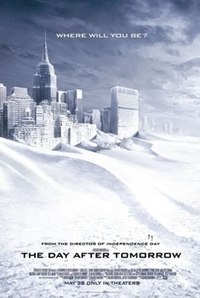
The Day After Tomorrow starts with a chunk of ice the size of Rhode Island breaking off the Antarctic and ends with everything north the southern United States and North Africa frozen under a new ice age, in between: super-twisters, tidal waves, flooding, snow and hail the size of your head. Again, New York City and Los Angeles have become the first strike targets in the war against disasters, but then again are we surprised by any of this in a disaster movie, especially from the director of Independence Day.

The film stars Dennis Quaid as a Paleoclimatologist whose trying to warn the Powers That Be about the potentially devastating effects of global warming, but with this being a disaster movie of course no one listens to him. He does however find an ally in another scientist played by Ian Holm whose weather monitoring station has been noticing a decrease in ocean temperatures in the North Atlantic. And since this is a disaster movie, the hero has an estranged wife and a son whom he's not that close with, a son who just happens to be heading out on a trip to New York for an academic decathlon competition with two other team members, one of whom is the girl he has a secret crush on. The stage is set.

I'm guessing that it’s the above synopsis of characters and motivation that is giving this movie its critical beating; I mean I freely admit that they are disaster movie clichés. Another reason may be all the bad science in the movie, which drew riotous laughter from of my sister the environmental scientist when I told her about it. There were also a few typical scenes like when a pack of wolves that escaped from the Bronx zoo manage to head down Manhattan island, in the freezing cold temperatures, and manage to find some of the only fresh meat in the area in the form of Jake Gyllenhaal and his two fellows who venture out to find medicine for a sick friend.

Despite all of this though I am giving The Day After Tomorrow my thumbs up. Sure it insults your intelligence in terms of both dramatic and scientific content, but hey its well meaning, its got great special effects, and it doesn't waste time pretending to be something it isn't. This a disaster movie, plain and simple, with all the pluses and minuses that genre implies.

Thank writer/director Roland Emmerich who last directed The Patriot a movie so over blown with American self-congratulation and self-aggrandizement it would have been right at home in Post- 9/11 America. Which makes this movie all the more interesting given the way the Vice-President acts almost Dick Cheney-like, in fact he kind of looks like Cheney too. The film is obviously and shamelessly critical of particularly Bush Administration policy when it comes to the environment. Although the science is bad, the movie has its heart in the right place, correctly pointing out the paradox in how global warming can in fact result in global cooling.

Bottom line: The Day After Tomorrow will not win any prizes for writing or dramatics, but it will make you forget the problems of the world for a couple of hours. Or will it?

Friday, 26 May 2006

X-Men: The Last Stand

Rating:***

Threes are tricky; for every Return of the Jedi, Last Crusade and Goldfinger, there's a Porky's Revenge, Godfather III and Beyond Re-animator. The third X-Men falls somewhere in between, like Search for Spock or Rise of the Machines, it gets the job done, but it feels like something has been lost in the time between films. On the bright side though, Last Stand is nowhere near the debacle a lot of Internet fans feared it would be; while some of the subtlety and subtext has been lost, Brett Ratner has nonetheless crafted an enjoyable X-Men adventure.

The film opens with two scenes that really get to the heart of the X-Men, and what makes the characters so unique. First, we flashback 20 years where we see Professor Xavier and Magneto (Patrick Stewart and Ian McKellen, de-aged through CGI) arrive at the home of Jean Grey, a young girl who we know becomes a powerful member of the X-Men.

Ten years after that we get what is probably the most disturbing scene in the series when we see young Warren Worthington III in his home bathroom covered in blood and feathers. On his back are two boney ridges where his wings used to be - he's cut them off.

In two very brief scenes, Ratner sums up the philosophical and social undercurrent of the X-Men. Xavier and Magneto, once friends, but split along the divide of where they see mutants in relation to humanity, Xavier believing in peaceful coexistence and Magneto's desire to assure mutant supremacy. With young Warren, henceforth to be know as Angel, we see a boy deeply ashamed about a matter of biology he can't control, fearing what others, paticularly his father, will think of him. This kind of social science has been key to the X-Men's success since the 60s, and Ratner nails it.

Ultimately the two stories tie together, Angel's father owns a pharmaceutical company that has developed an enzyme that will permanently suppress the gene that gives mutants their abilities; it becomes known as a 'cure'. The cure is brought to Xavier's attention by Hank McCoy (Kelsey Grammer), the Secretary for Human Affairs and a former X-Man called Beast for obvious reasons. While Xavier cautiously weighs the potential options, Magneto begins raising an army, "They think they can cure us," he tells his followers, "Well I say, we are the cure."

If Ratner and his screenwriters had left it at that, we really could have had something here. The perfect follow-up to the first two films about the nature of mutants, how they relate to normal humans and where their place is, and can be, in the world. However, the filmmakers added another element that really weighs down the momentum of the cure storyline, and doesn't add much to the overall film.

As you'll remember from the last X-Men film, Jean Grey (Famke Janssen) sacrificed herself to save her teammates from certain death. We know from the final scene of X-2 though that that wasn't necessarily the end for Jean. In Last Stand she's found alive, but she's definitely not the same. According to Xavier, Jean is so powerful he had to put blocks in her brain to prevent her powers from consuming her. In the process, the blocks created a dormant personality called 'Phoenix'. It's this Phoenix that is now at the helm of Jean's powers, as she joins up with Magneto in his attack on the source of the cure, a young mutant named Leech (Cameron Bright).

What stinks here is that the whole Phoenix development seems like an after thought to everyone involved. They had a really great story with the cure concept, but then they remembered that thread left dangling at the end of part two and I guess they felt that they absolutely had pick that up and squeeze it into the plot somehow.

The Phoenix concept comes from one of the classic X-Men stories from the comics called the Dark Phoenix Saga, where Jean Grey, thought killed in action, miraculously returns from the dead with new powers thus rebranding herself Phoenix. But it turns out that Grey is possessed by some kind of alien entity who drives her to go on a galactic killing spree before a final showdown with the X-Men on the moon's surface, where Grey kills herself after realizing the damage she's caused.

Epic, right? And while I hardly expect this story to be adapted verbatim, it does imply a kind of grand scope, a Homeric adventure even, enough to fill an entire separate trilogy. At best, the Phoenix plot is a B story, only occasionally do we get a glimmer of the fearsome might of Phoenix, she mostly just takes orders from Magneto, which is a shame when you think of the potential this character holds. She does kill a couple of the X-Men for what is purely shock value, but in one case we don't see a body and the other is taken away in a post credits epilogue.

There is a lot of good in this movie though don't get me wrong. Hugh Jackman is once again the Wolverine to beat, he perfectly captures the character's duality: the angry loner and the reliable teammate. McKellen as Magneto is absolutely pitch perfect; there's a scene where one of his Brotherhood is depowered, and when they plead for help he simply says, "I'm sorry, but you're not one of us." Also worthy of note is Grammer's Beast, I love the character from the comics and Grammer does him justice despite issues of make-up beyond the actor's control.

On the other hand, Halle Berry really underplays Storm, it's just hard to accept her as the defacto leader of the team. I understand that Berry wanted more screentime, but she failed to understand that you have to give more to get more. Also, a lot of characters are really under used; including,surprisingly, Angel (Ben Foster) who just seems to disappear after the first act. The metallic Colossus finally makes the team after a cameo in X-2, but he only shows up for the fights.

It feels like all the characters, save for a couple, get the short end of the stick; there is so much story and so many characters, the only time there seems to be any cohesion is during the fight scenes. (Matters aren't helped by a brisk 100 minute running time.)

Another thing about the film is the way it teases with fleeting glimpses at other corners of the X-Universe. Like the giant, mutant-hunting robots the Sentinels, we finally get to see one (sort of) but only in the context of a training session in the team's holographic Danger Room. Last stand also introduces us to Juggernaut, a powerful villain in his own right, but for this story he's just one of Magneto's stooges, who spouts cring-worthy lines like, "I'm the Juggernaut, bitch!"

With enough dialogue like that, you come dangerously close to entering camp territory. (For more on camp see every last minute of Batman and Robin.) Like I said earlier a lot of the subtlety and subtext has been lost in this edition, still the film does occasionally surprise with it's social commentary; but in keeping with the times the metaphors used allude to modern debates about people who claim they can 'cure' homosexuality. There's also a great scene where government agents are interrogating the shape changing Mystique (Rebecca Romijn), calling her by her real name: Raven Darkholme. "I don't answer to my slave name," is her response.

To Ratner's credit though, he's made the best out of an awful situation. He was flown in at the eleventh hour to replace Layer Cake's Matthew Vaughn, handed a script already finished, a cast already joined, and a release date written in stone; yet somehow he managed to put together a relatively successful picture. I think a lot of the sloppiness in the film could have been corrected with further drafts of the script. Part of that blame lies with the corporate bosses at Fox and their single-minded determination to beat former franchise helmer Bryan Singer to the punch by releasing X-Men before Superman.

With some terrific action sequences and enough heart-felt character moments to make the film feel more then a giant special effects driven mess. Kudos to Ratner for proving the pundits wrong, X-Men The Last Stand may not be perfect, but then again, what in life is?

Thursday, 25 May 2006

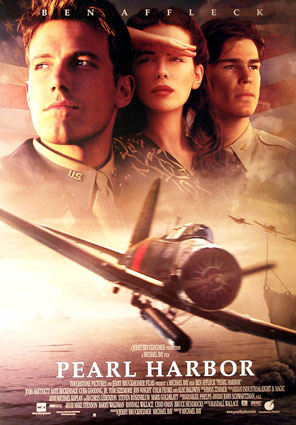
Pearl Harbour

Rating: **

To quote Roger Ebert I hated, hated, hated, hated, hated, hated this movie. No other film throughout 2001 has conjured such dread in my soul. If I never had to watch this movie again in my life, I would die incredibly happy. Even seeing the ad on the back of the TV Guide feels like burning acid in my eyes. This monster from the depths of Hell is called Pearl Harbour. Be afraid be very afraid.

We all know the story by now; two friends who grew up together in rural Tennessee find love with the same nurse on the eve of the December 7, 1941 attack on the U.S. Pacific Fleet based at the title port. With camaraderie, and romance set against a very real historic event, then mix generous portions of actors playing historical figures and computer generated special effects, what could possibly go wrong?

For one thing if you recognize the above plot summary, then you’ve probably seen Titanic, the 1997 Oscar-winning Best Picture directed by James Cameron, Pearl Harbour has a lot in common with it. Its the story of a love triangle set against a historical disaster re-created with incredible detail thanks to state-of-the-art special effects technology. Pearl Harbour is a copycat right down to the soundtrack which features the film’s score and a love ballad sung by Faith Hill rather then Celine Dion.

Titanic’s success in part belongs to Leonardo DiCaprio whose winning charm as Jack Dawson propels us through the film. (Well it was for those of us who weren’t 12 year old girls at the time.) In Pearl Harbour we are instead treated to Ben Affleck and Josh Hartnett, who are both decent enough actors, but in Pearl Harbour they come across as the two cool guys in high school who only hang around together to make sure that one doesn’t out-cool the other. The only saving grace in this devil’s triangle is Kate Beckinsale, who although has to surpress her British acsent, still manages to register some kind of performance.

Not that romance was ever director Michael Bay’s strong suit. Bay’s idea of a romantis interlude is the “Animal Crackers” scene in Armageddon, but that whole relationship felt tacked on any way. But not as fake as the Nicolas Cage/ Vanessa Marcil relationship in Bay’s The Rock. Whenever the movie focuses on the love story it becomes as phony as a Backstreet Boys video where they lament about getting dumped. Then there’s Cuba Gooding, Jr.’s portrayal of a navy crewman, continuing the Hollywood trend of everyone loving black people, there’s no such thing as racism in these movies. Thank the Patriot for this, with Mel Gibson the man who loves his slaves. Unfortunately cool special effects can’t make up for screenwriting from the bottom of the chum bucket.

Memo to Michael Bay; you an direct Aerosmith videos, and a descent action movie, so stick to what you know. too bad there are so many willing to take the plunge into the celluloid cesspool, willing to over look bad acting, bad writing, bad history, and bad directing, and can still make Pearl Harbour oart of their video collection. I pray for their souls everyday.

Wednesday, 24 May 2006

An Inconvenient Truth

Rating: ****

The sheer idea of making a movie about former US Vice-President Al Gore talking for an hour and a half must have caused a few spit takes from studio execs and money men when it was proposed. It probably went from bad to worse when it was mentioned that the topic of Gore’s talk would be the environment and global warming.

Gore being the fastidious straight man of the Clinton presidency has long been the brunt of far too many jokes about his apparent dullness. Clips from The Simpsons like Martin Prince’s talking Gore doll (“You are listening to me talk”) or Gore putting on Kool and the Gang’s “Celebration” after the sale of a copy of his book: Sane Planning, Sensible Tomorrow, helped solidify Gore’s reputation as a stuffed-shirted bureaucrat with the emotional pallet of Lt. Commander Data.

However, this isn’t the Al Gore that’s on screen in An Inconvenient Truth; this Al Gore has fire in his belly, raw passion and the charisma of a rock star.

An Inconvenient Truth is basically a filmed version of a multimedia presentation that Gore has given world wide about the impending global crisis caused by global warming. Gore uses scientific data and anecdotal evidence to illustrate a single point: that the Earth is on the verge of catastrophe because of the human impact on global warming AND that it’s not too late for us to start doing something about it.

This isn’t a presentation for academics either; Gore makes the science quite understandable with layman’s terms and a number of colourful graphs. He even opens up the presentation with a clip from the Futurama episode “Crimes of the Hot”, which explains the origins of global warming in an accurate, all be it, typically Groening fashion. (“Hey Sunbeam, where do you think you’re going?”)

Gore hit’s home with before and after pictures of the world’s glaciers, computer models of projected flooding in the event of continued melting and showing how recent disasters like Hurricane Katrina are a symptom of the bigger problem. He debunks the myths of global warming being cyclical and the idea that scientists disagree on the causes of global warming. n the Iend, he finishes on an up note by showing how relatively minor changes in a broad section of areas can do much to start to reverse the damage.

Interplayed throughout the presentation are scenes of Gore talking about his roots in Tennessee, his political career, loosing the presidency in 2000 and what attracted him to educating people about global warming and why he started doing the lecture again after leaving politics. Personally, I think the film could have done without a lot of this because I was really into the presentation, but it was kind of neat to see clips of Gore meeting with people and being welcomed to various places like some kind of rock star - almost like a campaign video…

I like to consider myself moderately literate on the subject of global warming, so a lot of what Gore was talking about didn’t come as a particular surprise, although to see all the information presented up on screen like that was a little disheartening. No, the real revelation here is Gore himself; he was funny, committed and commanding as he delivers his lecture. If this Al Gore had ran for president in 2000 there would have been no need to worry about hanging Chads because he would have won hands down – no question.

An Inconvenient Truth is decidedly apolitical; this is not a Democratic issue, as Gore says, this is a human issue. I’m sure some people will call the movie partisan regardless because Gore does take a few swipes at the current administration’s (lack of) environmental policy; but he’s no harder on them then he is on American auto makers that are vehemently against emission standards. The power of the documentary comes during the final half hour when Gore takes all this data he’s presented and hits us with a model of what the future looks like if things don’t change.

If the goal of an advocacy documentary is to make you leave the theatre thirsty to return to the world at large to create change; then An Inconvenient Truth is a resounding success. I suppose the only real danger is that this film may only be preaching to the choir, but I hope that this picture’s word of mouth will carry it through to the conscience of everyone so that maybe the debate could move away from debating if there’s a problem, to doing something about it.

Tuesday, 23 May 2006

Star Wars Episode III: Revenge of the Sith

Rating: ***1/2

Since the Star Wars prequel trilogy was announced in the early 1990s, fans have been waiting anticipation to see some of the things that George Lucas had only hinted at through his novelizations of the Original Trilogy, and in interviews. Unfortunately for many of those same fans, they had to sit through The Phantom Menace and Attack of the Clones in order to get here. Revenge of the Sith fulfills the promise of the prequel trilogy, by giving us a story that ties up most of the loose ends from the first prequels, and adequately links the two trilogy’s together. Even the haters are going to have a hard time admitting that this isn’t the movie they’ve been waiting for.

I’ll spare the overly complicated plot summery, and just say that the film hits all the major plot points. The end of the Clone Wars and the rise of the Galactic Empire, Anakin’s surprisingly subtle surrender to the Dark Side, the penultimate duel between Anakin and his former mentor Obi-Wan Kenobi, the birth of Luke and Leia, how they came to be separated, and the fate of their mother Padme.

One the delightful twists to Revenge of the Sith is the way passes on the usual allegory on mythology in order to tell a more contemporary parable, drawing from history and dare I say, the nightly news. “You’re either with me or you’re my enemy”, Anakin tells Obi-Wan after the Anakin led slaughter of the Jedis. “Only a Sith Lord deals in absolutes”, is Obi-Wan’s reply. Message received, the universe is to full of complexities to believe in the dichotomy of an either/or proposition. Then there’s the formation of the Empire, formed out of the ashes of the Clone Wars in order to maintain the highest level of security for the Republic. “This is how liberty ends, with thunderous applause”, Padme observes as the new Emperor Palpatine stands before the soon to be obsolete Senate.

Two problems have been a plague to the prequel trilogy: the acting and the writing, and thankfully both are taken up several notches for this concluding chapter. The script is much tighter pacing wise, leading one to the opinion that more the likely most everything that was important to say in this trilogy was saved for this chapter.

While Sith sports some wonderful actors like Ewan McGregor, Samuel L. Jackson and Jimmy Smits, the movie is owned by Ian McDiarmond as Palpatine. McDiarmond gets to sport that same silky smooth evil that made his character so great in Return of the Jedi. His turning of Anakin his borderline subliminal, and considering the way his plan comes together, its easy to understand the characters over confidence in Jedi. The film’s only new major character General Grevious is a welcome addition to franchise’s tradition of memorable secondary characters, his menacing humpbacked walk and persistent smoker’s cough make for a interesting addition into the Star Wars pantheon of creatures.

There are only a few outright demerits to the film. One is that horribly stilted dialogue that has been a plague to the prequels seems not as noticeable in this one, mostly because I think all the actors, even Natalie Portman and Hayden Christianson, pulled out their A-game for this one. When the dialogue does sound silly, the emotion of the moment keeps your head in the movie. Another minor gripe is Yoda’s journey to the Wookie homeworld and team-up with Chewbacca, who joins Jabba the Hutt, Boba Fett, and a deleted appearance by Geedo in the Phantom Menace, on the list Original Trilogy character cameos that don’t really add much to the overall story, but regardless they are fun to see for fandom at large.

Although the movie’s denouement makes for a satisfying and emotional conclusion, it was regardless a bit rushed and it felt like a number of semi-important scenes were left out for brevity’s sake. In these things however I reserve my final judgment, for this is the DVD era, and everything left on the cutting room floor always finds it way to a bonus disc. One should be warned also, for those who are easily squeamish or under the age of ten, Revenge of the Sith sports some surprisingly gruesome violence, just so you know.

Revenge of the Sith will even the most cynical Star Warrior both appeased and satisfied, but its enough to make one wonder: for the first two movies, was Lucas just rusty behind the camera, or was Sith always going to be the exception to the Prequel trilogy by nature? Regardless, Revenge of the Sith proves that faith can be restored after all. This is the movie they’ve been waiting for.

Monday, 22 May 2006

Mission: Impossible I & II

Rating
- Mission: Impossible: ***1/2
- Mission: Impossible II: **1/2

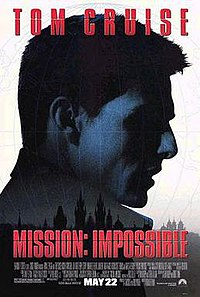
In the interest of corporate synergy we get the recent release of the first two, Tom Cruise starring Mission: Impossibles in new DVD transfers, just in time for the release of May's Mission: Impossible III directed by Alias and Lost mastermind J.J. Abrams.

In terms of ingredients, the Mission:Impossible franchise is a mixed bag. Cruise as the film's producer made a smart decision in turning the series into a director's showcase by bring on Brian De Palma, followed by John Woo, then Abrams. On the downside is the fact that the plots for the films are almost inaccessible and that the M:I concept of the team was practically jetisoned for the idea of making Cruise's Ethan Hunt a kind of American James Bond.

De Palma's original is the better of the two; it's a Rubik's cube of a spy tale that retains much of the core concept of the television show, including the team idea. The film introduces Hunt as a member of the Impossible Missions Force team of Jim Phelps (Peter Graves' character from the TV show, played in the movie by Jon Voight). In the midst of a standard recon mission, the entire team sans Hunt and one other, are killed. Hunt is implicated and forced to go underground, culling a team of mercenaries from the disavowed list in order to clear his name.

There's some debate as to how well the original Mission holds up, but for me it holds up exceedingly well. The vault break-in scene is still a masterwork of tone and editing, and the climactic action sequence in the Chunnel is as gripping as ever. The score, by Danny Elfman, perfectly evokes a musical sound of a spy flick. And the movie sports a really strong supporting cast including; Ving Rhames, Jean Reno, Henry Czerny, Kristen Scott Thomas and Vanessa Redgrave.

In 2000, we got the second installment of Mission: Impossible, which is definitely the more problematic of the two films. Returning from part one are Cruise, Rhames and screenwriter Robert Towne. Everything else is brand new thanks to Hong Kong action master John Woo.

In M:I-2, Hunt recruits a thief to infiltrate a group led by a rogue IMF agent (Dougray Scott, who incidentally, lost the chance to play Wolverine in X-Men because shooting went long on M:I-2).The rogue is out to sell a super virus called Chimera, as well as it's cure called Balariphon, to the highest bidder. Not that any of that matters because the plot is barely comprehensible when put up to scrutinization, all that really matters in this outing is Woo's amazingly choreographed fight scenes and action set pieces.

A lot of people see M:I-2 as where Woo started to go horribly wrong, for his movies have had neither commercial nor critical appeal since, the only real stand-out in his North American work remains 1997's Face/Off. All the action, the gun fights and the chases are trademarked Woo, but usually his movies are built on strong storytelling ground, giving actors a chance to stretch their emotional muscles as well as the physical ones.

The film also complete peels off the team aspect in favour of turning computer whiz Rhames and annoying chopper pilot John Polson into mere sidekicks for Hunt. Scott looks like he's the evil mastermind from an Old Navy commercial, and I'm not sure why Hunt falls for Thandie Newton's master thief because she seems both vapid and really not very intuitive given her profession. The only person I really give a pass to is a cameo appearance by Anthony Hopkins as Hunt's mission commander; Hopkins at least seemed to be having a good time.

Mission: Impossible II gets a pass because at least it's got some good action, but if you want a real spy movie it's best to check out part one. At least until Abrams unleashes number three on us in a couple of weeks.

Sunday, 21 May 2006

Shrek 2

Rating: ***1/2

It wasn't with a lot of anticipation that I went to see Shrek 2. While I highly enjoyed the first one, I saw it before it became the phenomenon, and before the Smash Mouth cover of "I'm a Believer" was so over-played it tarnished even the original Monkiees version. But something happened as I stocked shelves Friday night, as that big brown-eyed green ogre stared back at me from numerous boxes of cereal; as I heard that burly, Scottish drawl reciting lines inside my head I'd thought forgotten, I remembered that there was a very funny movie underneath all the hype.

So I walked into Shrek 2 a little more stoked then I had been before, and I left the theatre very satisfied. Hilarity: Accomplished.

The sequel finds our hero, his bride Fiona, and his "noble steed" Donkey, off to meet Fiona's parents: the King and Queen of Far Far Away, who needless to say are rendered speechless at the appearance of their new son-in-law. Without going to deep into the surprisingly dense plot, some of the highlights include: a very Godfather-like Fairy Godmother, Puss In Boots as a ridiculously ineffectual assassin, and the revenge of some of the Fairy tale creatures from part one. All of which is told with gag references to movies like Lord of the Rings and Raiders of the Lost Ark, even Sleepy Hollow. Disney, as in part one, is spared no mercy with Captain playing piano at “The Poison Apple” pub, and a surprising personal fact about Pinocchio.

As with part one much of the credit for the comedy goes to the voice cast, and Shrek 2 boasts a very impressive cast indeed, not just returning Mike Myers, Eddie Murphy, and Cameron Diaz, but newbies John Cleese, Julie Andrews, Rupert Everett, Jennifer Saunders and most especially Antonio Banderas as Puss In Boots, obviously riffing on his role in The Mask of Zorro. The most surprising casting though has to be the Ugly Step-sister as played by Larry King. Yes, that Larry King! And if I could say just a few words about Eddie Murphy's performance as Donkey, it’s undoubtedly the best comedy Murphy has done in the last twenty years. Period.

Shrek 2, again like the original, has a fun, bubble gum pop soundtrack complete with tunes like "Funky Town", an opening theme from the Counting Crows, and a Murphy/Banderas cover of "Livin' La Vida Loca", which does Ricky Martin better justice then William Hung ever could. There will be inevitable comparisons between the first and second films, which one's the better and all that, but the one area I noticed improvement over the original was in the animation. The realism, certainly most noticeable in the human characters, continues to get better, even for a mere fairy tale.

Shrek 2 had some big expectations to meet, but fortunately the creators kept their eyes on the prize. What we get is an infectious crowd pleaser with possibly more jokes for the adults and than the kids, no matter what your feelings on cereal endorsing ogres.

Saturday, 20 May 2006

Over The Hedge

Rating: ***1/2

Hard to believe that it was just over a decade ago that cinema animation was revolutionized by the release of the first full-length computer animated feature: Toy Story. Since then, CG has come to own the animation industry in North America, even Disney has more or less scraped their traditional animation studio in favour of creating an in-house computer toon shop.

Looking back this was not unexpected; after The Lion King, animated films produced by Disney and other American studios got progressively more formulaic. Musicals with talking animals can only get you so far. But now we are at a similar crossroads with CG films. Ever since Shrek, CG animated films been typified by classic tales with post modern spins, rapid fire one liners and pop culture references.

In this regard, Over The Hedge immediately sets itself up to be different from the pack, but that's not to say that Hedge doesn't have any jokes because it does, the difference is: there's something more to hold on to.

Perhaps Hedge differentiates itself because it is based on the comic strip by Michael Fry and T. Lewis, which appears in newspapers throughout North America. The story follows a racoon named RJ (voice of Bruce Willis) who crosses a bear named Vincent (Nick Nolte) when he attempts to heist the bear's store of pilfered snacks. Vincent gives RJ a week to collect a wagon full of food lest RJ becomes Vincent's next meal.

RJ finds himself in the middle of a new suburban development, and in the middle of this development is the last acre of greenspace populated by a group of animals led by the cautious turtle Verne (Garry Shandling). RJ befriends these animals and, under the pretext of helping them gather food for the winter, takes the group on a tour of the food-filled world of humans, enlisting there help (unbeknownst to them) to gather all the items on Vincent's shopping list.

Like any good family film, Hedge makes some pointed comments on modern life with a heart felt message about love, friendship and cooperation. The script was surprisingly sharp in regards to undermining life in cotemporary suburbia; an ordinarily easy target , but the writers dump most of the abuse on the Home Owners' Association president voiced by Allison Janney.

Of course, all-star voice casts have become old hat for animated films since Robin Williams' voice came out of Aladdin's Genie back in '92. Ever since though, famous voices have not always made a movie better, sometimes a famous face just doesn't translate into a recognizable voice. On occasion it's the reverse that's true, as the real life personality and inflections overwhelm a character.

Over The Hedge finds a balance though; Willis, Nolte and Shandling are all perfectly cast. Also enjoyable is Steve Carell as an over-excited squirrel; Wanda Syles as a sensitive skunk; William Shatner and Avril Lavigne as a father and daughter possum; Eugene Levy and Catherine O'Hara as a porcupine husband and wife with Fargo-like accents and Thomas Hayden Church as the self-styled "verminator" Dwayne.

The film itself, skirts the recent trend of CG realism in favour of a more stylized look, which may or may not be the obvious choice when dealing with talking animals. The world of Verne and RJ is bright and energetic, and owes more in it's design influence to Pixar flicks like A Bug's Life and Finding Nemo, than past Dreamworks fair like Antz and Sharktale.

Over The Hedge also stands apart because it's a film built from the story up, not by stringing together a bunch of pop culture references. It's a formula that's made Pixar king of the CG toons, not to mention Fox-based Blue Skies, producers of Ice Age and Robots, whose becoming something of an industry upstart. It's a wise decision.

I often wonder what will happen to movies like Shrek. In the future will people be buying copies of the 50th anniversary edition of Madagascar much like Disney classics like Cinderella or Sleepy Beauty? That will, of course, depend on how well Ricky Martin karaoke and a Zorro-inspired Puss 'N Boots translate in 2054. Sure we get it now, but somehow I doubt "Livin' La Vida Loca" will stand beside "Yesterday" and "Like A Rolling Stone" in the annals of great pop songs.

Over The Hedge is not immune from this either though. There were more than a couple of times that the other adults and I laughed at something that went far above the heads of the majority of the audience, namely children. Think the "It was beauty that killed the beast" line in Chicken Little or the constant references to The Godfather and Goodfellas in Sharktale.

The only thing that really got on my nerves were the "original" songs by Ben Folds. I use the quote marks to dismiss the labeling of any Ben Folds song as original, since many of them sound exactly the same. This is another thing that animated movies can do without: having some name-brand musician write and perform original songs. It was new and interesting when Randy Newman did it for Toy Story, but when Jack Johnson gets top billing with Will Ferrell for Curious George, things have gone too far.

Bottomline, the film's not perfect, some of the jokes work better than others; but I liked the story, the look and the voice actors. Still, the animated film to beat this summer will be Pixar's Cars, featuring the return of John Lasseter, new head of Disney animation, to the director's seat.

Friday, 19 May 2006

The Da Vinci Code

Rating: ***

Upon seeing the movie version of The Da Vinci Code my only thought was simply: this is what all the fuss is about? I had of course read Dan Brown's novel a couple of summers ago, but considering all the hunger strikes, boycotts and all the other gibber gabber, you'd think that Ron Howard had made a movie based on The Satanic Verses, not on some hackneed airport novel with specious research.

For the three of you who are uninformed about the plot, The Da Vinci Code is about a Harvard symbologist (Tom Hanks) and a French cryptologist (Audrey Tautou) who are implicated in the death of four prominent Parisians; including the curator of the Louvre. The pair is being pursued by a relentless police captain (Jean Reno) who believes them guilty beyond the shadow of a doubt and a mad albino monk (Paul Bettany) who thinks they hold a key to a secret that could mean the end of the Catholic church. It's a cat and mouse game that's played out against some of the most famous landmarks in Europe, as all the characters pursue the true secret of the Holy Grail.

It's been often said that Brown's book reads more like a screenplay than a work of literature; Akiva Goldsman has now proven as much by managing to take the 400 page novel, and successfully squeezing it into two and a half hours. One of the things he ditched are the chapters upon chapters of exposition. In this movie you won't see Hanks belly up to a computer library catalogue and search for key words, oh no! Who needs books when you can Google key words on wi-fi Internet access on some guys cell phone.

Also, say goodbye to much of the character development of the film's bad guys, the monk Silas and his boss Bishop Aringarosa (Alfred Molina). Aringarosa seems at times almost forgotten in the action, and Silas just keeps popping up like some sort of Jason Voorhees-like boogeyman.

Hanks was an interesting choice to play the symbologist Robert Langdon, but unfortunately Langdon is such a passive "hero" in the film that he's not given much to do. The action just sort of revolves around Hanks; like the proverbial ping-pong ball, he bounces from one situation to another, sometimes spouting lines like, "I have to get to a library." At least in the novel, Langdon is genuinely invested in solving the mystery, but in the movie he often defers to the expertise of Sir Leigh Teabing (Ian McKellan).

To wit, McKellen seems to be the only actor in the film having a good time. The screen instantly lights up as soon as Teabing enters the picture thanks to McKellan's easy charm. With a twinkle in his eye, and a jovial flection to his readings, McKellan manages to sell his expository dialogue with grace. It's the initial scenes with McKellan that Hanks really comes alive as Langdon.

Now I've razzed on Ron Howard before, maybe a little too much for a director as accomplished as him, but some how Howard ends up behind the wheel of films that are stylistically too big for him. (Remember The Grinch?) I have enjoyed some of Howard's work in the past: last year's under appreciated Cinderella Man comes to mind, Apollo 13 obviously, as well as parts of the little seen 2003 western The Missing. For The Da Vinci Code however, it feels like Howard knew he had a winner and really didn't want to fly to far off the map, lest he generate controversy amongst the book's hardcore followers.

Granted, for some inexplicable reason, this poorly written, barely researched, dime store yarn has draw the ere of so many divergent groups and sects, but the movie version is rather toothless. Take the character of Silas, who in the novel is described as the alpha albino: his skin lacks pigmentation, his hair is bleeched white and his eyes are red. The Silas in movie though simply looks like a chap who's fair skin colour could be cured with a few weeks on the French riviera. Why? Because albino activists were upset that one of the book's villains was one of them. Forget the fact that as far as villains go, Silas was almost relatable; a man who had suffered much and had a deep religious conviction. Of course, the screenplay jetisons much of those plot points.

I give Howard credit: the film's got style. But as we all know a good film doesn't run on style alone. This could have been like Raiders of the Lost Ark meets Mission: Impossible; but it's more like Unsolved Mysteries meets Scooby Doo. Much like the book that inspired it, The Da Vinci Code entertains, but leaves you empty from the experience.

As for all the hype surrounding both the book and the film, in my humble opinion it's much ado about nothing. As a potboiler, The Da Vinci Code is divine; Brown zooms you from one cliffhanger to the other, and pumps you full of so much esoteric knowledge the lay man or woman will think they've gotten the condensed version of a history degree.

There in lies the rub, that ridiculously stupid "fact" page at the beginning of the novel. The one that says that the Priory of Sion is a secret society that started up in the 10th century and gained power after unearthing the Holy Grail under the ruins of Solomon's tomb. Well, any number of Internet sights will tell you it was started by some bored French guys in 1956. What does it tell you when even the Internet wags won't buy your conspiracy theory?

I'm reminded off all the post release hype around Titanic. At some point people discovered that there was a real Titanic, and that real people died when the ship went down in 1912. They also discovered that many of the victims recovered were buried in a graveyard in Halifax. In that graveyard there's a tomb belonging to Jack Dawson, AKA the name of the character that Leonardo DiCaprio played in the film. However this Dawson was a coal scuttle in Titanic's engine room; never had he drawn Kate Winslet naked or shouted, "I'm king of the world" from the ship's stern. But the "facts" didn't get in the way of people thinking it was true. I think Stephen Colbert calls that "truthiness".

If you want to see a relatively harmless summer popcorn movie, than by all means, see The Da Vinci Code and enjoy it as a well-crafted conspiracy yarn. But there's no deep meaning to be found there, no ancient secrets for you to uncover and no revelations that will shape or shatter your belief system, whatever they may be.

Monday, 15 May 2006

The Matrix Reloaded

Rating: ***

You can’t help but admire the chutzpah of the Wachowski Brothers, the writing/directing team behind the first Matrix and now the first of two sequels. In 1999, The Matrix became a cultural birthquake, creating a look and feel that has since been copied by many imitators be it explicitly like scenes in Shrek and Charlie’s Angels, or implicitly like the production design in the films Red Planet and Minority Report. With the Matrix Reloaded “The Brothers” designed it with the intention of deflecting any and all attempts at copycating. Bravo.

The plot has been dissected to death, so I’ll hit on some of the things that struck me in my viewing of the movie. Much of the first half hour of the movie takes place in “the Real World”, especially the last human city Zion, which was only eluded to in the original, and for the record the Zion “rave” scene is as bad as you’ve heard. But all but a few of the Zion scenes feel superfluous, one of the exceptions is a conversation between Neo and a Zion councillor played by Anthony Zerbe, held in the bowels underneath the city, which has interesting overtones when we learn the surprise twist near the end.

Among returning characters like Neo, Morpheus, Trinity, Smith, and the mysterious Oracle, are new players like the ghostly Twins; the mysterious Architect, the may or may not be human, creator of the Matrix; as well as Niobe, a fellow freedom fighter from Morpheus’ past. But most importantly are two characters named Persephone and Merovingian, who are apparently two of any number of rouge programs that roam the Matrix, which explains the return of Agent Smith and his ability to duplicate himself.

If you’ve seen the trailers, you know the action in the Matrix Reloaded is huge, especially the 15 minute long freeway chase which features flashy motorcycles, menacing big rigs, and bullet-ridden Fords. What was underwhelming though was the “Burly Brawl”, the initial fight between Neo and the Agent Smiths that takes place about halfway through. Perhaps because Neo had dispatched the soog Agent in the original, so there was no sense of actual endangerment despite the pressence of dozens of Smiths. A close quarters fight between the Smiths and Neo and Morpheus in the film’s climax is much more effective.

Although the third act feels a bit forced after that bombastic car chase, The Matrix Reloaded is still one cool trip. I think a lot of the disappointment being voiced is because the first Matrix presented an already complete universe, that anywhere the sequels were to take us was bound to disappoint. Hopefully we’ll get the whole picture in a few months when the story is wrapped up in Revolutions, penciled in for a November 7 release. Till then though Reloaded is a hell of a tobaggan ride.

Saturday, 13 May 2006

Just My Luck

Rating: **1/2

Every once and a while, a movie comes along that makes you say: “Somebody paid money to make that?” Actually, that’s just a tad fatalistic. An epitaph like that should be reserved for something based a video game, directed by Uwe Boll or starring Pauly Shore, maybe a combination of all three. Just My Luck is no where near that bad. Plodding? Yes. Predictable? Certainly. Yet it’s not without its charms.

Lindsay Lohan plays Ashley, a woman crafted with such incredible good luck it actually stops raining when she steps outside. Then there’s Jake (Chris Pine), who while out one morning tying to get the attention of record label big shot ends up getting arrested for a multitude of charges related to indecency. So while Ashley falls completely backwards into a plum promotion, Jake struggles to hold on to his crappy job cleaning toilets in a bowling alley and the British band he’s trying to promote as “the biggest band in New York.”

At a party for the above mention record label big shot organized by Ashley, Jake sneaks in to plant a demo CD on the big man. Instead he meets and dances with a mysterious young woman who turns out to be, you guessed it, Ashley. (I should mention at this point, that the theme of the party was a Masquerade ball. Everybody in masks!) During a dance floor kiss Ashley and Jake do more than exchange spit, they also switch out their incredibly polarizing luck powers.

Three guesses where things progress from here and you won’t need the first two. Jake’s life is going places after saving the record producer’s life, while Ashley’s existence ends up in the crapper after a serious of very unfortunate events. (Seriously, not even Screetch Powers had this kind of rotten luck and he was stuffed into a locker two or three times a week.)

Just My Luck was directed by Donald Petrie, who’s made a career out dolling out insipient and uninspired rom-com drivel. He also directed Miss Congeniality and How to Lose A Guy in 10 Days, which aside from not being Shakespeare is notable only for their record setting number of romantic plot contrivances per minute. Luck is directed with no style, hardly any flair and very little shame.

Aside from the lame yet serviceable plot device that the screenplay is built on, the entire film is a 90 minute ad for the ‘power-pop’ four-piece McFly. This would have been fine had the band been mildly original, or failing that, entertaining; but McFly is only suitable for background noise for the melodramatics on One Tree Hill. It would have been a little more interesting if the producers had gone out and found a wholly unknown band that wasn’t The Caesers: The Next Generation. (‘Power pop’, what the hell?)

Fortunately, at the centre of the film is the very likable duo of Lohan and Pine, who despite contrivances you’re actually rooting for. While casting little Miss Lindsay as an executive at a Manhattan PR firm is pushing things a little, I thought Jake looked and acted the part of someone who was a struggling band manager. Of course, they’re both entirely one-dimensional; Jake is an untarnished good guy that looks out for his little cousin and the accident prone girl he meets on the street and Ashley is an oblivious princess who’s sole preoccupation becomes getting her luck back and not getting a new job after being fired, for example.

You sit there and you wait for the characters on screen to catch up to where you are, you see them put all the pieces together at a glacial pace only to have it all unravel at the night of McFly’s big debut. (The drummer is trapped under the stage, what do we do? Oh, here comes Ashley, she’ll kiss Jake, transfer their luck powers and rectify the situation.)

But the film has a good spirit and some genuinely funny bits of slapstick. Sure it’s bubblegum, but it’s worth chewing on for a while and doesn’t leave you with a bitter taste.

I think Lindsay Lohan has a future in this business; she’s certainly got charisma and talent going for her, she just needs to stop doing movies that have that “Starring Lindsay Lohan” vibe to them. Getting a job with Robert Altman on Prairie Home Companion is a good start, now if she could stop partying like it’s 1999… I like what Jon Stewart said a few weeks ago on the Daily Show, “You just want to hug her and tell her that, ‘you don’t have to live your life in a day.’”

But back to wrap up the review with a healthy dose of anti-Scrooge by saying that Just My Luck isn’t going to win any prizes for originality or ingenuity, but it’s got some heart and that’s what counts. This movie’s a time killer, not a time waster.

Friday, 12 May 2006

Poseidon

Rating: **1/2

Of all the boats in movie history the only one that's probably had worse luck than the S.S. Poseidon is the H.M.S. Titanic. All-in-all, there have been three filmed versions of Paul Gallico's book about a capsized luxury liner and the small group of survivors trying to escape certain death. The first was 1972's The Poseidon Adventure, which launched a decade long Hollywood obsession with disaster pictures; then, last fall, there was the similarly titled TV movie that turned the disaster from a tsunami to a terrorist bomb. Now we have Wolfgang Peterson, the modern master of water-born disasters, taking his shot at the Poseidon to mixed results.

Like Ronald Neame's original, Poseidon is an all-star affair with Josh Lucas, Kurt Russell, Richard Dreyfuss, Andre Braugher, Emmy Rossum, Mia Mastero, Kevin Dillon and Freddie Rodriguez. Unlike the titular boat of the original this Poseidon is state of the art, and on New Year's Eve a huge tidal wave capsizes the ship, leaving a handful of survivors in the ship's ballroom. Although the Captain recommends that everyone remain in the ballroom till help arrives, a few hotheads, including many members of the cast list above, decide to climb through the bowels of the ship to get to freedom.

The film clocks in at about 100 minutes, so it's a quick clip as you watch the characters hurtle one disaster after another. On this count, and this count alone, the film works; it has wonderful set pieces and death traps that occasionally gets the heart racing. These sequences would matter more though if we cared about the characters, that is if the vast majority of them weren't self-centred winers.

In Neame's Poseidon, tension was built up for the first quarter of the film; we got know the characters, where they came from, where they're going, and a little bit about who they are. In Peterson's film, he doesn't waste time with pleasantries, everything we need to know about a character and their conflict is summed up in one sentence throwaway lines like: "Do you miss being Mayor?" or "have you told your father yet?"

Any added suspense is removed due to the fact that as soon as the ship tips over and the survivors begin their journey to the top of the boat, it's pretty much written all over the screen who lives and who dies. There's no shock value, no "Holy Crap, I can't believe they killed HIM!" moment. There are three types of characters in Poseidon, there are the ones who serve a purpose, those who sacrifice themselves for loved ones and those that need to be saved constantly.

There's never really any "Shelly Winters moment", like in the original Poseidon where Winters' character, an over-weight grandmother that the other survivors have had to carry through the film, rescues a fellow survivor while clearing the way for the others to reach safety. There's no frustration or even grim determination in the survivors of the remake, they're just going through the motions.

There's a scene in the original where Gene Hackman's character Reverend Scott, the defacto leader of the survivors, lashes out at God as they face one last obstacle to their freedom. He hangs from a steam valve, yelling to the high heavens that no one else will die, and if God demands a sacrifice then He should take him. There really is no heroism in Poseidon, there's even a scene where one character literally sacrifices another for his own survival.

In the remake, Scott is split into two characters Lucas' Dylan and Russell's Ramsey. It sort of undermines the suspense when you have two main characters, it means that almost certainly one will be sacrificed, not that it matters because the entire situation seems another day at the office for both men. At least Hackman had the appearance of a man under pressure.

I'll say this for Poseidon, it's a decently executed, well-built popcorn movie that will, if nothing else, will give you a good time. The only real reason to remake The Poseidon Adventure is to take advantage of modern special effects, we see the wave hit the boat from the insider out, we can watch the ship capsize from every angle and you can see debris and bodies float under the submerged deck of the boat. It all looks cool at least.

If you want to see Poseidon, then I recommend seeing it on the big screen so that you can take in the film in all it's glory. I fear that the cracks in the film will really show through on home video.

Tuesday, 9 May 2006

Hot Docs - Look Up In the Sky! The Amazing Story of Superman

Rating: ***

The final screening of the Hot Docs Festival was a very last minute addition, so last minute in was just announced mere days before the start of the festival. Yet somehow, the word got out and the ticket holders line outside the Isabel Badar theatre on the U of T campus was all the way down and around the block on Sunday evening.

Look Up In The Sky! is set up like an A & E Biography; a chronological recounting of the DC Comics character often considered the first superhero. The film was directed by renowned documentarian Kevin Burns and co-produced by Bryan Singer, the director of June's Superman Returns. Culled together from meticulous research into the Man of Steel's nearly 70 year history, Burns and Singer include footage from, quite literally, all of Superman's various media incarnations-from comics, movies, cartoons, TV series and musicals. Any one even remotely connected to Supes gets an interview as well. Actor Kevin Spacey, who plays Lex Luthor in the new film, narrates.

We start off in 1930s Cleveland, where two friends named Joe Shuster and Jerry Seigel create a comic strip periodical called Science Fiction. In 1933, they author a story called “Reign of the Superman”, inspired by the Neitzschean notion of the superior man. This “Superman” has bald, telepathic and a villain. Almost overnight, Shuster and Seigel re-imagined the character as an alien refugee from a doomed planet, who comes to Earth and becomes a hero that protects the people. It took the pair five years to find any interest in publishing the adventures of a strongman in tights; but when National Allied Publicity took a chance on the character for the first issue of it's new book, Action Comics, it wasn't long before Superman had become icon.

The movie chronicles the various changes to the character and his mythology. After the comic premiere of Superman, it wasn't long before movie serials and radio adventures of the character were being made. Superman became a balloon in the Macy's Thanksgiving Parade, and was a feature attraction at the 1940 World's Fair. In the 50s, George Reeves was the Man of Steel in a weekly TV series called The Adventures Of Superman, the film discusses Reeves role in shaping the archetypal Superman, and Reeves' mysterious suicide that ended the show's run.

Of course, much time was lent to the Richard Donner movie starring Christopher Reeve and all the difficulties in getting that it made. Burns' then focuses on the decreasing quality of the film's sequels, which coincided with a slump in comic sales. We see Superman return to the lime light as the comic book Lois and Clark get married and the TV Lois & Clark begin their weekly adventures.

The film wraps up with a surprisingly lengthy look at the WB series Smallville, and Superman's new resonance in a post-9/11 world. Which, of course, leads into a series of clips and discussion about the forthcoming release of Superman Returns.

Before seeing this movie I thought my knowledge of all things Superman was pretty good, but some of the things that Singer and Burns had dug up made me feel no better than a lay man. For example, it was the radio show that renamed the Daily Planet and Perry White, made Jimmy Olsen a member of the main cast and introduced the concept of kryptonite.

The crowd was in stitches over two, little seen, classic clips in particular. The first was a little seen pilot from the 60s called Superpup; which featured little people in puppet-like dog heads performing a Superman tale. So instead of Clark Kent-you get Bark Kent, and Lois Lane as a poodle. Superpup was made shortly after the death of George Reeves as a way to capitalize on the character's popularity with children; TV programmers wisely decided that this was not the best way to do that, and it's been rarely seen since.

Another favourite clip from the movie was footage of the ABC production of a Superman musical from 1975. Believe it or not, it was actually based on a Broadway play from the 60s, and while it was directed by Hal Prince, who won a Tony for Fiddler on the Roof, it closed after 128 shows. The musical was resurrected for TV in '75 and David Wilson was cast as Superman and Leslie Ann Warren played Lois. If you've ever seen musical spoofs on The Simpsons like “Kickin' It: the Story of the Betty Ford Center” or “Stop the Planet of the Apes I Want to Get Off”, then you have some vague idea about how well this Superman musical was pulled off.

There are a lot of great interviews in the film; from the comic creators to art historians to cast members of the various Superman media and even observant fans like Mark Hammill and Gene Simmons. They all offer great insight and show a deep affection for the character, his story and his legacy. They offer great anecdotes about their experiences, but I think a couple stood out more than others.

One story from 1950's Lois Lane Noel Neill was about how she was never asked to take part in any of the Superman breakfast cereal commercials because advertisers thought it'd be inappropriate for Lois and Clark to be seen eating breakfast together. (You can see where they were going with that.) These same advertisers however had no problem with Clark and Jimmy eating breakfast together though. The audience drew their own conclusions from there.

The other interview that struck me was Jon Peters, the producer who has been trying to resurrect Superman's big screen adventures since the mid-90s. Peters has often be justly vilified for some of his ideas like changing the colour of Superman's costume to black and trying generally rearranging the Superman mythos to fit a more cynical, post-90s sensibility. Peters, in his interview, praised Singer for his traditionalist slant and more or less said that he was wrong about the direction he tried to take.

Whether you're a Superman fanatic, or an interested neophyte who only knows about Superman lore from a few scattered episodes of Superfriends, there's a lot for everyone to enjoy in Look Up In the Sky! It reminded me a lot of the Star Wars documentary Empire of Dreams. Although you may not see it for awhile (the Toronto audience was the first to get a look-see), I have a feeling that this is going to turn up as a special feature on some future Superman Returns DVD. This film has really wet my appetite for Superman again.

Monday, 8 May 2006

Kingdom of Heaven

Rating: **

Considering the current geopolitical climate in the world, the War on Terror and the invasion of Iraq being prime antagonists, a movie about that one hundred year period where Christians, Jews and Muslims slugged it out over control of the Holy Land. So leave it to Ridley Scott, one of the most influential directors of our time, to not only take this potential hot potato, but run with it.

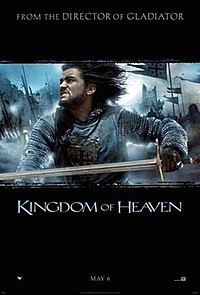
Kingdom of Heaven begins in 12th century France where a young blacksmith named Balian (Orlando Bloom) meets his birth father for the first time, a Baron named Godfrey (Liam Neeson) who is on his way to Jerusalem to fight in the Crusades and protect the Holy city from the armies of the Muslim leader Saladin (Ghassan Massoud). Having lost his wife and child and having nothing else to live for, Balian reluctantly joins his father in his mission while learning what it means to be a knight, and a man of conscience, and if possible to reconcile the disputed land into the Kingdom of Heaven.

One could consider this film a kind of thematic follow-up to Scott's Oscar winning Gladiator, but no matter your feelings toward that film, Kingdom is no Gladiator. While both Gladiator and Kingdom wander through various subplots and political maneuverings, Gladiator remained focused on Maximus and his revenge. But Kingdom only focuses when it comes down to the climactic siege of Jerusalem, when Balian suddenly is transformed into a master strategist and military general.

Ridley Scott continually proves, as with some of his past efforts like Legend, Black Rain and Hannibal, that his style as a director can over come the quality of the material, and he does so again with Kingdom of Heaven. The battle scenes combine the ferocity of Gladiator and the close quarter’s immediacy of Black Hawk Down, while the photography by regular Scott collaborator John Mathieson is unquestionably beautiful. The cast manages to get the job done although there are times that the term "auto-pilot" comes to mind in regards to some of the performances. As for Orlando Bloom, he's probably now so adept as a sword's man he could probably make a career out of being an actual Crusader. I'm more looking forward to Bloom's more contemporary turn in Cameron Crowe's upcoming Elizabethtown.

The politics of the film will undoubtedly hit a sore spot for some, but not for submitting to traditional stereotypes. The famed Knights of Templar are portrayed as race baiting thugs, while Masseur’s Saladin, whose legend in the Middle East to this day is so great that Saddam Hussein once claimed to be his direct descendant, is portrayed as a thoughtful, and honourable leader. Ultimately though debates of religion play shot gun to the epic battles, and political power plays, Bloom's character is borderline agnostic and more preoccupied with potential romance with a princess played by Eva Green. It’s hard to believe a man without deep religious conviction would rise to such prominence in the Crusades.

Kingdom of Heaven is unquestionably ambitious in scope and style but it ultimately tries to be too many things, and I think the only sword fight movie fans are looking forward do right now involve a couple of guys named Anakin and Obi-wan.

Sunday, 7 May 2006

Van Helsing

Rating: **

You know that summer is in the air when the big Hollywood studios start whipping 'em out, Summer Tent pole movies that is. One of the two times a year that Hollywood unleashes their biggest projects utilizing big bangs for bigger dollars. The starting shot this year is Van Helsing, and I'm here to tell you that it could be better.

Van Helsing as played by Hugh Jackman bears no resemblance what so ever to the Doctor from Bram Stoker's novel, and in the movie Van Helsing is only there to oppose the assembled monsters, the character could have been named "Buddy" and it wouldn't have made an inch of difference. Van Helsing's enemies are the incomprehensible team-up of Dracula, Frankenstein and the Wolf Man.

The biggest failure of Van Helsing is the way it lets down its actors, Jackson is the most notable casualty, which is too bad because he's a very versatile actor. He's done big action in X-Men and musical theatre on Broadway, but the script leaves him hanging, Van Helsing's motivation is mysterious, and the reasons he works as a Vatican sanctioned Monster Hunter are never revealed. Kate Beckinsale plays a Transylvanian princess but she's not given much to do character-wise either. Beckinsale has three things going for her: she's talented, she's beautiful, and she's British, but she's unfortunately been unable to find a big-budget Hollywood project that's suited her, not Pearl Harbor, not Underworld, and certainly not Van Helsing. David Wenham, who last sunk his teeth into the role of Faramir in Lord of the Rings, plays Van Helsing's "Q" a Friar named Carl, he too suffers from distinct lack of character.

To be fair the movie is not as bad as all that. I did enjoy Richard Roxburgh as Dracula, it was certainly a much better portrayal then Gerald Butler in Dracula 2000, and Roxburgh is better here then he was as Moriarty last year in the League of Extraordinary Gentlemen. From a production stand point the movie is a masterpiece, the act direction is incredible, the film is beautifully shot, and Alan Silvestri's score adds to the adventure and action sequences.

However the movie suffers greatly from CGI overkill, big bats, little bats, werewolves of all types and sizes. There's a black and white prologue at the beginning that was interesting enough, not that it added much to the end product, and it was only there to remind the viewers of the films, which inspired it. But ultimately the film suffers because it's just too busy, the action is relentless and any quiet, character moments seem to drag because character and dialogue was not the script's focus.

As much as I liked Stephen Sommers take on the Mummy, Van Helsing just feels like a good idea gone wrong. I once heard somewhere that writing is about choices, in this instance the choice to stuff three monster movies into one was perhaps a tad too ambitious. Van Helsing is campy fun, but that’s about it.

Saturday, 6 May 2006

Art School Confidential

Rating: ***

Taking the mickey out art school types is easy, but building a satisfying black comedy around them is some what harder to do. So from the writer of Ghost World and the director of Bad Santa we get Art School Confidential, a movie that somehow manages to be utterly hilarious some of the time and as dark as a crawl space under the porch the rest of the time.

Our hero is Jerome Platz (Max Minghella), a young man who's been the subject of ridicule his whole life due to his artistic leanings. After graduating high school he enrolls in a prestigeous art school in New York where he shares a dorm room with a closeted fashion major and an aspiring filmmaker directing a movie about a serial strangler that's been stalking the campus.

Jerome starts classes where he befriends a kid named Bardo (Joel Moore) who always starts the school year off with a new major. Bardo in turn, introduces Jerome to Jimmy (Jim Braodbent), a failed artist living in squalor. Jimmy warns Jerome that being an artist is more about how good you are at brown-nosing then it is about how talented you are at art. Jerome refuses to listen though, he's determined to make it and is sure that his talent will pan out and bring him success.

Of course a girl enters this somehow, through a drawing class Jerome falls for an art model named Audrey (Sophia Myles). Jerome desperately wants Audrey's affections and his desire for her, along with an ongoing disenfranchisement with his fellow art school students, leads him on a spiral of depression. The end result is utterly surprising, and not even remotely where I thought the script was going so I won't spoil it.

Easily the best part of this movie is the cast; anytime you can get John Malkovich, Anjelica Huston, Steve Buscemi and Jim Broadbent on to the same movie set, you really know you've got something good here. Malkovich in particular is excellent, without a trace of creepiness, as Professor Sandiford, a man seemingly resigned to his life as a simple art teacher. His eppervesent personality is only betrayed when he's told that his art show isn't going forward; a split second later though he's back to instructing Jerome about finding his muse. Huston and Buscemi mostly show up in cameos as an art teacher a gallery owner respectively.

The main cast though is mostly unknown, led quite ably by Minghella, who's so far only had a handful of rolls in films like Bee Season and Syriana. He perfectly plays Jerome as one of filmdom's archetypal sad sacks; a little tortured, a little over his head, and very slowly going mad. Another actor I liked is Moore, although he's forced to give the stereotypical speech highlighting the various cliques at the school,but Moore's charm really sells it. It helps that Bardo is an interesting character, whose type I've never really seen in a movie like this: the kid who's turned changing majors into a kind of zen meditation.

Another brief performance I enjoyed was from character actor Adam Scott as one of the art school's most noted alumni. With a wicked dry wit he shoots down the kid who asks him how you get to be a great artist, while joyfully answering Bardo when he speaks up to ask him why he's such an asshole.

One of the things I liked about the script is the way it rips into the culture of the tragically hip art student; the type that dare to presume that they alone know what qualifies as new and innovative, worthy of praise and imitation. The film mercilessly and brilliantly undermines those guys, while putting forth the idea that art is in the eye of the beholder.

But the thing of it is that the script is terribly uneven. A great deal of the first hour is wall to wall hilarity, but the movie then takes a dark turn, and gets darker and darker, and just when you think it can't get darker - it gets really dark. The film then wraps up with an utterly hysterical and ironic ending that pretty much sums up the volatile nature of the art world; it completely blindsides you but makes perfect sense in the context of the movie. The trouble is that at times it fells like two different movies, or at least as if it was made by two different filmmakers making two versions of the same movie and then having them edited together.

There's also different things that fall flat, like a prolonged sequence at the beginning of the movie where one of the roommates gets obsessed with getting Jerome laid, followed by a montage of Jerome dating the stereotypical psycho movie girls. Sometimes the film feels a little too episodic, which is probably a holdover from the film's graphic novel origins. Also there are a lot of characters and subplots beneath the A story; probably a little more than necessary, and definitely more than can be adequately explored in a two hour movie.

Still for the reasons I outlined above, Art School Confidential is worth seeing. Always assuming of course that you can find it at a theatre near you.

Friday, 5 May 2006

Mission: Impossible III

Rating: ****

With all the couch-jumping, Matt Lauer smoking, Xenu fighting, Tom Kitten excitement; we've forgotten why Tom Cruise is one of the most bankable stars in modern Hollywood. Fortunately we are reminded with the third entry into the Cruise-controlled Mission: Impossible franchise. Considering the oversaturated coverage of his personal life, it's to Cruise's credit that he can really melt into his fictional worlds. Of course this is due in part to the fact that Cruise surrounds himself with top talent; in the case of Mission: Impossible III, it's writer/director J.J. Abrams.

Abrams (co-creator of Lost) created the spy-fi drama Alias, a series heavily influenced by the original M:I TV show of the 60s. Fittingly enough, Abrams recruits fellow Alias alums co-screenwriters Roberto Orci and Alex Kurtzman, composer Michael Giacchino and production designer Scott Chambliss to create what is really the first, true Mission: Impossible film.

Abrams employs the same disjointed chronology and flashbacks that he's used to great effect in his TV work. The film opens with big bad arms dealer Owen Davian (Philip Seymour Hoffman) threatening IMF super agent Ethan Hunt (Cruise) by holding a gun to the head of his bound girlfriend Julia (Michelle Monaghan). Davain is demanding that Hunt relinquish a MacGuffin known as "The Rabbit's Foot" by the count of ten or he'll will pull the trigger.

Flashback to Ethan and Julia's engagement party, where Hunt gets a call form his superiors that one of the agents he helped train has been captured by the bad guy she was sent to surveil: one Owen Davian. Hunt's team is reassembled for a rescue mission that doesn't go as planned, which eventually leads Hunt to pursue Davain himself. However, Davian is one slick bad guy, and soon his pursuit of The Rabbit's Foot also becomes about revenging himself on Hunt.

I'll say it again: this is truly a Mission: Impossible film, fully in the spirit of Bruce Geller's original creation, but with modern touches and Abrams signature style. This is the first M:I to really embrace the team concept; everybody has a part to play and everybody plays their part. There's the Brains (Cruise), the Wheel Man (Jonathan Rhys Meyers), the Tech guy (Ving Rhames) and the Bombshell (Maggie Q).

We also get to see Hunt's IMF team perform the same type of elaborate act of con artistry that made Mission: Impossible different from the James Bond school of espionage. The main sequence of the film involves the team sneaking into the Vatican to kidnap Davain and replace him as he makes a drop at a charity event. The entire scene is beautifully staged as we see every member of the team play their role. Even the masks, that were so cumbersome in M:I-2, regain their coolness in the film as Abrams' shows how the masks are made.

Cruise's name may be above the credits, but in many ways it's Hoffman that owns this film. His Davain is such a remarkable example of scum and villainy he practically oozes slim in what few scenes he has. I love the idea of taking the guy that gets knocked out, dumped in a closet and doubled by IMF becoming a revenge fueled nutcase. Also good is Shaun of the Dead's Simon Pegg as Benji, IMF's own Marshall Flinkman (Alias fans know what I mean).

The movie does suffer a bit after time catches up to the opening scene and the tired, old double agent routine is employed for the third time in the series. But overall, Mission: Impossible III has some great action, cool gadgets and interesting character developments that make the film much better than it needed to be. A terrific start to the summer, popcorn movie season.

Wednesday, 3 May 2006

Spider-Man

(***This review was written back in May of 2002)

Rating: ****

I expected Spider-man to be good but in actuality; Spider-man was Great!

When coming out of the movie theatre, I immediately declared it as THE BEST COMIC BOOK MOVIE IN THE HISTORY OF THE UNIVERSE! (and no, I am not over selling it.) This previous position was formally held by 1978’s Superman the Movie by director Richard Donner, then in 2000 by Bryan Singer’s adaption of X-Men. Both movies captured the spirit of the comic book from which they originated, keeping respect for the material while retooling them for the big screen. But while Superman and X-Men merely exceeded, Spider-man excells. Under the careful direction of Sam Raimi, the steady pen of screenwriter David Koepp, and brought to life through stars Toby Maguire, Kirsten Dunst, and Willem Dafoe, Spider-man swings into the box office withh style to spare.

Director Sam Raimi, while not being the first choice, was definitely a wise one. Although he is perhaps best known for his trilogy of low budget gore and hilarity known as the Evil Dead series, Raimi has taken huge strides in recent years to go mainstream with A Simple Plan, For the Love of the Game, and The Gift. Yet in between Raimi created his own suerhero movie; in 1990 he directed and co-wrote Darkman; a movie about a horribly disfigured scientist who uses 99-minute masks to gain revenge on the mobsters that disfigured. Having been released a little over a year after Tim Burton’s first Batman movie, Darkman was more or less written off as a copycat, but in actuality is a stylish and original film. But anyway, twelve years later brings us back to Spider-man, which like Burton and Batman, will elevate Raimi into a household name.

The story for those in the (don’t) know goes like this. Timid teenager Peter Parker (Maguire) is a nerdy kid from Brooklyn where he lives with his Aunt May and Uncle Ben. But while he has an aptitude for science, we first meet him literally running after the school bus. We also meet the object of his affection Mary Jane Watson (Dunst) and his best friend Harry Osborne (James Franco). While on a field trip to the genetics lab at Columbia University, Peter is bitten by a genetically modified spider. By the time he wakes up the next morning, he has 20/20 vision and the physique of an Olympic gymnast, but as we all know that’s not all. Peter also discovers superior strength, the ability to leap tall buildings as well as stick to them, to fire webs out of his wrist, and the always handy “spider-sense”.

While Peter initially uses his new found powers to put the bag on the school bully, and make some quick cash performing as an amateur wrestler. It all goes to his head in any rate that is until he lets a robber to escape the police, only to minutes later find his Uncle Ben shot dead by the very same robber he let escape. Thus Peter learns that with great power comes great responsibility, and decides to dedicate his life protecting the innocent as the Amazing Spider-man. I really appreciated Raimi’s patience here, for it is almost a whole hour into the movie before Spider-man appears in full costume for the first time, nott that I noticed or anything.

Meanwhile... as they say, Harry’s father Norman Osborne (Dafoe) an industrialist and a scientist, out of fear of losing valuable military contracts, experiments on himself creating the Green Goblin, the greatest test yet for Spider-man, as the two carry out a one man war against each other from their first battle in Time’s Square to their climactic brawl on the Brooklyn Bridge. Like I said last time Willem Dafoe is a master at playing crazy, but not even the same type of crazy. Whether it’s the mad bomber in Speed 2: Cruise Control, or the Vampire/”actor” of Shadow of the Vampire, Dafoe doesn’t play the same way twice. In Spider-man, he plays the Green Goblin/Norman Osborne as separate yet equal, whether Osborne is the unwitting pawn of the Goblin persona, or the Goblin is the id for Osborne to carry out his dirty work is best left unclear. But definitely makes for an interesting villain.

But as I’ve said the vast amount of the responsibility for the success of Spider-man lies with Sam Raimi, and although he has come a long way from his Evil Dead days still finds way to remind us that he remembers where he came from. Like Tim Burton, Raimi enjoys a good opening titles sequence with a Danny Elfman score, come to think of it I do too. For the “spider-sense” scenes Raimi uses that kind of choppy slow motion thing, that makes the camera seem to be moving faster than it is. It takes a minute to get that that’s supposed to be the Spidey-sense, but look at it this way; in the comic book Spider-man’s spider sense is a couple of wavy lines coming out of his head. There is also the trademark Raimi layered montage in which different elements of a scene are plastered on top of each, this is especially obvious in the scene where Peter decides onm a Spider-man costume.

Does anyone else smell franchise cooking? With $200 million in the bank and counting, Spider-man 2 is now in the pipe ready to hit theatres this time in 2004. But until then, Spider-man is a terrific study in how to get comic book movies right; it features a plot, with believable characters that change and grow throughout the process of the film. Every once in a while a Hollywood blockbuster not only delivers on it’s hype, but on the expectations of the fans. Here’s hoping that the rest of the summer hit parade delivers the same.

Tuesday, 2 May 2006

X2: X-Men United

Rating: ****

Remember when sequels used to suck. Well the makers of X-2: X-Men United don’t either. According to Director Bryan Singer, X-Men 2 is his “Empire Strikes Back” but I can think of a better comparison; Star Trek II the Wrath of Khan, both are superior sequels with better action, story and character development, over their originals which were criticized by some as being too slow, and the feeling that it was rushed to completion, which of course it was. But finally, with more time, and yes, more money, Singer has made his X-Men movie.

Singer as well as screenwriters Michael Dougherty, Dan Harris, and David Hayter crafted the story based on the 1982 X-Men Graphic Novel entitled “God Loves, Man Kills”, in which a Reverand named Stryker leads a crusade against Mutants, and the X-Men in particular. In X-2, Stryker is an army colonel, who leads a military raid on Professor Xavier’s School of The Gifted, after a teleporting mutant called Nightcrawler attempts to assassinate the President. Stryker’s plans force the X-Men and Magneto to team-up before all the Mutants on Earth pay the price for Stryker’s revenge.

Along with the survivors of X-Men 1, X-2 introduces us to some new faces like Stryker, and Nightcrawler as well as the fire-controlling Pyro, the Wolverine-like Lady Deathstrike, and an expanded role for Iceman. In the raid scene we also get a few cameos of some future X-Men like the metallic Colossus; Shadowcat, who can pass through solid objects; and Syrin, she with the super-sonic scream. Cameos like these, as well as several otherr delightful little, blink-and-you’ll-miss-them, Easter Eggs will keep X-Men fans glued to their seats.

As with X-Men the first, an actor’s performance is just as important as the effects. Classically trained theatre actors Sir Ian McKellan and Patrick Stewart play it straight as Magneto and Professor X respectively. McKellan plays Magneto like the Devil, someone who tells you the things you want to here, makes pretty promises to lure you to his cause. It’s beautifully illustrated in an exchange between him and the young Pyro, which has serious overtones if you are at all familiar with the comic. While Stewart adds depths of shade to Xavier, drawing him as man just as willing to take many of the same risks Magneto does, to achieve his own goals.

Like Wrath of Khan, X-2 leaves things open for an obvious sequel, with the death of a major character and a closing scene that suggests that character’s rising from the dead. And as with that past Trek, X-2 has proved already that it’s got the financial backing of the movie-going public to proceed with part 3. I’d already be anxious to see it, but there’s something else I got to do right now...go and see the Matrix Reloaded. overtones if you are at all familiar with the comic. While Stewart adds depths of shade to Xavier, drawing him as man

Monday, 1 May 2006

Hot Docs - Secrets of the Code

Rating: ***1/2

With the forthcoming release of the movie version of The Da Vinci Code, and nearly 40 million copies of the novel that have already found a home on bookshelves worldwide, interest in related subject matter has never been higher. From the Louvre museum in Paris to Rosslyn chapel in Scotland, people have been trying to decipher the “clues” themselves; taking the novel's plot of a centuries old conspiracy to protect the bloodline of Jesus Christ and Mary Magdalene to heart.

Monday at Hot Docs, festival organizers screened the work-in-progress Secrets of the Code, the new documentary from renown filmmaker Jonathan Stack. According to Stack, the audience gathered in the Varsity Cinema on Bloor had been one of the first audiences to view Secrets of the Code. Stack said that he had begun filming this past January, wrapped shooting in February and had sped through editing to have a workable film for Hot Docs. Before the show began, Stack apologized if some of the things in the film weren't clear yet and for the temporary narration track, apparently Susan Sarandon wasn't recording the narration until Friday.

Since The Da Vinci Code became a literary phenomenon, more than a few people have worked on various projects through which to address some of the religious and historical fibbing that author Dan Brown committed while piecing together his thriller. National Geographic specials, TV documentaries, even entire websites have been dedicated to exploring the novel's mythology, and in many cases disavowing things that Brown assures the reader at the bigging of the novel are “facts”.

Stack's documentary is not one of these however, it is a much more spiritual journey. It explores the life of Jesus, the sacred feminine, the Gnostic texts, the Knights Templar and the Priory of Sion as a kind of road trip across Europe and the Middle East. Stack always refers back to Da Vinci, but one need not have read the novel to get a lot out of the documentary.

Stack explores French caves that contain prehistoric art concerning the sacred feminine; he visits a mountain top in France where Mary Magdalene supposedly pursued her spirituality after the death of Jesus and he takes us to Roslynn, highlighting some the buildings other, non-Grail mysteries. The film also takes to places not mentioned in the book; like the ancient catacombs beneath Rome where Popes and commoners were buried together and culminating in a journey to Meggido in Israel, the location of the final battle between Good and Evil as prophesied in the Book of Revelation.

Along the way, Stack talks to numerous experts from both sides of the Da Vinci debate. Art historians argue over the hidden meanings, if any, in the fresco of The Last Supper; and theologians debate whether Jesus and Magdalene were husband and wife and what the exact nature of their relationship was. Among those interviewed is Richard Leigh, one of the authors of The Holy Blood and The Holy Grail. Leigh's book is at the esoteric work that was the major influence on Brown as he wrote The Da Vinci Code, so much so that Leigh and one of his co-authors recently sued Brown for plagiarisms.

Not to say that Stack doesn't gloss over any historical inaccuracies in Da Vinci, but that's not the point of the film. Sure, the Priory of Sion was made up by some imaginative French guy named Pierre Plantard in 1956 with any evidence sitting an illustrious and magnificent history being pure fiction. But Stack asks the question, what is driving people's fascination with the possibility of a more mortal messiah?

The film is about our obsession, as one scholar put it, to reach journey's end. Is it enough to find out what the Grail is and where it is? A life long Grail hunter considers whether it wouldn't be disappointing to read in the paper one morning to see that the Holy Grail had been discovered. Further, Secrets of the Code asks us to think about when a story stops being a story and becomes a sacred document; that the truth doesn't come from any one source and rarely is it as simply as people would like it to be.

Although the film was unfinished, I think it's message came through loud and clear. It can be summed up in one of the lingering thoughts of the film concerning the fruit from the tree of knowledge in the Garden of Eden. The idea that we, human beings, were always supposed to have eaten the fruit, but Eve bit of the apple it wasn't rip yet. That fruit is ripening in us right now, and with it a desire to consume more knowledge. Sounds like a fit theme for Hot Docs to me.