Monday, 10 May 2010

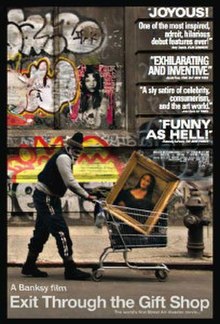
Exit Through the Gift Shop

Rating: *****

So far as movies go, Exit Through the Gift Shop is pretty darn close to perfection. Sure there’s the *wink*wink* maybe it isn’t entirely non-fictional debate, or the postulating that thing is really an elaborate prank on the part of British street artist Banksy on the art world, but sometimes, when you have this good a time at the movies, you don’t ask questions. Is Exit a phoney? A great big phoney? I don’t know, but I got my fingers crossed under the truth is stranger than fiction clause.

What really matters is that Exit Through the Gift Shop is as funny as a movie about graffiti, self-promotion and the perils of inspiration can get. The film, while being shot by French transplant to Los Angeles Thierry Guetta, was edited by Banksy himself. If the name Banksy sounds familiar, it may be because he’s one of the world’s most well known street artists. He’s the guy that replaced Elizabeth II with Diana Princess of Wales on several 10£ notes. He also graffitied the wall dividing Israel and the West Bank. In other words, he’s not like one of the kids that spray paints his initials on the side of the corner store last night.

The thing about Exit is that Thierry had tremendous access to some of the greats that lead the movement to legitimize street art since the turn of the century. It was kismet after all seeing as how his cousin is the infamous Space Invader. In L.A., through his cousin Invader, Thierry was introduced to Shepard Fairey. Fairey’s most recent claim to fame was that he was the designer who came up with the iconic red and blue image of President Barack Obama back when he was just candidate Obama. Prior to that though Fairey was known for the omnipresent caricature of Andre the Giant with the word ‘Obey’ underneath it.

Eventually, Thierry was introduced to the man himself – Banksey – which if you’re making a documentary about street art is like getting the Master Leonardo in your doc about Renaissance art. What nobody knew at the time though, was despite the fact Thierry was getting all this remarkable, historic footage, he was just sticking the tapes in one of numerous plastic totes and never looking at the results of all those nights on the streets of L.A., Paris, and London, filming street art.

Banksy was kind enough to share some of Thierry’s eventually edited film in Exit and let’s just say that it was a work of such sensory overload that it would have made Noriega surrender. Still, this is where seeds of doubt start to grow: was Thierry, despite his passion and enthusiasm, really this inept?

What happens next is almost beyond belief as Thierry pursues his own street art under the nom de plume Mr. Brainwash (or MBW if you like). But Thierry gets bored with the dull, hard work of building a street rep and fast forwards to putting together a gallery show that would convert the old CBS Studios in the greatest schmorgesborg of pop art the scene has ever known. Does it work? Why spoil the whole movie?

The focus of the film is on this man who goes from zero to art world phenomenon and he basically falls bass ackwards in order to do it. One can read some inherent criticisms of the mainstream art world and the group-think manner in which it decides what’s now and what’s important, and how Thierry became a dupe or an accomplice in this process. Whether or not Thierry is a performance art piece by the man behind the curtain (and the movie) doesn’t matter because the message is the same. Banksy himself just seems amused.

If nothing else, you can read Exit Through the Gift Shop as another inspirational tale of pursuing your love of art and doing so in complete disregard of legitimacy, legalities, or even talent and insight. The point is to create, and maybe to take care with whom you give inspiration. As for the movie itself, if all you take away from it is a good time, then the rest doesn’t matter. At least that’s the Thierry philosophy as far as can gleam it.

Sunday, 9 May 2010

Hot Docs - The Devil Operation

Rating: ****

The David Vs Goliath trope is not a new one to documentaries. In many ways, it’s one of the most often told stories as an individual or small group struggle against a large, monolithic force, usually a corporation or government agency. In these movies, dastardly deeds are being done by the seemingly unstoppable bureaucratic force, but a small, dedicated group of resisters are (usually) able to turn the tables and make their world a better place. Sometimes the road is rocky and the enemy a little more sly than our heroes would like, but good guys win and bad guys lose. Mostly.

In the case of The Devil Operation, the “David” is a small group of farmers and activists in Peru are the thorn in the side of Newmont, a U.S. mining company. At the base of Newmont’s largest mining operation in South America, the people are protesting the laissez-faire manner in which the company is getting the gold. In complete indifference to the environment, farm land and the health and safety of the indigenous people, Newmont’s all about the bling-bling. But the protestors enjoy success, though granted it’s through both violent and non-violent action. But what does the company do when it’s fed up?

Well, if you’re Newmont, you mount a massive, Mission: Impossible-like operation to spy on and just generally harass those that are fighting against the mine operation. Father Marco Arana, a man so renowned for this dedication to eco-activism that he was named a Hero of the Environment in 2009 by TIME Magazine, leads the more diplomatic wing of the protest, and for his effort, he is given a highly provocative name by Newmont’s spies: “The Devil”. From lawyers to the simple farmers that just want to protect their lands, each of them is treated as if their part of an organized crime operation with Newmont’s P.I.s acting like pit bull F.B.I.

Director Stephanie Boyd followed Father Marco and the other protestors for 10 years (but not in the way that Newmont was following them). Like some kind of thriller in the vain of The Firm or North By Northeast, Boyd collects stories from the people fighting the mine and learns about the harassment and scare tactics used against them by Newmont. In a mixture of astounding disbelief and hypnotic attentiveness, you watch some of the most obsessive acts of greed ever put to film. Even Scrooge McDuck would look at this mess and shake his head in disgust. I’ve spent a lot of time with community activists, many of them are good natured people that care deeply about the issues they’re passionate about, and trying to imagine people dumping this kind of time, effort and energy into dissuading them does nothing but boggle the mind.

Still, there was something extremely affirming about seeing these people persevere in the face of such staunch and all-encompassing opposition. Newmont is an ideal villain because their tactics are so distasteful and their goals – digging all the gold out of a mountain – are less than altruistic. Boyd marvellously captures the tension and suspense thanks to remarkable access and a fearlessness in pursuit of the story. This is documentary filmmaking at some of its finest: competently made with style and precision and with a direct narrative point of view. Compelling and engaging, The Devil Operation shows that the little people still have power no matter what’s thrown at them.

Hot Docs - War Games and The Man Who Stopped Them

Rating: ***1/2

A lot of people get the lion’s share of the credit for ending the Cold War: Ronald Regan, Mikhail Gorbachev, even Ronald McDonald. But what about Colonel Ryszard Kuklinsk? Who? you're asking. Kuklinsk was a high ranking officer in the Polish army, one of their best actually with dozens of citations to his name. But he was also a traitor. To some people anyway, nearly as many think he’s a national hero that laid aside nationalism for the sake of not just the free world, but for the entirety of mankind as well. War Games and the Man Who Stopped Them is Kuklinsk’s story, one that unfortunately he didn’t get a chance to contribute too.

No, that’s not foreshadowing of a sinister end to Kuklinsk, but that wasn’t altogether certain considering that one night in 1981 when he and his family had to flee Warsaw for fear of him being discovered as an American spy. Kuklinsk was a decorated officer and pride of the Polish military, but he was a humanist too. Upon seeing the Warsaw Pact plans in anticipation for an invasion of Western Europe, up to and including the use of the nuclear option, Kuklinsk said to himself that enough was enough. He turned spy for the Americans and over several years provided valuable intelligence that might have hastened the collapse of the Soviet block.

A combination of memoir, docudrama and spy thriller, War Games chronicles Kuklinsk’s nearly decade long service as a double agent, his tragic retirement in Florida and his eventful return to Warsaw that where people came out to welcome him and lynch him in equal measure. It’s a weird, wild story that spans across the worlds of international espionage and family heartbreak. Director Dariusz Jabłoński gives the film both a personal touch and a journalistic distance. That’s not an easy task, but Jabłoński’s personal relationship with Kuklinsk before his death is tempered by the fact that the man’s death offers some remoteness to the subject material.

Treading in the grey waters of international intelligence gathering, there’s plenty to get the paranoid-turned mind going with visits to facilities and ceremonies so secret that there’s no filming allowed lest there be exposure for the active C.I.A. agents inside. Not that this is some James Bond action piece, this is the real nuts and bolts of spy work in all its unglamorous glory. But this is a story about a man who was accidentally a spy, a man struck by conscience and with the courage and guile to accept that his actions may have led to no happy ending for himself. Terse and mechanical, yet still loving and personal, War Games is a great tribute to not just Kuklinsk, but to unsung heroes that influence events bigger than themselves all the time.

Saturday, 8 May 2010

Hot Docs - Congo in Four Acts

Rating: ****

Events in Congo don’t make the news a lot, but it’s one of the most unstable areas in Africa and that’s really saying something. This is where the documentary works really good, highlighting the people, stories and aspects of current events that don’t typically get covered in the nightly news. What makes Congo in Four Acts even more interesting is that it’s four short documentaries directed by filmmakers from The Democratic Republic of Congo (DRC). From the impoverished streets to the overworked civil servants, a very fascinating light is shed on this country by the people who know it best.

The project began as an educational experience for its filmmakers: Dieudo Hamadi, Divita Wa Lusala and Kiripi Katembo Siku. The result was a refreshingly honest and direct look the people and problems of Congo, representing four very diverse subject matters. In Ladies in Waiting the bureaucratic nightmare that is a struggling maternity ward is examined. Symphony is an eye-opening, first-person look at the slums of Kinshasa. Zero Tolerance is an almost COPS-like vignette about justice and sexual violence in the eastern DRC. Then, to finish, there’s Mine, which is about young children that break rocks for pennies.

Each of these films offers a unique insight into several areas of life in the Congo. It’s hard to pick a single segment that has more of an impact than the others, but those versed on the issues will certainly come to appreciate Zero Tolerance. Rape has been used as a weapon with alarming frequency in the Congo, but seeing the sight of young men under the age of 13 being brought in to the police charged with sexual assault is fairly haunting. Combined with the matter of fact manner in which these boys are brought in to elocute their crimes with the parents trying to make excuses for them, and you’ve got a really bleak picture of human rights in the Congo.

By comparison, Ladies in Waiting, Symphony and Mine aren’t nearly as sensational, but they are still very powerful. These three highlight tremendously the struggles with poverty and status in the Congo. Mine shows a mother and child breaking rocks for hours in order to make the equivalent of a quarter for all that hard labour. The barter system is taken to the extreme in the maternity ward featured in Ladies in Waiting where treatment continues only if the women or a family member is able to provide a significant item for collateral. Both of those shorts are vastly different in opposition to the starkly silent Symphony, as the only sound comes from life on a crowded, filthy street in the city of Kinshasa that’s just miles from a more affluent area.

There’s a looking glass factor to Congo in Four Acts where in we’re given these brief though potent little insights into life in the DRC. We see what life is like in this place but we’re not given either context or commentary. The filmmaking style is very visceral and immediate, almost the roughest, greatest intention of the documentary art form. Basically, these are stories and insights that could only be gotten by people living in this place, at this time. Fascinating and enlightening, Congo in Four Acts is a must see for anyone interested in issues and Africa.

Hot Docs - How I Filmed the War

Rating: ***1/2

Geoffrey H. Malins is probably one of the most influential filmmakers you’ve never heard of. His 1916 documentary, The Battle of the Somme, represented a great leap forward in the areas of filmmaking, war photography, reporting and, indeed, propaganda. But let that last one not diminish the impact that this film had when it was first released, or its historical significance nearly 100 years after the fact. Canadian filmmaker Yuval Sagiv has now revisited this documentary in a highly unusual way by exploring the blurring of the line between truth and propaganda while digging into Malins’ own conflicted background.

First of all, the movie is silent. The only sound is clacks and scratches of the old film, which is intercut with title cards containing bits of narrative or dialogue, like the films of the silent movie era in which The Battle of the Somme was released. The title cards are a mix of filmmaker researched information about Malins and the film, or excerpts from Malins book about the filming of the documentary and being the “Official Kinematographer” of the British forces on the front lines of the Great War. The conceit is pretty effective where in this new documentary feels like itself is a relic. It’s like someone put a disc of James Frey’s mea culpa interview with Oprah in the back of copies of A Million Little Pieces.

Honestly, it should come as no surprise that Malins staged some parts of his film to make it look more action-oriented then would have been possible in a way that wouldn’t get the cameraman shot in 1916. If that’s surprising it’s only because we expect people in the past to be more honest, or that the technology was so new, we think it had never occurred to anyone to exploit it. Or does anyone care? It’s common knowledge now that the picture of the American flag being raised over Iwo Jima was staged yet that doesn’t seem to rob the image of its power as a symbol. You still see it on motivational posters to this day after all. Even Sagiv seems to treat it as an afterthought as the famous charge “over the top” as a fake is only examined near the film’s end.

The really interesting parts of the documentary involve how Malins cut through the typical propaganda of the time by projecting a lot of realism in his work, as well as the sorted story of Malins himself. Malins, like Frey, seemed to play fast and loose with his origins, but fortunately for the filmmaker this was easier to get away with before the invention of the internet and Google. Still, the “spotty” history of Malins does nothing to belie this work he created. A work that, for its time, startlingly captured the horrors of the war front in an era where war was still romanticized. Trench life, in all its grime, was shown in a way that a lot of the era’s recruiting material tried to ignore. Despite Malins’ sleight of hand and the officials of the times’ editorial pruning in the interest of morale, the refreshing honesty of The Battle of the Somme still resonates a century later.

As for the film about the film, there’s an experimental quality that can, at times, be distracting. It’s seems as if Sagiv has created a director’s commentary for a silent film done in the style of that film’s original release, which creates an odd, post-modern twist in the way How I Filmed the War can be viewed. There are occasions when I think the art draws too much attention to itself, but Sagiv’s format is refreshing at the very least. But as well done as this film is in the way Sagiv made it, I would still love to see something with a little more analysis and distance; a true consideration of The Battle of the Somme and its impact on filmmaking. Perhaps Sagiv can next break new ground with a documentary sequel or remake.

Friday, 7 May 2010

Iron Man 2

Rating: ***1/2

Oh hype. Bringer of expectations, destroyer of dreams, you certainly know how to jerk our collective chains and make us expect the impossible. Realistically, no movie could live up to the economic and critical expectations that are those now owned by the superhero sequel Iron Man 2. The tremendous success of the first Iron Man movie was completely out of left field given the fact that the billionaire in the high tech suit of armour didn’t quite have the name cache of Marvel Universe compatriots like the X-Men or Spider-Man. But casting Robert Downey Jr as the titular hero and hiring so-called serious actors like Terrance Howard, Gwyneth Paltrow and Beau Bridges cultivated a rare attitude towards summer blockbusters: that this was something that might be able to be enjoyed on an intellectual level as well as visceral one.

Indeed the whiz bang of Iron Man 1 was its weakest link with everyone noting the power of the acting, character development and storytelling over the special effects and action sequences. But naturally, the only thing in Hollywood better than success is even greater success. And just like that, the expectations for Iron Man 2 are as high as anything called Harry Potter, Star Wars or Twilight. Which is why it’s so frustrating to say that this movie misses the mark, although it should be noted that it doesn’t miss it by much.

But frankly, this Iron Man is packed. Not only is Tony Stark (as portrayed once again by Downey) struggling with his very public dual identity, but he’s also struggling with his mortality as the very same technology that’s keeping him alive is also killing him. Aside from the personal, Stark must contend with a government that wants his suit and a rival that wants his life, only to get gobsmacked by a new villain with a claim on Stark’s technology and a deadly grudge that needs indulging.

This might be problematic if not for director Jon Favreau’s penchant for casting. Sam Rockwell and Mickey Rourke share co-villain credit as Justin Hammer and Ivan Vanko respectively. Hammer is Stark’s closest rival and trades between hating Stark for his genius and charisma and admiring him like a younger brother. Vanko, who’s a conglomeration of two Iron Man comic villains, is a man on a mission of vengeance, and Rourke has the right menacing presence to make Vanko a formidable foe for Stark. The other new character is Scarlett Johansson as Iron Man’s fellow superhero (and possible future Avenger) the Black Widow. Predominately it seems that Johansson’s responsibility for the film is to look sexy and kick butt, and by this basis she succeeds beyond expectations.

Still, the appearance of Black Widow and the expanded role of Samuel L. Jackson as Gen. Nick Fury tips a potentially fatal flaw in the film in that there are times when this Iron Man movie seems to be more about being a “backdoor pilot” to the upcoming Avengers movie. The so-called Easter Eggs are kind of glaring in their obviousness in that there might as well be Post-Its on screen referencing why this item is important. Like the old Pop-Up Video show. There’s a section in the middle where Stark is given a time out by Fury that seems like a tacked on tease for The Avengers and it kind of takes you out of the movie, which already has a lot of complex plotlines going on, aside from setting up more movies.

When not bogged down with foreshadowing, Favreau does well picking up where he left off so far as the main characters and their relationships. Don Cheadle seems more comfortable playing Stark BFF Col. Jim Rhodes than Terrence Howard did in part one, but despite being upgraded to fellow iron man War Machine, it seems that Rhodes’ role is still kind of diminished. Downey still plays a mean Tony Stark, but there was a kind of sense that he was reaching a bit too hard. Like Johnny Depp in the second Pirates of the Caribbean movie, Downey was trying force himself to play Stark rather than just play him. Still, Stark is one of the most dynamic and relatable superheroes ever put to film.

Despite these sophomore hiccups, the Iron Man franchise is still remarkably satisfying as a popcorn movie and as a dramatic work. Favreau’s emphasis on character continues to pay off and the director even gives himself a chance to play in this one with an expanded part for his Happy Hogan, Stark’s bodyguard. In one way, it reminded me of The Dark Knight for the way it crammed so much in to the story, leaving the viewer wondering what possible direction the filmmakers can take the character in next. I mean that on an individual basis in Iron Man 3 of course. We all know that Stark’s got a big meeting with his super friends in the future.

Wednesday, 5 May 2010

Hot Docs - The Parking Lot Movie

Rating: ****

Remember Clerks? It was Kevin Smith’s breakthrough first film about directionless slackers working the cash register at a convenience and video store in the middle of nowhere, New Jersey. One can find an easy allegory on the surface of The Parking Lot Movie, a documentary chronicling the self-styled bohemians that attend a parking lot in Charlottesville, VA. But these are no mere slackers that take your money and watch your car between – how did the synopsis put it – long periods of tedium, punctuated by swearing back at irate customers. But this isn’t a movie about the tedium of doing menial labour, but about fraternity, capitalism, the class struggle and knowing the value of having somewhere to consider the zen in life.

Chris Farina has owned the Corner Parking Lot in Charlottesville for over 10 years. Sandwiched between the vibrant downtown bar scene and the campus of the University of Virginia, business is rarely slow for Farina and his dedicated group of employees. Now, one might think that working at a parking lot would be dull and socially dilapidating, but actually working for the Corner Parking Lot is one of the coolest jobs to have. An assorted bric-a-brac of undergraduate and graduate students man the main gates between classes. They’re philosophers, musicians, artists, and intellectuals Just don’t mess with them or try to do the parking equivalent of the dine and dash, because they will find you.

The Parking Lot Movie is bizarrely captivating; a film that should be as dull as rye bread but is profoundly watchable. The characters you meet are your typical, college-aged hipsters that revel in how much smarter they are then you, but if that sounds like your crew, then you’ve found kindred spirits. But really, these are good-natured guys working a job they like and sometimes, without realizing it, it affects them in profound ways. But it’s a parking lot, you’re saying right now. To which I respond by saying that you kind of have to see it to get it.

There are a couple of levels to this movie that make it so immensely enjoyable. First are the personalities. The various attendants profiled are all insightful and interesting young men with good heads on their shoulders. It sounds trite to say (not to mention ridiculous given the job description), but this is more than work for them. Former clerks can appreciate, and perhaps be envious of, the no B.S. way that these attendants handle their business. (No, the customer isn’t always right.) And though it may seem far-fetched to the average viewer to think that one would get so obsessed that you’d run down someone that parks and runs, the primitive mind of a present or former clerk knows too well the impulse of not letting that kind of person get away.

Secondly, there’s the sociological subtext. While not explicit, there is in the film a kind of commentary about cars and the entitlement of the people that own them. As well, this corner parking lot is a front line of the class war, as people look down their nose at these attendants without knowing, or caring, that some these guys are academic superstars in their off hours. The film was shot over three years, and the coda at the end reveals that many of the attendants have gone on to being professors and researchers at various institutions of higher learning. It’s one of those quiet victories that makes the worst times worthwhile. Still, it’s not like the job at the parking lot itself is terrible.

Interestingly, I think Parking Lot Movie would make for a good double bill with another Hot Docs film called A Different Path. The latter is about the positive side of going car-free while the former is about the negative side of drivers and the car culture that people behind the wheel overlook, or simply never see. On its own though, Parking Lot Movie is terribly life-affirming and proves that even the most tedious jobs have in them some pearls of wisdom that can lead you to live a happier, healthier life. But you have to know someone if you want a job there.

Hot Docs - Small Wonders

Rating: ***

In the documentary Small Wonders, filmmaker Tally Abecassis shows us three shops in small town Canada and how they struggle to remain relevant in a consumer market driven by the axiom “Bigger is better.” Fittingly, there’s something about the doc itself that feels charmingly antiquated. Abecassis shot the film over 10 years with a 16 mm camera, and the result is a feeling of looking into a time capsule. The man running a watch repair shop, the woman running the corner hardware store and the kindly old man with the photography studio all feel like characters from a drama of yesteryear. The inside of their stores are like boxes shielded from time, but the proprietors are still aware that times have changed.

If you’re looking for a polemic about how Wal-Mart’s ruining the world, this is not your movie. While it would be impossible to tell these stories without touching on the fact that the retail world is all about the mighty big blue box, the tone struck is not accusatory or overly negative. People getting their portraits done at a big box, getting hardware suppliers more cheaply and with greater selection, or throwing out a broken watch is all part of the current trend, and trends change. That’s life, folks.

Still, for these utter personal tales there’s something that feels rather distant about the way Small Wonders tells these stories. There’s a cool kind of analysis to the narration that makes the film seem more like a graduate psychology thesis rather than a loving memorial to a bygone age. There’s something kind of spacey about the approach, a separation of subject and author, which is weird considering that Abecassis spent 10 years chronicling these three people. The film’s conclusion is more philosophical too seeing as how everyone closed their stores or were forced into smaller spaces. One can almost take the ending as a tribute to the power of the lost cause, which I don’t think the filmmakers were trying to convey.

There is still something to admire in Small Wonders though, and it’s that these are interesting people with interesting stories to tell. They’re stories that you don’t get out of working down an anonymous aisle at the local big box. From the helter skelter filing system to the personal touch that can only be got from people who are symbiotic with their businesses rather than cogs in the machine, there’s something admirable about those profiled in Small Wonders. I just wish that the documentary about them was able to connect better.

Tuesday, 4 May 2010

Hot Docs - A Different Path

Rating: ****

Oddly timed in an act of universal kismet, A Different Path comes hot on the heels of that incident in the Gulf of Mexico that President Barack Obama called “potentially unprecedented environmental disaster.” With scenes of disgusting oil poisoning the pristine ocean front of the U.S. Gulf coast, we should all be looking to a different path (as if all previous incidents involving oil unleashed on a defenceless and delicate eco-system haven’t already driven that point home). To put it bluntly, A Different Path is one of the most anti-car movies I’ve ever seen. Not that it’s an hour and a half of harping on the evils of the personal automobile, but rather an impressive and positive film experience.

Independent filmmaker and musician Monteith McCollum follows several individuals that are trying to make the world a better place by getting people to think about transportation options beyond the single-occupant automobile. Richard Dyksterhuis and his wife Cleta Hughes are part of a small group seniors in a town in Washington State trying to get a sidewalk laid in their rundown neighbourhood. These seniors, including one in a wheelchair, literally risk life and limb trying to draw attention to the issue as discourteous drivers right them off as “senile old people.” On the other side of the continent in Toronto, Michael Louis Johnson leads a group called “Streets are for People” as members try to reclaim downtown parking spaces through games, art instillations and the like.

The trick of this film is that’s a very preach-to-the-choir movie. That’s through no fault of it’s own, of course, it’s just that’s exceptionally hard to get many people to see things from the movie’s point of view: cars are mostly bad, creating a car-centric society is killing us, and we’re eventually going to pay for it because this life is unsustainable. There are places in the GTA where officials explicitly say publicly that if they implemented a public transit system, then they would attract the “wrong kind” of people to their town (ie: the poor and the newly immigrated). As cities grow, spending on transit remains stagnant while fares rise. And still some people look at you like a leaper when you suggest public transit as a viable alternative to getting around. Either that or they say you’re immature for riding a bike to get from point A to point B being over the age of 18.

Fortunately, the movie itself is not as angry as the last paragraph. As well, these are not your typical activists profiled. Take the case of David Hughes, a former New Yorker that lived in Manhattan, but had to commute to an office in New Jersey everyday. Literally being able to see his office building across the river from his apartment window, Hughes did something unusual: he decided to kayak across the Hudson to work everyday. The result was that he cut his commute to a third; 30 minutes by kayak as opposed to an hour and half with the bridge and tunnel crowd. That kind of blew my mind a little, but it also punctuated the film’s real point. This is a movie about thinking outside the box. This is a movie about finding original solutions. This is a movie meant to get one thinking about one’s own space and what they can do to improve. It’s transportation policy D-I-Y.

But I don’t think A Different Path would be half as inspiring without its artistic flourish. Certain scenes and stories are punctuated with stop-motion slides and illustrations, which combined the phone interview soundbites and the POV shots of Johnson riding his bike around Toronto, give the film an ethereal, dream-like quality. It’s like John Lennon’s “Imagine” re-imagined as being about a world where car culture no longer holds its sway. This is daring work. As in it dares you to be as forward, and as imaginative, and as positive thinking as its protagonist. If you don’t walk away with from this film smiling, then you’ve got no soul.

Hot Docs - The “Socalled” Movie

Rating: ****

In 2010, the Montreal-based hip-hop impresario that goes around calling himself “Socalled” has haunted my life. Well, not really. I was at Hillside Inside in Guelph back in February where he was one of the headliners, which was the first time I was introduced to the man that puts the funky in Jew funk. The Hot Docs website says that “If Woody Allen and Lil Wayne had a love child it would be Josh Dolgin, a.k.a. Socalled.” It’s a fair description, but one that doesn’t nearly do justice to the man, his music or his world.

What does Socalled do? Well, he’s a musician, magician, cartoonist, and filmmaker, So fittingly, The “Socalled” Movie comes across as every inch the whirling maze of art, images and music that enrapture the film’s subject. The cameras of director Garry Beitel follow Socalled through performances across two continents and catches the musician during down times to discuss just what it is that makes him tick. I’m not sure if we get a straight answer to that, but you can’t help but see the fun in the man and his music, which is insanely catchy and just overall fun. And lest you think this is one of those high-minded artist profile pieces, be prepared for some interesting cinematic interludes courtesy of Socalled himself.

An artist as unique as Socalled deserves a film that’s just as unique as he is, and that’s precisely what Beitel delivers. Easily, The “Socalled” Movie is one of the better music documentaries to seen in some time.

Monday, 3 May 2010

Hot Docs - Candyman: The David Klein Story

Rating: ****

In pop culture, Candyman is typically synonymous with a movie based on the Clive Barker short story about a Bloody Mary-like spook with a hook for hand. Instead, think of this Candyman as a real-life Willy Wonka tale involving the American Dream, corporate greed run amok and the enduring free spirit of dreamers everywhere. But really, it’s just the first hand account of how the Jelly Belly came to be.

Once upon a time, jelly beans were boring. Separated into rather static, colour-coded flavours like orange, yellow and black, the jelly bean was a hearty candy, but not necessarily the one longed for when one was in the mood for something sweet. Enter David Klein. Klein was one of those kids that put himself through law school and then never took the bar exams. You know – an eccentric. An amateur inventor, Klein cam up with a simply ingenious idea to concoct gourmet jelly beans. Jelly beans with flavours like cotton candy, root beer or popcorn.

If the fictional Wonka (as portrayed by either Wilder or Depp) is a character of supernatural effervescence, then Klein is the man Roald Dahl inadvertently based his candy-maker on. Klein is the inventor of the Jelly Belly, and if you’ve never heard of him that’s not an intentional act of evasion by a private man. You see, the Jelly Belly Candy Company was once called The Herman Goelitz Candy Company. Klein brought his idea for the Jelly Belly to them in 1976; Goelitz made the candy while Klein sold it at a local ice cream parlour. A lot of blood, sweat, tears and energy later, Jelly Belly was about to make Klein the biggest name in candy since Milton S. Hershey. But that’s only part of the story.

The rest is typical of the American corporate culture. One man’s out-there idea proves successful and is taken over hook, line and sinker by a company smelling profits and not willing to share them equally. It’s a story as old as time, or at least as old as the first time one human bartered object A for his neighbour’s object B and ripped him off by keeping both A and B in the first place. Now if this were a Hollywood movie, then the next scene would be of Klein marching into a crusading lawyer’s office to see if he has a case. For Goelitz, being the evil corporate robber baron, must pay for merely giving an admittedly large stipend to the Jelly Belly creator and hording the millions more that Klein could have made for themselves.

But that’s actually not what happened. Instead Klein merely went about his life trying to figure out other great candy concoctions that kind of went no where. Or certainly no where that his first, great invention went anyway. The strange thing is that though Klein realizes he was ripped off, and many former Goelitz employees as much as admit that their former boss ripped off Klein, the inventor himself remains optimistic and composed. In an age of litigious overreaction, Klein is rare breed.

The tone is almost anti-climactic but it’s really not. Despite the fact that the inventor was quite nearly erased from the tale of his own invention, Candyman is a case of the truth bears out. It’s also an example for us all as Klein found contentment in the fact that he brought happiness to people rather that wallowing in the resentment that he got screwed over by a company that knew they were screwing him over and what’s more that they could get away with it. Some may call that being a sucker, but I call it heroic. And if there is any justice in this world Candyman will serve a greater legacy to Klein than any amount of candy royalties ever will.

Hot Docs - Talhotblond

Rating: ****

With MySpace, Facebook, Twitter, Linkedin and all the assorted social networking facets that exist the days, it’s easy to forget that once upon a time, so deeply personalizing one’s self online was strange and one could never be sure if the person on the other end was being earnest. Sure, there are still plenty of people on the internet, predators mostly, that are pretending to be something they’re not, but often we take people at their word that they are who they say they are. Think about it: how many times has someone you’re not sure you know, friended you on Facebook or the like?

But filmmaker Barbara Schroeder quickly sets internet paranoia back by about 10 years in her first feature documentary Talhotblond. Utilizing journalistic precision and impeccable research, Schroeder recounts the unfortunate set of circumstances that led to the murder of Brian Barrett, a promising young man that got caught up in the worst case of fatal attraction since, well, Fatal Attraction.

The story begins in online chat rooms and a cyberspace tale of boy meets girl. On one end is marinesniper, an 18-year-old enlistee about to head off to the frontlines of Afghanistan and Iraq; on the other is talhotblond, a bright precocious and virginal teen queen with blond hair and long legs. A torrid cyber-romance takes place between the two as marinesniper and talhotblond participate in X-rated chats, or sexting as the kids call it. By all appearances talhotblond was every inch the 18-year-old vixen she said she was, and marinesniper the ripped and dedicate young man doing his patriotic duty.

There was just one problem though: marinesniper was a 46-year-old factory worker pretending to be a battle-hardened soldier looking for comfort in his small town girl back home. Of course, talhotblond wasn’t all she advertised to be either, but that’s a twist best left revealed in context of watching the story unfold in the movie. Indeed, Talhotblond may be the best story Law & Order: Special Victims Unit never told. A startling tale of deception, obsession and naiveté taken to perilous extremes that resulted in the death of a young man whose only crime was being a bit too trusting.

Using exclusive access to the players and insightful analysis from psychologist Rex Julian Beaber, Schroeder paints a complete anecdotal and psychological dissection of the tragedy. What drove Tomas Montgomery, a man with a steady job, family and, by all accounts, a happy, productive life, to become so thoroughly obsessed with a woman he never met that he would kill someone for her exclusive affections? As incomprehensible as that question is, the filmmakers do a pretty reasonable job not writing Montgomery off as a gross pervert, and tries hardily to understand him. His counterpart, the woman calling herself “talhotblond” remains a sphinx though. Not including her in the doc, either through her own refusal to participate or the filmmakers purposefully excluding her, makes the film’s title character its real villain.

In thinking about the film, that part is problematic. Such great pains were taken to cover the field and understand the players, as each text message shown seemed mined with subtext. But the woman at the centre of it all was conspicuous by her absence. Combined with the posthumous narration by an actor playing Brian Barrett, the film seemed uncomfortably partisan. What is admirable about the film are the facts of the case, and they way they’re presented, and what is surprising about it is that those facts are so lurid, so scandalous, that given our current media culture, this story is not more well known.

Schroeder’s compelling narrative style though makes Talhotblond one of those has to be seen to be believed documentaries. The implicit tragedy of the film is that the most honest person in the central triangle is the one that paid the most terrible price, and the feeling that Brian Barrett was left alone out in the vast internet forest without adequate protection. But what is adequate protection? Is it a crime to play act or pretend to be something you’re not? Is that not what things like World of Warcraft and similar online games, are all about? Talhotblond is a guaranteed discussion provoker with no easy answers.

Saturday, 1 May 2010

Harry Brown

Rating: ****

Revenge is a pretty durable theme in movies, and on the surface the new film HARRY BROWN has a lot in common with the Charles Bronson franchise DEATH WISH. Both are about urban decay, personal loss, ineffectual police and the horrid discover of what a man is capable of and how easy it is to pursue those dark matters. However, what’s lacking is a kind of raw-raw, “Kill-‘em-all!” philosophy that’s embedded in the DEATH WISH films, vessels of a time in urban America when crime was a sphinx and completely impenetrable.

The background of HARRY BROWN is the socio-economic conditions of the council-estates, the British version of social housing. Not that this is a documentary or anything, but it is made clear that this is the background for the film. It’s a place where things are desperate and where the hooligans can have an easy foothold because the area is made of people that can’t easily defend themselves. Like the title character’s best friend Leonard (David Bradley) who starts carrying a knife to defend himself when he begins to be bullied by the local youth. Believing the police unable or unwilling to help, Leonard assuredly tells Harry that he will defend himself if necessary.

Leonard is, naturally, killed, and the police, as he predicted, seem unable to help bring the people responsible to justice. Against this though are Harry’s own frustrations about his fear about the local youths and his unwillingness to travel through an underpass, even considering that it’s a short cut to the hospital where his wife lies dying. The one-two punch of the death of his wife and Leonard makes Harry depressed. He’s either looking for a fighting or looking for an out when he encounters some local punks in that same underpass after Leonard’s funeral. Either way, his training as a former marine kicks in and he kills the punk. And an idea is formed…

In terms of glorification for D.I.Y. justice, HARRY BROWN falls somewhere between DEATH WISH and GRAN TORINO. Unlike Bronson’s character in the DEATH WISH series, Harry’s vengeance is directed to the people that killed that his friend, and he has a plan that consists of more complicated mechanisms than walking around the neighbourhood with a loaded gun. (It’s worth keeping in mind too that in DEATH WISH, the gang that kills Bronson’s wife and rapes his daughter are never seen again after that scene. And there’s no greater evidence that it didn’t take the writers much to push Bronsan’s character to kill.) Violence isn’t the point in the film, but more the character’s set loose frustration. The discover y of violence as an easy solution.

What sells the film is the performance by Michael Caine as Harry Brown. He’s able to play both sides of the characters soul: the inner soldier and the outer man broken by age and his own perceived ineffectualness. Harry’s character, as essayed by Caine, is kind of easy to understand, which is really something giving the complicated morality of the situation. Caine is good here. He’s reserved, he’s thoughtful and he makes damn sure that he’s not giving Harry even a gleam in his eye or any other hint that this character is having a good time. Harry Brown is a pretty compelling character, and its Caine’s gravitas and poise that helps sell it.

The file itself is built pretty standard. Anytime the story veers away to the detectives investigating the death of Leonard or combating gang activity in the estate, the movie comes across like any other police procedural. The third act too was a typical Hollywood conclusion with Harry heroically saving the cops, and finding out that there’s a bit of a conspiracy afoot with all the local criminality. I could have done without any of that, but I suppose they had to find a way to wrap the film and that was the best of all options. But when focused on Harry Brown, HARRY BROWN is a fascinating character study in the well-worn cinematic genre of the revenge fantasy.