Monday, 31 March 2008

Stop Loss

Rating: ****

There have been many films lately that tackle the Iraq war. Some deal with the murky politics of the conflict, others deal with the cost on the home front in regards to the lives of soldiers and their families. But I don’t think any have combined those two things as elegantly as Stop Loss. Like her first film, Boys Don’t Cry, director Kimberly Peirce’s unflinching eye examines the emotional toll that results from a single act of defiance. In Boys it was the bold choice of Brendan Tenna to walk in his rightful shoes as a man. For Stop Loss’ Brendan King it’s also a matter of optics: does a volunteer soldier have any rights when his country needs him in a time of war?

King (Ryan Phillippe) returns to his small Texas town following a tour in Iraq that saw a number of his men killed or injured. The losses have an obvious emotional toll, but King, along with his friend Steve Shriver (Channing Tatum) are consoled by the thought they’re getting out of the army. However, King is caught by the army’s stop loss program, a clause that reserves the right of the armed forces to cease a soldiers discharge if they’re needed for the ongoing war effort. Based on a moral high ground, King believes he’s done his service and demands to be discharged. When he’s not, King goes AWOL and embarks on a cross country trek with Steve’s girlfriend Michelle (Abbie Cornish) to see his senator and request support.

A left wing bias is hard to argue when your main character is a US Army soldier that has served his country with distinction. His argument is more a matter of contractual obligation than an ideological point of view – the killing of civilians and such – although, that plays an important part too. On the one hand King is treated like a conquering hero, while on the other it can be argued he’s some kind of indentured servant; Peirce likes to play up both sides of this perspective that paints a vivid picture of the emotional hardship of being a soldier. You’re one relief overseas is the knowledge that one day your service will end and you can return home. Is it not a cruelty then to take those men, turn them around and send them back?

Aside from the administration of soldiers in a war, the film also looks at the psychological ramifications; none more prevalent than in the example of Tommy, a member of King’s unit, played by Joseph Gordon-Levitt. There’s always been a strong stigma against those with mental issues in the military or rather those that seek out help dealing with them. As the men arrive home on the bus, their roughneck CO (Timothy Olyphant) reminds them not to get into fights with civilians or hit their wives and kids while they’re on leave. It’s almost treated as a little injoke, but the fact of the matter that it’s deadly serious. Levitt’s devastating portrayal of an army man driven so mad by the ramifications of his vocation that he’s given a bad conduct discharge, is a movie in and of itself grounded in the actor’s exceptionally strong performance of quiet suffering.

Indeed, the entire cast is very strong. Phillippe plays both righteous and humble, strong though confused altogether in his portrayal of King. He doesn’t quite understand why he’s doing the things he does, but he knows that to accept the alternative is wrong; that what’s being done to him is wrong. Tatum is also very strong as Steve, who turns into Brendan’s opposite in the face of his friend’s actions, re-enlisting voluntarily in order to get the charges against King dropped. You get the feeling that Steve doesn’t believe just the same as King, but it occurs to him that he’s not capable of much outside an army uniform. To see how the suicide of a fellow soldier affects them and leads them into a final confrontation is a mean, emotional feat.

Lead by strong acting and a script that makes no easy decisions out a handful of horrible options, Stop Loss is powerful, personal filmmaking that takes the broader issues of the Iraq War and presents them in a relatable microcosm. It’s an affecting film with a number of strengths that make it one of the most compelling of the slate of recently released films on the subject. The end will leave you talking about the choices made and the choices you’d make, when it seems like the whole world is against you.

Sunday, 30 March 2008

Superhero Movie

Rating: *

It’s kind of a joke but not really, with all these Scary Movie guys running around doing parodies of every genre possible, that the only thing that will be left to do is Porn Movie. That’s not a complement though, these movies have become, and perhaps have always been, just terribly formulaic. Say what you want about the old Naked Gun and Airplane movies, at least they made some semblance of crafting a normal plot and weren’t just re-scripting one example flick and updating it with the freshest pop culture references.

Superhero Movie takes off from Spider-Man, but instead of being bitten by a genetically-enhanced spider, young Rick Riker (Drake Bell) is chomped on by a dragonfly. Instead of red-head May Jane, Rick pines for the blonde cutie Jill Johnson (Sara Paxton). And instead of the creepy father figure of Norman Osborne AKA Green Goblin, the Dragonfly faces off against Lou Landers AKA: Hourglass (Christopher McDonald). With the guidance of Leslie Nielson as Uncle Albert, Rick as the Dragonfly fights to protect Empire City from the forces of evil in an arc very similar to that other bug themed superhero movie.

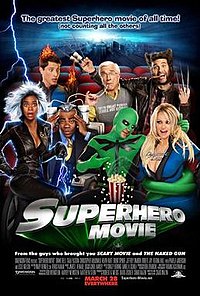
Yawn. Nothing’s more predictable than a spoof, so it had better assuredly bring some funny and hit all the right laughing notes. Nope, and you can practically tell by the movie poster, itself a rip-off of Scary Movie, that the film demonstrates a complete disregard for doing anything even remotely unique, let alone smart. One gets the feeling that they weren’t even trying very hard with the little asides and references. Aside from some rich deserved jabs at the Fantastic Four and a rather tacked on homage to X-Men, this is just a long, sad Spider-Man rip-off that would have worked just as well as a five minute sketch on Mad TV.

Reflecting that rather bland nature of the script is the even blander nature of the cast. I don’t know who Drake Bell and Sara Paxton are but they really didn’t distinguish themselves here. In the obligatory mean jock role is Ryan Hansen, who’s best known as Veronica Mars’ Dick Casablancas and will likely remain that way since he’s so non-existent in Superhero. Nielson, McDonald and Brent Spiner as a mad scientist have all done better work and couldn’t possibly seem less engaged if they tried. Other actors like Jeffrey Tambor and Tracy Morgan get thankless cameo work and even Pamela Anderson seems embarrassed dressed up as a busty Invisible Girl.

If this genre (such as it is) intends to carry on in perpetuity until Hollywood no longer bundles entirely independent productions under loosely defined categories like “horror” or “action”, then they’ve got to start doing it right. When the first Scary Movie came out, it was just a hack rip-off of Scream with bodily fluid jokes - hardly worth mentioning if it weren’t for the fact that it was a rousing success. But almost a decade later, it’s time to grow up and elevate the bar for a change rather than cranking these out on a conveyor.

Incidentally, there’s been talk of people boycotting Superhero Movie because of the actions of the Weinstein Company in stalling the release of Fanboys due to an internal debate over whether or not a storyline involving a teen with cancer was too much of a downer. Solid, but there are other legitimate reasons to reasons to ensure people don’t walk into this thing. I say boycott Superhero Movie because it makes no qualms and no apologies about being terrible.

Saturday, 29 March 2008

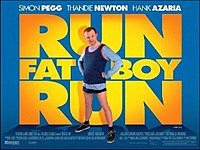
Run Fatboy Run

Rating: ***1/2

David Schwimmer’s feature directorial debut, Run Fatboy Run, could be thought of as Chariots of Fire for slacker shlubs or a comedic Rocky for runners. Sure that doesn’t sound like a compliment but it is, because Fatboy is a wonderful new entry into the comedic sub-genre of loveable loser films. And not only is it delightfully hilarious, but it’s got heart to boot. With a charming cast and smart writing, this is one of my favourite comedies of the year so far, a truly enjoyable underdog story with that manages to be funny and sincere.

The titular tubby is Dennis (Simon Pegg), a mall security guard living a charmed life after leaving his pregnant fiancé Libby (Thandie Newton) at the alter. Although their marriage went up in smoke, Dennis is still active in the life of their son Jake (Matthew Fenton), while being content to not even think about the reasons why he ran like a bat out of hell from his wedding day. But all that changes when Libby starts dating Whit (Hank Azaria), a business executive and fun runner. After taking some ribbing from Whit, Dennis decides that he himself will run an upcoming marathon to prove to everyone that he is capable of finishing something he starts.

Now we all know that Pegg can play the buffoon as well as a hardcore action star, but Fatboy proves that he can also be a romantic lead as well. True that Shaun and Dennis have a lot in common: they’re not self-starters, they’re barely self-reliant, even the word slacker doesn’t seem quite adequate enough. I will say this though, at least Dennis shows some sign of improvement by the end and he didn’t even have to survive a zombie apocalypse. But the fact is all the actors are great. Thandie Newton, who always seems kind of passive no matter the role, actually shines as the girl everyone wants. Azaria, meanwhile, is appropriately smarmy and borderline jerkish as Dennis’ romantic foil.

Now granted, Fatboy treads a lot of the same trails blazed by a lot of underdog romantic comedies: the loser versus the winner, the showdown, the montage, that last moment of self-doubt. But hey, it’s all in how you play it. Do you still root for the hero? Are you still involved in his story? And especially in this case, are you laughing at the onscreen antics? In the case of this film the answer is ‘Yes’ to all three. You cheer for Dennis and you boo Whit as he gets progressively less appealing as the film goes on. You also enjoy the antics of Dennis’ friend Gordon (Dylan Moran), who bets the farm on Dennis with his gambling buddies. Not to mention Mr. Ghoshdashtidar (Harish Patel), Dennis’ landlord who’s always handy with a spatula against the thighs for motivation.

And finally, hopefully without spoiling anything, I liked how the movie ended. Which is kind of as expected but there’s a unique half-twist that I think makes it worthwhile. Basically, the moral of the day is that one grand gesture can’t wipe the slate clean after a probable lifetime of karmic boo boos. It says people can change, but true change is earned not awarded. And best of all, it’s a tale told with dry English wit, so it kind of seems that you didn’t really learn a lesson at all.

Run Fatboy Run is another great entry for Pegg, who seems to be setting himself up as the English comic to go to for the new millennium. Also, this is a really great start for David Schwimmer and signals the possibility that he has a bright future as a feature filmmaker. Not bad for the guy who’s single greatest cinematic contribution before hand was The Pallbearer. You’ve come a long way Ross Gellar.

Friday, 28 March 2008

21

Rating: **

There’s not much to say about 21 other than it comes across as Ocean’s 11 Junior with Kevin Spacey as a cruel and calculating Danny Ocean and Laurence Fishburne as a more deranged and hardcore Andy Garcia. But then presenting card playing as some kind of exciting spectator sport represents a huge problem to be overcome for the average filmmaker; even in Casino Royale where the whole point is a card game only about 15 minutes is spent playing it. And if the seeming glamorization of cheating while gambling isn’t enough, there’s always a timely lesson about how these two things are the best way to eliminate your student debt.

Ben Campbell (Jim Sturgess) is a working class lad at M.I.T. looking for the money to pay his way through medical school, preferably a highly sought after scholarship. Ben comes to the attention of Math prof Mickey Rosa (Spacey), who runs a card-counting crew of M.I.T. students. They journey to Las Vegas every weekend, and using a co-ordinated system, they turn the tables on the house at the Black Jack tables. Of course, it’s not too long before Ben realizes that despite the ungodly sums of money he’s making, he’s way in over his head. Meanwhile, Ben’s come under the scrutiny of an old school security expert (Fishburne) who has a history with Mickey.

Partially based on a true story (what isn’t these days), I was struck at how fake the movie seemed; it was more like some kind of jokey episode of Dawson’s Creek at times. The lesson is never trust anyone over 30, since all the younger characters are genuine and mere pawns in the Vegas scheming of the adults, while Spacey and Fishburne are manipulative and mean. You know they’re both bad ass because they’re smokers and Fishburne smokes in the security office in clear violation of local and state laws on the subject. Take that!... All you health mongers that have the audacity to create healthy work spaces.

The real problem with 21, aside from all the card playing, is that you don’t really see the consequences of Ben’s hard living lifestyle and you don’t see any sign that Ben has actually had some sense and street smarts beat into him by Fishburne’s brass knuckles. I mean hasn’t he seen a movie ever, doesn’t he know about double crosses and how in this line of work he’s in, no one is as they seem? Maybe it’s because Ben only has eyes for team mate Kate Bosworth, who really needed to be more of a femme fatale to make the film more interesting. What I don’t get is: were they trying to make the film as realistic as possible? Because I didn’t buy it.

There was no tension in the film. Even when there was risk I didn’t feel like there was any risk. With no tension from the probably false assumption that casinos poo-poo card counters with a smack to the face and warning, we are left with the mind numbing excitement of watching people play Black Jack. Granted, the game is easier to follow for the gambling layman than poker or whatever, but that doesn’t make things more fun to watch. Frankly, I don’t understand the poker tournament phenomenon on TV, I can’t be bothered. How can you sit there and watch someone play cards? It’s not like you can cheer them on. “Hey Jimmy! Draw an ace! Draw and ace!”

Unfortunately in 21 you’re supposed to be cheering for the bland MIT kids, when what you really want to see is a showdown between Spacey and Fishburne. Spacey is slick and Fishburne is bad ass, but I knew these things already and these guys can fight that fight in their sleep. The safe bet on 21 is to wait for it on DVD.

Monday, 24 March 2008

The Savages

Rating: ****

Something about The Savages appeals on a level you can only connect with if you have a sibling. That love them and hate them dynamic that makes you appreciate someone for their support but deride them for being a pain in your butt, while realizing that at once you both need them and would sometimes do anything to be rid of them. Sad but true. The battling Savages are the epitome of this in Tamara Jenkins’ tragicomedy of (nearly) the same name. Anchored by three great performances, The Savages will make you laugh, make you cry and maybe just even appreciate those people that share your last name and a deep-seeded, familial connection.

The story follows John and Wendy Savage (Philip Seymour Hoffman and Laura Linney), two highly dysfunctional people that credit their lack of functioning to their verbally abusive father, Lenny (Philip Bosco). John is a theatre professor in Upstate New York whose Polish girlfriend is leaving the country after her visa expired, much to his disinterest. Wendy is a corporate drone dating a married man while struggling to remake herself as a playwright. They’re both forced to confront their father and their past when Lenny’s girlfriend dies and he’s unable to care for himself anymore. Moving him closer to home, from Arizona to New York, old tensions and old arguments resurface as John and Wendy must deal with the pending death of their father and the remains of his legacy.

If you like bittersweet tales of family dysfunction like Noah Baumbach’s The Squid and the Whale or the works of Wes Anderson or Alexander Payne, then The Savages is your type of bitter pill to swallow. As I said, it’s anchored by three excellent performances by three workhorse actors that never really disappoint. But working together here, Hoffman, Linney and Bosco and truly make you believe the wellspring of resentment that’s the undercurrent of the story’s emotion. Hoffman ably shows off his ability to feign disinterest as another smarter-than-thou academic. Linney is really understated and reserved in what could have been a really shrill and disagreeable part, while Bosco plays Lenny as a guy trying to cover-up a much deeper poisonous nature that he really just can’t hide.

Aside from the melancholy nature of the characters, Jenkins really works the setting to add greater and almost overwhelming bleakness to the affair. The desolate winter of Buffalo is captured in all it’s glory and manipulated through interesting camera work to magnify the isolation of the characters; as if the winterscape is a manifestation of the Savages' foulness. But aside from the great cinematography and Mise-en-scène, Jenkins is particularly savage (heh) with how the characters treat each other. It can be rather unflinching in how these supposed family member acts towards one and other, but somehow both the actors and Jenkins manage to convey the love as well.

It really is quite impressive how easily you get sucked up. The Savages has really a barebones kind of script that plumbs very current issues of child’s responsibility to their parents later in life and how the love between them is sometimes not something easy to come by or explained easily. With the compelling acting and the very realistic, vérité style of filmmaking, Jenkins overcomes what could have amounted to “Movie of the Week” style histrionics and jabs us with the unflinching truth of the emotions. There are quite a few opportunities for laughter in The Savages, but these are usually followed by a pause. Somewhere between comedy and tragedy is real life, and The Savages really captures that.

Saturday, 22 March 2008

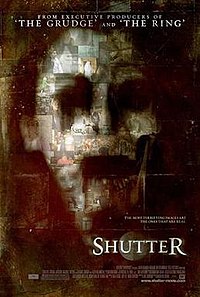
Shutter

Rating: **

If you’ve seen The Ring One and Two as well as The Grudge One and Two, plus The Messenger, Pulse, Dark Water and One Missed Call, then you’re probably going to see what’s coming with Shutter. Now the original Shutter was a Thai-made film released in 2004, as opposed to the others which were all J (meaning Japanese)-horror, but the fact of the matter remains these films all trade in a similar thematic and stylistic storytelling techniques. Consistency is fine, but a problem exists when you’ve repeated yourself so many times it gets stagnant. It happened to 80s slashers, it happened to the post-iconic 90s and it’s happening now with torture porn.

In Shutter, another newly married couple gets caught up in another ghost story. Ben (Joshua Jackson) and Jane (Rachel Taylor) are on their honeymoon in Japan when, while driving down a lonely stretch of road, Jane thinks she’s hit a young woman. There is no evidence to show that anyone was hit other than Jane’s word and the fact that the ghostly image of the same woman is now turning up on every photograph the couple takes. The clue is spirit photography; ghosts talking through pictures, and the ghost of the girl Jane thinks she ran over has a heck of story to tell as soon as Jane puts all the clues together.

This is one of those movies where I become obsessed with a nitty-gritty detail that sort of draws out my obsessive-compulsive bug. In this case it’s the fact that everybody seems to be using film cameras. Now if you know your spirit photography lore, than you are already fully aware of the fact that this phenomenon only appears on a picture that requires some kind of physical means of rendering a photograph. Thus it does not work with digital cameras. But what does everybody have now-in-days? Digital cameras.

So immediately we have an inherent contradiction at the basic nucleus of the film. Now I know a couple of photographers and unless it’s a special request from a client or a personal artistic project, they never use film anymore; they’re more or less 100 per cent digital. But what does Jackson’s professional photographer use? Oh yeah, you better believe it’s film. And what does the professional photographer at their weeding have? If you said film, you’re right. And what type of camera does Jane have? Well… she actually has a little pocket digital. But can she pick up ghostly images on it? You better believe she can.

If there’s one thing I can say for Joshua Jackson as an actor it’s that I can’t see him without thinking of his iconic role as Pacey Witter on Dawson’s Creek, which is a step up from when he started out on the Creek and all you could think about was The Mighty Ducks. In Shutter he’s kind of wooden and stilted, which is kind of the pace of the film but that doesn’t mean that the people have to be. Rachel Taylor is perhaps best known for her small part in Transformers last summer, but she won’t get a boost from this. The put upon wife is a thankless role as it is, and Taylor isn’t given much to do aside from looking concerned.

Shutter does earn a few points for trying to make things a little twisty at the end, but frankly I was unconvinced by it. It was a bad Scooby Doo ending although I did find the film’s final image a little leeringly creepy. (How apropos!) But this only came after nearly two hours of sitting through all the conventions and tactics of every one of the movies I listed at the top. Which are really, in actuality, the only ghosts that are haunting this thing in the end.

Drillbit Taylor

Rating: ***

Despite his very real and very troubling personal difficulties recently, Owen Wilson has built a kind of niche market on playing loveable losers. Like Matthew McConaughey, and to a certain extent Wedding Crashers cohort Vince Vaughn, he’s cornered a significant market share of the Peter Pan syndrome afflicted; grown men who won’t grow-up, stuck in a seemingly permanent state of arrested development. It’s an act that can wear thin (see: anything McConaughey’s done lately), but hey, you have to appreciate a guy that knows how to exploit his niche.


Wilson plays the eponymous AWOL army ranger that lives as a bum and spends all day hanging out with his bum friends. After his latest park eviction, Drillbit decides that he’s had enough and is packing up and leaving California for the “Great White North,” all he needs is 240 bucks for a plane ticket, 80 for a good winter coat and another 50 for the “federales” (meaning: Mounties). To get the money, Drillbit erroneously accepts a gig as bodyguard for a trio of high school freshmen (Nate Hartley, Troy Gentile and David Dorfman) looking for protection from a pair of high school bullies (Alex Frost and Josh Peck).

From a script co-written by Seth Rogen it should be very unsurprising that the film comes across a little as Superbad-light: the Prequel. The three-friends: Nate, Ryan (AKA: T-Dawg) and Emmett are more or less the 1.0 versions of Evan, Seth and Foggell (AKA: McLovin’). Having said that though, the high school geek is still an underserved demographic when it comes to the hero role in a comedy like this, so any effort to give them the spotlight is appreciated.

Having said that though, there is a formula at work in Drillbit and that makes it rather obvious and predictable. I mean, come on… we all know Drillbit’s going to be found out, that kids are going to have to stand up to their tormentors solo and that despite his initially selfish ends, that Drillbit will form a real bond with the boys and grow into his role as their protector. Too bad then that the movie is actually really quite funny, it makes it so much harder to hate.

It also sort of reminded me of a movie from a few years ago called Max Keeble’s Big Move in which the title character, ever the perennial dork, plots revenge on all those at school that wronged him before moving away. (Oddly enough, helping this connection is young actor Josh Peck, who plays one of the bullies here, but one of the picked on kids in Keeble.) It was bright and funny too, although, like Drillbit, not wholly original. But the point is: who cares? As long as you’re laughing it doesn’t matter. Wilson’s great, the kids are great and they are all great working together.

Like other reason comedic successes, Drillbit Taylor comes form the factory Apatow, and admittedly this is not their strongest effort. What I don’t believe however is that this is an indication of slippage on the part of an ordinarily razor sharp production house, but I can’t ignore that it could have been better either. Overall, it’s on par with Walk Hard in terms of talent and hilarity; not bank breaking funny, but still very satisfying.

Tuesday, 18 March 2008

Southland Tales

Rating: **

If ever one night you have a headache and decide to relax by watching a movie, may I kindly suggest that it’s not Southland Tales that you put into your DVD player? Director Richard Kelly’s follow-up to Donnie Darko is famously one of most poorly scored films in the history of Cannes, so much so that it took a year and a half to get the stink of that failure off before it was released however limitedly. But moving beyond matters of connectivity, the movie itself is a jumbled mess that looks awesome and does at times show signs of genius at work, but something got seriously lost in translation.

Based loosely on the Book of Revelation, or as I like to call it “The Thrilling Conclusion of the Bible,” Southland begins with a disaster and ends with a nifty time distortion of some type not really explained. Which also kind of describes Donnie Darko now that I mention it, but there you have it. The difference is that Kelly is attacking a little bit of everything with Southland: the War on Terror, the Bill of Rights, censorship, consumer culture, peak oil, you name it; if it’s a hot topic, Kelly’s spinning on it.

Dwayne “Formally known as ‘The Rock’” Johnson plays Boxer Santoras, a high profile actor and husband of the daughter of the Republican VP nominee, Bobby Frost (Holmes Osborne). Boxer has no memory as some kind of accident has stripped him of it, so he is currently shacked up with porn star/entrepreneur Krysta Now (Sarah Michelle Gellar). Meanwhile, a World War 3 vet named Roland Taverner (Seann William Scott), who’s also without memory, is being used as an unwitting pawn by Neo-Marxists to set-up Boxer and give Frost a political black eye.

With me so far? And I haven’t even got into any of the stuff involving Justin Timberlake as another Iraq vet that sits on a sniper post on top of a restaurant in the Santa Monica pier (he’s also the film’s narrator). Also, there’s been nothing told about ‘Fluid Karma’ and its dual use as a limitless energy source and hallucinogenic drug. Then there’s all the stuff about a ‘tear in the fourth dimension,’ which, when revealed, just made me cringe because it obviously looked like Kelly was intentionally revisiting Donnie Darko.

And sure, Darko was trippy, dippy fun that made you scratch your head while saying ‘This is awesome!’ but the thing of it is that Southland fails to make that connect despite the staggering similarities, and I think that’s what got a lot of critics upset. The problem here is that the story is too sprawling; too many characters, too many B stories, not enough focus on any one thing.

Darko benefited from having the theoretical scientific philosophy stuff confined to one character, it made the journey much more unique and much easier to accept. But in Southland you’re dealing with more than prophetic warnings from Frank the Bunny and obscure books by ‘Grandma Death’, there’s a whole pseudo-alt-history of the world you have to wrap your head around all while keeping the two dozen plus characters straight in your own mind.

Of course, this doesn’t do the actors any favours. Johnson is a fairly compelling actor, I would even say that he’s the De Niro of pro-wrestler turned actors, but the ambiguity of the movie does him no favours. Characters may not know where they fit into the world, but they need some kind of direction and I think that poor boxer didn’t have that.

Also impressive was Timberlake, but I feel like a lot of his character’s story was left missing somewhere. His pantomime to The Killers’ “All the Things I’ve Done” was a slice to watch, but there was little context. It was on of those scenes where you’re in awe for a minute and then things switch up to the next scene and you’re back at square one with a movie that’s showing you pretty things and not saying much.

But the film looks great though! That extra time and money for special effects really paid off. And it should be noted that in the midst of any tantrums about how Southland Tales doesn’t make a lick of sense, there are a few things worth pointing out. First, this may be a case of getting more out of a film on repeat viewing, but still I remain firm in the opinion that a movie should make some kind of sense the first time around.

Also, I don’t think that there are as many filmmakers that are as challenging as Richard Kelly, his movies have more ideas per minute than some can sustain thought their entire running time. It’s for these reasons that didn’t give Southland Tales a failing grade.

Sunday, 16 March 2008

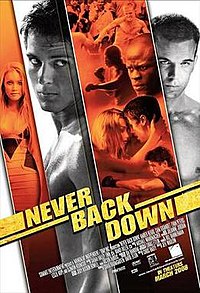
Never Back Down

Rating: *1/2

Remember in the 90s when there was that cartoon called James Bond Junior, which featured the super-spy’s teenaged nephew who was backed up with gadgets by his best bud I.Q., who was the original Q’s nephew. They also hung out with Gordo Leiter who was supposedly the son of CIA agent Felix Leiter. While not that contrived, Never Back Down sort of brought JBJ to mind for me. And though I’m pretty sure there’s some kind of demented brilliance to this film, which I like to call Fight Club: Novice League, but ultimately it’s as hollow as a used pair of gloves. I’ve seen stuff with more drama on the Internet.

The film follows rebel without a clue Jake Tyler (Sean Faris), who moves from his hometown in Iowa to a new life in Orlando along with his widowed mother Margot (Leslie Hope) and his tennis prodigy brother Charlie (Wyatt Smith). At his new school, Jake gets an eye full of the beautiful and vivacious Baha (Amber Heard), who invites him to a party held by local bad boy Ryan McCarthy (Cam Gigandet). But it’s a set-up. Ryan just wants to fight Jake, who as a reputation as brawler thanks to a football tussle at his old school. After getting whomped by Ryan, Jake decides to that he needs to up his skill set and seeks guidance from local recluse/mixed martial arts master Roqua (Djimon Hounsou).

Yawn. At least the film has an entire cast of beautiful people to gander at. But seriously, you know you’re in trouble when the movie sells itself as a prime example of mixed martial arts, only to be disclaimed as presenting an inaccurate representation of the sport at the centre of the film. Phew. You see that sentence? It would be considered too smart to be read aloud in this movie. Further, the writer, whose sole remaining credit is Homeward Bound II, seems fine with the idea that the audience is just as comfortable with the cliché as he is. How many times does a good looking outsider fall for the girl of the local bully, only to steal the girl, make enemies with the jerk and have to fight back to prove who’s the man once and for all?

I’d like to say that this is Karate Kid for the You Tube age, but that’d be giving it too much credit. There is something interesting going on with Djimon Hounsou as the master martial artist haunted by memories of home, but who cares about building character when you can throw up another phat montage sequence; a narrative device in sports films that was stale long before Team America: World Police. It’s a wonder I didn’t shut this off out of boredom, the thing is so predictable. Where’s the originality? The fact this is mixed martial arts instead of street brawling? The flash in the pan celebrity of You Tube? Being a fly by night Ralph Macchio? This thing isn’t even worthy of Next Karate Kid starring Hilary Swank.

There’s no menace, there’s no skill and there’s no talent. What am I supposed to take away from this? Amber Heard is hot? Duh. Sean Faris can’t act? That’s an understatement. Cam Gigandet is a silly name? Well, that’s not what I was thinking of. More like, this guy will never live down the fact that he played the Marissa-killing Volchok on The O.C. People scoffed at Step 2: The Streets, and the people like me that gave it a passing review. But believe you me, Never Back Down makes Step Up 2 look like the upcoming Stratford production of Caesar and Cleopatra starring Christopher Plummer. But, you know, with awesome fights.

Saturday, 15 March 2008

Dr. Seuss’ Horton Hears a Who

Rating: ****

Despite being some of the most beloved children’s books ever written, the stories of Dr. Seuss do sometimes translate badly to other mediums, particularly if they’re live action and starring big-screen comedians in the title role. Which is why the filmmakers of Horton Hears a Who were smart right off the bat: they decided to do it animated and keep Jim Carrey (The Grinch) heard and not seen. From the creative team behind Ice Age and Robots, Horton is a fantastic family film that will appeal to one and all.

Horton (Carrey) is an elephant living an idyllic life in the jungle. While minding his own business one day, his attention is drawn to a floating speck from which he swears he hears someone yelling for help. When the speck lands on a clover, Horton takes it upon himself to protect it as he finds out that the speck is actually the vibrant world of Whoville, run by the cautious Mayor Ned (Steve Carrel). While the Mayor struggles to convince the Whos that there’s a doom coming, Horton has to beware of elements in his jungle, namely an overbearing Kangaroo (Carol Burnett), who believe that Horton’s overprotective behaviour towards a speck is subversive in some way.

I think that the key to Horton’s success is that it is an organic extension of the book as opposed to, say, The Grinch, which loaded the story with numerous subplots that just take away from the main story. Then, at the same time, it overloaded the central theme to the point where it feels like the story’s message is being drilled into your head with the proverbial jackhammer. Horton’s focus is to tell a good story, and the extension fits naturally with the original text combining a Disneyesque quest with Looney Tunes zaniness.

Carrey, in what is surprisingly his first animated feature, spares the mugging and is rather quite genuine as Horton. Burnett as the misguided Kangaroo is a good foil, like one of those school teachers that chided you over the dangers of daydreaming rather than focusing on matters of “reality.” A more cynical person may say, “What was her problem any way, even if Horton was delusional?” But not me, I just rolled with it. Other voices include Will Arnett as the vicious vulture Vlad, Seth Rogen as Horton’s mousy friend Morton and Amy Poehler as the wife of Whoville’s mayor.

But aside from the typical buffoonery and inspirational lessons about how a person’s a person no matter how small, Horton revels in just being fun. I really like a couple of sequences where the movie steps outside of itself and embraces other artistic forms in a pair of cut away looks at Horton’s subconscious. Once tipping the hat to the classical Seussian look as Horton visualizes the Whos and then again as Horton sees himself as an anime hero fighting off monkey hordes. With other absurd touches like a cookie-baking bunny also named Vlad, ensure that Horton has more than a touch of the unexpected.

Surprisingly funny, narratively enjoyable and clearly well made and crafted to perfection technically, Horton Hears a Who is an animated gem that does justice for Dr. Seuss for a change. It’s a treat for the young and for the young at heart; a colourful adventure that proves once again that sincere often works better than snarky.

Friday, 14 March 2008

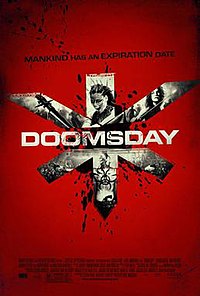
Doomsday

Rating: **

There’s no way to enjoy watching someone so obviously talented fall flat on their face; with Doomsday, writer-director Neil Marshall comes down after a staggering trip following two pieces of modern horror genius: Dog Soldiers and The Descent. In this case I can understand the appeal after all, the story has all the ingredients to be bawler of a picture for a key demographic: the youngins. Unfortunately, they may be stupid enough to fall for it, and unfortunately for me I wasn’t able to. This movie is profoundly messed up and I don’t mean that in the good way when referencing a horror movie.

Taking place in a futuristic England, 25 years after a deadly plague force the government of the UK to wall off Scotland from the world, Doomsday treads some very familiar ground. When the virus reappears in downtown London, the government dispatches a crack team to penetrate the Scottish border, find a group of known survivors and locate the man they believe to have cured them. Naturally, things go horribly wrong when the team is ambushed in Glasgow. Future Scottish society, it seems, will be split into two separate, but equally important groups: the goth-punks that rule the cities and the medieval kingdom that controls the rural areas.

So, Doomsday’s a good title, but I think that Resident Mad Max Cannibal Holocaust of the Rings 28 Weeks Later would be better, though a little wordy. There are times that the movie feels like it could have been made by anybody who had ever been to a cinema, let alone a highly talented filmmaker like Marshall. From the Road Warrior antics to the bizarre Medieval Times Dinner and Tournament meets Gladiator interlude, Doomsday looks more like a You Tube trailer mash than a movie; even the leading lady seems like a pale imitation.

But for some strange reason the movie actually started out as good, oddly compelling even; I wasn’t sure where it was going but it had to be someplace good. Marshall makes a critical error in that he compounds the insanities one on top of the other under the presumption that since we’re here, we’ll just go along with it. It could be the creepy cybernetic eye of Rhonda Mitra’s character or the usual faceless drones that make up the marine and medical team of coffin-stuffers (or is that barbecue?), but frankly I think the film goes off the rails with the goth-cannibal-punks, Lord of the Dance strip show in kilts.

And oh, my poor head! The logic of this thing boggles my mind. Generally if I want to be this confused I’ll read Doc Jensen’s Lost column at ew.com and try to wrap my head around all the suggested literary allusions. Like how does a newly opened cellphone work in a post-apocalyptic waste land without a SIM card? Why would the British government hide a blue 2008 Bentley Continental GT with a full tank of gas, in a military bunker, while in the midst of a pandemic crisis? I’ll spare you the general psychosis of the ending except to say that if you made it that far without being offended, you’ll definitely be thinking twice.

Having said all that though, Marshall directs the action well and creates some genuinely adrenaline filled sequences… that is if I didn’t all ready seem them in every Mad Max made by George Miller to date. Usually this kind of blatant rip off is saved for utilization by our old friend Paul W.S. Anderson, who loves nothing more than stealing other people’s material when adapting other people’s material. Maybe Marshall thought it was homage, I don’t know, but ich bin unimpressed.

Monday, 10 March 2008

Paranoid Park

Rating: ****

There’s something bizarre about a skateboard movie. The principle characters, who are normally skateboarders themselves, would never be so droll to presume enough self-importance to think they were worthy of being the centre of the story, and worse still, they wouldn’t care. A very sanguine subject matter the existence of a skater, and any movie also faces an uphill battle in trying to capture the fluidity and skill of actual skateboarding. (I know from personal experience how difficult that can be.)

Enter: Gus Van Sant. Once a Hollywood wunderkind on the rise thanks to efforts like To Die For, Good Will Hunting, and the shot-for-shot redo of Psycho, Van Sant has gone deeper into his indie roots as of late, experimenting with a much more intimate type of cinema using minimalism on set as well as inexperienced actors found through social networking sites like MySpace. Interestingly, Van Sant’s new laissez-fair type of filmmaking is the perfect fit for this adaptation of Paranoid Park, a story about a young skateboarder that gets in over his head.

Van Sant’s native Portland, Oregon is the setting, more specifically O’Bryant Square Park in Portland’s downtown area, a frequent hub for the homeless and those seeking to engage in criminal activities, hence its nickname: Paranoid Park. The desolate, post-industrial landscape of the area around O’Bryant reflects the sort of Spartan nature of the movie and the seeming emptiness of the main character. With a monochromatic colour scheme, Van Sant seems to draw attention to an alarming kind of neutrality in Alex, the movie’s main character.

The story, such as it is, tells of how Alex (Gabe Nevins), a typical disenfranchised high schooler, that heads to Paranoid Park in order to impress some of the older kids that skate there. Once there, Alex sneaks away with guy he meets there to a nearby train yard where they start riding the freight trains only to attract the attention of a security guard. In the struggle, Alex pushes the guard who falls across the next track and is killed, ran over by a passing train. Alex, feeling the guilt of what transpired ditches the evidence, his skateboard and clothes, and tells no one of what transpired.

The key to the film is understanding that it is not narrative per se, but rather Alex’s various attempts at reconciling what happened in his own mind. It takes a while for the viewer to realize that the story unfolding is not events as seen, but rather events as spun in Alex’s head. At first he doesn’t want to admit his involvement, but he soon comes to recognize his complacency. At the suggestion of his girlfriend Jennifer (Taylor Momsen), or is that “would-be-girlfriend,” he writes down what’s troubling and it’s not until later you realize that all the scenes of Alex writing are him trying to tell the story again.

This fascinating blurring of the lines between event and memory makes Paranoid Park such an interesting film to watch. It demands attention and if you don’t check yourself as the story unfurls, you’ll find yourself constantly trying to catch up. The nihilist approach to the story suits it, and I don’t know if the young actors are playing dull or actually are dull, but it works in favour of the movie and adds to the air of realism Van Sant’s trying to convey.

While Paranoid Park may be of an art house kind of flavour, it glides nicely along as an engaging, though occasionally challenging, story about confused morality. And to top it all off, Van Sant work wonders in capturing the skateboarding aesthetic; sometimes it seems as though they mounted the camera person on a board and let him rip. Brilliantly and efficiently small scale, this skate park is open to everyone.

Saturday, 8 March 2008

The Bank Job

Rating: ****

Like a lot of action actors, the same rules apply: put Jason Statham in the right roll and he’ll shine. Now Statham’s not necessarily a good actor, or even a typical leading man, but I will say that he’s compelling and his charisma shines through even when he’s at the centre of some of the worst kind of dreck. And also… you’ve got to love that voice, it’s like English Darth Vader with a throat infection. Well Statham finds a niche in The Bank Job, a wicked heist movie that’s more about the criminals than the crime.

Apparently based on a true story, The Bank Job referenced is a break-in to a London vault that holds the safe deposit boxes, in which a number of less than scrupulous Londoners hold their blackmailables. One box in particular holds some rather scandalous photos of a member of the Royal family in a three-way, a bargaining chip for black power front man Michael X (Peter De Jersey). Former model Martine Love (Saffron Burrows), through her lover, a MI-6 agent (Richard Lintern), brings the job of recovering the photos to career criminal Terry (Statham) and his crew. Complications ensue as the heist doesn’t go according to plan.

The Bank Job seamlessly spins a web of deceit, intrigue and political turmoil while juggling a large cast of characters each with their own motivations and counter offers. Fortunately, it’s easy to keep up with the various and crosscutting developments. Unlike say Ocean’s Eleven, the film doesn’t fain the fact that these are dirty people doing dirty deeds; on the gritty streets of London, you are as advertised. The film at first seems to play against that, but when the fallout of the heist catches up to the gang and the real villains find out, they are truly in deep Barney.

Also separating The Bank Job from other heist pictures are the characters, everybody has their own motivation and the fun is watching all these radically different people crash into each other over what should have been a matter of easy money. Stratham balances things really good; he’s not a typical tough guy in this, he’s a family man with ambition to do right by his wife and girls. The rest of the all-British cast is equally impressive, a joy to watch interacting as they either bungle through the robbery or bungle through the pursuit of the robbers depending on the side they’re on.

Fast-paced, action-filled and at times even a little funny, The Bank Job does a wonderful job of sucking the audience in and getting them to follow along in what is probably a pretty improbable set of circumstances. But then again, truth is stranger than fiction and if there’s one thing that this Job is, it’s strange. A great vintage look, an accessible type of grittiness, tart English dialogue and a compelling leading man all combine to make this a movie that’s rather difficult to resist. One could almost say it’s a steal, but no me, do buy your movie tickets.

Friday, 7 March 2008

10,000 BC

Rating: **1/2

Sometimes you trust your friends when they tell you that something is worth your time and on other occasions you ask yourself why you bothered listening. Such is the case with 10,000 B.C., a journey into man’s distant past without the benefit of a road map and ice scrapper. What were you expecting from the man that gave us Independence Day, The Day After Tomorrow and the Godzilla remake? you might be justified in asking. Not a damn thing, I answer, but like the hero’s journey in 10,000 B.C. you sometimes just go without knowing where you’re going to end up.

Set up like a typical Joseph Campbell arc, but dumber, the movie tells the story (with the soothing narration of Omar Sharif) of D’Leh, (Steven Strait) a young mammoth hunter living in the mountains of somewhere on Earth in the year 10,000. As a child, D’Leh’s father left the tribe on a secret mission, leaving his son under the care of master hunter Tic’Tic (Cliff Curtis). Poor D’Leh has to become the tribe’s new top hunter so that he can battle the reputation of his father’s perceived abandonment and win the girl of his dreams, Evolet (Camilla Belle). But soon, dark riders arrive in their camp and kidnap most of the tribe including Evolet. Now, D’Leh must man up and rescue the girl while defeating an evil empire.

This is one of those reviews where I’m going to be taking things rather literally, exactly as the filmmakers didn’t intend things to go down. First of all, I want to ask the pertinent question: Exactly where the hell is this supposed to take place? Because I have no idea. It starts out in snow covered mountains where winter seems unending. When Evolet and the others are captured, D’Leh and Tic’Tic pursue them crossing their home mountain range, journeying through a precarious rain forest before having to trudge through an unforgiving desert… by foot. Basically given the landscapes, it seems as if they walked in a big circle around the European and African continents rather than going from point A to point B.

Secondly, it’s hard for me to enjoy the hero’s journey when the hero is a whiny little bitch. I know Luke Skywalker did his share of complaining whether it was not going being able to go to Tosche station to pick up some power converters or writing off Han Solo’s ride as “junk,” but D’Leh takes things to a whole other level. Dude, I know they took your girl, but a little respect for the fact that they also took like three-quarters of your tribe as well. I, at times, had visions of the trailer for the upcoming animated film Kung Fu Panda, and was generally surprised when Tic’Tic didn’t slap D’Leh like Homey the Clown.

But seriously, could these bad guys be any more lame? D’Leh’s whining would be hard enough to take, but the fact that the bad guys are a loose collection of non-descript thugs that speak in grunts (as compared to the perfect English of the tribe’s people) makes it worse. Oh, and Roland Emmerich, thanks for beating me over the head with the inference that the head evil dude was from Atlantis I was only able to pick that up on the third go-round. And I’d think that the guy that made Stargate would recognize that the monster pyramid being built by the baddies for some as yet unexplained reason was about 5,000 years ahead of its time.

Okay, so now I’m being petty. Truth of the matter is that 10,000 B.C. is competently made with some very impressive special effects. And I guess as long as you aren’t thinking too hard on all the logical fallacies, you should be able to enjoy yourself without a lot of fuss. And in spite of its faults, there is always a good time to be had in watching primitive man (no matter how cleaned up he may be) whomp the crap out of each other. I, however, for the most part was underwhelmed. I guess Emmerich still needs time to evolve a better blockbuster.

Sunday, 2 March 2008

Penelope

Rating: ***

The key problem with the film Penelope is that it assumes that Christina Ricci can be hideous even if she’s wearing a prosthetic pig nose. I know that fantasy films require a certain degree of suspension of disbelief, but seriously, I just can’t buy it. At times, Penelope can be funny, whimsical and just a little bit off kilter. But at other times it feels like its trying too hard; like it’s trying to out quirky the competition. Realistically, the film should have worked better than just okay, but it finds enough oddity in its star power to achieve some success as a modern fairy tale.

Penelope is the sum of a curse placed on a wealthy family that deemed the first daughter born of the Wilhern family will have the looks of a pig in retaliation for the mistreatment of servant girl years before. Penelope’s mother (Catherine O’Hara) is utterly cautious about letting anyone have a look at her daughter, even the blue blooded suitors she’s recruiting to marry Penelope and lift the curse. Naturally though, when the men see her face-to-face they run the other way, until one day a single man named Max (James McAvoy) looks to be a promising possibility and inspires Penelope to come out of her shell.

Part fish-out-of-water story and part Cinderella tale with a twist, Penelope plays like the filmed love child of Tim Burton and Wes Anderson. The sets are immaculately designed, especially Penelope’s bedroom, which is filled with relics of a childhood lived inside away from the eyes of everyone except those that live in the house. The film is shot with mellow tones highlighted by rich colours that boldly standout on screen from the rest of the action. And let’s not forget the quirky characters: Richard E. Grant’s put upon dad, Simon Woods over-reacting Edward and Peter Dicklage as an eye-patched journalist out to get Penelope’s mom back for taking his eye years earlier.

Unfortunately, while the movie occupies itself with looking cool and acting cool, a lot of it seemed forced to me. A lot of the plot felt standard, not unoriginal per se but definitely uninspired. You can practically guess in advance that when Penelope goes public, she becomes a media darling, just as you know that Max is going to be her true love in the end, no matter how many hurtles are thrown up between the girl with the pig nose and the man with a gambling problem. It’s too bad then that while Ricci exudes easy naivety and charm, McAvoy seems so entirely disengaged from the material it makes you wonder why he took this gig.

Naturally, there’s a twist near the end that caught me by surprise in the way of how utterly anti-climactic it was. If this is a fairy tale, where’s the moral lesson? Where’s the comeuppance for the haters? And why are Edward’s parents forcing a marriage between him and Penelope? Some stuff goes unexplained and some stuff just goes. But it all comes down to the fact that Christina Ricci isn’t ugly – even in a pig nose, which the make-up designers seemed to go to great lengths to delude the aesthetic impact of.

Bottom line is she makes it work, and I suppose in the interest of benefit of the doubt I can go along with supposing she’s ugly. But seriously, I’ve seen Maury Povich’s show. I know what else is out there. A pig nose is the least of your concerns, especially when the rest of her looks and sounds like Christina Ricci. Penelope had method and opportunity, but unfortunately no motive.

Saturday, 1 March 2008

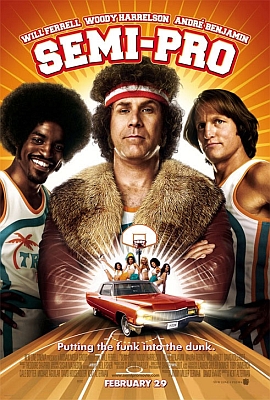
Semi-Pro

Rating: ***

I guess Will Ferrell just won’t be satisfied until he’s played every sport for comedic effect. After soccer, car racing and figure skating, Ferrell’s worked his way up to basketball with Semi-Pro, the semi-true story of the ABA’s absorption into the rival NBA in the 1970s. And while its true that four teams were taken in by the NBA, one of them wasn’t, nor was ever going to be, the Flint Tropics, because they did not exist. Gathering together a group assembled from the usual gang of hotshot comedians the Flint Tropics come to hilarious life in a story that says it’s okay to aim for number four.

The year is 1976, and Jackie Moon (Ferrell) has taken the profits made off his hit single “Love Me Sexy” and bet it all by being owner, coach and star forward of the Tropics out of Flint, MI. The Tropics are on the list as one of the teams that will not be absorbed into the NBA at seasons’ end, but a little thing like that is unlikely to dissuade Jackie Moon. So he proposes that the best four teams make the cut, and begins to shore up his team so that they can make a serious run for fourth place or better. He brings former Boston Celtic Monix (Woody Harrelson) to help steer the team, which includes star player “Downtown” later “Coffee Black” Clarence (Andre Benjamin).

The film also stars Will Arnett, Andy Richter, David Koechner, Kristen Wiig, Rob Corddry and for some reason Jackie Earle Haley. They’re all totally dedicated to the on screen insanity, and have actually all worked together enough to get their comedic timing down pat. Overall, Semi-Pro falls somewhere between Anchorman and Talladega Nights on the Ferrell charts; funny but not really revolutionary. The film is saddled by a couple of things, first, there are the trappings of the sports movie genre and second there are the trappings of the Will Ferrell movie genre.

Like any other sports movie, Semi-Pro comes down to a big game where the superstar learns the value of teamwork and the team learns the value playing for personal glory rather than material fulfillment. A last minute inspiration leads to a signature movie that allows the home team to get a leg up on their more talented competitors, in this case the “Alley-Oop”, which according to Semi-Pro came to Jackie Moon in a vision of his dead mother (played by Aretha Franklin). As for Ferrell himself, you can expect the same old: wacky and stupid antics done with the type of fearlessness rarely seen in movie comedy. He gets naked, he sings, he makes an ass of himself, he subjects himself to crotch shots, he’s all over it.

With nothing original, the film itself had better provide the laughs in good measure. Fortunately, Semi-Pro delivers some serious comedic chops and is laugh-out-loud on several non-consecutive occasions. For Ferrell fans this is a definite can’t miss and for comedy fans generally, I think you’re assured a semi-good time to say the least.