Friday, 22 January 2010

Legion

Rating: *1/2 stars

Legion begins and ends with the same bit of narration. The lead character Charlie (Adrianne Palicki) relates a story her mother told her about a prophesized time when God would pull the plug on humanity and wipe out the whole lot of us, which, I can only imagine, is not the best bedtime story to feed a kid. Anyway, the young Charlie asks her mom why God would suddenly chuck his bolt and decide to be done with the human race after investing thousands of years in us. "I don't know,” Charlie’s mom said, “Maybe He was just tired of all the bulls**t." Conforting. But sadly this little bonbon is an indication about how much thought the filmmakers put into Legion.

Legion is a muddled mess that barely even pays lip service to Biblical lore in telling an overtly Biblical tale. Sure, it’s set in a desert and the things being fought, were told, are angels, who are under the command of God to slaughter each and every one of us, but there are several inescapable plot holes. First, why are the angels acting like zombies? Two, why was the old lady from the trailer so demonic in look and action? Three, what was it that made God say “that tears it” in regard to the human race? Question four though is in regards to Charlie’s unborn child. The one that the former archangel Michael (Paul Bettany) says is going to be humanity’s new saviour. Uh, didn’t God get the memo that this new messiah was on the way?

Populating this world of half-assed plot development is a rather sterling, though ultimately wasted, cast of actors. Dennis Quaid plays the atheist, the guy that says that he doesn’t even believe in God and He can shove his apocalypse. Charles S. Dutton plays his best friend the Believer, so naturally he’s one of the first to die. Tyrese Gibson, well, I’m not sure what the deal with his character was, but he was packing heat anyway. And Lucas Haas plays Jeep, the slow-witted young fellow who loves Charlie deeply even though she can’t return those feelings (I also assume that he’s an unknown relation of Sarah Palin given the low IQ and ridiculous first name). Basically, it’s every stock character known to screenwriting for a post-apocalyptic stand-off movie; sans a rendition of “Spirit in the Sky” on the soundtrack.

Now normally I’m a sucker for stuff like this, even lousy PA (or post-apocalypic) movies have escapist value. But Legion was just infuriating for its unanswered questions, and it’s seemingly reckless disregard for crafting a coherent story. I can only assume that this is a story that the filmmakers were sitting on for so long that they knew it backwards and forwards enough that they thought they could ditch the little details, like the Harry Potter adaptations. I’m no Jerry Falwell by any stretch of the imagination, but it seemed like the whole religious angle was either a convenient framework for a zombie movie, or everybody was just too lazy to do even a Wiki search level of research in the subject matter. Perhaps most damning (pun intended) is that this came out about on the heels of The Book of Eli, which is PA done right. I know that Armageddon is en vogue right now, but event direct-to-video stuff is more lively, not to mention inspired, then Legion.

Saturday, 16 January 2010

The Lovely Bones

Rating: ***1/2

Much has been made of the box office showdown between filmmaking titans Peter Jackson and James Cameron given that their latest films opened in fairly quick succession. But really, comparing The Lovely Bones and Avatar is like comparing apples to an apple explosion crumb cake doused in whip cream, topped with strawberries and garnished with three lit sparklers to create a dazzle effect. Watching Avatar and now The Lovely Bones is like seeing a gold medal hockey game and then watching game one of the World Series; both events feature players at the top of their game and giving their all in a high stakes match, but you’ve got two entirely separate enterprises with their own rules and nuances.

The Lovely Bones does not have much in common with Jackson’s best known works The Lord of the Rings trilogy and the King Kong remake, nor does it have much in common with the filmmaker’s early horror films. It is a quite unique new venture for the New Zealand director, a touching story of love’s reach after death. Although there are still some visually amazing scenes, the heavy lifting is down by actors acting and not by their interaction with computer generated beasties that were added in post. So what’s wrong with it? Well, there are, at times, some tonal issues.

The film plumbs some rather extreme emotions, but will occasionally jump from one extreme to the other. One minute, Jack Salmon (Mark Wahlberg) struggles with the powerlessness in losing his daughter Susie (Saoirse Ronan) and the difficulties in relating to his wife Abigail (Rachel Weisz) even a year after Susie’s death. Then we meet Abigail’s mother (Susan Sarandon) who tries to pick up the domestic slack in the Salmon house with a hilarious montage of her messing up the laundry, burning dinner, and self-medicating with the scotch. For a minute there, you’re not sure what movie you’re watching: American Beauty or Ghost Dad.

Fortunately, these sort of polarizing incidents are few and far between and I just chalk it up to a trace left in the adaptation process. You can get away with grandma dancing around the living room with a cigarette hanging from her mouth following her grandchild’s death in a book, or in this case the novel by Alice Sebold. The pacing demands are different in a film because you can grasp the passage of time more on the printed page. What works in the film version of Lovely Bones is the emotion. The kind of gut wrenching voyeurism that comes in watching a family fall apart after tragedy. The story compounds that with Susie watching her family from the in-between, a kind of Heaven’s waiting room where souls undergo a process of releasing themselves from their living past before moving on.

There’s a kind of push-pull effect in the story as Jack Salmon struggles with Susie’s death by playing amateur detective while Susie watches from the in-between sometimes distracted by the wonders of her new world and sometimes haunted by her insights into her murderer. Jackson manages to keep a nice balance because ultimately it’s not the story about catching a murderer, but rather about learning how to let go and living with our own human mortality. The point isn’t how you die or if there’s anything after ward, the point is that everybody dies and it’s important to acknowledge that in spite of the tragic circumstances.

But having said that The Lovely Bones isn’t an overly weepy film, or at least it’s not depending on your susceptibility to such things. The performances were spot on with Wahlberg, Weisz, Ronan and Stanley Tucci as Susie’s killer all doing some good work. Jackson however needs to shake off his finely culled instincts for the epic if he wants to make small movies like this because he’s seems to want to go bigger than the moment calls for: bigger music, bigger effects, and bigger picture. That’s not a bad thing, but The Lovely Bones is more art house on the side street than multiplex at the mall. Regardless, Lovely Bones marks a nice change of pace for the director behind it, and a darn fine movie in its own right.

Friday, 15 January 2010

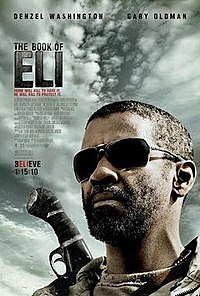
The Book of Eli

Rating: ****

You can take The Book of Eli a couple of ways. It’s a kin to Children of Men where in the hope of humanity’s future is in the hands of a single stranger running through a minefield of unscrupulous villains. It’s a Sergio Leone-like western about a man with no name, but one who’s on a righteous mission in a Godless land. Comparisons with the Cormac McCarthy novel The Road and its film adaptation are also inevitable as one man walks a lonely road westward avoiding bandits and cannibals while surviving by his wits and luck. The Book of Eli references all these things, but for some strange reason feels neither stolid nor derivative.

This gritty, violent and occasionally disconcerting tale is weaved with incredible visual flare and snappy pacing by Albert and Allen Hughes. The Hughes Brothers came screaming out of the gate in the 90s with Menace II Society and Dead Presidents, two powerful urban dramas about men on the fringes struggling to find a better life. In a way, The Book of Eli covers the same thematic ground: a man wanders the deserts of an Armageddon wasteland, driven by a voice to deliver a book to a location he knows not where, in the vague hope that the human race will find the ability to rebuild itself.

Denzel Washington plays the wandering soul, who, like the aforementioned nameless character from A Fistful of Dollars, drifts into a small town ruled under the iron thumb of petty tyrant here called Carnegie who’s played by Gary Oldman. Carnegie is a dreamer. A man that seeks to unite the last dregs of humanity under his flag, he just needs a certain book in order to do it, the one that just so happens to be in possession of Washington’s wanderer. But rather then bending to Carnegie’s will, the stranger is a much more vexing presence, and adding insult to injury is the fact that his stepdaughter Solara (Mila Kunis) takes off after the stranger to follow his example.

First you have to appreciate just how bad ass Washington gets in this movie. The actor, although never failing to enlighten, inspire or entertain, is certainly not known for his butt-kicking heroics, so it was interesting to see Washington play that part. Oldman is, of course, a natural sleaze from the top of his greasy hair to the bottom of his blood-covered boots. There’s a wicked rivalry between the two men, which gives a more complex social and political underpinning to this world that the Hughes Brothers have created, at least more so than the average after-the-end-of-the-world drama. It’s a post-apocalyptic story you can admire for its visceral, yet fantastical believability.

This balance is hard to find, just look at the recent adaptation of McCarthy’s The Road. It’s weird that a lot of the potent and poetic imagery that was missing from the movie Road was present in Book of Eli. The opening scene in Eli takes place in a dead forest as it snows ash, which is right out of some of the most powerful images in The Road book, yet strangely this was never evoked in the film version. The desolation, the desperation, the silence, all seemed kind of missing in The Road film as I remember it but is brought to depressing life in The Book of Eli.

The added bonus is that the audience gets some slick action as well and a rather interesting twist that will get you thinking after the credits roll, perhaps even to the point of catching a repeat showing. Sure, The Book of Eli is not wholly original, but in the moment of watching a really amazing gunfight it really doesn’t matter. From the awesomeness of Washington’s kung fu, to the evilness of Oldman’s wannabe preacher, the movie doesn’t fail to entertain. I’m not sure if one book can save the world, especially the book Washington’s wanderer is packing in the movie, but you will believe there’s hope for the post-apocalyptic genre.

Saturday, 9 January 2010

Leap Year

Rating: **1/2

To get through 99 per cent of the romantic comedies out there, you have to accept a couple of things. First, that the girl at the centre of the story is always fastidious or precise in a manner that’s measurable. Second, the man she’s with and/or interested is almost always bad for her. Third, the new man that she thinks is bad for her almost always ends up being the one beneath his layers of gristle and/or cynical detachment. Additionally, the story nearly always begins with some kind of ridiculous conceit: a deadline, a road trip or a mission. The talented few are the ones that can take these concepts and wrangle them in such a way to make the experience bearable, if not enjoyable.

Leap Year has a deadline, a road trip and a mission as the fastidious and precise Anna (Amy Adams) follows her foolish father’s advice to chase after her boyfriend to Dublin in order to propose to him on Leap Day. According to an Irish legend, which may or may not be an actual Irish legend, a woman can propose to a man on the 29th of February and he has to accept. The powerful bonding magic of Leap Day is just what Anna needs when Jeremy (Adam Scott), her boyfriend of four years, fails to propose after they buy a swank Boston apartment. Anna, desperate to seal the deal goes by land, sea and air to Dublin to meet up with Jeremy at a medical conference so that she can surprise propose to him on the 29th.

Naturally, following traditional rom-com conceits, Jeremy is a borderline jerk that appears only mildly interested in Anna, that is to say when he shows any interest in her at all. It should go without saying that the romantic intentions of any man that would show his girlfriend photos of open-heart surgery via his mobile device over dinner should be questioned, and questioned thoroughly. As to what Anna sees in Jeremy is never really explained, but I suppose when you invest four years in a man, simply dumping him would be like burning your own house down. Fortunately, while on her trip, Anna gets diverted by bad weather, and fate drops her at the small pub owned by Declan (Matthew Goode), an Irish bloke that prefers a tall pint of Guinness to a high-maintenance woman.

Anna and Declan’s excellent adventure across the Irish countryside is the typical, movie couples’ journey from open hostility to flirty animosity to begrudging companionship to actual friendship and romantic realization. Screenwriting Mad Libs is saved by the chemistry between Adams and Goode who snipe at each other in a believably loving way. You root for them and get somehow invested in the story despite the fact that the plot is superficial and obvious. Goode’s Declan is just the right kind of scruffy ne’er-do-well and Anna is just prissy enough that you don’t find the characters completely annoying. Which just leaves poor Jeremy, but you can live with the other man being a clueless buffoon in this instance.

The bottom line is that Leap Year in one of those rare romantic comedies where you can live with the predestined nature of the plot and the overly conceptualized characters and just take it all in stress free. Maybe it’s the season and the past several weeks of high concept, highly significant filmmaking, but there’s a simplicity to Leap Year that’s charming rather than annoying. Rather than rage against the ridiculousness of the plot or complain about the overly stereotypical nature of the battling old Irish men trading trivia at Declan’s pub, you can just sit back and enjoy. And in this way alone, Leap Year’s got the luck of the Irish working for it.

Friday, 8 January 2010

Daybreakers

Rating: ***1/2

It’s no great secret that there are a lot of Twilight haters out there, so guys, because many of you are guys, this one’s for you. Yes, post-modernism and melodramatic teen romance is for wimps in Daybreakers, a movie that doesn’t just bring back those old vampire idioms, but does it with style. Do like vampires that burn up in sunlight? Vampires that cast no reflection? Vampires that have to be eliminated with an old school stake to the heart? Well ladies and gentlemen, you just found your ride and I think it’s safe to say that you will not be disappointed. Daybreakers has everything a vampire movie needs: mood, monsters and bucket after bucket of blood.

Daybreakers posits a world nine years hence that’s been transformed by some kind of plague that started turning people into vampires. In a little under a decade, vampires have taken over and the human race is on its last legs either being sedated and farmed for their blood or on the run from ending up in such a fate. Sadly though, this isn’t a vampire Shangri-la because fewer humans mean fewer blood supplies. The price of blood is going up and the supply is being rationed, but with the horrible result of lack of blood being a monstrous mutation for the suffering vampire, society is on the brink of collapse. For haematologist Edward Dalton (Ethan Hawke), whose job is to find an adequate blood substitute, things are a little stressful.

Like a certain other vampire also named Edward, Dalton has mixed feelings about human blood and begrudgingly works on a blood substitute believing it a round about way of saving the human race by eliminating the culling and blood farming. A vampire of such moral fortitude would naturally find allies amongst the remaining humans. Enter Elvis played with winning B-movie hero swagger by Willem Dafoe. Elvis was a vampire, but accidentally cured himself and thinks Dalton might be able to help him find the answer. The solution is ingeniously simple as it turns out, but is it too late to save human and vampire? That’ll be for the sequels to decide. For the most part, Daybreakers is a compelling tale about survival on the fringes, and a fascinating look at a society gone topsy-turvy.

A world of vampires running out of blood makes for a powerful allegory be it oil, food or water. Along with that is the sneaking corporate interest as represented here by San Neill’s Charles Bromley, a Lex Luthor-like business suit that controls the largest supplier of human blood. Neill does evil right in playing Bromley as a slick tycoon that doesn’t see problems, but sees money making opportunities. For the monster maniacs there are subsiders, a mutated, almost zombie-like vampire that’ll feed on vampires once driven mad by long-term fasting from human blood. There is a lot of good bloodletting at the hands and mouths of the subsiders, so despite high-minded literary terms, horror fans will enjoy the guts that Daybreakers has.

But then again, perhaps you’ll just enjoy the central conceit of the film and the fact that it takes place in a world run by vampires. A world where you can buy blood and coffee at the subway newsstand, travel through underground walkways during daylight hours and have your car specially rigged with a series of cameras so you can drive around protected from sunlight. You’ve got to love those little details, and the film plays them beautifully. True, this is one of those futures where everybody dresses like it’s the 1950s, but for high concept on a budget, the filmmakers do a pretty decent job. The bottom line is that Daybreakers is fun, and there haven’t been a lot of vampires movies that you’ve been able to say that about, sparkle-pires and their teenage concubines included.