Saturday, 20 March 2010

The Runaways

Rating: ***

It’s easy to forget while watching her get all damsel in distressy as TWILIGHT heroine Bella Swan, but Kristen Stewart can act. Dakota Fanning, meanwhile, I used to think can act, but it seems like she’s forgotten how somewhere between CHARLOTTE’S WEB and THE TWILIGHT SAGA. Together they’re the vaguely lesbian jail bait – I mean quintessential and groundbreaking founders of the all-girl band The Runaways in the new bio-pic of the same name.

Stewart plays Joan Jett and Fanning plays Cherie Currie, who through an act of fate come together to form their breakthrough act. Currie, a disenfranchised suburban high school student with delusions of David Bowie, finds herself on the radar of famous manager Kim Fowley (Michael Shannon) shortly after he’s approached by Jett with an idea for a band that’s made up 100 per cent of musicians of the female persuasion. Contracts are signed, hits are made, and tours in Japan incite riot amongst the local fans. All of which is pretty typical of these sorts of movies.

In case the history escapes you, Currie went into a spiral of booze, drugs and sexual experimentation. You’re supposed to be concerned, but you could honestly care less if Currie flames out or fades away. Fanning doesn’t do much to make Currie likeable, and as a result the character comes off as cold, unlikable and thoroughly unengaging. Stewart is much cooler, probably because we know there’s a brighter future for Jett than Currie. Stewart also doesn’t seem to be drawing attention to herself, and whether that’s due to the nature of the character, or the coolness of the actress’ performance, I don’t know.

Regardless, the real star of the film is Shannon as Fowley. Every minute this guy’s on screen you’re engaged, you’re fascinated and you’re enthralled. Such an absolutely magnetic performance comes dangerously close to outshining the rest of the cast, which is sort of problematic when you consider that the focus of the film is supposed to be the all-girl band he’s representing. I hope that Shannon is remembered at awards’ time, as this is incredibly compelling work.

Also on the plus side is director Floria Sigismondi’s treatment of the time period. Things have a very genuine 70s feel from set design to wardrobe. And it goes without saying that the music’s incredible. I’m not sure if the real life Jett actually heard Stewart’s voice and for a minute thought it was her’s – as reported in a New York Times article – but it’s easy to see, given the way that Stewart seems to channel all aspects of Jett. Indeed, the film is steeped in the rock ‘n’ roll vibe of the period, a throwback to days when becoming a rock star that packs stadiums was still in the realm of possibilities and when people had to buy your music.

Where THE RUNAWAYS slides though is that the band’s story didn’t feel particularly worthy of its own movie, at least the way it was presented. There are a lot of typical band movie clichés including over-indulgence, temper tantrums, fallings out and reconciliations, but overall, aside from the real life aspect of the story, I’m not sure what recommends THE RUNAWAYS over other movies about bands. The film is still compelling though thanks to Michael Shannon and Floria Sigismondi’s team who brought the rockin’ 70s back to life with such wicked clarity. For this, THE RUNAWAYS is perfectly enjoyable so long as you don’t expect anything too deep besides good music.

Friday, 19 March 2010

Diary of a Wimpy Kid

Rating: ***

After all the fantasy novel series and their sequels that have been adapted with varying degrees of quality by the major studios, it’s nice to see a youth novel without any swords or sorcery getting the big screen treatment. Sadly though, DIARY OF A WIMPY KID is another example of half-hearted dedication to creating a quality film. The middle school setting and all the kids there-in I had no trouble buying, but there was something to the movie that I didn’t quite buy.

A lot of it had to do with our hero Greg Heffley (Zachary Gordon), who thinks he’s Zack Morris, but he’s really more like Screech. Greg’s sole compulsion is to secure his rightful (in his opinion) place as the coolest kid in school, though he’s concerned that his BFF Rowley (Robert Capron) might take his Q-rating down a couple of notches. The problem is that Greg is rather self-absorbed and obsessed with securing his own status, while only seeming to give enough of a damn about Rowley so that he’s not completely friendless in a world of kids oblivious to his coolness.

The story follows Greg and Rowley through the usual doldrums and dilemmas of middle school, like trying to avoid the bullying of older kids and getting marked by the dreaded “cheese touch.” Greg also has an older brother (Devon Bostick) who makes Greg’s life miserable, as older brothers are known to do. Still, Greg continues to drift blissfully on the opinion that he’s got it going on, at least until the accidental breaking of Rowley’s hand over Christmas break leads to an avalanche in popularity for the former uncool friend. And that’s when the claws come out…

As the movie wears on, it’s hard to like our hero Greg, though I’m not sure if that’s the point or just that the actor and the director didn’t know how to play things. My mind drifted to MAX KEEBLE’S BIG MOVE, a similarly themed treatise about middle school popularity starring Alex Linz. In the film, Max becomes popular after getting revenge on all his neighbourhood adversaries knowing that in a week’s time he’ll have moved out of town with this transferred father. Of course, Max gets a swelled head and loses, briefly, his less-cool friends. But with Max I got a true sense that the kids was losing grip because of his new found social status; Greg meanwhile is just obsessed with getting that status.

Still, there’s something real in that because kids aren’t perfect and are sometimes convinced of their own self-importance. Things like “the cheese touch” a cooties-like ailment that you catch when you touch a mouldy slice of cheese on the playground, have the faint aroma of truth to them. I also liked an appearance by Chloë Grace Moretz as Angie, a sound voice of reason (or conscience) for Greg as he tries to navigate his various conundrums. The film also moves along without much baggage and is entertaining enough for a few good laughs, while leaving you with little in the way of after taste (or memorable scenes).

So far as kids’ movies go, DIARY OF A WIMPY KID has enough going for it to be mildly entertaining, but almost on a purely psychological level; like how anyone that’s graduated high school can appreciate SAVED BY THE BELL on a fantasy level. It’s not perfect, and while the story presented as a series vignettes may work in the context of the book, in the movie things seemed a little too episodic as the characters went from one hijink to the next. It could have been worse, but it could have been much better too. Like a lot of wimpy kids, this movie is painfully average.

Friday, 12 March 2010

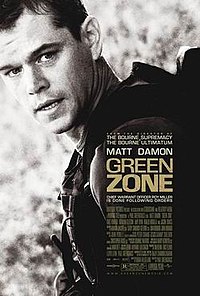
Green Zone

Rating: ****

I’m a big admirer of the book Imperial Life in the Emerald City by Rajiv Chandrasekaran. For those of us who were against the Iraq War before it was cool, it’s a soul-crushing, hair-pulling, frustrating tale of corporate greed, partisan back-slapping and one particularly disturbing episode where the one time probable Secretary of Homeland Security treated Baghdad like his own personal Westworld. The book was told in vignettes, but it painted an overall picture of how the post-war effort in Iraq went so horribly wrong. The Mess O’Potamia, if you will, wasn’t a result of one big screw-up, but rather the proverbial sting of a thousand bees.

When the book was optioned by Hollywood, I had no idea how they would turn Chandrasekaran’s book into a narrative film. Recruiting director Paul Greengrass was a good start though because his Bloody Sunday and United 93 were both detailed, visceral, near-documentary accurate dramatizations of real events. However, in the case of Green Zone, the trailers came across as kind of “Bourne Identity in Baghdad,” as in all action and no subtext. This was a rather frightening notion for me, again, because Chandrasekaran’s literary work was so powerful to begin with.

But for a minute there, I forgot I was working with professional: Greengrass, actor Matt Damon, and screenwriter Brian Helgeland. The many vantages of the book are boiled down into a single player, Warrant Officer Miller played by Damon, a U.S. Army soldier charged with finding weapons of mass destruction. As we join the action, just a couple of months after the fall of Saddam Hussein, Miller is already frustrated with the fruitless search for WMDs. He begins questioning the intelligence openly and rightly figures that if the threat was so imminent and the intel overwhelming, then his job should be going a heck of a lot easier.

Damon is really good as a patriotic soldier driven to performing duty, but is gradually coming to terms that his country may not be as altruistic in its intensions as he is. The plot unfurls convincingly without seemingly like a digestible, Hollywood version of the complexities presented in Chandrasekaran’s book. Greg Kinnear gives a thoroughly sleezy performance as typical Bush-era lackey Clark Poundstone and Brendan Gleeson does surly right as Martin Brown, a C.I.A. operative that’s been in the Middle East long enough to know political B.S. when he hears it. These three characters really perfectly encapsulate the themes and points of view from the book, and as a bonus, they feel neither plastic nor preachy.

Aside from Amy Ryan’s reporter, a kind of apologetic newspaper woman that was given access in exchange for hyping the war, the film feels real. My problem with the reporter character is that she flies in the face of what we saw, and what we still see, in American mainstream news. Those people are not sorry, and never have they seemed anything of the sort. Their current criticisms of the war seem hollow because it was non-existent before the war started and in hindsight, there was plenty to be suspicious about. Ryan’s character also doesn’t fit because she seems more pastiche than person. A plot device to give Kinnear’s Pouondstone a villain on his field.

Mostly though, Green Zone was a profoundly satisfying thriller of both the war and political variety. Greengrass blends both well by giving the thinking man the complexities of war policy and its administration to mull over, while the obligatory action scenes provide nice balance and a few explosions. But what I really appreciate is the details, the little stories and asides worked in the background to make this film a true adaptation of Imperial Life in the Emerald City. This may also be the first film about the Iraq War to transcend the partisanship, and if there’s a reason for that it’s because of the old axiom: truth is stranger than fiction.

Friday, 5 March 2010

Alice in Wonderland

Rating: ***

I knew we were in uncharted territory when Alice in Wonderland didn’t open with one of those great title sequences to Danny Elfman’s theme music that typically kick off a Tim Burton movie. Burton is perhaps my greatest filmmaking inspiration, which is why it pains me so to say that his Alice comes out into a mere ho-hum. Granted, it’s visually amazing, but I can’t say that I was whole-heartedly engaged with this take on Lewis Carroll’s classic. It seems as if Burton has spliced together the original animated Disney Alice with a tame version concocted by American McGee, all in what seems like an effort to bolster Johnny Depp’s ongoing campaign to make himself as ugly looking as possible on film.

Yes, the Bozo the Clown meets Lloyd Christmas mug of what’s supposed to be the Mad Hatter on the movie posters is indeed Johnny Depp. I can’t knock the guy’s enthusiasm, but now having completed their eighth collaboration, I think it’s time for Burton and Depp to see other filmmakers. Nothing against either of them, but Depp’s become a crutch for Burton because Depp’s an actor that Burton knows will go out on a limb. But Depp is “big box” now. His boutique days when he could get away with playing a guy with scissor hands or a cross-dressing schlock-maker while burying his movie star presence aren’t what they used to be. Sadly, Depp doing kabuki Mad Hatter doesn’t work as well as it should. For the most part.

But The Hatter isn’t the main character of this story. In this Wonderland Alice, played by newcomer Mia Wasikowska, is a young woman who’s taken to party where it’s expected she’ll be proposed to. Like Robin Williams’ Peter in Hook, she’s grown up thinking that her childhood sojourn into another world was nothing more than childish fantasy. So it’s an awful surprise to her when she sees a familiar white rabbit in a waist coat and fob watch hopping through the garden. It takes Alice a while to catch on that her Wonderland excursion was real, not that this is the Wonderland she once knew thanks to the machinations of the Red Queen (Helena Bonham Carter).

Of course this isn’t an adaptation, which is probably why the film feels like it has no cohesion beyond the stylistic. There’s a blatant kind of Lord of the Rings feeling where there’s an elaborate quest for a magical device and a final, titanic battle on a chessboard shaped field. Frankly, in this instance, the whole thing seemed rather dull and if there’s one thing that Wonderland shouldn’t be, it’s dull. Sadly, it might be the fate of these 3-D efforts, Avatar included, to suffer in the narrative while being visually very pleasing. In this case though, I can’t completely get behind the look of the film since all the digital tricks work against that Burton vibe. He’s not a boy with his toys like James Cameron, Burton’s the kid that wears 40s fashions because of his distaste for all things modern.

There is an ambition to the film that’s admirable, but Tim Burton has never been an epic kind of filmmaker. Even the little superhero movie he did (Batman) looks like a low budget indie as compared to the way summer tentpoles are made now in days. What does this matter? Because Burton’s about quirk, and quirk doesn’t cost. He’s also about character, and you don’t need motion-capture technology to make a character interesting. The difference between Alice and Burton’s past triumphs is the difference between someone singing a song and really being a performer. I can enjoy it, it can engage me, but it doesn’t really fill me up spiritually. Alice in Wonderland, as the collective name of Lewis Carroll’s literary work, is insanely adaptable with enough vibrantly weirdo characters for two Tim Burton movies. But this could have been better. And while 3-D may save the movie industry, some of us still want a good story with compelling characters. And if possible, a less scary looking Johnny Depp.