Saturday, 26 March 2011

Hobo with a Shotgun

Rating: ***

The effect of GRINDHOUSE, the Robert Rodriguez and Quentin Tarantino experiment in resurrecting extinct forms of cinema, still reverberates. Most people agree that the best part of the whole GRINDHOUSE experiment were the fake trailers in-between the feature programs. Rodriguez already took his shot when he turned MACHETE into a full-fledged movie of its own, but now, inexplicably, it’s Jason Eisener’s turn. Eisener lucked out to begin with by winning a contest to have his original faux grindhouse trailer, HOBO WITH A SHOTGUN.

Expanded into a full feature, Eisener captures the grindhouse aesthetic with ease, and the streets of Dartmouth are an easy pass for the dirty, dingy avenues of Anywhere, American urban decay. Rutger Hauer steps into the roll as the nameless Hobo, who rides the rails and arrives at Hope Town. He’s immediately confronted with all the corruption and violence of a city run by the wicked, in this case crime boss Drake (Brian Downey) and his two sociopathic sons Slick (Gregory Smith) and Ivan (Nick Bateman). When the Hobo saves a young prostitute named Abby (Molly Dunsworth), he tries to report the criminals to the police, only to find that the police are all but owned by the crooks.

So what is a Hobo to do? Well, in this instance he performs in a bum fight to get the $50 he needs to buy his precious lawnmower from a pawn shop and get the heck out of dodge. Too bad then that this is a Hobo with a conscience, and when the hoodlums of Hope Town finally push him too far, the Hobo puts his $50 on a shotgun instead, and begins to clean up the lawless town, becoming a folk hero in the process. Of course, Drake isn’t going to take that lying down, and the whole affair escalates in one bloody mess after the other.

Oh yes, there will be blood. The movie no sooner gets started when the Hobo comes across a man who ends up getting his head squash under the tires of Slick’s car, all for the apparent amusement of Drake and his gang, and done in the style of the ancient gladiator arenas. If one thing saves the scene from complete gruesomeness, it’s the fact that the victim is Robb Wells, Ricky of THE TRAILER PARK BOYS fame. But fans of blood and guts will definitely not be disappointed. There are more than a few disembowelments and dismemberments, and the Hobos shotgun never seems to need reloading.

Fortunately, the acting is appropriately over the top and well-suited to the tone of the film. Downey is especially a stand-out as the villainous Drake, who is as dastardly a villain as one can expect from something like this. Smith, made famous as the clean cut, troubled teen from the old WB show EVERWOOD, is unrecognizable underneath big sunglasses and greasy, slicked up hair as Slick. Dunsworth, meanwhile, adds at least one touch of adorableness in a morass of ugliness. She wears the worn mantle of hooker with a heart of gold well, and would stand comfortable alongside Rose McGowan’s Cherry Darling in the modern grindhouse heroine hall of fame.

The one weak link, and I can’t believe I’m saying this, is Hauer. Now Hauer’s a class act, no question, and there’s nothing wrong with his performance per se, but it’s just a little hard to shake the knowledge that you’re watching Rutger Hauer play the Hobo with a Shotgun. He’s like a sanitized version of what the character should be, with perfect teeth and a kind of Hoboish sunny disposition. In the original trailer, the Hobo was as borderline as the crooks and criminals he was blasting away with his shotgun, and looked a little deranged while doing it. Hauer never quite gets to that level, but in exchange there’s more gravitas and seriousness. The trick is I’m not sure how well that does in tone with the rest of the movie.

But by and large, HOBO WITH A SHOTGUN is B-movie goodness; gritty, dirty and filled with high energy and enough blood and guts for three normal slasher films. It should be enormously satisfying for people with fondness for vintage grindhouse, and it manages to achieve it with very little in the way of winking at the camera, or making self-referential nods. So it can be done, but the question is can it be done again? Can the new wave of grindhouse be maintained? I guess that depends on, as always, the box office numbers.

Friday, 11 March 2011

Red Riding Hood

Rating: ***

Red Riding Hood is a mess. It’s got purposefully stilted-acting, incidents of sheer lunacy, harlequin-style romance, scary scenes that are not particularly scary and gory scenes that are not particularly gory. But having said all that there’s some kind of magic at work here by director Catherine Hardwicke.

The (kinda) modern retelling of the classic fairytale “Little Red Riding Hood” starts with a theme used popularly in Hardwicke’s last supernatural outing Twilight: an innocent girl torn between two lovers. The titular heroine is Valerie played by Amanda Seyfried, who with her big Disney princess eyes looks like she just walked out of a fairytale herself. Valerie’s in love with Peter (Shiloh Fernandez), a woodcutter that’s after her own tomboyish heart, but Valerie is betrothed to Henry (Max Irons), son of a prosperous blacksmith who’s no where near as dark and dashing as Peter.

But in this village – “So small barely anyone remembers the name,” Valerie informs us – there’s more to the local colour than who the prettiest girl in the land is going to marry. Nope, this town is haunted by a werewolf, whom the villagers have been satiating for two generations with an animal sacrifice every full moon. Ritual goes off the rails though when Valerie’s sister is found dead, killed by the wolf. With that it’s pitchforks and torches time as the men folk head off into the mountains for hunting season.

The fun doesn’t really get started until Father Solomon rolls into town. Played by Gary Oldman as a combination of Dr VanHelsing, Father Merrick and Col. Kurtz, Solomon arrives with an entourage of werewolf hunters and a giant copper elephant teapot torture device to help flush out the offending wolf. What are his credentials? “I killed wife!” he yells at anyone that doubts his resolve. She was also a werewolf.

Not that this is a simple monster/monster hunting story. Nope, there’s plenty of other intrigue as well like which one of the numerous villagers are suspect of being the werewolf, and why exactly Valerie is able to commune with the wolf when no one else can? It asks her to run away with him… like Peter. One the other hand, she glimpses its human eyes and sees they’re brown… like Henry’s. And what exactly is grandmother (Julie Christie) always doing skulking about?

For a sleepy little village plagued by a monster, this hamlet seems more like Melrose Place during Sweeps. But at least it’s beautifully realized. The film’s design is superb, with nary a flake of fake snow out of place in the beautifully created village by Tom Sanders. It reminded me very much of Tim Burton’s Sleepy Hollow where there’s a very naturalistic yet artificially creepiness to the setting, which you can do when you build a medieval village to your specifications on a soundstage. Even with that there are several loving establishing shots of the mountain wilderness of British Columbia, where the movie was shot.

The technical specs of the film are amazing, I would expect nothing less, but that’s not a reason to see Red Riding Hood. Amanda Seyfried is pretty to look at, as are the two strapping lads that play her consorts, but really what kind of Hollywood movie would this be without pretty young things in the middle of the action? And for those of you expecting sparks in the vein of another Seyfried vehicle, Atom Egoyan’s Chloe, holster your guns, because aside from a brief instance of PG-13 rated “sensuality,” Red Riding Hood is pretty chaste.

The best part of the film for me was watching a talented group of actors each acting like they’re in an entirely different movie. Seyfried sometimes seems like she’s trying out for innocent bystander number two, Christie seems like she’s playing the Cheshire Cat, or even the proverbial cat that caught canary at that, and even creepy Gary Oldman would be creeped out by the level of creepiness Father Solomon is capable of exuding.

Meanwhile, even actors in smaller parts get a chance to shine. Christine Willes plays Henry’s grandmother and has a Joan Crawford “no wire hangers” vibe when she tells her perspective future granddaughter-in-law that she’s the prettiest of all. And Michel Hogan (Battlestar Galactica) proves again that whether he’s talking about frakking toasters or carrying around a wolf head on a stick, nobody does gristle better than he does.

Despite all that though, the improbable combination of acting styles, the immaculate décor of the set design and the conventions of 700-year-old legend known to everyone, there’s something quite entertaining about Red Riding Hood. It’s not a perfect film and its intentions are not exactly clear, but it’s a breeze to get through. Although not to Grim Brother specs, this fairytale provides a good time at the movies, whether you end up loving it or hating in the end. I have a feeling that there will be plenty of either.

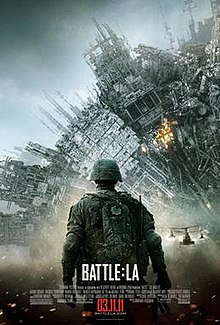
Battle: Los Angeles

Rating: ***

The alien invasion genre has been enjoying a resurgence lately. There was last fall’s SKYLINE, this coming summer’s COWBOYS & ALIENS, and the highly-anticipated TV drama FALLING SKIES. But for now we have BATTLE: LOS ANGELES, a film that could euphemistically be called BLACK HAWK DOWN with flying saucers. Actually, it’s a fairly apt description, though a tad ambitious given everything. Still, for a satisfying, gritty, urban warfare epic, BATTLE: LOS ANGELES is actually very satisfying.

The set-up is simple: aliens arrive off the coastal areas all around the planet and their intentions are immediately identified as hostile. Wave after wave of Marines are being sent in to combat the aliens’ ground assault (fortunately, for some strange reason, they have no air support…yet). One squad of Marines, led by a green lieutenant, are dispatched to help recover civilians from the war zone before the Air Force begins their bombardment. Naturally, complications occur, and the squad is left to the command of Sergeant Michael Nantz (Aaron Eckhart), who’s close to retirement and haunted by some nondescript war drama.

The film is solid in setting up the battle, and doesn’t try and bog the thing down with some unnecessary melodrama, or over-complicating the aliens and their reasons for descending on planet Earth. SKYLINE failed epically because the motivations of the aliens are unclear, and their motivations weird and terrifying. Combined with the fact that all the human characters in that movie, including TV’s Eric Balfour(!), were beneath contempt and what was left was a movie neither compelling or particularly engaging.

The urban warfare perspective serves BATTLE: LA better as opposed to the SKYLINE’s whiny condo dwellers approach. The action is well-directed if not inspired, but director Jonathan Liebesman wisely shirks the idea of going full handheld with the action, but still manages to level a touch of realism to how the film is made. In other words, this isn’t pseudo-war documentary, or rather what some people think the way a war documentary should look. The action is fairly solid, and, admittedly, it’s gratifying to see an alien invasion movie that doesn’t try for one minute to be STAR WARS redux. (INDEPENDENCE DAY, I’m looking at you.)

But let’s rewind for a moment, and revisit the alien’s motivation. Apparently, they’ve come to our world looking for water, which seems to be how they power their ships, and hey, they just love the stuff, I guess. (I wonder if they’ve ever warred against the aliens from SIGNS?) Set aside the fact that water is one of the most common compounds in the universe (we seem to find it everywhere, even in our own solar system), and its base components – hydrogen and oxygen – are two of the most basic elements in the universe, the aliens still had to come to Earth to find water?

Setting aside that they can travel hundreds of light years across the universe but can’t smash some hydrogen and oxygen together to get water, why do invading aliens even need motivation? It’s been a while since I’ve read WAR OF THE WORLDS, but I don’t remember the passage where the unnamed protagonist gets the expository behind the invasion. Maybe aliens can be dicks. Maybe they don’t like our faces. To me, no motivation, articulated or supposed, is better than a stupid one like they hate us for our water.

But back to the movie, which as I said, is perfectly serviceable and actually rather enjoyable. You are kind of sad to see the soldiers dispatched when their time comes, and Eckhart is truly effective as the sergeant that keeps the unit together despite everything. BATTLE: LA is lo-fi, effective popcorn action with a little bit of sprinkled melodrama for seasoning. It’s a satisfying effort all around, even if it doesn’t reinvent the wheel in the process. Or is that saucer?

Friday, 4 March 2011

The Adjustment Bureau

Rating: ****

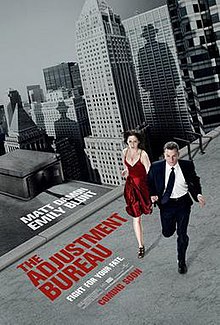
Philip K. Dick has provided the basis for some of the most exciting and imaginative science fiction films in the history of cinema: Blade Runner, Total Recall, and The Minority Report. Of course, the work of Dick also inspired Next, Paycheck and Impostor, but the author can hardly be blamed for the cinematic missteps made more than 20 years after he died.

But Dick is done right by The Adjustment Bureau, a philosophical treatise about fate versus chance, disguised as a romantic drama with a conspiratorial bent. It’s also a new entry in the subgenre of Matt Damon running movies. Damon plays a U.S. congressman with high political ambitions that realizes there’s more to the world he knows than he ever knew, and the aftermath of that seems to be a lot of running. He runs enough for all 435 members of the U.S. House of Representatives. But then again, if you were chasing the girl of your dreams and she looked like Emily Blunt, you’d probably do a lot of running too.

Damon’s Congressman, David Norris, has a bright political future, and is set to be the youngest member of the U.S. Senate ever, only to be T-boned in the eleventh hour by a scandal involving a gag with his old fraternity brothers. On Election Night, on the brink of his first real loss, David rehearses his concession speech alone in the men’s room, when meets an utterly enchanting woman named Elise (played by Blunt). Elise is hiding from security after having crashed a wedding, and through this chance meeting, David is able to give an impromptu speech that turns his loss around and sets him up for a victory next time.

What David doesn’t know is that despite the love-at-first-site connection between him and Elise, he wasn’t supposed to see her ever again. This is where The Adjustment Bureau comes in. A group of near-omniscient figures that nudge people to where they need to be in order to meet their destiny, Bureau Case Agent Harry Mitchell (Anthony Mackie) is supposed to wait for David to pass by a bus bench one morning and have him “accidentally” spill his coffee. But Harry falls asleep and misses David, and instead David makes his bus and just happens to run into Elise again. Is it fate? Is it written in the stars? Or is The Bureau just getting really sloppy?

David finds out pretty early on about the Bureau and its agents. Richardson (John Slattery) lays it out for him when David arrives at the office early and catches a Bureau adjustment in process. Basically, Richardson tells David, you have bigger fish to fry than romancing some random girl you’re smitten with. And sorry dude, we really meant that to be a one time thing and if you don’t do what we say, we erase your memory like the Men in Black.

I did enjoy the almost laid back quality of the Bureau. They’re not some perfect force of universal bureaucrats, but capable of fallibility and making mistakes. Apparently, David’s not the first guy to find out about the adjusting business, and he probably won’t be the last. Reluctantly, he accepts that he can’t see Elise again. Of course, Richardson burning the slip of paper with her phone number on it made that a bit easier.

The film’s pace moves rather briskly. We flash-forward a few years later to the brink of another senate run by David, and through no fault of his own, he one day looks out the bus window and sees none other than Elise walking down the street. Loophole, boys. He didn’t seek her out, this is completely random and David knows it’s random because the Bureau guys told him seeing Elise was a no-no. Where does fate end and chance begin? The Bureau and Richardson still insist that a life with Elise is not in David’s plan, but why does he keep running into her?

It’s a rare quality that the philosophical divide can create genuine suspense and an edge-of-your-seat quality, but screenwriter and director George Nolfi manages to do just that. You both root for David and Elise to find love with each other, but you fear those consequences that the Bureau agents speak of. There’s a “Come on, just let those crazy kids be” cheering appeal, but you’ve got to wonder why they’d chase a guy all over Manhattan to keep him from the ballet dancer he’s crushing on. But to the viewer though, love wins you over in the end.

That decision is helped with the wicked chemistry between Damon and Blunt, which makes you believe in love at first sight. Blunt comes across as free-spirited but not too flighty, while Damon manages to bring out convincingly the romantic inside the buttoned down politician. I give kudos to Slattery and Mackie for giving their characters some human grace rather than playing things too cold and distant, I just wish someone could have told Terence Stamp as Adjuster boss Thompson that he didn’t have to play it like General Zod.

But the focus in The Adjustment Bureau isn’t on grandiose sci-fi set pieces or scenery chewing overacting, it’s on simple storytelling and character work. It’s charming and witty in its way, and you may scoff at the silliness of the Bureau agents getting their powers through their awesome fedoras, but in keep with the tone of the movie, it makes perfect sense and not contrived at all. It’s a winning movie that does Philip Dick proud, and handily proves that you don’t need a lot of flash or cash to make a compelling sci-fi movie. I don’t know if it’s your destiny to see it, but it should be.