Friday, 24 December 2010

Barney’s Version

Rating: ****

Like any good life story, the autobiography of Barney Panofsky spans times of great joy, sorrow, doubt, self-obsession, and fascination. And like the film based on it, the entire experience goes by like a breeze, it loads you with emotion and leaves you with fleeting memories as you try to hold on to the best parts. The wonderfully acted and richly photographed film version of the Mordecai Richler novel Barney’s Version is an extremely satisfying film that rewards viewers that like the complexities of human life and drama.’

Barney’s Version follows the life-long adventure of Barney Panofsky, who over the course of his life marries no less than three women. His first wife, who he marries after getting her pregnant, commits suicide after their child is stillborn. He meets his second wife years later while doing a bizarre bit of unenthusiastic fundraising for the cause of fighting Anti-Semitism, and then meets and falls for the third while at his wedding reception to his second wife. The film is replete with lessons of love won and lost, and with a potential murder mystery to boot.

At the centre of the film is a tremendous performance by Paul Giamatti as the titular character, a Jew from Montreal that often dives head first into love only to ding his head on the hard bottom of the pool. Of course that doesn’t stop him from getting right back out and trying again, and try again he does. Three times. Although he can come across as a sometimes selfish and self-indulgent character, Giamatti fills Barney with an easy likeability that makes you root for him through the screw-ups and just plain hiccups of life.

At the same time Giamatti leads a wonderful ensemble, including, first and foremost, Dustin Hoffman as Barney’s father, Izzy. Izzy could have been a caricature, but in Hoffman’s hands there’s a naturalness and ease that makes the character very grounded. Hoffman plays well off Giamatti, with the more exuberant Izzy playing well, in mismatch way, against Barney’s neurosis. Scott Speedman, meanwhile, adds another feather to his acting cap as Barney’s good friend Bernard 'Boogie' Moscovitch, a troubled writer that ends up at the centre of a darker chapter of Barney’s story. Speedman plays raw and tortured as ‘Boogie’, but still maintains his sense of charm.

Of the three wives, Rosamund Pike gets the most screen time as Barney’s third wife Miriam, so naturally she gets the most opportunity to create a well-rounded character. She’s gorgeous sure, but Pike does a really great job of portraying a lot of what goes on inside Miriam, the quiet frustrations and uncertainties that she can’t say, but nonetheless feels. Minnie Driver’s a blast as Barney’s unnamed second wife, and adds a lot of humour to the film’s middle. Rachelle Lefevre gets to stretch her acting muscles a little as the ill-fated first wife, who makes a brief but all so memorable appearance at the beginning of the film.

The technical specs are excellent thanks to the beautiful, globetrotting locales like Rome, New York City and, of course, Montreal. The cinematography by Guy Dufaux (The Trotsky) consumes every detail and renders it in loving fashion; the colours, the buildings and the foliage all create a wonderful pallet on which the drama takes place. The script by Michael Konyves doesn’t take anything for granted and director Richard J. Lewis keeps the action moving tightly, and expeditiously. The film is over two hours long, but doesn’t feel the least bit bloated. Another fun touch by Lewis is the Who’s Who cameos by a few famous Canadian filmmakers.

But in the end, Barney’s Version is a fun tear jerker, a sad clown kind of movie that is carried simply by the quality of the actors and the characters they play. The worthy Golden Globe winner Giamatti deserves every accolade in what maybe his finest performance since Sideways, and for, at the very least, making cigar smoking a colourful affectation for a film character once more. Of course the title of the film, and the book, implies that there maybe only a little truth in how this character tells his story, but for the most part I bet that Barney’s Version is the version that’s the most fun.

Wednesday, 22 December 2010

The King's Speech

Rating: ****

In the spirit of renewed interest in the British Royal Family thanks to the upcoming nuptials of a certain prince, perhaps the timing is serendipitous for a bio-pic of Prince Williams’ great grandfather, a man who understood very well the importance of looking good in front of the media, if only because he was powerless before it. Ruling in the age of the radio, it’s almost like something out of story book to think that this man that wasn’t originally supposed to be King, was hampered in his public speaking by a stammer. All the more so given that he became King in a time when his countrymen would need to hear his voice the most.

Impeccably cast and directed with a light touch by Tom Hooper, THE KING’S SPEECH is everything a movie like this should be: inspiring, thoughtful, dramatic, dynamic, and with a touch of humour as well. It’s easy to see why so many have become enamoured with this movie, and admittedly, it’s hard not to walk away enamoured yourself. It’s a real life fairy tale based on a true story. A king-to-be, felled by a weakness he must overcome to save his people after they’re abandoned out of selfishness and pettiness by his brother. It’s the stuff of legend.

Fortunately, the actors keep things very real. Colin Firth is the future King George VI, who we first see stumble through a simple pronouncement, and you get the sense that this isn’t the first time that this Prince has had trouble getting through a speech. His wife Elizabeth (Helena Bonham Carter) visits a speech therapist off the beaten track named Lionel Longe (Geoffrey Rush) to see if there’s anything he can do for her husband. Longe, a failed actor from Australia who does speech therapy as a way to make money, uses his unconventional techniques to help the Prince, and starts to get results as the British throne faces one of its greatest challenges.

Firth is great, a natural at conveying a kingliness that can be at once commanding and yet loaded with self-doubt. I glad that there weren’t a lot of “pity me” moments for this King, and that the story focuses more on his confrontation against his affliction and the camaraderie that develops between the King and Longe as they work to overcome the King’s speech. Interestingly, the solution is less about beating the stammer as it is about using it, but the film does a great job in portraying how difficult it is to overcome a stammering affliction.

But I’m not sure the film would have worked as well with Rush’s relaxed charm as Longe, a man whose life could not have been too relaxed as he was trying to help the King of England address the British people on the eve of World War II, or any day before that for that matter. Rush’s cool head and confidence makes you believe that this was a man who could get away with calling the King “Bertie” and the way it’s played between Firth and Rush makes you believe that George VI was a King that would let it slide.

But the film isn’t all speech lessons and phonetics, there’s some serious drama in the mix as well. Most of it concerns George’s elder brother King Edward VII, who ascended to the throne after their father George V died. Edward VII of course abdicated when he was too infatuated with American divorcee Wallis Simpson that he either had to give her up or give up the throne. History shows how self-centred Edward was and how he basically shirked his duty to God and Country for the lust of a woman who was known to many. Edward isn’t played too broadly, but it would be somewhat incorrect to say that he isn’t a bigger villain in the film than Hitler.

Still, the film isn’t so much about outer conflict as it is about internal conflict. It’s about fulfilling one’s duty and making it our own despite our fallibilities. It’s about the rewards of hard work, perseverance and determination. All these are quality lessons for any story, and of course, the basic building blocks for any good movie looking for Oscar gold. THE KING’S SPEECH treads lightly the ground between sentimental and cynical and the result is a winning drama, which is, essentially, a two hour long build-up to a guy giving a three minute speech.

Tuesday, 21 December 2010

It's a Trap!

Rating: ***1/2

I suppose it was inevitable, even the writers of Family Guy’s latest Star Wars parody seemed poised to agree. The Griffins are watching TV when the power goes out, to which Stewie immediately observes, “We’re doing Jedi, aren’t we?” Yes Stewie, yes you are. And despite the protests of the show’s staff, by this point the Family Guy renditions of the original Star Wars trilogy are more than a get rich quick gimmick by the good sports at Fox. Having said that though, one detects a hint of exhaustion. One Star Wars spoof let’s you get most of the funnier jokes out of your system, a second let’s you think about what you might have missed, but a third…

Well, to start of with, It’s a Trap is still pretty darn funny. Fans of Family Guy’s mix of pop culture cut away gags and no they didn’t just say or do that moments will be well rewarded. Written by Cherry Chevapravatdumrong and David A. Goodman, the episode gets a lot done. It stuffs in a lot of cameos from other Seth McFarlane shows like American Dad and The Cleveland Show, a lot of jokes at the Ewoks’ expense and a lot of roasts at the expense of Seth Green. Overall, it’s a solid effort with plenty of laughs, though a few of those jokes couldn’t have been more obvious. (Meg as the Sarlacc? A little on the nose, guys.)

So what works? First of all, the writers’ room clearly knows the material and, despite jokes to the contrary, are still passionate about it. This has to be the only time in history (aside from the three Robot Chicken Star Wars’ specials too, of course) where repeated, obsessive, detail-oriented viewing of George Lucas’ space saga has paid off. Aside from being an enthusiastic spoof, It’s A Trap is also a pain-staking homage to Return of the Jedi, at least artistically, and certain scenes seem practically rotoscoped from the original film. Family Guy is not typically cited for the skill of its animators, but for this they deserve kudos.

As for the gags, the Family Guy crew get things fairly spot on. Recasting the Rancor as Rush Limbaugh was an uproarious bit, especially considering that Rush himself cameos. The Chips Ahoy bit is also fun gag, but for pure pointless hilarity there’s an elongated sequence of the characters nodding to each other before the fight on Jabba’s Sail Barge. For innuendo laughs, it’s got to be the commercial for Han Solo’s staffing service called, not-so-appropriately, “Hanjobs.org,” but fortunately for fans that not the most risqué that the episode gets. (Hint: What did happen to those Imperial prisoners on Endor?)

On the downside, there was almost an over reliance on cameos. Conway Twitty appears in another cutaway, and I’ve got believe even his estate is getting sick of those royalties by now. I also felt that there was maybe a bit too many characters from the “McFarlane-verse” Casting American Dad’s talking fish Klaus as Admiral Akbar was great, but an appearance by Dad’s Roger the Alien as Moff Jerjerrod and The Cleveland Show’s Rolo as Nien Nunb was a little much. And sorry fans, but it’s my sad duty to report that despite Ernie the Giant Chicken’s reappearance as Boba Fett, there is no Giant Chicken Fight. I think we’re all feeling a little cheated there.

Still, I applaud the Family Guy cast and crew for their accomplishment with these Star Wars parodies. It’s kind of sad that it’s over, but I can’t help but think that having The Cleveland Show do parodies of the prequel trilogy is a better idea than the writers might think. As for It’s A Trap, it’s an improvement over the Empire spoof Something, Something, Something, Dark Side, with tighter gags and more energy, but it still can’t top the freshness and excitement of the original Blue Harvest. Regardless, this is a must have for Family Guy fans.

Friday, 17 December 2010

TRON: Legacy

Rating: **1/2

The hype was outstanding, which is interesting because when the original TRON came out in 1982 it was, to borrow the phrase, an unmitigated disaster. Still, to a lot of children of the 80s there is something to recommend it with a retro-futuristic charm from back in the day when Commodore 64 and Atari 2600 were the cutting edge of home computing. It’s as quaint as it is antiquated in the cyber-age, and the legend has been fuelled through the years by a small and growing chorus of fans. Disney heard the siren song of endless, sweaty wads of geek money and knew that the long gestating sequel was to be moved to the top of their to-do pile. But honestly, what was the point?

The original TRON, much like last year’s AVATAR, was a creature of style before substance. It was a GULLIVER’S TRAVELS tale of a stranger in a strange land whose triteness was obscured by the cutting edge filmmaking that was being employed to tell the story. I wish that TRON LEGACY had the same problem. The story is a whirlwind of philosophical technobabble and special effects porn tied together by the loosest tendrils of a story. When your film’s called TRON and the actual character the film is named after comes across as a mere after thought, there’s cause for concern.

But that’s just part of the problem. For some reason Kevin Flynn, the computer visionary played by Jeff Bridges in both the original TRON and its sequel has morphed from a young Bill Gates to an older Dude. As in THE BIG LEBOWSKI’s Dude. There’s actually a scene where Flynn tells his anxious son Sam (played with perfect woodenness by Garrett Hedlund) that he’s messing with his zen thing. Well sorry there Flynn, but the son who hasn’t seen you in 20 years has a lot to deal with, including being sucked into the computer-based wonderland of The Grid.

The backstory is basically that Kevin Flynn disappeared two decades ago, leaving behind his son Sam orphaned and ambiguous as to whether or not he wants to continue his father’s legacy at Microsof… I mean, Encom. Content to live like a digital anarchist, Sam does what he can to skewer Encom’s capitalist agenda. He’s still visited by his father’s friend Alan Bradley (Bruce Boxleitner, also of TRON part 1) who this night comes with interesting news: he’s received a page – like, on a pager – from Kevin Flynn’s old arcade, where the porthole to TRON land resides.

Once inside, Sam does the usual TRON stuff like racing on light cycles and throwing flying discs in gladiatoresque struggles. It’s part of the machinations of KLU (a younger-by-way-of-CG Bridges) to escape The Grid and take over the real world because the porthole can only be opened from the outside. Flynn, for his part, has been trying to protect the last of the “isomorphic algorithms,” a group of programs that evolved naturally in the environment of The Grid. Quorra (Olivia Wilde) is the last of these programs after KLU’s genocidal spree.

One of the key problems is that the story is almost needlessly convoluted. What could have been a solid father-son story is loaded with a lot of misspent and unrealized mythology, and that’s a complete turn-off. “Isomorphic algorithms” don’t exactly have the same simplicity as, say, The One Ring, or a mystical alien rain forest, and getting talked down to with the cyber speak by The Dude is somewhat less than appealing. The plot holes were galling, and odd little Easter Eggs are inserted with no subtlety at all. For example, Cillian Murphy appears as “Edward Dillinger II,” a character named after the antagonist played by David Warner in the original film. He appears in one scene, and such heavy emphasis is placed on naming this character with three lines, they might as well have put in one of those You Tube footnotes saying, “See more about Edward in TRON 3.”

The acting is also demure. Bridges looks like he’s thinking about all the better roles he’s done lately and how he’s back here in TRON land in spite of all good sense. “Younger” Bridges doesn’t fair much better as the film seems to teeter between believability and outright goofiness so far as the effects work is concerned. Hedlund almost seems like a computer himself, as Sam is remarkably emotionless in spite of a story that should have had him on a roller coaster of emotion. Wilde manages to defy the odds by being engaging and energetic as Quorra. She’s easily the best part of the film. Michael Sheen also shines in a brief bit as a Ziggy Stardust looking nightclub(?) manager.

But despite the fact that this was a fan driven enterprise, I can’t possibly see why a fan of original TRON could find this film approachable. There’s not a lot of fun here, and because the effects are state-of-the-art, photo realistic 3-D, even the kitsch value of the production design is lost. The movie is pristine to look at, and the music by Daft Punk is amazing, but at most, TRON LEGACY is an awesome, two hour Daft Punk music video. Sadly, TRON LEGACY is another example of a movie not living up to its own hype.

Tuesday, 7 December 2010

Destination Forks

Rating: ***1/2

I go to a lot of comic conventions and sci-fi festivals, and at every one of these occasions there are people running around in elaborate costumes based on anime characters. I don’t get a lot of anime, I haven’t really been able to engage in a lot of it, but God bless those fans because they care about their stories, they take pride in them, and wear that pride on their sleeves. Literally.

Now I know the fandom surrounding those hopelessly devoted to the Twilight series of books and films is seen down the nose of a lot of people, but are they really that different from any other fan? Like Trekkers they have their own cute little nickname: Twihards; like Star Wars or Harry Potter fans they line-up at midnight on open night to see the next movie; and like the people who take the Seinfeld tour of New York or visit the real life “Cheers” in Boston, Twilight fans have their own Mecca, the small town of Folks, Washington.

Destination Forks is an interesting companion piece to The Twilight Saga: Eclipse, which also came out this week. To the people for whom the fandom around Twilight is incomprehensible, this documentary may shed some light on the phenomenon. Then again, it might not. Amongst my group of friends, associates and fellow critics, I’m probably the easiest on the sparkly-vampire/shirtless werewolf epic romance, but as these things go, I don’t think the simple charms of Destination Forks is going to convert the conscientious objector to The Twilight Saga.

As for the documentary itself, I think it sometimes struggles to get over a point where it can stop proving why it’s something more than an expanded extra that probably should have been left on disc two of one of the Twilight releases. From the loving, travelogue-esque photography of Forks to the corporate video-like title cards, I struggled to get into to Destination Forks initially, but as soon as we start diving into the cottage industry of Twilight-related tourism in the town, I have to admit that I was hooked.

Among the stops are the respective homes of Bella, Edward and Jacob. The owners of each home are interviewed and they talk about their experiences with the fans and their place on the pop culture radar. What’s interesting is that it’s more than a money-making scheme for these people, and you can tell how deeply they’ve entrenched themselves into the lore. The retired couple that run the real life bed and breakfast at the fictional home of the vampire Cullen clan can trace the ownership of the house back to when the Cullens might have, theoretically, bought the house. Additionally, the owner at that time was a doctor himself with five children – three boys and two girls. Coincidence, or inspiration.

Another stop I liked was a visit to Port Angeles and the restaurant Bella Italia, the real life location where the fictional Bella and Edward had their first date. The owner of the restaurant talks about how their mushroom ravioli dish was a seasonal menu item until Twihards started coming in year-round asking for it. (For non-fans, mushroom ravioli is the dish Bella was served on the aforementioned date.) Another handy piece of info from the owner is that if you plan on stopping by his restaurant for some mushroom ravioli, make a reservation. Apparently, people line-up to get in an hour before this 55-seat eatery opens.

The rest of the film more or less documents the fan experience from the intergenerational bonding to the silent minority of male Twilight fans. One of the things that interested me, from a sociological standpoint anyway, was hearing some of the young women talking about the appeal of the story. It affirmed something a blogger from Entertainment Weekly wrote this past summer that part of what attracts girls to the story is the old-fashionedness of the romantic leads. One girl espoused the gentlemanly qualities of Edward and how “you don’t find guys like that anymore.” I’m not sure if it’s enough to let the “Twihaters” give a pass on the franchise and its fans, but who knows.

Regardless, I found Destination Forks a delightful little documentary. I’m still not sure if there’s enough to it to justify buying it as an entirely separate disc, but I enjoyed it just the same.

Friday, 12 November 2010

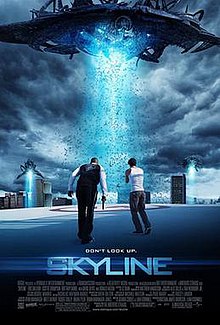
Skyline

Rating: *1/2

Obviously, alien invasion movies are works of fantasy, so by their nature they are somewhat unbelievable and require a suspension of disbelief. SKYLINE, however, requires a frontal lobotomy. There isn’t a single character in this film that I was invested in, the visual effects were less than stunning, the story was strained and the entire concept seemed tired and clichéd. By the time the film is over, I had no idea what the point was, who the story serviced or what I was supposed to get out of it. And sadly, I don’t think I can blame it all on actor Eric Balfour either.

Balfour plays Jarrod, who arrives in L.A. with his long-time girlfriend Elaine (Scottie Thompson) for a few days of chilling out with his buddy Terry (Donald Faison) in his overly technical and extravagant downtown L.A. pad. In the wee, small hours the next day, a blue light falls at several points in the city and if you stare into it too long, you become so mesmerized that you barely notice it when you’re sucked up into a giant spaceship. After the initial vacuum effect, the aliens start going house to house to find human stragglers, like Jarrod, Elaine, Terry and a few other hung-over party survivors.

Aside from the aliens, the human drama centres on Jarrod and Elaine trying to cope with the fact of Elaine’s just revealed pregnancy and all the “life-changing” dilemmas that go along with that. Not helping is Terry trying to get Jarrod to drop everything back wherever he’s from and moving to L.A… Land of milk and honey. Land of the endless party. And land where you’re assistant will gladly follow you into the shower for several minutes of heavy breathing under the nose of your live-in girlfriend.

Here that everyone? Terry’s a jerk! And if you need any more proof, the first thing he does when aliens are revealed to be on the loose is grab a gun. Meanwhile, Jarrod’s does the typical square white guy freak out at the sight of a gun. (Doesn’t he live in the United States?) Elaine becomes the typical girlfriend in peril, meaning that nothing Jarrod suggests is even remotely convincing to her. Granted, in this instance, Jarrod’s plan to make a run for it to the marina and take off into the ocean because there are no alien ships over the ocean, was idiotic. Clearly, Jarrod thought this was SIGNS and that the aliens were afraid of water, not that he was in SKYLINE and that the aliens were focused on cities because they were vacuuming up people, and there are no people on the ocean!!!

Speaking of residual presence of alien invasion movies past, it’s hard not to get a derivative stink off of SKYLINE. You like people hunkered down in a single, enclosed setting (SIGNS)? You like giant alien ships hovering about a major American city (INDEPENDENCE DAY)? You like looks inside the goop filled recesses of alien technology where machinery is biology (ALIENS, WAR OF THE WORLDS, THE THING)? Then you’re going to love SKYLINE. Except you probably won’t. The characters are lame, and the glimpses inside the aliens’ world looks like something out of a video game, and that video game is Bioshock.

I’m going to do some spoilers a bit here because to get a full taste of the insaneness and idiocracy of the film, you need to know how it turns. Ready? Still here? Okay…

So we learn near the end that the aliens are collecting humans in order to take their brains by yanking them right out of the skull, cast away the other 95 per cent of the human body and putting those brains inside the alien machines to make them run. Come to think of it, you never actually see the aliens themselves, just the organic suits and other war machines that run on human brains. Which begs the question: how did these machines run before they ran on human brains? It’s like Underworld all over again; how did the werewolves kill the vampires before they discovered sunlight bullets? If you can answer any of this, you’re smarter than me. And the screenwriters.

Anyway, we learn all this when Jarrod and Elaine are sucked up into one of the ships. Jarrod gets the brain removal treatment while Elaine is taken away to some icky alien maternity ward where the newborn is ripped out of the new mother’s womb (presumably when the baby’s mature enough to be delivered). This begs another question: what are the aliens going to use the babies for? Why separate the mothers from everyone else? Simple logic like this needs resolution. But before you get too deep into it, the alien stormtrooper who received the brain of Jarrod starts blasting away at the other aliens seemingly in order to save Elaine. So Jarrod was the only human whose love for his loved one was so strong it overcame the alien tech to do his brain’s bidding? Unlikely, but there’s no time to explore this because it’s where the movie ends.

But this is what happens when you get visual effects guys to write a script; the human characters are bland and the alien technology and creatures is meticulous in its detail. And the only really original part of the script is never explored because it happens in the end, where the real movie should have began. SKYLINE had promise, much like the last movie by Colin and Greg Strause, ALIEN VS PREDATOR: REQUIEM, but the whole enterprise sinks under an undeveloped script. When you’re rooting for the aliens to win, you know you’re in trouble. Actually, nobody wins in this.

Friday, 5 November 2010

Fair Game

Rating: ***

One of the great assets to Doug Liman’s Fair Game is how ably and subtly he’s able to rewind the clock back to 2003. Here and now, the idea of going to Iraq to displace a dictator that had absolutely zero to do with the terrorist attacks of September 11th, 2011is ludicrous. A tragic act of executive hubris where bad decision making followed bad intelligence. Support for the Iraq War, and trying to find someone who will admit that they did, is a little like trying to now find fans of O-Town, 98 Degrees, and the other inter-changeable boy bands that were on the radio at the time.

There’s a scene in the second half of Fair Game where Ambassador Joe Wilson (played by Sean Penn) is meeting some businessmen. He excuses himself to use the washroom and when he returns to the table, an irate woman is explaining to his clients about how Wilson, having called into question the Bush Administration’s justification for war in a New York Times op-ed, is a traitor, and other awful things. At this point, Wilson is close to his wit’s end; he’s been labelled a pariah, his wife Valerie Plame has been outed as a CIA agent in seemingly retaliation, and his business meeting has been ruined by someone who bought the party line. There’s such electricity to that scene, the emotion runs over, and you can feel Wilson’s frustration to the core. It’s such an energizing scene and the pity is that you wish that energy could have translated through the rest of the movie.

Based on books by both Wilson and Plame, Liman’s film is a rather under-stated and fair-minded re-enactment of the scandal that, at the time, only slightly derailed the George W. Bush White House, but nonetheless laid the ground work for its eventual downfall on all matters concerning Iraq. In terms of story, the film is almost distant and unemotional. It’s tactful in saying, or rather not saying, where in lays the fault of ruining a good woman’s career and discrediting her and her husband. At heart though, and there is a heart, it’s about how two distinguished people deal with fact they’re nearly ruined for the sake of political inconvenience.

Penn as Wilson and Naomi Watts as Plame are both really well cast and are more than up to the challenges. Penn particularly amazed me for managing to downplay his innate Sean Penn-ness, toning down the persona and playing Wilson very straight without any added demagoguery or big speech moments. There’s just the frustration of a man whose own word and integrity is called into question, and the fact that doesn’t sit well with him. Watts as Plame is the model of civility. Her reaction to being outed as a CIA officer is to cover herself. The mere admission of her status means the worst possible damage of all has already been done. She’s a career woman that loses her career, or rather has it taken away. It’s stolen, but with all her skill, there’s nothing she can do to get it back. What use is a covert operative whose face everybody knows?

Technically, the film is well made, although there were a few scenes that felt that Liman was trying too hard to duplicate his style from The Bourne Identity. Of course real life spy games are not the same as cinematic ones, and to me this was one of the more interesting aspects of Fair Game, seeing the real, almost mundane, facets of intelligence gathering. Liman paints well the difficulty in getting absolute facts in the murky world we live in, and how that difficulty was compounded by a government with an agenda and a minimum standard to meet for war.

On that account, the film tells the story in a very straightforward manner, and I would say emotionlessly as well. I imagine the point was to be as unbiased as possible, but the fact is that this is a personal story, told from the perspective of the people involved most intimately in it, and the point is that there should be more fire to the story and the way it’s told. The performances by Penn and Watts nearly sell it, but I think that the film starts too soon, and ends too early in the timeline of events. It felt like the story wasn’t over, and while there was some kind of resolution it was neither emotional nor political.
 
The strong performances do win out slightly though, but the dynamics of the debate and the lack of a forceful voice is kind of concerning. This isn’t an occasion where we have to skate on thin ice around the subject, for it is know pretty well known that a lot of people in the White House did a lot of bad stuff to fight a war on specious evidence. There was no call for such a soft touch, and one can be fair to both sides without treating them both with kid gloves. On second thought, maybe Fair Game lives up to its name in an unexpected way.

Friday, 29 October 2010

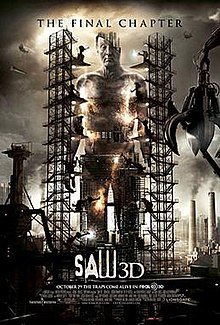
Saw 3D

Rating: **

Nothing says finality like 3-D. That seems to be the theory of the day with the previous release of THE FINAL DESTINATION in 3-D (which, as it turns out, is not The FINAL DESTINATION after all), and the new release of what is supposed to be the final SAW. The finale can’t come soon enough, in my opinion. There are only so many times that a group of narcissistic, self-involved people can be lured into overly elaborate and grisly death traps where they are literally taken apart at the seams featuring buckets and buckets of fake blood and chum. Unless it’s in 3-D, of course.

But really, 3-D was about all the producers of SAW could do to inject some new life into this franchise, which despite being still the slimly budgeted gore fest it’s always been, has come to feel bloated and self-involved. Every new film adds a layer of mythology that both complicates the original simplicity of the core story, and requires even greater feats of mental dexterity from the viewer to keep track of who’s a threat to who and is trying to get revenge on who else, all while a character that’s been dead for four films now somehow pulls the puppet strings from beyond the grave.

Tobin Bell still has some face time in this one as the titular philosophical serial killer Jigsaw, but his on-screen presence is mitigated. Even the villains(?), or is that antagonists, from the past few movies, Betsy Russell as Jigsaw’s ex-wife Jill and Costas Mandylor as his would-be protégé Hoffman, seem to spend a lot of time on the bench. The real story in this SAW is the return of Cary Elwes as Dr. Gordon, the man who gets away at the end of SAW I after sawing off is own foot. A prologue shows Dr. Gordon crawling away immediately after and cauterizing his own stump to stop the blood loss. I’m sure fans of the series enjoyed this throwback, but to me it’s another reminder of what this series has lost through all its iterations.

The subject this time is Bobby Dagen played by Sean Patrick Flanery. His sin is that he’s a survivor of one of Jigsaw’s death traps and has made a mint as a self-help guru in the aftermath. Of course, he’s surrounded by a group of spineless yes men (and women) and has a loving wife that admires him for his courage in the face of having had hooks pierced in his chest and forced to hoist himself on a rig in order to escape. If it takes you longer than two minutes to figure that Bobby is talking out both sides of his mouth, you might not be smarter than a fifth grader. Time to play a game for real, Bobby? You betcha!

One thing I’ll say about the 3-D is that it makes the death scenes much more squeamish. Seeing the blood and guts fly everywhere, even right at you, is enough to turn your stomach. At that, I think SAW reaches you on a visceral level, but outside that immediate yank on your gag reflex your left with a confusing mythology and a bunch of characters you don’t give a damn about. The kick-off game features a two men and a woman. The men, who were both being led on by the woman, are forced to choose who will get the business end of buzz saw, and by default win the girl. In the brief time we know them these characters are so ugly, killing all three would be a mercy to the human race.

At least if this is the end, the SAW movies go out on a technical high note, which should leave the fans of the series with a satisfied blood lust and a stunted appetite for bloody disgusting deaths. If not, their thirst will never be quenched and it’s pointless to continue anyway. It’s hard to believe that this is the series that started out so audaciously and featured first rate actors like Bell, Elwes, Danny Glover, Ken Leung and Michael Emerson. But I guess on the seventh film of a horror franchise, playing the G-list players is inevitable, even if they don’t get to work with A-list material.

Friday, 22 October 2010

Score: A Hockey Musical

Rating: ***

Create a musical about a hockey protégée and the question is what takes emphasis, the hockey or the music? Perhaps a better question is what took the Canadian film industry so long to come up this idea? The concept seems natural enough: you take the typical sports movie clichés, put them in a hockey rink, load up some hardcore Canadiana and then score the thing with a generous helping of catchy tunes. That’s the formula for Score: A Hockey Musical, the new movie from the director, who, in his last film, sent Joshua Jackson on a cross-country biker trek at the whim of a Roll-Up-the-Rim-to-Win cup.

For all intents and purposes, the film comes set up much like a hockey game. It begins with the national anthem as sung by Scottish crooner John McDermott, then heads into a first period of excitement where, not knowing what to expect, we meet the starting line-up, gage their talents and make our bets on how this game will end up. From there we settle into the second period, where events unfold as expected as everyone saves their energy for the grand finale in the third period, as the team comes together for one final burst of energy and drive in order to bring the game into a friendly result.

Having written that just now, I feel that I’ve strained the hockey game metaphor perhaps a bit too far. For Score not only sticks closely to the conventions of the hockey/sports movie, it’s also finds comfort in the routine of the musical. The perfectly named Farley Gordon (Noah Reid) is a sweet, simple, home schooled 17-year-old with hippie parents and a killer acumen for the game of hockey. Naturally his parents don’t understand and, dare I say, generally disprove of Farley’s (natural) love of the game.

For Mr. and Mrs. Gordon there’s even more trepidation about the sport when they’re introduced to Walt Acorn (Stephen McHattie), owner of the fictitious Brampton Blades, which is part of a fictitious version of the Ontario Hockey League. Farley desires to play minor league hockey despite only ever playing on the neighbourhood rink, so it’s quite the culture shock for him when he’s introduced to the rude, crude and yes, violent world of competitive hockey. Also complicating things for Farley are some confusing feelings for his platonic (though she wishes it was more) BFF Eve, played adorably by Allie MacDonald.

Writer/director Michael McGowan stacks the deck in his favour with a lot of familiar faces, from former Grease girl Olivia Newton-John playing Farley’s mom to Hour man George Stroumboulopoulos playing an announcer to a cameo by the most famous hockey dad of all, Walter Gretzky. Noted Canadian musicians Nelly Furtado and Hawksley Workman also pop up in small cameos, not that you’ll really notice. Furtado and Workman seem to be a part of the film if only to up the musical street cred. The same could also be said for the appearance of the elder Gretzky and former Calgary Flame Theo Fleury. You have to appreciate the half-hearted shout outs, but the movie doesn’t really need them, nor do they help.

The kind of typical sports movie territory of a rookie superstar initially basking in the recognition of his skill before getting crushed with self-doubt and finding his way again is a well-worn plot. Of course, like all sports movies, it works for the most part on an emotional level. Farley’s quest is fun to follow, if only because watching him navigate the seemingly brutal world of minor league hockey despite his declared pacifism makes for an interesting conflict. How does Farley get the respect of his brawling brothers on ice without betraying his principles and throwing down? McGowan clearly wasn’t able to find a satisfying enough solution, but it’s fun watching Farley struggle.

As for the music, there’s really no standout hit, which is kind of key when you’re putting a musical together. A day later and I wasn’t sure if I remembered any of the songs, and even hearing them in film wasn’t exactly a toe-tapping affair. As well, it took a while for the musical aspect of Score to really take hold. When the cast broke into the first couple of songs there was a slight jarring effect as you say to yourself “Oh yeah, it’s a musical, and this is natural.” I’m not sure if that was a function of my own viewer mentality or something the film did on its own, but it took a minute of getting used to.

On a whole though, I have a hard time saying that Score wasn’t a satisfying experience. I think coming out of it, you get exactly what you thought you were going to get going in. The energy and dedication of the cast and crew is indeed all there on screen, making the film an enjoyable romp despite any stylistic or narrative hiccups. In fact, it’s hard not to sit there and enjoy the film. It’s campy in a good way with some good laughs and, if nothing else, a solidly patriotic disposition that gives a friendly poke to all those obsessed with Saturday Night on the CBC. You don’t have to know hockey – or musicals – to get it, but it can’t hurt either.

Saturday, 16 October 2010

Hereafter

Rating: ***1/2

With few exceptions, there’s always something to recommend in a Clint Eastwood film. As a filmmaker, he’s very chill, very cool. He’s a director that can let the story happen without forcing anything and without trying to drum up any kind of false emotion of dramatic tension. In a way, his movies just kind of happen, and honestly, if he did it any other way would the third act of Million Dollar Baby have had the same punch that it did?

So naturally, going into Hereafter, a meditation on how death and near-death affects three very different people, one knows that they’re not going to see The Sixth Sense as reinterpreted by the man that played The Man With No Name. In many ways, Hereafter isn’t a movie about death and the afterlife, but about people dealing with grief and trying to make sense of a knowledge that they probably shouldn’t have. It’s intriguing, it’s really well told, but it seemed sometimes to lack an extra dramatic bump to push the story further.

The style of the film, according to Eastwood, is very much in keeping of French films in that it tells separate stories that come together in one big scene at the end. It’s an interesting approach, but one that makes the story hard to sit through at time. As the action unfolds in three separate and distinct lines that switch back-and-forth, you know that the story’s building up to a strange, sudden and coincidental convergence of the three at the very end. Knowing this, some of the drama is zapped from the movie, and in return you have to trust that Eastwood’s deliberate pace will get you there eventually.

In the meantime we meet George (Matt Damon), a blue-collar worker in San Francisco who desires nothing more than to forget about the fact that he has a psychic ability that can help people communicate with loved ones in the afterlife. Of course, this isn’t made easy thanks to George’s brother Billy (Jay Mohr) who, like Peter Venkman, sees dollar signs in paranormal activity. In London, young Marcus tries to cope after his twin brother Jason (both played by real-life twins George and Frankie McLaren) is killed in a car accident. Then there’s French TV reporter Marie LeLay (Cécile De France), who nearly dies in a tsunami while on vacation, and the more she throws herself into work, the more haunted she is by her near death experience.

Eastwood glides smoothly between the three different stories, but each comes with its own strengths and weaknesses. Much of Marie’s story is interesting as she begins a political memoir only to start fully exploring her own trauma after nearly drowning. Throwing out her planned book about François Mitterrand, she starts to investigate near death experiences and those researching them only to find that these people are met with vitriol for their efforts. This was interesting, but then the screenplay kind of saddles Marie with a lot of typical career woman drama: an impatient boyfriend, worries about job securities and ambitious rivals, and so on.

Damon does good work as George by making the character more exhausted by his ability rather than disgruntled about it. He doesn’t hate his gift, he’s just tired of the way it separates him from people, the way it lets him, both accidentally and purposefully, gleam knowledge that he’d rather not have. There’s a great scene where George’s cooking class partner Melanie (played by Bryce Dallas Howard) kind of goads George into a reading only to reveal something she never expected him to hit upon, a deeply personal and invasive secret. In ruins any chance at romance between the two and further highlights George’s aspersion of his abilities despite the constant push by his brother.

For Marcus’ story, Eastwood manages to avoid a lot cutesy or melodramatic moments, although some of the stuff the young boy encounters kind of strained the tone of realism I think Eastwood was aspiring to. Still, the McLaren Boys were very good and very natural in a Dickensian sort of way. One of the final scenes, which is a chance meeting between Marcus and George, could have come across much more hokey if it had seemed like McLaren was trying to really act it big. The fortuitous series of events that brought the two characters together would have been bad enough, if it weren’t for the emotional and tonal restraint shown by the actors and the filmmaker.

So no, Hereafter isn’t a ghost story or a thriller, or chalk full of surprise twists or marshmallow men and the like. But what it all adds up to is something I’m not sure of. I think the stories are compelling, but there’s really no underline message, or maybe there are too many non-specific messages that can be derived. As usual, Eastwood shows unparalleled craftsmanship, and it’s nice to see him expand his horizons. So far as ghost stories go though, Hereafter makes an excellent case for something weird going on we know not what. No spooks, no squeals, just the simple possibility that there’s something more to this life. And that’s something we can all believe in.

Friday, 15 October 2010

Red

Rating: ***1/5

The great gift of Red is that it’s fun. Although it’s got more Oscar-winners per capita than most action movies or comic book adaptations of its kind, it doesn’t really break any new ground or put a high premium on dramatic performance. So why see it? Well let’s start with John Malkovich concealing a weapon in a big pink pig plush toy and Dame Helen Mirren firing a big, damn machine gun in an evening gown, and go from there.

Red, based on the graphic novel written by Warren Ellis (creator of Global Frequency and The Authority), is actually an acronym for “Retired, Extremely Dangerous.” It’s a classification that’s given to Bruce Willis’ Frank Moses, a retired CIA assassin living a not-so fulfilling golden years in placid suburbia. The thing he gets most excited about is his pension cheque, which he promptly tears up so that he has a reason to call Sarah (Mary-Louise Parker) at the administrator’s office.

Frank’s quiet retirement though comes to a thundering end when a high-tech hit squad tries to, ahem, liquefy his assets. A trained agent, Frank knows that anyone he’s had contact with is in danger, and that’s a pretty short list that starts and ends with Sarah. Along the way Frank recruits his former CIA pals Marvin (Malkovich), Joe (Morgan Freeman) and Victoria (Mirren) to help him sort out the whos, whats and whys that an Agency goon (Karl Urban) is trying to erase him with extreme severity.

Part Bourne game of cat and mouse, part Grumpy Old Men, and part J.J. Abrams spy-fi shenanigans, Red easily entertains. It’s a brainless summer blockbuster with Oscar-calibre talent; like a Coen Brothers movie as interpreted by Michael Bay. Needless to say then that this movie does not follow the almost barebones plotting and straightforward narrative of Ellis’ original three-issue comic book, but this Red manages to expand on the book’s simple story in a satisfying, though nearly convoluted way.

Yes, the story is jam-packed to the point where you’re not sure where the emphasis of the story is supposed to be: the notion of talented assassins dealing with retirement or a massive government conspiracy involving the vice-president, illegal arms sales and some kind of black ops in South America years earlier that initially put Frank on the endangered spies list. All considerations of nuance though are laid aside once the guns start blazing, and when they do, as a viewer, you’re more than happy to let the violence engage you.

But if that’s not your speed, there’s always the quality acting on display. You do get a feeling of genuine camaraderie from the cast, a group of analogue soldiers kicking butt better than the agents of the digital age. Poor Karl Urban is left out in the cold playing the straightman, but he plays his part well enough to let this Masterpiece Theatre version of The Expendables take centre stage. For this reason, Red can elevate itself above the usual action movie tedium to be something a little for engaging than just the guns and ammo.

Aside from the main cast, which would be pretty tremendous by itself, we get some quality supporting performances as well. Brian Cox plays a former Russian spy who tries hard, though unsuccessfully, to hide his pleasure at finding himself the needed ally of his former adversaries. Meanwhile, Richard Dreyfuss channels some remnant of Dick Cheney after having played the Great Sat – I mean, former U.S. Vice-President in Oliver Stone’s W, by here portraying the weapons manufacturer at the heart of the conspiracy.

Still, it’s Malkovich that steals the show playing the burnt out, Section Eight Marvin. Speaking of the Coens, I was reminded strongly of Burn After Reading when seeing Red because it’s almost like the madness of Osborne Cox took off to a whole new level of paranoia in the face of an ever expanding “League of Morons.” Without Malkovich, I don’t think this movie would have gone down the same. John, all’s forgiven for Jonah Hex.

But despite the balance that Red strikes between laughs and action, the film may be too much of one and not enough of the other according to some viewers. But the right frame of mind makes the difference, I think. Much like The A-Team movie from earlier this year, Red honestly mixes comedy and gun play with a healthy and lively cast of characters. It’s a satisfying summer film in the chill of fall though, and is, at the very least, a good time at the theatre.

Friday, 8 October 2010

My Soul to Take

Rating: **1/2

Much like John Carpenter, who brought his new film THE WARD to the Midnight Madness section of the Toronto International Film Festival, Wes Craven has spent the last few years in the shadows of inferior remakes of his past successes. The bigger deal with Craven’s new film, his first 2005’s RED EYE (that is precluding his segment in PARIS JE T’AIME) is that this is the first time that he’s directed his own script since 1994’s NEW NIGHTMARE. Craven, being the mind behind Freddy Krueger, does indeed know what evil lurks in the hearts of men, but something about his latest, MY SOUL TO TAKE, just doesn’t quiet measure up to efforts of the past.

Not helping the matter is another ramrod, after the fact 3-D “upgrade.” There were times that I watched the screen without the glasses until the blur effect on the people’s faces got on my nerves enough to make me want to put the glasses back on. Can we stop the insanity? Was adding 3-D to MY SOUL TO TAKE, which was lensed under the title 25/8 and promoted as such when Craven was at Fan Expo two years ago, really going to gather AVATAR or ALICE IN WONDERLAND like yields? I doubt it. And special shout out to the trailer for SAW 3-D for using the boring, old hand reaching out of the movie screen motif in promoting the latest, dimensionally-enhanced chapter of the torture porn franchise.

But back to MY SOUL TO TAKE, a perfectly serviceable slasher film that gets bogged down in its own mythology and the distractingly horrible 3-D. Somewhere, at some point, Craven seemed to have some mojo working for him, but I’m not all together sure what that mojo was. Seven high schoolers have the misfortune (or good luck) of being born on the same day in the small town of Riverton, which also happened to be the same day that a notorious serial killer named the “Riverton Ripper” was captured and then lost to a raging river in the middle of a storm. But was the Ripper really dead?

Flash-forward 16 years, and the teens gather on their birthday to offer a challenge to the spirit of the Ripper. The one selected is Bug (Max Thieriot), who, according to tradition, must physically defeat the Ripper in order to keep the seven safe from his vengeful spirit. Naturally, this is the year that those old superstitions don’t protect the seven teens as well as they used to. Bug and his friends find themselves targeted by a force that might be the Ripper returned to extract revenge, but it may just as well be one of the seven under the control of one of the Ripper’s evil personalities.

The core story is solid, and Craven is certainly experienced enough to develop it in a compelling and frightening way, but as I watched the story unfold, I couldn’t help but feel as if the director was throwing too many balls up in the air. The film’s prologue sped by at a break neck speed, so much so that you’re forced to wonder why anyone was even bothering with the back story. When we get to the present day, there’s seems to be a whole other level of activity happening. The school’s students tremble in fear of a 90 lbs goth girl (Emily Meade) that keeps the kind of tight stranglehold on school society that would make Dick Cheney proud. Combined with gabbed filled scenes between Bug and his BFF Alex (John Magaro), which seemed to me as if Craven were channelling Aaron Sorkin, and I wasn’t sure what tone exactly the filmmaker was reaching for.

Obviously, Craven was trying to reach beyond the typical slasher pic, but like the Icarus of mythology, he was flying too close to the sun and his wings melted. MY SOUL TO TAKE isn’t so much a slasher film. There isn’t a lot of blood and not that many outlandish death scenes. There’s supposed to be some kind of mystery, but I didn’t find it very mysterious. We are, at times, supposed to believe that Bug is the unholy vessel for the spirit of the Ripper, but if Max Thieriot has ever even thought about doing as much as jaywalking I’d be very surprised. There’s very little about the kid that says “I could be menace to society.”

The result is that the end has no real tension. Not there was much of a build-up anyway once we get the revelation as to why the goth girl is the mean mother that she is. Again, the film feels like it was in the hands of someone who didn’t quite know what they wanted to do with all the things they wanted to do it with. Unfortunately, that person was the same person that wrote and directed the whole thing to begin with. Having said that, there’s something quite serviceable with MY SOUL TO TAKE. Another couple of drafts might have worked out the plotholes and some better pacing might have created true scares. Still, I feel encouraged by Craven’s return to the big screen, or at least I would if his next film weren’t a trip back to the SCREAM well… But at least that’s not going to be in 3-D.

Friday, 1 October 2010

Let Me In

Rating: ****

To preface, I was prepared to utterly hate this movie. You can’t even begin to describe how much I wanted to hate this movie. The audacity of Matt Reeves, maker of the BLAIR WITCH of monster movies CLOVERFIELD – which I did kind of enjoyed – to take a film already in such a near state of perfection, and “Americanize” it in order to reach a “bigger audience” is incredible. And to Hammer Studios, the British production house that once gave us the gifts of Christopher Lee and Vincent Price in the iconic roles that made them stars on both sides of the ocean, how can you reclaim your throne as a pre-eminent voice in horror film by starting off such blatant thievery?

Okay, so that’s my bad because guess what? LET ME IN, the film by Reeves based on the Swedish art house hit LET THE RIGHT ONE IN and the novel of the same name, is a pretty stunning piece of filmmaking in its own right. This is remake done right. A film that stands on its own and is completely true and gracious to what came before. Even the cynical will have a hard time admitting that there isn’t something to recommend in LET ME IN, which is, of course, why it’s done so terribly at the box office.

LET THE RIGHT ONE IN hit North American shores in 2008, quite nearly coinciding with another tale about vampire-human relations based on a popular book. Of course, while TWILIGHT reveals in teen romance novel conventions, Tomas Alfredson’s LET THE RIGHT ONE IN is a frank and brutal story about isolation, loneliness, fear and fate. Reeves take in LET ME IN keeps all those elements and adds a few new ones of his own. Transplanting the action from present day Stockholm to Los Alamos, NM in 1983 (the time period around Ronald Reagan’s “Evil Empire” speech), the story feels more chilling than ever, but with a kind of raw familiarity.

But for the most part, the story’s the same. Young Owen (Kodi Smit-McPhee) is a quiet, unathletic and slightly off-kilter 12-year-old that’s bullied at school, only to go home to his Jesus and alcohol addled mother (Cara Buono), where he’s largely left to his own devices. In the dead of winter, a new family moves in to his apartment complex: a man (Richard Jenkins) and his daughter (Chloe Moretz). When Owen first meets Abby on the playground in their building’s courtyard, Abby tells them that they can’t be friends, but that doesn’t stop her from coming out and talking to the boy… At night anyway.

Reeves creates a sense of foreboding extremely well and he takes the film’s main themes and practically douses you in it through every frame. Owen is oblivious and innocent, but one he’s not without his dark side, and Smit-McPhee is very, very good at making you sympathetic for Own while at the same time worrying about how balanced this kid is. Abby, meanwhile, is clearly not so innocent, but there’s something about her as embodied in Moretz that makes you think there’s a desire within her to be the child that she looks like on the outside. Jenkins, to complete the main triad, looks perfectly haunted as Abby’s caretaker.

The overall tone was just about right with a very bleached out, old school film look that makes LET ME IN look right at home with its older cousins from Hammer Studios. Of course it was nice to see genuine (fake) blood in a vampire movie, not mention genuine scares and imperfect characters with strong moral dilemmas. In other words, perfect horror movie fodder. What I could have done without though, and this is a very minor complaint, is the CG Abby and her crazy bug-like abilities. It took a bit away the creepily realistic tone of the film using an obviously fake creation, but thankfully Reeves didn’t over do it.

In the end though, the result is a thoroughly captivating remake, which are two words that don’t normally go together when we’re talking about a horror movie remake. Perhaps only THE FLY and THE THING can claim as much, but both those movies had the advantage of time and distance from their inspirational source. LET ME IN is like a brilliant touring production of a Broadway play, sure it’s not the original, but that’s not to say that it isn’t a great show. Reeves deserves great credit (and apologies from the doubters) for showing tremendous care with the story, the original film and its legacy. This is potent storytelling; scary, funny, tense, and just a little bit cute. Considering that anything with even a little name recognition gets remade nowadays, to get something remade well for the art of it is a rare gem indeed.

Friday, 17 September 2010

The Town

Rating: ****

Since abandoning his supposed career as an action star, Ben Affleck has enjoyed a tremendous creative rejuvenation and critical response where lesser actors might have been taken out with the tide following the type of tabloid scrutiny he received. As a filmmaker, Affleck has shown an affinity for the type of characterization and plot-driven storytelling that is sorely lacking in films like Surviving Christmas, or Paycheck, or Pearl Harbor. Even his acting has gotten better with really good performances in Hollywoodland and State of Play.

But really, Affleck the writer/director is where it’s at these days. His latest, The Town, which is now available in Blu-ray and DVD, isn’t quite as compelling as his last film Gone Baby Gone, but it is a thoroughly involving and well-made heist film. Back in his native Boston, Affleck’s adaptation of Chuck Hogan’s Prince of Thieves is about the villains, dreamers, wise guys, and good guys that populate Boston’s Charleston neighbourhood. A title card at the beginning of the film says that Charlestown churns out a disproportionate number of armed robbers, but that’s only the beginning of the story.

Affleck plays Doug, a Southie criminal that’s not so vaguely dissatisfied with his criminal life, but he finds himself rather indentured to Fergie (Pete Postlethwaite), the local crime boss who Doug’s father worked for before getting sent to prison. While robbing a bank, Doug and his crew take the bank manager hostage and then release her near the shore after they’re sure that they’ve made a clean getaway. The job nearly went south because of Doug’s increasingly impulsive right hand man and best friend James (Jeremy Renner), so Doug begins to interact with the manager, a woman named Claire (Rebecca Hall), initially to find out what she knows, but he soon begins a romantic relationship with her.

Naturally, the local FBI, led by Special Agent Adam Frawley (played with the All-American good looks and square jaw of Jon Hamm), is closing in on Doug and his gang, which only quickens Doug’s desire to abandon his life of crime, and perhaps seek a new life somewhere with Claire. It’s this kind of character drama, rather than action-packed heist theatrics that carries The Town through to an emotionally-charged and intense finale where the outcome is far from certain.

If anything, the action seems almost mitigated and secondary with the focus on Doug’s struggle between his new love with Claire and his desire to get out of South Boston while struggling with loyalty to his crew and the life he’s used to, no matter how dreary, in Charlestown. Affleck is compelling low-key and is convincing as man beaten down by his circumstances. He also gives himself some very good veteran actors to play of off. The proverbial ghost of Doug’s jailed father, as embodied by the great Chris Cooper, throws a long shadow on Doug’s actions through the rest of the film. Postlethwaite is also fantastic, balancing a cold shrewdness and menace as Fergie.

The film also features some acting surprises too. Renner comes across a little too over the top at times. James is a goon, and he’s gradually becoming more ensconced in his gooning as Doug’s desire to leave gets stronger. James spent nine years in jail, and it’s implied that he was, in part, covering for Doug, which aggravates Doug’s guilt further. But from they way James acts and uses emotional blackmail to get Doug to stick around and pull him into one more heist, it’s no wonder that Doug wants to get out of Southie. Another surprise is Blake Lively, who with a convincingly think Boston accent and an emphasis on body language does a lot with the kind of thin role of Doug’s jilted ex-girlfriend Krista.

As I think about it, my preference for Affleck’s Gone Baby Gone comes from the fact that the former is a much tighter, and smaller scale story when compared to The Town. This film has a lot of various plot threads and a rather large web of interconnectivity between various characters, which makes the expanded edition of the film included on a future Blu-ray beneficial. Sometimes brevity and judicious editing are a filmmaker’s friend, but I think The Town would benefit from extra time an the extended cut.

Regardless, The Town stands as a fine film in its own right and as another feather in the Affleck filmmaking cap. The action is well-executed and thrilling, and the character drama is engrossing with mostly excellent performances. And as bonus, it’s all set with the authentic gritty back drop of Boston’s own back streets and back alleys, not to mention the climactic shoot out at “Boston’s Cathedral”, Fenway Park. Affleck definitely shows that he has the chops here, both as an actor and as a director, and the result is a well-made and rewarding film.

Thursday, 16 September 2010

TIFF - The Whistleblower

Rating: ****

The Whistleblower may not be one of the most talked about films of the Toronto International Film Festival, but it is one of the 2010 Fest’s most compelling. Like a police procedural with an international flavour, the film has the added gravitas of being “ripped from the headlines,” a hook that’s both compelling and repellent. Additionally, The Whistleblower features a first rate performance by Academy Award-winner Rachel Weisz, whose positively brilliant as she trades between frustration and inspiration from beginning to end.

Weisz plays Kathy Bolkovac, a Nebraska cop that takes a job as a private police officer in post-war Bosnia. As one of the few female cops on the force, Bolkovac manages to make progress in small ways in the prosecution of domestic violence against women, a measure that gets her recognized by the U.N. High Commissioner on Human Rights (Vanessa Redgrave). Under her new responsibilities, Bolkovac finds herself neck deep in the murky world of human trafficking in Bosnia, which has tendrils leading from the pimps to the very people that Bolkovac is working with at the U.N.

This is not surprising, and there really is no mystery for Bolkovac to solve, but what makes The Whistleblower compelling is a matter covered by many stories in the past, how can one person make difference amidst a system hopelessly corrupt. Bolkovac makes a few allies, like an internal affairs officer played by David Strathairn, but despite their reach and high standing, they turn out to be as powerless as she is when it comes to exposing complicity with the local sex trade.

Because of its subject matter, The Whistleblower is difficult to watch for a couple of reasons. First there’s the obvious and depraved abuse of these young women, many of whom were sold into slavery by people they loved and trusted. Although the film is rarely explicit in its depiction of the abuse, there are some rather chilling things alluded to or implied. The other difficulty is the sheer wall of obfuscation that Bolkovac encounters. Whether it’s the fact of the collusion of her colleagues or the fact that they do it so brazenly and without consequence, you can’t help but feel that there’s no way one person can make a dent in all of this.

Still, as they say, where there’s a will, there’s a way. Bolkovac is an admirable character, determined and committed, but at the same time flawed. She took the job so that she might have enough money to spend more time with her kids, but in the process she’s given a position requiring more than a six month commitment. However, the film doesn’t dwell on Bolkovac’s difficulties as a mother connecting to her children, but perhaps how she used that longing and poured her heart and soul into helping these young women.

A gut-wrenching journey, The Whistleblower tests your patience and gives you hope. Anchored by some pretty solid performances from Weisz, Redgrave, and Strathairn, as well as character actors like Nikolaj Lie Kaas and David Hewlett, this is a compelling drama and highlights a frequently overlooked issue. First-time director Larysa Kondracki, who also co-wrote the screenplay, keeps a very tight grip on the material and delivers the story with precision and determination. Well made with a good message, The Whistleblower is a film that deserves to be known far and wide.

TIFF - 127 Hours

Rating: ****1/2

Naturally, Danny Boyle could only follow-up the relatively light rags-to-riches Indian fairy tale that was Slumdog Millionaire with a true life survival story that features an amputation scene so graphic that it’s reputedly made some audience members seek medical attention. The story of Aron Ralston, who while climbing Blue John Canyon in 2003 became pinned by a boulder and forced to amputate his own arm to get free after five days, is brought to vivid, poignant and occasionally funny and inspiring life in 127 Hours.

Carrying the weight of the film nearly solo is James Franco, who proves himself more than up to the task. Going for long stretches with just himself to react to on screen, Franco proves his chops easily and handily while making Ralston both flawed and heroic. Boyle has said that what he liked about Ralston’s saga is that here was a man, uber-confident in his ability, brought down to Earth and made ordinary in, literally, the most crushing way. 127 Hours works on that level, but there are so many more. It’s cautionary, it’s a hero’s journey, it’s a one-man against the odds story. But mostly though, it’s just great.

Working with many of his Slumdog collaborators, Boyle seems to do quite a lot with a simple survivalist’s story. Starting off like something you’d expect from an extreme sports video, we follow Ralston as he travels to Blue John Canyon in Utah by highway at night to the tune of Fresh Blood's "Never Hear Surf Music Again." He gets up early the next morning and hits the bike trail, jauntily saying into his camcorder that he’ll beat the time it takes to bike to the canyon by 45 minutes. Naturally, it’s all to set up the idea that Aron Ralston is a guy that plays hard and is perfectly confident in his skill.

After a brief interlude where he helps a couple of wayward female hikers (Kate Mara and Amber Tamblyn) see a whole other side of the park, Ralston suddenly loses his grip as he scales the canyon. A boulder pins his right hand to the canyon wall, but even in this Ralston doesn’t lose his cool. That changes very quickly though. Desperation sets in, there’s a continuing trend of plans that go nowhere, then concern about the lack of food and water, and the slight madness that comes when your trapped between a rock and hard place with no way out.

Smartly, the script by Boyle and Simon Beaufoy doesn’t go too wild with meditations on fate and is quite open about how it was Ralston’s almost reckless confidence is to blame considering that he went out into the wild, and told no one where he was going. Flashbacks and dream states are also used to great effect, but are minimal and compelling. There’s never really any full-blown conflict shown, even in the fleeting glimpses of lost love with a girl played by Clémence Poésy, the focus is on one man in an extraordinary situation. It’s an against all odds tale where the unthinkable becomes doable.

For the record there were no ambulances called, or sudden hysterical walkouts in my screening, but most everybody was bracing for the worst. Even I, who have sat through some pretty hardcore torture porn horror movies, had a hard time watching Franco’s Ralston do ad hoc surgery with nothing but the cheap, China made multi-tool and his own guile. The way the scene is shot and edited though highlights the desperation and impulsiveness of the decision, and when it’s over, even members of the audience feel the exaltation of the moment.

I have a feeling that 127 Hours will certainly be movie award material at the end of the year, with Franco especially deserving of shiny bobbles in recognition of his acting. About 95 per cent of the film is about Ralston’s struggle and Franco owns every minute and you know by how compelling the film is from beginning to end. It’s unstoppably watchable, with the possible exception of the amputation scene (and a little tease about that event, which Boyle inserts earlier in the film). 127 Hours is a one man play about survival and tests perceptions in a very visceral way, and, at the very least, it’s a strong advocate for the buddy system.