Saturday, 30 August 2008

Disaster Movie

Rating: *

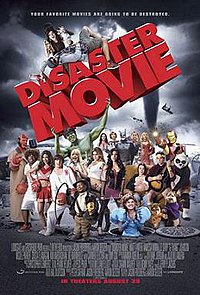
It’s an interesting point of fact that the movie spoof called Disaster Movie, actually satirizes very few disaster movies. It’s also an interesting fact that Disaster Movie now ranks at number one on the IMDB’s list of the Bottom 100 films of all-time. Could the two be connected? Maybe, because if you can’t even deliver on the most basic of promises implied in the title, you’re clearly unable to grasp the simplicities of your medium. Not that filmmakers Jason Friedberg and Aaron Seltzer have ever been lauded as prime examples of the deep end of Hollywood’s talent pool, but honestly, has there been a deficit of disaster movies the last few years.

The answer, of course, is yeah, actually. Other than Cloverfield, I had to look back to 2005 to find something closely resembling a disaster movie, War of the Worlds. So maybe this was misguided. No, wait, this really was misguided. I realize that Friedberg and Seltzer have to maintain a certain momentum, because if they stop making films the people that fund might start to realize that they’re enabling two of the most bumbling filmmakers in the history of movies. There is no self-awareness at all; no sign that either of these two doofuses seem to have any idea on how to even execute a successful knock-knock joke let alone a comedic narrative. They’re pure Baltic Avenue: cheap, efficient and horribly unfunny.

Once upon a time, there was this movie call Airplane, which slyly and subtly sent up a number of airport-based emergency pictures developed in the 1970s. Made in 1980, it’s known for a lot of great one-liners and some seminal comedic performances. But if there’s one thing it’s not remembered for is an inexplicable cameo appearance by someone made-up to look like Harrison Ford’s Han Solo or Marlon Brando’s Colonel Kurtz. In other words: everything was in its right place. Even though it was a spoof, a send-up, it had its own internal logic from which the insanity flowed.

Disaster Movie takes shots at Iron Man, Juno, High School Musical, Cloverfield, Incredible Hulk, Hellboy, 10,000 BC, Night at the Museum, Enchanted, Superbad and Indiana Jones and the Kingdom of the Crystal Skull. Many of these films, of course, weren’t even released yet while Friedberg and Seltzer were making the film and only one them has anything even remotely to do with a disaster movie. And while I can appreciate a certain creative guile in stringing all these desperate things together, I can’t deny that this is sloppy, sloppy, sloppy. Not to mention lazy, lazy, lazy. Instead of actually trying to plumb for something imaginative and maybe a little fresh, they just went to Apple Trailers with pen and pad in hand.

At least in past films like Meet the Spartans and Epic Movie, there was some degree of star-power to turn on, even if it was just Method Man and Kevin Sorbo. Carmen Electra once again contributes, taking time out her… whatever she does schedule, to fill in for Angelina Jolie’s Wanted role. This, I have to admit makes sense, it always struck me that Electra was the low-rent, D-list version of Jolie. This just confirmed it. But honestly, somewhere amongst the cast of no names and Mad TV rejects there were one or two standouts. Nicole Parker as Enchanted’s princess coolly explaining her lack of emotion while killing Speed Racer was one; Christa Flanagan’s spot on impression of Ellen Page’s Juno is another. Of course, when Friedberg and Seltzer make fun of Juno’s overwritten dialogue it seems more a matter of professional jealousy than anything.

But a couple of interesting mimicries can’t make up for the vast majority of the film where you’re fidgeting in your chair waiting for inspiration to hit on screen. I kid you not, there was an entire sequence where one superhero after the other comes out to fight a twister: Iron Man, Hellboy and the Hulk. As if to say, “Look, we know what movies came out this summer,” the filmmakers demonstrated that they have all the flair and observation of a three year old that just learned the name of something new. Consider this an indication of the IQ level necessary to get any enjoyment out of this thing.

Friday, 29 August 2008

Babylon A.D.

Rating: *1/2

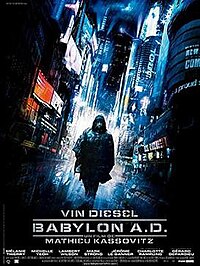
I’m not sure exactly where Babylon A.D. went off the rails, but it did. Surely everybody knows about director Matthieu Kassovitz pronouncement that Fox took his film and chopped it into a hideous CHUD of a love child and that star Vin Diesel backed him up on that 100 per cent. These tales of titillation in creative differences may be of some fascination to those interested in that part of the movie business. But what I don’t understand is how something that’s got some kind of interesting stuff going on at the periphery can be so dull and unimaginative almost completely. The film as presented seems one, long, boring trailer for a much better film, whether that film is Babylon A.D. or merely the ones that inspired it.

We once again return to our dystopian future, namely some nameless eastern European country where the native tongue is gibberish. We see Diesel’s character, Toorop, rough up some peasant for selling him a defective gun before retiring to his rat-hole apartment for some delicious dog and vegetables. It turns out Diesel is a mercenary of some repute, and an old employer charges him with taking a Nun (Michelle Yoeh) and her ward (Mélanie Thierry) from their abbey home in Mongolia and escort them to New York City. Why, is never made explicitly clear. But what is clear is that a lot of people are interested in the girl for some inexplicable and not entirely understood purpose, and Diesel is the lone wolf out to protect her at all cost. Basically the plot comes down to this: it looks cool, go with it.

First of all, somebody owes Ridley Scott a big hug and a kiss because Babylon’s Manhattan looks like a Giulianied Time Square meets Blade Runner: very pretty and very clean. And while accolades are being doled out, I think a solid is owed to Luc Besson as well, because from as far as I could understand, this is the exact same premise as The Fifth Element but with no space monsters or hammed up acting by Gary Oldman. Whom else do props go out to? Well, let’s give a shout out to Alfonso Cuaron, because the part of the film that takes place in a refugee camp is pure Children of Men. And later in the film, when it’s revealed that the girl is pregnant, you have to stop yourself from that reflex in smacking yourself in the forehead.

Aye, there’s the rub because pretty much everything up to the announcement that the super girl’s eggo is preggo makes a kind of sense so that you can just follow the action and the chases without putting to much thought into the affair. Then she says, “I’m pregnant” and you’re saying to yourself, “uh.” And if that weren’t enough, the film sort of devolves from there into a plot free-for-all that ends inexplicably with Diesel looking like a J. Crew ad applying for Dad of the Year. Then as the credits start to roll you think to yourself, “Well wait, wasn’t he supposed to be heartless mercenary?” How does somebody go from deadly killer to Ned Flanders? Well, for whoever cut Babylon, it’s as easy as scene transition.

The summer film slate has been great this year, unquestionably so. In an atmosphere like this, the term “stale leftovers” refers to the fact that you’re seeing The Dark Knight for the twelfth time. What Babylon A.D. is that place you go to after the bar on Saturday Night for some food. The place that is bad but cheap and you don’t care because you know there’s a fairly decent chance that you’ll be throwing it up in an hour and a half anyway. But then again, who can you hold responsible for this mess? Everybody involved in it, hates it. At least we all now know why.

Tuesday, 26 August 2008

Where in the World is Osama bin Laden?

Rating: ***

When I heard the premise of Morgan Spurlock’s latest documentary, a one-man pursuit of the world’s most wanted terrorist, Osama bin Laden, I thought his eyes were bigger than his stomach. It’s an unusual observation for a man that repeatedly ate through the McDonalds menu for an entire month, but the idea was certainly ambitious. Now what makes Spurlock think he can succeed where the combined militaries of the US, NATO and Afghanistan have failed? I can honestly say that I’m not really sure. As he says at the top, if action movies have taught Spurlock anything, it’s that a single man can solve complex problems through grand, sweeping exploits in limited time.

Proceeding from the point that he wants to make the world a better place for his soon to be birthed child, Spurlock decides to take it upon himself to find public enemy number one: Osama bin Laden. He travels to Egypt, Morocco, the Palestinian territories, Saudi Arabia and Afghanistan to follow the clues and talk to the people on the street, not so much to squeeze them for info about bin Laden, but to get their thoughts and opinions about America. Spurlock’s road trip takes him through some unusual places and to some unusual meetings, but is he really on the trail on bin Laden? I don’t know. It seems a long way to go to get to where you need to be.

So because of this, the documentary is largely about Muslims and what they think of America, Americans and American foreign policy. For the “They hate us for our freedom” crowd it may come as news that people of the Islamic faith actually don’t feel that much hatred for the average Joe U.S. Citizen. But for those of us who read and research and try to understand, there’s nothing really revolutionary in this revelation. Driving the point home again and again, Spurlock shows us that the average Muslim on the street is not part of some faceless horde eager to end freedom, but rather they’re affable, relatable and tolerant for the most part.

Spurlock presents his journey with his usual comic flair that given the material comes out more often confusing than not. Seeing Osama bin Ladens dancing to “U Can’t Touch This” by M.C. Hammer, for example, is comedic genius. But considering the danger Spurlock sometimes found himself, and the fact that he kept reinforcing that danger to the viewer, many of the laughs left me feeling a little weird, is he laughing in the face of death or laughing because it can look back after the fact? Also, the initial quest is doomed from the start, so why bother? If the intent was to simply interact with people in the Middle East, than just go already and do it. The whole Osama angle has stunt written all over it, and yes, eating Mickey Dees till you nearly kill yourself is as much a stunt as this, but it was a stunt with purpose.

Obviously going in I knew that Spurlock would not find bin Laden; I’d like to think that kind of thing probably would have made news outside of Variety and that the most hunted man since Richard Kimble wasn’t being held in secret till the film’s opening. So, on the one hand, I can’t say I was disappointed in this movie, but on the other hand, the entire premise is undermined from the start in this movie. However, Spurlock’s interaction with the “man on the street” was interesting, and with the director’s usual charm and humour is actually quite affecting. Because of it’s easy going manner and charisma, I think Where is worth seeing, just don’t expect everything to be wrapped up in a neat, little action-movie tied package.

Sunday, 24 August 2008

The Longshots

Rating: ***

The Longshots has certainly been beaten up by many, critically and commercially. To be honest, I wasn’t expecting much myself, which made the surprise all the more pleasant that while this film does not necessarily have the arm of the best starting quarterback, it’s got the heart of a player running out on the field to start in the Super Bowl. It’s a decent family film, with a timely and effective message that I think will resonate. But into every year comes one football movie (or two, or three, or four like last year), and while these films are usually all agreeable in their own way, they sometimes don’t succeed independently.

In this one, Ice Cube plays Curtis Plummer, a down and out ex-football hero, now unemployed factory worker caught in economic downturn limbo. Curtis’ sister-in-law asks that he look after his niece Jasmine (KeKe Palmer), after school and Curtis does so reluctantly because of the promise of $5 per hour. But Curtis starts to make a connection with Jasmine and discovers that the girl has inherited a natural aptitude for the pig skin. Fortunately, the local team is short on talent and drive, so the coach (Matt Craven) is a little more receptive to the possibility of a female quarterback. Little do they know that this girl’s crack through the glass ceiling would renew the spirits of a whole town.

Yeah, I know what you’re thinking: how contrived. About how many movies has this been now where football overcomes tragedy by stirring the hearts and minds of the downtrodden? The thought had occurred to me, and it’s valid, but I also found this movie effecting in a way that captures a spirit that reflects what’s happening in the real world right now. We know that things are in the crapper, so to speak, but there is tremendous hope that we’re on the cusp of a huge correction. It’s a populist movement that combines inspiration with self-determination. And if that message happens to come in the form of a football, well, I guess I can live with that.

Honestly, The Longshot reminded by of a movie from a few years ago called Akeelah and the Bee, which was about a girl trying to go all the way from South Central to the National Spelling Bee. Of coursing, helping the comparison is that fact that Palmer plays the main character in both films, but the two stories both use competition as a means to teach its characters the value of finding yourself and making yourself the best person you can be. Again, themes not uncommon to football movies, or sports movies in general, but it worked for me here. As did the father-daughter relationship between Ice Cube and Palmer, and the way Cube plays Curtis’ transformation from borderline alcoholic to motivated father-figure.

And to think that all of this was brought to us by Fred Durst. You may remember Durst as the record mogul/lead singer of the band Limp Bizkit, which seemed to just blink away into the ether shortly after the turn of the century. It was another one of those things that made me, in reading about this movie, take pause. But Durst direction is restrained and not overly emotional, although I do kind of wish he would kind of go into the emotionality of abandoned parents and finding family. Still, the film is very well made and Durst shows that he has more of an aptitude for filmmaking than he ever did for whatever Limp Bizkit was known for.

But ultimately what works is the film is very sweet-natured, very natural and not at all pushy with what’s it’s trying to do. For a lot of critics, the term “small town sports drama” seems to be a put down of some kind, but the thing of it is that this movie isn’t out to prove anything to anyone. Sure it’s predictable, but it’s also very pleasant. It’s a crowd-pleaser in a true sense and beating up on it has the same logic as kicking a puppy. So don’t kick the puppy, let The Longshots be what it is.

Saturday, 23 August 2008

The House Bunny

Rating: ***

There was just something about that poster for The House Bunny. You know the one, where Anna Faris in bunny ears is staring off into space out the left hand side of the frame. At once, the poster is mesmerizing, hilarious and appropriate. An image that perfectly sets up this comedy about a Playboy Bunny that finds herself on the street and turns to a “dweeb” filled sorority to find purpose and a home. This isn’t Annie Hall, but it doesn’t pretend to be either. It’s just a fun little film anchored perfectly by Faris’ mastery of the blank stare and playing dumb without being dumb.

Shelly (Faris) finds herself turfed out of the Playboy Mansion shortly after her 27th birthday. With really no marketable skills, Shelly finds her way to a local university’s sorority row, which she immediately makes the connection as “Little Playboy Mansions.” So Shelly becomes the new House Mother of the Zeta Alpha Zeta sorority, home of the seven, biggest, female misfits on campus. A hare’s breath from loosing their charter for lack of new members, smart cookie Natalie (Emma Stone) immediately sees the value in Shelly as means of drawing attention of boys, which means drawing the attention of more girls to Zeta.

Obviously there is a philosophical dilemma at the heart of the film: the fact that Shelly turns the ruggedly individual girls of Zeta into Barbie dolls in order to be popular. Okay, fine, obviously a movie called “The House Bunny” isn’t going to be a advocate for feminism, but I think it finds a relatively decent balance between the comedy and a message of be as you are. No, really. I’m being serious. It’s worth noting too that the script was written by two women, the two women behind Legally Blonde and Ella Enchanted actually, so there is a feeling at work that there’s a true female voice behind all the male pandering.

But what centres it all is Faris’ brilliantly dimwitted portrayal of Shelly. She’s endearing, even when her naivety and foolhardiness are being played for laughs, like her constant mispronunciation of “philanthropy.” At least there was no “it’s cool to be dumb” message in the end, as Shelly tries her hand at self-improvement, forgoing her previous dream of being a Playmate. Naturally, Hugh Hefner cameos, and actually has a fairly substantial part, which allows him opportunity for some self-deprecating humour. (A depressed Hef? Heaven forbid!) Stone and the other Zeta girls played by Kat Dennings, Rumer Willis, Kiely Williams, Dana Goodman and Americal Idol runner-up Katherine McPhee gel really well together and play off Faris’ bimbo routine with funny results.

But The House Bunny can’t escape what it is and that’s a light and frothy comedy that appeals to young women that can identify with the desire to be popular and get made-up to look like a model. Fortunately, there’s also enough message in the end to say that it doesn’t have to be all that. It doesn’t break any rules and serves as an above average Cinderella-story that would be more universal if it weren’t for the icky fact of the matter in what Playboy is all about. It won’t break your brain in thinking about it and that’s okay, as the film proves, you don’t have to be always thinking so good… well. I meant “well.”

Friday, 22 August 2008

Death Race

Rating: **

You have to appreciate the utter lack of pretension that a film has when it literally sells itself like the video game it is. One will never pretend that the original Death Race 2000 from Roger Corman was anything like high art, or that it was full of subtle, social commentary. But what it was, in the end, was totally Corman: big ideas, small budget, high energy. It makes you wonder what the studio was thinking when Paul W.S. Anderson walked in and said, “Hey, you know what Corman did in the original? Well I can do the same thing for five-times the price!” Done. Let cameras roll.

In this Race, the setting is a track inside an island prison, not a cross-country free-for-all. Frankenstein and Machine Gun Joe are here, Thomasina Paine though seems to have been edited out of the script at some point though. In the original, Frankenstein was a masked driver, whose identity was shared amongst numerous men; when one went down another Frank was activated to keep the legend alive. The final Frank’s goal was to win the race, shake hands with the President and detonate a concealed grenade in his prosthetic hand. Well, this Frank is still out for revenge, but it’s against the prison warden played by Joan Allen, the woman that framed him for murder.

Apparently in the world of this Death Race, just four years hence, America’s economy will be so crappy that crime will escalate to the point that jails will be too crowded to be run successfully by the government. So corporations take over, and in an effort to make money, Death Race is created. If a convict wins five races, he’s freed. Frank’s almost one five, but he’s killed in action. Enter: Jensen Ames (Jason Statham), a former racer that doesn’t remember killing his wife. The warden offers him this: win the last race for Frank and you’ll get your freedom. Machine Gun Joe (Tyrese Gibson replacing Sylvester Stallone) has other plans though, as he tries to position himself in first for the win.

Basically the whole thing is loud, brazen and loud in that order. The on screen carnage is well done and I think the film accomplishes what it sets out to do, but honestly, it’s kind of boring as well. How many times as Statham played this guy? Ooh, he’s a rogue with a heart of gold; his wife’s dead and his got a baby daughter on the outside. Innocent man and all, that’s the first time that’s happened on film. The prison conceit is new, but really kind of unimaginative. Not that I’m saying keeping the thing cross-country is any more original, but with the money this new version had to burn, getting out on the open road to different localities and settings must have some kind of appeal. Instead we see the same stretch of track and other sets for 90 minutes.

Also, I seem to remember the characters in the original being more colourful. In this film we only really get to know Jensen and Joe, even though there’re about seven other racers in cars fighting for this thing. They all seemed cut from the prison stereotype pattern book, but the movie keeps referring to them like we have anything to remember them by. Statham takes the mask off at every opportunity, so the entire mystique of Frankenstein is undermined, and Statham himself is one of those actors that, unless utilized properly, just uses his gruff voice and five ‘o’ clock shadow to emote. The one with the real mystique is Ian McShane as “Coach,” the lead mechanic and designer of Frankenstein’s car, but unfortunately most of McShane’s work involves colour commentary about the on track carnage, remarking “Now, that’s entertainment.”

Unfortunately, it’s more like that’s not quite entertainment. Many of the car race scenes are cut so choppy that you have no idea who’s doing what to whom. And you’d think the film’s one acting ace in the hole, Joan Allen, might salvage something from the more human performers, but she looked strangely plastic and robotic to me in this film. Films with criminals as the heroes are sensitive things, we expect the crook and murders to flamboyant and bad, but the hero can’t be any of those things. The Bruckheimer hit Con Air, although equally dopey, got the formula right: personality plus explosions equals a more well-rounded jailhouse action thrill ride.

I’m surprised writer/ director Paul W.S. Anderson didn’t think of that, he’s always demonstrated a magpie like ability to take bits from various movies and try to resell them is a completely new package. The first Resident Evil was a rip-off of James Cameron’s Aliens from beginning to end and his Alien Vs. Predator borrowed heavily from John Carpenter’s The Thing and numerous others. It’s funny how money doesn’t sometimes equal improvement. For a pure energy and gonzo, seemingly out of control, action experience, the original Death Race 2000 remains the superior effort. But we all knew that already, didn’t we?

Tuesday, 19 August 2008

The Wackness

Rating: ***

The Wackness is one of those movies where you don’t know quite what to make of it. On the one hand it’s a hot slice of 90s nostalgia, really the first film of its kind to capture that certain je-ne-sais-quoi that I grew up with in the early 90s – specifically the summer of ’94. On the other hand though, it’s a purely conventional teen drama about parents that don’t understand, the girl you love but won’t love you back and the fine art of drug dealing in the midst of Rudy Giuliani’s quest to rid New York of the poor and the morally objectionable. Also, there’s the creepy shrink you exchange pot for therapy sessions with…

Luke Shapiro (Josh Peck) lives on the East Side of New York; he like fly girls and dope tunes. But Luke is also barely known by his peers and at that only because he’s the local pot dealer. During the summer before college, Luke keeps up with his summer job, selling pot from behind the wheel of an ices cart. The summer also affords him an opportunity to get to know Stephanie (Olivia Thirlby) better; she’s Luke’s crush and the step-daughter of his aforementioned therapist, Dr. Squires (Ben Kingsley). Squires, seemingly bored with his life and marriage, begins spending time with Luke, if only to help steer the troubled kid away from the easily disinterested Stephanie.

Ultimately, the story is as conventional as any boy meets girl tale, and Luke Shapiro has about the same amount of flourish as your average, low-end pot peddler. Maybe that’s the point, I don’t know, all I do know is that Luke isn’t really that interesting a character. It’d be easier to root for the underdog if we knew there was something more to him than fantasizing about Stephanie and his issues with his constantly bickering over money parents (played by David Wohl and Talia Balsam). Thirlby, on the other hand, weaves just the right mix of sweetness and danger, not a physical sense, but you just know that this is a girl who’ll break your heart over giving you hers. In following the film’s odd dichotomy, Steph’s interest and disinterest in Luke makes perfect sense.

The real star though is Kingsley who offers just the right combination of authority and dementia as Squires. The good doctor is capable of both tremendous insights and riotously borderline behaviour. Kingsley’s aloof madness captivates and it affects everyone he acts with, especially Peck. The kid comes across as kind of flat a lot of the time but in the orbit of Kingsley’s quasi-depressed craziness, the actor ups his game and actually tries to match Sir Ben as the sober Ying to Squires’ Yang. There’s a great line in the end where Luke says he’s thinking about taking psychiatry in college, just as he gets Squires into drug dealing; I wish writer/director Jonathan Levine had played up that aspect to their relationship a little more, the changing balance of which one really needed the therapy of another.

Story-wise the film doesn’t try for much and simple follows the characters around from one personal disaster to another. One’s forced to wonder if that’s the point: like a long summer day, you just meander with no real goal in particular and just see where everything takes you. Not to mention the fact the film takes every single opportunity to beat over your head that this film takes place in ’94, from odd mentions of Zima to repeated shots at Giuliani’s gentrification of New York. Really, when it comes to setting, Levine should have just left it to the phenomenal soundtrack to set the scene. With tunes by A Tribe Called Quest to the Notorious B.I.G. to DJ Jazzy Jeff and the Fresh Prince, the music is a key part to The Wackness emotional pallet; it takes you there.

But The Wackness ultimately tows the middle road. On the one hand the soundtrack, the production design and even the way its shot are what takes you away and back to the time and place of the film. But on the other hand the characters are bland or are otherwise trite, while the story never really seems to take you anywhere as you listen to the now-sounding pedantic slang of the time. Kingsley’s performance is what makes this a win (barely), but otherwise, The Wackness is just wack.

Saturday, 16 August 2008

Star Wars: Clone Wars

Rating: **1/2

There’s something immediately off-putting about Star Wars: Clone Wars. Maybe it’s because you sit there expecting the 20th Century Fox Fanfare and logo instead of the twinkling keys of “As Time Goes By” and the Warner Bros. shield. It could have been just the fact I was dipping a furtive toe back into the world of Star Wars just three years after George Lucas said, “enough is enough.” In the unbearable light of hindsight, the prequels just don’t stand up, but having said that the Clone Wars microseries by Genndy Tartakovsky was the proverbial bomb as opposed to this new Wars apparently. So what do we make of the nearly unanimous negative reviews…

Well, it turns out there was more than adequate reason to fear the Dark Side because without Tartakovsky, and despite being upsized to computer generated 3-D, Clone Wars is kind of lame. It’s kids stuff. Not that I’m using that as negative, but I’m just wondering: how is this a feature? If you grew-up post-Return of the Jedi then you’ll surely remember the animated series Droids and Ewoks. (And if not, you’ll certainly remember the theme song of the later: “We’re the E-E-E-EE-EE-woks…” but I digress.) Well imagine if Lucas said, hey, why don’t we throw the first three episodes of these on the big screen. Or better still, what if he decided to bring the Ewok live-action TV movies to a theatre that was near you at the time?

Scary thoughts for an idle movie review, but these vignettes couldn’t help but pop into my mind as I sat there watching Clone Wars unfurl. The animation is nothing too spectacular, really something more belong to a video game than a theatrical film. Seriously, under a state of altered perception I might have been confused and started fumbling around looking for my joystick so I can put the thing on pause and go grab another Red Bull. It felt lacking in ambition. There was really nothing here that could not have been done live action and, if anything, it kind of reinforced the artificialities of the prequel trilogy.

Not to put too fine a point on it, but Tartakovsky’s Jedis were badass. Watch his series again and see the green, squidy Jedi blow-up a freakin’ submarine with his mind (and the Force). Watch Mace Windu leap tall buildings in a single bound. And witness Yoda as he makes two space fighters crash into each other in midair. Better still, you can actually feel a sense of (phantom?) menace in the battle droids as they swarm up on the heroes silently, brutally, none of that “Roger, Roger” crap from the prequels. Well, kiss that good bye. The Keystone Cop portrayal of merciless robots is back in all its glory in Clone Wars; I just rolled my eyes, but at least the kids in the crowd were laughing.

The story is rather tame. The Separatists kidnap the son of Jabba the Hutt and the Jedi have to get him back in order to secure a treaty with the Hutts that will allow the Republic to use their trade routes for troop movements. Anakin Skywalker and Obi-Wan Kenobi are sent to the rescue naturally. The big new addition is Anakin’s never before seen padawan apprentice, a young woman named Ahsoka Tano. I think this comes from some kind of talk as to how the Wars can be marketed to the girls better, but depending on how it plays out in the new Clone Wars series, the addition of Ahsoka does offer an important new insight into Anakin’s character. How does the guy that defies the very rules of being Jedi, teach a kid to do the opposite?

Overall, the action was well done, the film moves along briskly and the kids in the crowd seem more than satisfied with what they got for the price their parents paid for the ticket. Me? I’ve got some serious reservations. This Clone Wars feels toothless. The former animated series played well in reinforcing Anakin’s fate (destiny?), little skirts with the Dark Side that show just how susceptible he is, and I missed that here. Plus, I was less than impressed with Kevin Kiner’s “remix” variations of the old Star Wars themes. Sure, he can make Horatio Cane sound cooler than thou every week on CSI: Miami, but that hardly makes him worthy of mantle of John Williams.

In summation, I would usually say something like “for fans only” at this point, but I don’t even think that the fans are going to like it. They’re probably like me, all Wars-ed out I’m afraid. Good for the kids once it’s on DVD and you can see it in the comfort of your own home I’d say. If there’s a bright centre to the universe, this is the film project that is farthest from.

Friday, 15 August 2008

Mirrors

Rating: ***

So it wasn’t until I saw Mirrors that I realized exactly how much I missed 24 this past, disjointed, TV season. You see, in Mirrors, I had to watch Kiefer Sutherland run around, trying to solve a mystery and save his family under the pressure of an unforeseen, though no less present, ticking clock. Even his exasperated “Dammits” had Jack Bauer written all over them, the man really knows how to turn that phrase. So Kiefer, I guess it’s welcome to Typecasting City; population: you. But hey, it could be worse. As it turned out 24 might have been a terrible though popular show. And the same could have been said for Mirrors too; but more that first part than the last.

Sutherland plays Ben Carson, a former NYPD detective riddled with guilt after riddling a man full of bullet holes. Trying to build some semblance of a normal life, Ben takes the night watchmen’s job at a burnt out old department store, which itself was a former hospital. So just to recap: fire plus dead people, plus old hospital closed for mysterious reasons equals not good. Naturally, the ghosts in the place start haunting Ben through their domain: the mirrors. As Ben begins to feel the pressure of the store’s spiritual inhabitants to find the missing “Esseker,” his friends and family begin to think he’s not as healed as he thinks he his from his trauma. But what happens when the entities from the store’s mirrors start following Ben and family from any reflective surface?

So yeah, I was prepared to have to take this film to task as another unfortunate victim of poorly plotted, poorly acted, not even remotely scary horror, especially coming from the director of The Hells Have Eyes remake. But surprise, the film actually shows a lot of life and more than just in the way that Sutherland is shown that he’s as adept at ghostbusting as he is at terrorist chasing. But part of the fault lies in that Sutherland is really the only member of the cast that sticks out, and you know when even the creepy little boy can’t work up enough creep you’ve already lost half the battle. But seriously, the whole production seemed to go to great lengths to make Ben more like Bauer; they dress the same, react the same to set backs and both are haunted (though in Bauer’s case, that’s more figurative.)

Another winning aspect of the film is the production design. The look of the Mayflower (the name of the burnt out husk of a store) is immaculately conceived and executed; with multiple levels, multiple nooks and crannies, to hide stuff around, and multiple mirrors from which to perceive the various horrors. Alexandre Aje plays that notion of confused perception, the corner of your eye factor, very well. The way he stages a scene, every mirror becomes a potential threat and he’s not shy of gore to boot although he uses it rather sparingly. There weren’t any real gotcha moments, which really costs the film, but I do like the compelling mystery at the centre of the story. It actually does not disappoint, even when one particular scene near the end strikes you with its borderline ridiculousness.

But I stand by a recommendation in favour of this film. I think that it manages to rise above its faults and become a rather interesting piece in its own right; satisfying on an audience level if not completely original in execution. Sutherland has the gravitas to make you believe that he’s fighting in any life-threatening situation, plus he looks comfortable as a family man. As I said, Mirrors doesn’t really jump out at you but its compelling enough that you follow along to the very end.

Wednesday, 13 August 2008

Tropic Thunder

Rating: ***1/2

If you’ll pardon the pun, the new comedy Tropic Thunder has been taking a lot of heat lately. First, activists for the mentally disabled picketed the premiere because of the film’s frequent use of the word “retard” in reference to a character played by Ben Stiller’s Tugg Speedman to prove himself a dramatic actor. The other controversy is the fact that Robert Downey, Jr. is playing a veteran method actor that has his skin darkened so that he can play a Black man, which has led to accusations that the film is promoting the racist practice of “Black Face.”

I honestly don’t think these things crossed the mind of Ben Stiller as he sat down to co-script and direct Tropic Thunder, a movie within a movie about spoiled actors deposited in the jungles of Vietnam supposedly to shoot a war movie guerrilla-style. No more so than the notion that all successful comedic actors get hooked on heroin, or that Vietnam vets fake their injuries to elicit sympathy or that Hollywood special effects technicians are borderline pyromaniacs. What Tropic Thunder is nine times out of ten is a swift and brutal farce and send-up of the world of big budget studio filmmaking.

The film begins with three faux trailers depicting each of the stars (or rather their version of the star they’re parodying) in their element. Stiller’s Speedman is an actor known for his action franchise Scorcher, which inspired a number of sequels, including the new Part VI, Global Meltdown. Downey plays Russell Cr… I mean, Kurt Lazarus, an Australian method actor whose new movie (co-starring Tobey Maguire) is a tale of gay priests called Satan’s Alley. The final member of the triad is Jeff “Fats” Portnoy, whose big franchise is The Fatties. Think Eddie Murphy’s Nutty Professor films, but somehow more offensive.

So on the surface, Tropic Thunder leaves no member of an identifiable ethnic or minority group unscathed, but the real target of the film is Hollywood. Downey’s portrayal of a man who gets so deep into his role that he can’t fins his way out again is drop dead hilarious. Downey (or is it Lazarus’) portrayal isn’t offensive, it’s actually rather respectful. And if things are looking like they’re getting out of line there’s Brandon T. Jackson as rapper/mogul/actor Alpha Chino to keep him in line. As for Stiller, well, I can see how people can get upset, but I think the intent is clear: to poke fun at actors that take a specific type of role with the intention of getting acclaim.

But part of the fun comes from an unexpected source. In what has to be one of the worst kept secrets concerning this movie, Tom Cruise makes an appearance as studio chief Les Grossman. Wearing a bald cap and fat suit, Cruise becomes the personification of everything we expect to hate in studio bosses; from launching a vitriolic, profanity filled diatribe against the militants holding his star hostage to trying to bribe said star’s agent with a G5 jet to get him to forget about it. It goes along way to restoring faith in Cruise as an actor rather than the caricature of himself he’s become in the last few years, especially when still is channelling his movie star fortunes for Speedman.

The action sequences are impressively shot with all the technical prowess of a major action film production and in the interest of imitation as the highest form of flattery, look for little winks and nods to all kinds of different Vietnam movies. But the real special effect is the chemistry between the five main characters: Stiller, Downey, Black, Jackson and Jay Baruchel, the only male cast member of Freaks & Geeks Judd Apatow hasn’t given a movie to. Throw in Nick Nolte as the grizzled vet and you’ve got a stellar cast to bring this subversive Hollywood satire to life. A great pseudo-action flick to wind down the summer with.

Tuesday, 12 August 2008

Mongol

Rating: ***1/2

Genghis Khan: a brutal warlord bent on conquest or a guy having a really bad couple of years? Certainly, the film Mongol leans toward a very understanding portrayal of Khan, a man who before he became the brilliant military leader he’s remembered as, spent half his life on the run and the other half as a prisoner. Give the givens, you can almost understand his forward-thinking quest to unite all Mongel people under his flag and try and conquer the known the world. In Sergei Bodrov’s Academy Award nominated film, we see a Khan that was forged in the wilds of Mongolia and what went into making his one of the most feared and revered names of the ancient world.

The film begins with Khan as a child (played by Odnyam Odsuren as a youth and Tadanobu Asano as an adult). Named Temüjin by birth, he’s taken by his father to a neighbouring tribe to pick out a wife, whom he won’t actually marry for another five years. On their way home, Temüjin’s father is killed by a rival, and in the ensuing chaos his tribe leaves him and his family alone to fend for themselves. Spending many of his best years bouncing from starvation to humiliation to slavery, Temüjin always somehow manages to escape and survive. As a young man, Temüjin struggles to make a life with his wife and children, only to realize that for their protection he needs to unite the clans. A legend is born.

Mongol is a sweeping, action-filled epic as only Hollywood can do, except Hollywood’s not the one behind this. Think Braveheart, think 300, think Gladiator because I honestly can’t remember another treatment of Khan like this before. Is it a tad anachronistic? Yeah, probably. Scenes of Genghis Khan all Father Knows Best is kind of jarring in an unexpected way, but I was more than willing to follow along. No one’s totally a monster, of course, and while some artistic liberties were taken, it did create a whole character and brought Khan down to a level we could all understand outside of the legend.

The cinematography by Rogier Stoffers and Sergei Trofimov beautifully captures the Chinese countryside as a frontier - miles from anywhere; earth tones pop to create a sense of realism and a documentary look. Also, I admire Asano’s portrayal of Khan as something far from the typical reading of the man. He’s a strategist, he’s patient, and he’s cunning. These aspects along with the portrayal of Khan as a family man and dedicated husband makes the film feel like they’ve discovered someone entirely new rather than a historical figure already notorious for centuries. Considering that we only see maybe one major campaign, the focus of the film is on character and relationships. It’s unusual for a film about one of the world’s top ten conquerors.

I do have some reservations though. The big battle scene seemed kind of forced after nearly two hours. The thing is this movie is epic, but it’s more of a feeling than it is a literal example of the genre. So when I saw a CGI created horde, it kind of brought me down because it felt kind of tacked on; like someone said, “We need at least one huge battle make this thing complete.” The film also goes into incredible detail about Khan’s early years, but the thing does become a tad repetitive as he goes from life with family, to life on the run, to life as a prisoner to escape, when the whole darn thing starts over again. And at times the film suffers the fate of the bio-pic; it’s a marathon of going through the motions in order to get Khan from point to point to point. It can get kind of stagnant as it feels like the characters are being manoeuvred rather than playing their role.

Still, Mongol is worth seeing because it does show this character in a way I don’t think we’ve ever seen him before. And despite the set up and the script it’s still an amazing feat in that it’s a big budget epic for a low budget indie price. So many movies spend so much and amount to so little. Mongol proves that you don’t need to be big to think big and that the word ‘epic’ is relative to your means.

Monday, 11 August 2008

Young People F***ing

Rating: ****

With a provocative title like Young People F***ing, it had better deliver on its promise, because just the fact of the title alone is enough to bring a storm down on you. Fortunately, the movie with the name that can’t be said on television or seen on a movie poster, is actually, at its heart, a delightful, honest and irreverent sex comedy that’s neither juvenile or gross. More blunt and tart than the Sex and the City movie and more grown up than the likes of American Pie, YPF manages to navigate some tricky logistical ground by creating a film that’s probably not what you think.

The film intercuts between the various dalliances of four couples and one threesome. Matt (Aaron Abrams) and Kris (Carly Pope) are long-time friends that have hit a dry spell in their romantic lives and find a solution in each other. Jamie (Doira Baird) is just looking for a one night stand from the roguish Ken (Callum Blue). Exes Mia (Sonja Bennett) and Eric (Josh Cooke) seem to be not quite over each other. Andrew (Josh Dean) and Abbey (Kristen Booth) have been together for a while and are worried that the spark is gone. And Gord (Ennis Esmer) invites Dave (Peter Oldring) to bed his girlfriend Inez (Natalie Lisinska) in order to live out a fantasy.

That’s pretty much all there is to it. The action, so to speak, is not only divided among the five encounters, but is separated into the six stages of sex, I guess you’d call them: prelude, foreplay, sex, interlude, orgasm and afterglow. Considering all the little subdivisions, the film moves along at a pretty quick clip, but they may just come from the fact that you’re having such a good time watching it. (Not like that, you perve.) It’s open and honest and if it’s funny, the reason is often because navigating the desire for sex is sometimes, in itself, a little humorous. The script as written by director Martin Gero and Abrams is aware of this and thus it deals in a genuine reality.

As for the notion that the Conservative government’s Bill C-10, a law saying that government can retroactively take money away from a movie they find offensive, was partially tabled because of this film, I say, “Wow. Clearly, no one in the Conservative caucus has seen this movie.” In fact I know they haven’t, a special screening was set up for members of Parliament and not one Conservative showed up. And some poor guy in Gary Goodyear’s office was apparently fired for reserving a ticket without permission. It’s too bad that this film has become a rally point for the pro-C-10 crowd if true, because frankly, they can find better examples.

Is it because there’s a swear in the title? Probably, but hey it gets one’s attention. Not to mention the fact this is a case of name the thing what it is. Remember Snakes on a Plane? Well, it was about snakes on a plane. It wasn’t that complicated. The same holds true for YPF, just a bunch of good looking twenty-somethings doing the deed. The talented and energetic cast approach the material with reckless abandon and play their roles for all their worth. No one’s playing to the cheap seats and you never get the impression that their was a lot of immature snickering after the camera stopped rolling. Pope, Booth, Dean and Desmer are the standouts I think, but honestly there’s no one here in this film that isn’t doing great work.

I think spoiling too much plot wise will get in the way of your enjoyment and besides the point, there’s really not that much to spoil. It’s straightforward, it’s funny and it’s just generally well made. Anyone that thinks this movie is offensive, purely on the grounds of it’s title or subject matter, clearly needs to get the pole removed, either that or cable TV. This is a great little film, very Canadian, and very funny. See it with someone you love or are otherwise about to love.

Friday, 8 August 2008

Amal

Rating: ****

On the surface, Amal has everything that you’d never find in a summer crowd-pleaser: it’s got subtitles, it takes place in a foreign land, there are no costume characters wailing on each other. But this Canadian film, the feature debut of North York native Richie Mehta (no relation to Deepa), is an as light as air fable about the spiritual wealth of the have nots versus the moral bankruptcy of the haves. It also packs a wallop at the end with a subtle and surprising a twist as anything M. Night Shyamalan could have come up with during his Sixth Sense days of auteur status.

Amal is the name of the title character played by Rupinder Nagra, a simple autorickshaw driver that tours New Delhi daily, ferrying passengers to and fro. Amal is an anomaly amongst drivers because of his honesty and polite manner; he does not begrudge his position on the low end of the totem. He one day drives for G.K. Jayaram (Naseeruddin Shah), by all appearances a common street vagrant, but in reality one of the richest men in Delhi. As he’s dying, Jayaram is searching the city for a last shred of humanity and finds it his humble rickshaw driver. Before dying, Jayaram drafts a new will that leaves his entire fortune to Amal; his estate has a month to find him before that fortune goes to Jayaram’s two greedy sons.

As I said: simple. It’s a fable with archetypes and structure, obstacles and things to solve, relationships to forge. The film is anchored by Nagra’s beautifully subtle portrayal of the titular character. There’s something almost magical about Amal, even if that magic is as simple in his down-to-earth decency. You want to argue the point that there aren’t many people like Amal out there anymore, but that derides the film’s underline insistence that there are diamonds in the rough out there and that perhaps we each need to take up a Jayaram like quest to find them and be enriched by them. Nagra has such wonderful presence throughout the story that you’re have tempted to tap him on the shoulder and say, “Yo, that kid you drive from school? His lawyer mom is sitting on a small, large fortune for you.”

Part of Amal’s magic is the relationships it develops. One subplot involves a young pickpocket who Amal helps after she’s hit by a car. In a stunning act of self-sacrifice, Amal sells his father’s rickshaw to pay for the girl’s operation. There’s also Amal’s mother (Amardeep Jha), who worries about her son always out in the madness of New Delhi’s streets and pushes him to find a woman to marry and settle down with. This leads to a rather light-hearted moment where one of Amal’s fares, the lovely Pooja (Koel Purie), with whom we’ve seen obvious romantic sparks, shows up on the family’s stoop with the present of a carburettor for Amal to repair an abandoned rickshaw. Pooja tells Amal that she used the money she was saving for her dowry, now many think of a dowry as an outdated example of patriarchy, but here Mehta uses it as a beautiful romantic gesture.

This wonderful tapestry of characterization, including Jayaram’s selfish son Vivek (Vik Sahay), creates a real and enriching story to become involved. And the ending, which I will not spoil, is as profound as it is simple. It’s not a gotcha moment, it’s a simple matter of fact and makes you think about your own perceptions and realities and assumptions in an immediate and impacting way. Mehta’s gift is elegance. He can tell a story so simply, you’re not even aware of the filmmaking involved. Amal wraps you up and sends you away thinking that there is hope in the world thanks to its lowliest of citizens. A wonderful film and a must see.

Thursday, 7 August 2008

The Sisterhood of the Traveling Pants 2

Rating: ***1/2

First of all, try to contain yourself. Yes, I’m reviewing The Sisterhood of the Traveling Pants 2. I went to the theatre with the intention of seeing it, went into the screening, spent two hours watching it and am now writing positively about it. It might also interest you to know that I’m reading Twilight right now, and if that makes me a big girl in your humble opinion then I readily accept that. Now let’s move on to the actual review. And what we have here is a movie that despite its soapy, girl-friendly storytelling is actually quite winning and charming for those amongst us who are normally more comfortable amongst the slaughter in the theatre next door.

The film reunites the four young stars of the original: Amber Tamblyn, Alexis Bledel, Blake Lively and America Ferrera. After a year away from each other at separate colleges, the sisterhood returns home to find that they’re once again going their separate ways for summer vacation. Tibby (Tamblyn) stays at film school in New York to work on the romantic-comedy script project she bungled during the school year. Carmen (Ferrera), feeling edged out with her mom’s new husband and pregnancy, heads to theatre camp. Bridget goes to Turkey for an archaeological internship after learning her father had hid years worth of letters from her grandmother in the basement. And Lena (Bledel) takes an art school course and falls for the male nude model.

And all along the journey, the magical jeans of the title are passed around from one to the other. The pants are actually kind of an afterthought amongst all the drama and romance in the lives of the four leading ladies; the screenplay is culled from the plots of the second, third and forth of the original Sisterhood books by Anne Brashares. So the film moves surprisingly quick, packing about four summer’s worth of excitement into a single whip of a narrative. The plots have all been done, but that’s surprisingly inconsequential, something about it feels fresh enough to pass muster and I know what this. But seriously, when a character in the movie starts remarking about sounding like an after school special…

Obviously the secret ingredient is the cast. What’s especially impressive is how the four main actresses spend little time together on screen but can somehow so easily convey the feeling of a lifelong friendship. I don’t think you can single out one of the girls as better than the other; they’re just all perfect in their own way. Tamblyn mixes sarcastic and sweet with Tibby while Ferrera is endearing as the reserved though slightly klutzy Carmen. Bledel also plays it sweet but with a bit more romantic bite when it comes to Lena’s storyline and Lively carries a lot of the heavier emotional baggage, world’s apart from her Upper East Side alter ego on Gossip Girl, as Bridget.

So yes, I was as surprised as much as anyone when I got wrapped up in The Sisterhood of the Traveling Pants and their globetrotting slacks. What can I say? Would I have sought this film out had it not been my intention to review it for this fine, upstanding web-based publication? Probably not, but I’m glad I did and no matter what way you find yourself seeing this movie – man, woman or child – I think that you will be too.

Wednesday, 6 August 2008

Pineapple Express

Rating: ****

What kind of demented genius thought to put a couple of stoners in the middle of a police shoot ‘em up? Well, whatever the reason, or wherever the idea came from, it is inspired because the result is the pot-fuelled action comedy vehicle called Pineapple Express. Named for the wonder weed at the heart of the nearly two-hour trip of a trip, the film struck me as a kind of response to all those times you’ve watched an action movie, got high and told your buddy, “I know how we’d handle this situation…”

In the film, the situation is that process server Dale Denton (Seth Rogen) sees drug kingpin Toby Jones (Gary Cole) and a police woman accomplice (Rosie Perez) kill a rival dealer. In his haste to get away from the scene, Dale tosses his roach, which Toby quickly identifies as that dopest of dope: Pineapple Express. Only one guy in the city has it: Saul (James Franco), Dale’s dealer and would be best friend. The two go on the run and try to stay one step ahead of Toby’s bickering assassins (Kevin Corrigan and Craig Robinson), Saul’s double-crossing supplier (Danny McBride) and Dale’s clingy 18-year-old girlfriend (Amber Heard).

From this humble set-up, we get the remarkably hilarious story of male bonding and friendship in spite of the dangers in duplicitous drug dealers. What works is the central comradery of Rogen and Franco, their odd couple back and forth when sober and unedited stoner speak while high is what puts you in the comfort zone right away. You know these guys, you like them, you want to see them become the true best buds you know they can be. It’s a platonic, hetero romance in a way; Saul wants to hang out with Dale, whom he thinks is the coolest of his users, while Dale just wants his quarter drive-thru style: just in and out.

Now we know Rogen’s work and we know that he can play dumb stoner slacker in his sleep, but as God as my witness I’ll never get over the sight of Rogen leaping like Rocky the Flying Squirrel at pistol-packing Gary Cole. It’s worth the price of admission alone. But while this may be true, the real revelation is James Franco, who typically seems so bland, but something definitely comes alive in him as he plays Saul. Also surprising was Ed Begely, Jr. as Dale’s girlfriend’s dad, playing against type as an over-reacting, shotgun shooting, typical middle-class father. Meanwhile, Rosie Perez also defies type by not being nearly as annoying as she used to be.

Directed with an indie sensibility by David Gordon Green (Snow Angels), Pineapple Express works on numerous levels. It’s the perfect amalgam of action and comedy as laughs never fail to connect even in the midst of a gunfight or car chase. It leaves you in stitches (although not in the same way McBride’s Red is by the end) as your leaving the theatre replaying your favourite scenes in your head. Is it high art? No, it’s just high, but even that’s not the point. Poignant lessons about friendship and the awesomeness of three-piece, heart-shaped friendship necklaces – now that’s a pot comedy worth investing in.

Tuesday, 5 August 2008

Encounters at the End of the World

Rating: ****

Well, if I didn’t get sick of Antarctica after Hot Docs this year, I guess I was never going to be. Good thing too, because Werner Herzog’s latest masterpiece is a brilliantly quirky and slightly philosophical look at the scientists and the science happening at the bottom of the world. Herzog finds some amazing visuals in the deceptively desolate landscape and beyond that finds incredible humanity as well in the merry band that make up the residents and inhabitants of Antarctica’s McMurdo Station. The result is a thoughtful, awe-inspiring look at the South Pole for all that live there, while not just being another “penguin movie.”

Herzog and cinematographer Peter Zeitlinger went to Antarctica as part of the National Science Foundation's Antarctic Artists and Writers Program, which helps writers and artists who wish to work on the continent in order to expand the its understanding by the public. Working just seven weeks in total in order to conceive the film with only two of those reserved to shoot it, Herzog openly admits at the beginning of the film that he wasn’t sure what he was going to get out of the trip. Though eager to explore some highly existential topics on his mind, Herzog is clear on what he’s not going to Antarctica to do, and that includes spending all of his time in McMurdo.

It begins with survival training; anyone that wants off the base to explore the continent has to pass this two day trial that includes building your own igloo/snow fort shelter and spending the night in it. Having passed (I suppose) Herzog and Zeitlinger begin visiting various research stations in the surrounding area. Among them was a team studying seals whose call in the water under the ice sounds not unlike an R2 unit; if you didn’t know it was the seals, you’d swear there was a synthesiser near by.

Naturally, Herzog eventually gets to the Penguins but rather than going cutesy, Herzog manages to convey emotions both hilarious and haunting. The image of a lone penguin walking with haste towards the inner land of the continent is once funny, until Herzog’s narration points out that the little bird is about to walk 5,000 miles to its death, and even if researchers caught him and brought him back to his nest, he’d just try it again. What compels him, Herzog ponders, and until he can see inside the mind of a penguin I guess we’ll never know.

Borderline insanity seems to be inherent in the story Herzog is trying to tell; the proverbial craziness of the people that pack up their lives and head to Antarctica. We meet a man from Colorado that left a job in banking to join the Peace Corp before being a driver of a Terra-bus at McMurdo. The station’s plumber escaped oppression in his home country and always keeps a backpack of emergency provisions “just in case.” Many there are researchers and professors from the universities of the world, while others are gypsies travelling the world, looking for the next frontier to challenge them.

The notion of frontiers and the philosophy of exploration are two of Herzog’s many themes in the film. Desolation and isolation are others. He touches on climate change, but seems more interested in its implication, ie: the end of the human race. The film seems as much the director’s diary of the trip rather than a well-thought out and purposeful movie that the trip was built around.

Herzog brilliantly weaves a lot of different threads and creates an almost exhaustive look at the continent out of a scandalously short 99 minutes. With limited means and limited time, Herzog once again proves his skills and talent as a filmmaker, where others might have been overwhelmed by the subject. Encounters at the End of the World is the next best thing to being there.

Saturday, 2 August 2008

Swing Vote

Rating: **

Somewhere inside Swing Vote is a residue of a good film. Certainly in its heart there’s a kernel, a seed, from which a tall and mighty oak tree of a film could have grown. But somewhere along the way, the tree got… uh, tree cancer, and started to bend over and shrivel. It’s too bad too because I think that the movie certainly has the talent in front of the camera to take it very far. But in an important election year for our neighbours down south, Swing Vote treats the matter almost frivolously, despite the fact that its intentions are the exact opposite.

Kevin Costner plays Bud Johnson, a slack about drunk that when he isn’t disappointing his daughter or showing up late for his job as some kind of egg sorter, is drinking himself into stoopers at the local swill barrel. It’s Election Day and Bud’s precocious daughter Molly (Madeline Carroll) wants him to vote, having learned the importance of it in civics class. When Bud fails to show after a post lay-off bender, Molly tries to sneak in and vote for him before the polls close, only the electronic terminal looses power in the middle of voting.

From there, the film pretty much unfolds as shown in the commercials and the trailers; Bud’s vote, though cast by his daughter, doesn’t count. The whole election comes down to Bud’s vote as it holds up the returns for one county in the state of New Mexico, which will resolve the tie game between the candidates. Both men, Republican President Boone (Kelsey Grammer) and Democratic challenger Greenleaf (Dennis Hopper), descend on the small New Mexico town to directly appeal to Bud, who slowly comes to realize that maybe there’s something more to this whole voting thing other than it being a nuisance to go through every four years.

Like Robin Williams Man of the Year, Swing Vote has its heart in the right place, but it’s woefully sappier than the former while doing so with less product placement. It’s pretty astute about the slings and arrows of political pandering, but then again if you’ve watched the news in the last 20 years you’ve done about the same amount of analysis that the movie does. The film’s only, truly inspired moment is during Greenleaf’s abortion ad, which is staggeringly hilarious and utterly satirical in a way the completely escapes the majority of the rest of the film.

The moral lessen seems to be that any meat-eating, beer-drinking, NASCAR-loving American can find their inner progressive if only the outcome of the election came down to them, and they receive a ton of mail from desperate people across the country. The film’s trying to be George Seaton, or worse, Frank Capra, but it feels tired and forced, especially because the characters in those films are already engaged and aware before stepping into a fight against a system otherwise. But Bud Johnson is none of those things. He may be certainly an average representation of the view (or rather Hollywood view) of your average, Bush-voting, fly-over resident, but that doesn’t mean we have to like it.

In different times, leaving the fate of the “free world” in the hands of a red neck doofus like Bud may have been funnier. Basically, the political stuff doesn’t work and Bill Maher, in a rare cameo, hits the nail on the head with the indictment of this character. What does work, and very well, is Bud’s relationship with his daughter. Though it kind of reminded me of Homer and Lisa Simpson and what if they were left alone together, which is kind of a lofty comparison on one hand, but on the other, it’s pretty close. But the chemistry between Costner and Carroll makes you feel that father daughter connection.

But a lot of what Swing Vote is about has been done better by other films; Dave, Wag the Dog, even King Ralph. Combine that with a terribly inconsistent tone, like when Bud makes a heartfelt speech that’s about 50 IQ points above anyone in this film, and you get a movie that doesn’t deliver on the lofty ambitions it has. I know that elections are treated as beauty pageants, I know network news treats us like we’re idiots, and I know Swing Vote should have been better, but isn’t.

Friday, 1 August 2008

The Mummy: Tomb of the Dragon Emperor

Rating: **

If anything, The Mummy: Tomb of the Dragon Emperor proves that it’s sometimes better to quit while you’re ahead. To put it simply: this film is painful, both in its conception and in its viewing. Could it be because that the main creative force behind the first two films ditched and has been replaced with a couple of new guys that can’t find that same magic and seem as if they didn’t even really try? Leave to the guys that drove Smallville into the ground and the visionary behind Stealth to concoct a Mummy movie that’s no fun at all.

Taking place in 1946, Rick O’Connell (Brendan Fraser) and his wife Evelyn (Maria Bello, replacing Rachel Weisz) are enjoying a quiet retirement, much to their disappointment, when the British Government press them into service for a special delivery to China. Meanwhile, their now grown son Alex (Luke Ford) has dropped out of school and is participating in an archaeological dig in China. The mummy found is the once mighty emperor of China (Jet Li), who built the Great Wall and buried his enemies beneath it. Naturally he’s awaked and the mayhem begins as the O’Connells chase the Mummy from the lost city of Shangri-La to the Great Wall of China.

Now I know that the previous Mummy films under the guidance of Stephen Sommers were frequently lambasted for being empty calories, but the joy of eating such a sugary treat, which was once so desirable, is gone. Sommers took a lot of flak for aping Steven Spielberg in his design and execution of the first two films, so what will become of Rob Cohen I wonder because so much of this third Mummy is lifted from parts one and two. When you get to the third film in the series, you better be offering something new and not just the same old recipes, granted mixed together, but two old things mixed in a pot don’t necessarily make a new thing.

If the actors seem so disengaged from the material, or are just otherwise misused. Fraser just isn’t the same without Weisz. Their chemistry was palpable, so much so that you didn’t even notice until it was gone. Bello does her best as a sub, but the result just isn’t the same. And speaking of talent wasted, there’s the case of Jet Li. A martial arts master that needed the Mummy franchise like the world needed another Indiana Jones. He gets the same treatment The Rock got in The Mummy Returns and the problem is we know he’s capable of so much more. The guy’s got such great charisma, so why stick him in and playing so bland – it’s embarrassing.

Which brings us to the action scenes. Now in a movie that features not only Jet Li but Michelle Yoeh as well, you expect to see some wicked stuff; the two are a couple of the best in their field. It only makes sense then that Cohen would so utterly bollocks what should have been the no-brainer part of the whole picture. Instead he takes in the camera way too close so that all the fight scenes are just a jarring fury of fists and grunted faces. But of course he pulls way back for the CGI wizardry, which, thanks but no thanks, we’ve seen all before.

The shame is that there are a lot of talented actors involved, who, if given the chance, are capable of a great deal. The material leaves you hanging, but more importantly it leaves you with the question: why was this even necessary in the first place? It’s a franchise exploitation picture like all those direct-to-DVD American Pie movies, put a name on it and they’ll come and get it. Unfortunately, I don’t think that’s how it’s going to go down this time.