Monday, 30 June 2008

The Stone Angel

Rating: ****

This adaptation of Margaret Lawrence’s popular novel is an emotional epic that’s sweeping in its resonance even though it barely leaves its rural Manitoba setting. The intimate story of a liberated woman that came of age in unliberated times is a great character piece that features a lot of tremendous acting, at least for the most part. It’s got soul, it’s got rhythm and it’s got blues, but occasionally it also scales the heights of emotional freedom; knowing that while you didn’t necessarily live a life free of regret, you certainly tried your best not too.

Hagar Shipley (played by Ellen Burstyn) is in the last days of her life, but that doesn’t stop her from being pushy, opinionated and stuck in her ways. Her son and daughter-in-law (Dylan Baker and Sheila McCarthy) want to move her to a nursing home, naturally she refuses. Hagar slips out of her sons home one night and heads out on a journey of rediscovery, piecing together the memories of her past despite her age. Back in her youth (Hagar’s younger self is played by Christine Horne), Hagar returns from university to becom involved with a poor farmer named Bram (Cole Hauser), disappointing her father and leading to a bumpy road to closure between her and her son.

This beautifully acted movie revels in true sadness, the type of sadness that can only come from life and the tragedy that goes with it. Whether it’s the tragedy of watching a loved one slip away from you mind and body or the tragedy that comes from being powerless to prevent it. Writer/director Kari Skogland (Chicks with Sticks) keeps a strong literary mind with the film by not watering the narrative down with extranious action or exposition. Still, the film flows easily across the decades, the storylines of both the older and younger Hagar tied together with the unknown consequences of pursuing one’s own life and how those mistakes can be translated across the generations.

Burstyn owns Hagar and is absolutely magnetic every moment she’s on screen. More than that, her own performance as the charcter haunts Horne’s, but I mean that in the best way as the two compliment each other and augment the other’s performance. Ellen Page gets high billing for her small, though merely compitently acted, role when it’s Aaron Ashmore (younger brother of Iceman Shawn) that gets to do a lot of emotional heavy-lifting as Hagar’s brother. Also good is Baker as Hagar’s grown-up son, who has to navigate the strong character of his mother with his needs of his wife. Baker is so good at projected that sense of fuming underneath the surface, you can practically see the steam coming out his ears.

Of course, I’ve been reading mixed things about the film, a lot of people who are fond of the book are not so fond of the movie. Having not read the book though, I can judge the film on its own merrits and from what I can see, it turns out fine. Very fine, in fact. It’s lead easily through with above solid performances from its main cast; even paparazzi-slayer Cole Hauser manages to find a few more fascial expressions than ususal. It’s well made, well acted and just generally well done.

Saturday, 28 June 2008

Wanted

Rating: ***

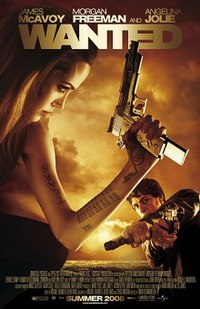
One part office drone fantasy, five parts unrelenting action spectacle, Wanted has all the ingredients to be a summer smash. Combine that with Angelina Jolie as the femme fatale, a comic book origin for the story and an up and coming, talented foreign director and you’ve got a practically unbeatable recipe for success. Well, Wanted certainly has spunk but like an all you can eat Chinese buffet, you gorge yourself on the offerings only to find yourself hungry a few hours later. Empty calories? Sort of, but there is something about this film that doesn’t sit quite right afterwards. It doesn’t linger in a good way like Iron Man and it certainly doesn’t make you anxious to have another go.

Based on a graphic novel by Mark Millar and J.G. Jones, we meet Wesley Gibson (James McAvoy) as a harmless, ineffectual, anxiety prone account manager that “only cares about not caring about anything.” Until one day when Wesley meets Fox (Jolie), who tells him that the father he never knew was the world’s best assassin and part of a group called the Fraternity. “Kill one; save a thousand. That’s what we believe” says Fox. The Fraternity’s leader Sloan (Morgan Freeman) persuades Wesley to join up and harness his inner killer in order to help the Fraternity find rogue agent Cross (Thomas Kretschmann). But is the Fraternity as advertised, or is there something more going on that Wesley doesn’t know about?

Firstly, the action is tremendous in Wanted. Director Timur Bekmambetov (Nightwatch, Daywatch) infuses those scenes with a post-Matrix, post-Bourne mindset where the movement is quick and the action itself defies what’s physically possible. It’s smooth but visceral, as Bekmambetov moves the camera around in a way not possible in normal space, combining the very best of CG and practical effects. The adrenaline really gets pumping and you just groove to the thrills as the film pulls not punches. And when they say this is an R-rated film, you better believe it is; you can see every brain splatter and hear every bone crunch.

But that’s not to say that Wanted doesn’t have a down right laughable side to it. So much so that it surprising these little things don’t bring the whole house down. Apparently the Fraternity was started from a society of master weavers and they get their instructions from the “loom of fate.” Now granted the master loom is a great visual, but come on? Weavers. Loom of fate. You’re really pushing things there with the suspension of disbelief and have inadvertently prove that just because some stuff works in comic books it doesn’t mean necessarily that it’ll translate to film.

But aside from matters of the origins, there’s Wesley’s seemingly blink of an eye transformation from Peter Gibbons office punching bag to Jason Bourne-style super killer. It’s rather funny to see Wesley come to realize that all the things he’s been feeling are seemingly connected to his rightful destiny as a super-powered killer, but the turnaround fires so quickly it makes you snicker in Wesley’s seeming indecisiveness. Although the film does play up well that element of fantasy and wish fulfillment: telling off your obnoxious boss, or smacking your smart alecy friend in the face with your ergonomic keyboard.

Unfortunately, these are the only scenes where McAvoy shows some signs of life, otherwise he’s wandering around looking like a deer in the headlights even when he’s supposed to be taking charge. And given the fact that many of McAvoy’s scenes are with Jolie, he really needed to be more focused in order to keep the action centred on him because she quite nearly steals every scene. Jolie, with her looks, her swagger and her strong, silent personality, is the perfect bad girl and is absolutely magnetic whenever she’s in frame. Morgan Freemman, meanwhile, appeared to be having fun doing his best Samuel L. Jackson impression.

Wanted will undoubtedly be satisfying for the summer, action junky crowd but ultimately it’s void of deeper meaning. I don’t feel any particular desire to see it again or wait for a sequel in order to follow the further adventures of Wesley Gibson; there’s something just too nihilistic about the story and concept and the supposed twist was not very twisty. Frankly, I’m not even sure where a sequel could go from here. Still, it’s an impressive movie technically that highlights the work of a pronounced, new filmmaking voice.

Friday, 27 June 2008

WALL-E

Rating: ****1/2

We are at a point now for Pixar where the animation house that launched the 3-D cartoon revolution is beyond being simply the maker of quality family films. With Ratatouille and now WALL-E, Pixar affirms its place as a studio that makes exceptional films that just happen to be animated. Like Ratatouille, WALL-E operates far outside the normal parameters of what’s considered a “family film” and will probably succeed in spite of itself anyway. But these aren’t kids’ films. Sure, kids can go to them and there’s nothing thematically objectionable in them, but this is Disney grown-up playing with big themes and nuanced characterization.

WALL-E is the name for a robot, an anagram to be precise meaning Waste Allocation Load Lifter - Earth-Class, whose responsibility is to collect and compact a world full of trash. As we see WALL-E trek across a desolate Earth, we see not only mountains of garbage, but several broken down WALL-Es, leaving one functioning trash compactor with binocular eyes, alone to clean the Earth with only a cockroach for company. The one side effect of WALL-E’s isolation seems to be the evolution of human-like emotion. WALL-E collects odd baubles from the trash piles and goes home at night to watch Hello Dolly, for what is presumably the 400,000th time. When he finds a singular, small plant in a discarded fridge, WALL-E just assumes it’s another trinket.

But the timely arrival of EVE proves otherwise. EVE, which stands for Extraterrestrial Vegetation Evaluator, is on a mission to see if the possibility exists that Earth is capable of sustaining life once again. When WALL-E tries to impress her by showing her the plant he collected, he doesn’t understand the implications when EVE shuts down, sends out a homing signal and is retrieved by her spaceship. Naturally, WALL-E ends up stowing away, unable to let EVE go. They’re both taken to a ship called the Axiom, where all of humanity’s lived for 700 years, getting fat and lazy as they wait for the signal to return home.

What’s in some ways a simple love story about two robots from different generations surprisingly has a very strong message about environmental protection, consumer culture, technological dependency and proliferating corporate influence. A lot of these messages are likely to go over the heads of younger viewers who may look upon the idea of getting to float around all day in a hover chair with a holographic screen you never have to take your eyes off of as cool, not to mention probably not too far from the truth. From a more mature perspective, director Andrew Stanton is firing a shot off the bow of modern society. How far a trip is it from talking on your cell-phone in the car to being a Jabba the Hutt sized immobile object, travelling down the hall talking on your view screen with the guy sitting next to you?

And if you’re sensitive to the fidgetiness of children, be forewarned: pretty much the first half hour has a very I Am Legend feel to it as WALL-E trudges across the post-out of landfills Earth all alone with nothing but a his pet for company. No words and no dialogue save for the mechanized sweeps, creeps, and beeps as well as the soundtrack for Hello Dolly. R2-D2: The Movie is assuredly an apt description for the film, as most, if not nearly all, of the main characters are adorable little robots barely capable of monosyllabic words. The story definitely picks up when WALL-E and EVE get aboard the Axiom and have to battle company robots to insure the survival of the plant, but I wonder if many of the children in the audience hadn’t already been lost by that point.

Still, for me, WALL-E is a film of startling ambition and fantastical realization. I saw it in digital projection and it is astounding – the environment is so crisp and tangible. Stanton also tries something new by combining live-action with the CG animation. Now this is not Roger Rabbit territory mind you. The film uses original footage from Hello Dolly, which make sense because seeing Barbra Streisand and Walter Matthau all cartooned up probably would have made for some unintentional hilarity. Fred Willard, though, also appears as the live action CEO of Buy ‘N’ Large, a Wal-Mart-esque corporation that will take over everything including, apparently, the US Presidency.

The complexities of the left-leaning themes don’t really dampen what is otherwise a standard, though obviously above average, Disney romantic adventure. It’s lively and colourful with a good sense of humour and fun, with the added secret sauce of a positive message on protecting the environment and the dangers of letting others control you as opposed to doing for yourself. Simply put, WALL-E is one of the best films of the year, animated or not. But it’s undoubtedly Pixar’s best since The Incredibles.

WALL-E, like all Pixar films, comes complete with a preceding short film by the animators. In this case, the short is called Presto and it is possibly one of the funniest cartoon shorts I’ve seem in a long while. About a turn of the century magician and his incorrigible rabbit, Presto features some impressive “physical” comedy while putting together the best antagonistic rabbit-human duo since Bugs Bunny and Yosemite Sam. It’s almost worth the price of admission alone so long as I don’t have to see the trailer for Beverly Hills Chihuahua ever again.

Thursday, 26 June 2008

Futurama: The Beast with a Billion Backs

Rating: ***

Fans get their wish again with the release of the second of four straight-to-video films based on the Matt Groening’s short-lived, though much beloved, Futurama. Taking off from Bender’s Big Score, The Beast with a Billion Backs sees the crew of the spaceship Planet Express ship explore the tear in the universe and come back with some surprising, and gender confusing findings. But similarly to their last outing, I’ve found that the Futurama gang is a bit rusty in getting back into their easy brand of smart alec, self-referential, sci-fi comedy. Still, under the opinion that average Futurama is better than no Futurama, it’s still a good outing with great comedy potential.

Numerous events are happening in this Futurama. Aside from the gang’s exploration of the tear in the universe, there’s also Amy and Kif’s wedding, Fry’s romantic entanglements with a girl that has four other, live-in boyfriends and Bender’s stalking of soap star Calculon and subsequent induction into the mysterious League of Robots. When Fry realizes that his girlfriend (voiced by Brittany Murphy) is incapable of non-group dating, he enters an alternative universe through the tear and finds a tentacled alien named Yivo (David Cross) that wants to find another universe to love. Using Fry to gather followers, its tentacles quite literally, and grossly as it turns out, touches everyone in the universe and only Leela (Katey Segal) can save the day.

Along the way, just about all your favourite characters make an appearance from the Robot Devil to Zapp Brannigan, Morbo, the Wongs, Hedonismbot and Richard Nixon’s head. Prof. Farnsworth’s rivalry with Dr. Wernstrom makes a return appearance as they play Deathball with their crews for the right to explore the tear. (Wernstrom’s team is, of course, made up of a group of grad students competing for a letter of reference.) Both Farnsworth’s flirtation with cannibalism and disregard for the safety of his crew is touched upon as well as Zap’s gross incompetence and never ending lust despite the immediate danger of a situation (not to mention his fondness for valour).

The problem though is that these DVD films feel like one, long extended episode rather then a movie, or worse than that like they’re three or four episodes of the show sewn together in an overarching narrative (which they actually are I think). As a result their ebbs and flows go from set-up, to joke, to resolution over and over again, making portions of Beast seem to drag out as you get ready for the next gag. And even then, it just kind of felt that this was a rerun: the problem’s identified by Farnsworth, Nixon decides to attack, Zapp is put in command but blows it, the people of Earth are turned into mindless drones and Leela has to save the day. All of these are shades of episodes like “Brannigan, Begin Again,” “Bender Gets Made” and “The Day the Earth Stood Stupid.”

But what it comes down to is the question: Does Futurama still have the funny? It does actually and there are several quality scenes and one-liners: from Farnswroth’s invite to take a meeting to the calamitorium to Zap’s command post at the Times Square Appleby’s where he makes a log on Stardate: Year of the Tiger. Stuff like the angry, three-eyed zebra and the 2-D Tunnel of Love are inspired, but Bender’s bizarre pirate revenge squad made up of a robot army of the damned seemed kind of tired and Stephen Hawking’s cameo kind of obvious. Yet, when it’s all said and done, there are more than enough laughs to be had and otherwise, it’s just good to have this wonderful show back in any form. I just hope that Futurama finds its space legs before the next disc and gets over this ocean madness.

Wednesday, 25 June 2008

The Hammer

Rating: ****

The Hammer is a surprise all over. It’s a boxing movie, which I usually hate. It stars Adam Carolla, whom I usually can’t stand. And it’s an underdog story, which usually ends with me holding my head in my hands, shaking vigorously at the absurdity of the sudden 180 degree success of the athlete and/or team. But alas, there was none of this as I watched The Hammer enthralled. This engaging film manages to break all the rules while somehow still keeping it all together and presenting it in a fresh, low key package that sneaks in under the radar and hits you where it counts.

Carolla plays Jerry “The Hammer” Ferro. He’s a recently turned 40-year-old going nowhere fast in either a professional or a personal sense. He quits his job and loses his girlfriend in the same day, only to soon have himself enticed with the possibility of returning to the ring, picking up where he left off as an Olympic bound boxer. Jerry surprises himself with his dedication to training but what Jerry doesn’t know though, is that his coach (Tom Quinn) is using the promise of an Olympic berth to keep Jerry around to spar with his real golden ticket Robert Brown (Harold House Moore). Over the course of training, both Jerry and Robert learn to respect each others talent, and Jerry learns to respect himself.

An actor and a boxer are two things I never thought would be associated with the name Adam Carolla, but boy does he bat a thousand with his movie. Carolla is instantly likeable and easily makes himself an affable everyman versus his more well known smarmy side. His line reading aren’t a series of one-liners, but rather indicative of man with a quick wit and no where to use it. It’s funny how Carolla had to end up in a sports movie for me to find him funny and better still, Carolla is just one of the good performances in this film. A cast of mostly unknowns back him up handily and deliver in a realistic way, complimenting the overall richness of the film’s feel.

And best of all, the film never once felt stilted. It’s got a dry wit, it’s got great character work and it has a story that flows and an appropriate pace while never showing the audience its hand or a road map to how things are going to end. It’s not an easy movie it terms of getting you from point A to point B, but it’s easy to get into the journey and follow along. Like the best Rocky films, the story uses boxing as a way for the hero to prove something. Take Rocky Balboa for instance, which was about ending things on your own terms. Well, The Hammer was about finding that something to give you that drive and determination to get out and live your life.

But no matter how the fight turns out, The Hammer is a winner from beginning to end. It takes a special film to capture simple humanity so easily, and what makes it even more surprising is that it came from the pen of Adam Carolla, who wrote the film’s story. This is a boxing movie for non-boxers too, and just a great movie for anyone looking for solid writing and acting and that “beginning of a beautiful friendship” feeling in the end. Just call it proof that good sportsmanship gets them every time.

Tuesday, 24 June 2008

Young @ Heart

Rating: ****

Hollywood maybe obsessed with youth, but every now and then it delivers a surprisingly insightful look at those living in their golden years. Usually it’s played for laughs though, especially when you think of the two standout examples of TV’s The Golden Girls and the big screen twins of Grumpy Old Men and its sequel Grumpier Old Men. Now that’s not to say that there aren’t tremendous laughs in Young @ Heart, the documentary about a group of senior citizens from North Hampton, Mass that sing rock ‘n’ roll songs, but what there is collectively in the film is just straight up humanity.

By the time British filmmaker Stephen Walker catches up with the choir, they’ve already toured the US and Europe bringing their unique arrangements of rock, both modern and classic, to sold out audiences everywhere. The group, whose average age is 81, is preparing a new series of songs with about seven weeks of rehearsal in order to learn standards like James Brown’s “I Feel Good” and Sonic Youth’s “Schizophrenia.” Walker’s cameras capture the various singers as they try and wrap there pipes around music that’s as many as three generations removed from where they came from. He also gets to know them personally, hearing their stories and what keeps their spirits and energies so high.

And high energy is what this documentary is all about. Like that annoying Dennis Hopper commercial for retirement planning, these seniors are not going out in a rocking chair and are as spirited and alive as anyone closer to the other end of the century mark. Even the sicker ones, or perhaps especially the sicker ones, it’s still easy to see an inner youth and vitality. Walker takes time to make these characters known to us, highlighting individual performers that stand out in the choir.

We don’t trudge through their pasts, but we do learn about the various relationships and talents among the choir members. Like Joe Benoit and Lenny Fontaine who are best friends, and Eileen Hall who, at 91, is the only resident of her retirement home with a key to the front door since she occasionally comes home late from practice. Joe and Eileen carpool with Lenny to practice because, of the three, Lenny’s the only one whose eyesight meets the minimum requirements to hold a driver’s license in Massachusetts. Lenny drives down the highway like a demon, and again, looking at this 86 year old, you wouldn’t know that he has a need for speed.

But there are some sad stories too, and out of them one gets a better understanding of the strength and resiliency of this group. Two retired members of the chorus return after bouts of bad health they’re still struggling with, and in a way, both men know that this will very likely be their final performance. The group also suffers a couple of deaths in the weeks leading up to the show. Again, the nature of the subjects makes you forget that these people are, relatively, close to death and loses come like a sucker punch. Still the spirit of the thing shines through, and following one of the loses, the choir does a performance at a nearby prison that brings the house down. And these are hardened criminals mind you.

Young @ Heart is a passionate film that highlights one’s zest for life need not retire when you do. And besides that, there’s a lot of great music, from the Talking Heads to Coldplay, these guys do everyone justice with unique arrangements and tremendous talent. This film is a true crowd pleaser in every sense and features equal amounts of humour and pathos, making it an incredibly rewarding audience experience. You’ll certainly never listen to The Clash the same way again.

Monday, 23 June 2008

Persepolis

Rating: ****

As Persepolis proves, for something like the billionth time, the animation medium is one capable of encompassing more than fairy tales and talking animal comedies. This film, based on a popular graphic novel, depicts one girl’s struggles in revolutionary Iran as the western friendly Shah is replaced with Islamic fundamentalists, making life much more difficult if you’re of the female persuasion. The 2-D, predominately black and white film is a powerful work that doesn’t need a lot of bells and whistles to gets its point across. It’s elegant, and beautiful, and best of all – autobiographical, with French subtitles.

The story is about Marji (Chiara Mastroianni), who begins the film as a rambunctious 10 year old. The year is 1979 and the revolution soon begins, ushering in the hopes of better times ahead for the Iranian people. But as the years pass, this turns out to not be the case and if anything, conditions get worse for the people. Marji, now a teenager begins to speak out about the new order, so much so that her parents, out of fear for her safety, send her to school in Vienna. But in Austria, Marji finds it difficult to adjust and as a result becomes an outsider herself because she’s Iranian. All this is just the beginning of Marji’s struggle to reconcile her search for self with the inner turmoil at home, in Tehran.

Touching without being sentimental and strongly worded without being political, Persepolis combines several different levels of storytelling into one highly dense package. It’s got great humour in the way that co-screenwriters and co-directors Marjane Satrapi and Vincent Paronnaud approaches Marji’s impudent childhood, and it tracks in great sadness when Marji, as a young adult, fends for herself on the streets of Vienna, both trapped by and insulated in her cultural identity. But there’s a tremendous universality to Marji’s story: the fascination with alien cultures, the disenfranchisement from one’s own culture and the desperate struggle to find yourself in world that desperately wants you to be easy to define.

The animation style is clean and simple, deceptively so considering the complex feelings and emotions involved in the film’s story. It’s the perfect companion to the two dual Persepolis graphic novels, from which the film is based and was also created by Satrapi, capturing the look of the book’s art work perfectly while adding the fluidity of motion. It’s easily charming and engrossing no matter how far removed you think you are from the events within it. Persepolis was nominated for the Academy Award for best animated feature this past March. And while it lost to Ratatouille, which doesn’t really disappoint me, is was certainly deserving of such an accolade for pushing the medium in new directions and for highlighting the true story of a barely understood culture.

Saturday, 21 June 2008

The Love Guru

Rating: *1/2

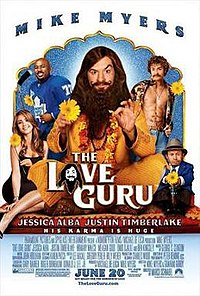
The Love Guru is utter and complete fantasy. Not because of the central character/idiot is flagrantly spitting in the face of one billion Hindus, but because it presumes that the Toronto Maple Leafs would ever make it to the Stanley Cup finals. And as for that first thing, all I have to say that if I were a practicing Hindu, I wouldn’t be writing a review right now, but be conjuring up protest signs with the efficiency of an assembly line. Not because of cultural sensitivity mind you, but because all that offensiveness is in the service of something spectacularly unfunny.

Mike Myers plays Guru Pitka, which is possibly the worst case of racial profiling since Maher Arar. Pitka lives in a fabulous LA ashra (which I’m sure is a perversion of that noun), where he receives celebrity clients and dreams of going on Oprah to secure his place as the next Deepak Chopra (who has the audacity to play himself in a cameo). Pitka is asked by Maple Leafs owner Jane (Jessica Alba) to reunite her star player, Darren Roanoke (Romany Malco), with his estranged wife Prudence (Meagan Good). This way, he’ll get over the shakes and lead the Leafs to a Stanley Cup victory over the LA Kings, whose gold-minder, Jacques Grande (Justin Timberlake), is Prudence’s new lover.

So as you can tell from the star-rating above, The Love Guru is more or less a failure. The only reason it gets two stars is because there are maybe a handful of scenes with some moderate laughs, but overall most everything is wince-inducing. And Guru looses half a star because of a Jessica Simpson cameo that proves that she doesn’t even the acting talent to play herself. Not to mention the fact that just about all the movie’s celebrity cameos get old quickly. Pitka’s greeting is “Mariska Hargitay,” so guess which Law & Order actress shows up at one of the Guru’s fun with acronyms shows.

And that’s just one of many examples of Myers’ tired shtick. The whole Hargitay joke and an accompanying SVU gag screams of some of Dr. Evil’s best pop culture puns from the Austin Powers series; remember “The Alan Parsons Project” or my personal favourite, “Moon Unit Alpha and Moon Unit Zappa.” Then when that stuff falls flat, the script turns to one of three options, the first being either a gross exaggeration or mischaracterization of Indian culture. Then, if he’s in the scene, a midget crack at the expense of Verne Troyer’s Leafs’ coach Punch Cherkov.

This leads to Love Guru’s most frequent theme: the penis gag. Not only does Pitka wear a chastity belt, not only do he and Roanoke joke about the old “ball-gazer” routine, and of course Pitka eats a “famous Indian dish” that consists of a type of nut in a doughy envelope, but one of the main gags is that Timberlake’s Grande (nicknamed “The Cock”) has a package that puts Dirk Diggler to shame. Oy! We get it, okay. No. Wait. One more thing: John Oliver’s lawyer is named Richard Pants, or AKA: “Dick Pants”. Aw, sweet! I could have written this movie half-drunk while being sleep deprived after three days without TV.

If there’s a saving grace to this movie, it’s the brief appearances of Stephen Colbert as a Hockey Night in Canada anchor, but even then I think that’s a pity vote for one of the funniest guys on TV (when doing his own stuff). It’s strange how Myers’, whose most significant film contributions in the last few years has been the Shrek films, could throw out pop culture references so stale. Singing “9 to 5” off the top of the film? Later whipping out “More than words” by Extreme? Celine Dion? I can’t think of a single memorable gag that connected, which is a far way from the first Austin Powers, which became a video hit because of how loaded it was with jokes.

It’s not that I have a problem with low brow humour; in fact, it’s usually the opposite. But somewhere between Goldmember and Love Guru, Myers went off the comedy wagon and seriously lost his mojo. Was it the pressure of having to deliver five years later, or is this just a miss? What I do know is that no matter how much mad cap mugging the lead actor can deliver, it can’t make up for the structural weaknesses that the film itself is laid upon.

Friday, 20 June 2008

Get Smart

Rating: ***1/2

You roll the hard six, as Battlestar Galactica’s Admiral Adama might observe, when you take a well know and beloved TV property and rejuvenate for the big screen years after the fact. To play it smart you have to make the show believable for a modern audience while you hang on to the things that appeal to the hardcore fans. Sometimes filmmakers get it right, but most of the time they get it oh so horribly wrong. Which brings me to Get Smart, a film that actually does a fairly reasonable job of updating its 60s origins for the 21st century, while even managing to work in the shoe phone for the Nokia age.

In this Smart, Steve Carell takes up Don Adams’ role as stumbling, bumbling Agent 86, Max Smart and Anne Hathaway is his put upon, level-headed partner Agent 99. Max is promoted from analyst to field agent when the spy agency CONTROL is infiltrated by their arch-nemesis KAOS. Max and 99 go undercover to penetrate the KAOS cell responsible, an outfit in Russia led by the mysterious Siegfried (Terrance Stamp) that’s collecting nuclear material to build bombs for nefarious purposes. But unlike the old TV series, Max isn’t totally ineffective, the threats are more deadly and the stunts are bigger. Alan Arkin co-stars as the Chief and Dwayne Johnson is Agent 23.

Of course, the original Get Smart came out in the midst of the Cold War and several different movies and TV shows about spies and spying; not the least of which was the James Bond franchise. But in the age of the no-frills espionage of Jason Bourne, Get Smart required something a little bit more than two hours of Carrel bumbling around the set, accidentally falling over things with a “Would you believe this?” and a “Missed it by that much that.” Fortunately the filmmakers made a smart call in my opinion by making the movie more of an action comedy than a spoof. Also smart (heh) was making Agent 86 more oblivious and naïve than outright clumsy and ineffectual.

As an action film, Get Smart is standard but serviceable, while as a comedy it’s above average with more than a few funny lines and cameos to keep the mind occupied. Carell is likeable in that Michael Scott way, but plays Max in an entirely different way than Adams did, which was nice and he was certainly at his comedic best since probably The 40 Year Old Virgin. Hathaway wasn’t the most obvious choice to play opposite Carell (he’s got 20 years on her), but she does have a nice chemistry with him and their relationship is rather on the sweet and innocent side of things. (The PDA never goes further than a peck on the cheek.)

Actually there’s a lot of great talent in this. Arkin is hilariously dead pan as the Chief; acerbic with just enough grease left to fly over a conference table and get into a fist fight with the Vice-President yelling “I’ve wanting to do this since Nixon.” Johnson (I’m stopping with “the Rock” suffix) proves his comedic chops ably as Agent 23, who’s one of the few field agents that has faith in Max’s skills. Terry Crews, David Koechner, Masi Oka and Nate Torrence offer solid support back at the office and there’s a couple of great cameos by actors playing Agent 13 and Hymie, two of the more classic character in the original Smart.

The comedy of Get Smart isn’t out to reinvent the wheel, but it is more than effective in delivering some laughs and some easy to enjoy action. A large portion of the credit for the success of the film should go to director Peter Segal, who’s previously made his name on a few Adam Sandler movies. He’s probably not going to get it though, because a lot of people are going to mistake the film’s accomplishments for failures. But if you want to go to something where you can sit back, relax and enjoy, Get Smart is a winner.

Monday, 16 June 2008

Shine a Light

Rating: ****

For a lot of people, this may be as close as you ever get to being in the audience for an actual Rolling Stones concert. But that’s okay, with a film like Shine a Light, you don’t have to be, because seeing this work is just about as good as being there, especially if you’re seeing it on the big screen. And who better than Martin Scorsese, for whom the Stones have been an invaluable source of implied attitude and machismo in his films for years, to bring the ultimate Stones concert experience to the screen in all the super group’s glory.

It’s a concert film basically, 95 per cent of the film is live concert footage from a two-night performance of the band at New York City’s Beacon Theatre on October 29th and November 1st, 2006. But Scorsese also works in some archival footage if interviews with Mick Jagger, Keith Richards, Charlie Watts and Ronnie Wood, mostly about their longevity and how the long the boys can keep on rocking like they do from as far back as the 60s.

But from all appearances in the film, the Stones (the youngest of whom is 61) have no problem finding the high energy needed to put on a huge rock concert. There’s spectacle, there’s showmanship, there’re special guests – everything you could possibly expect from a Stones concert but for the price of a movie ticket instead of the adjusted for inflation cost of a scalper. Naturally, the Stones play heavy on the classics: “Jumpin’ Jack Flash”, “Sympathy for the Devil”, “Satisfaction”. They also played “Loving Cup” with Jack White, “Live with Me” accompanied by Christina Aguilera, and Muddy Waters’ “Champagne and Reefer” with Buddy Guy. No “Gimme Shelter” though, which for a Scorsese movie is surprising.

The film starts with a black and white sequence that shows the concert preparations; Scorsese trying to control the set-up situation at the theatre in New York, while Mick and the boys make it difficult while on the road for him to finish planning. This semi-fictionalized scene adds a real touch of humour especially as Scorsese tries to get the final playlist out of the Stones. This opening, along with all the vignettes, helped break up the music nicely. Just as the film starts to drag a little, Scorsese throws in an interview bit or something else and it re-energizes the viewer for the next set.

Ultimately though, Shine a Light is still just a concert film, but fortunately it’s a concert film par excellence. They don’t get much better than the Stones when it comes to a live show, and there’s no better person than the director of The Last Waltz to capture all the action. The film gets right in their faces, and despite their age and the jokes that follow, the Rolling Stones still know how to put on one heckuva show. Shine a Light is the next best thing to being there.

Saturday, 14 June 2008

The Incredible Hulk

Rating: ***1/2

The re-whatevering of Hulk could have easily been one of the most cynical things done in the history of recent cinema, and believe me, there’s a lot of competition for that title. Ang Lee’s film was an impressive work and I’ve already outlined my reasons why I think so, but I guess in the broader sense, an artistic and introspective examination of the Hulk mythology didn’t fit in with the overall plans of Marvel Studios. Fortunately, The Incredible Hulk offers something new while not reneging on Lee’s film and treating it like some redheaded stepchild like, say, Roger Corman’s Fantastic Four. It’s not a perfect film, but it is most satisfactory.

This time Bruce Banner is played by Edward Norton, who brings a great deal more inner turmoil to the part than last Banner Eric Bana. In South America, Banner works in a factory and keeps his head down while trying to keep his inner peace and trading e-mail Hulk-cures with the mysterious Mr. Blue. But Banner’s past catches up with him as General Ross (William Hurt) sends in the marines to retrieve him. On the run again, Banner turns to ex-girlfriend Betty Ross (Liv Tyler) to help him reach Mr. Blue and his cure. Meanwhile, Gen. Ross recruits Emil Blonsky (Tim Roth) for an experiment where he’s given some of the Banner’s DNA in the hopes of creating a way to capture the Hulk.

It’s a pretty simple set-up, but one in keeping with the both the TV and comics origin of mean, old Mr. Green. “Leave me alone,” yells the Hulk to his army pursuers. A frequent repose for the monster in the comics; he’s always being pursued while always trying to find a way to be left in peace. The irony of the thing is that the one is contradictory with the other; he can’t be left alone because they’re always after him, which releases the Hulk in anger. Director Louis Leterrier indicates a strong love and regard for the Hulk in all his forms, taking inspirations from the comics for fight scenes while using “The Lonely Man” theme from the TV series to illustrate Banner’s isolation as a fugitive.

The effects have also improved in this one, Hulk seems much more emotional and complex, in other words: realistic. He’s more of a full-bodied character in this film and not some mindless id in torn purple pants. Unfortunately though Blonsky’s Abomination, I don’t think, is developed that well. One really doesn’t make the connection of Abomination as the evil Hulk and there’s really no adversarial relationship developed between the two characters either. The fight is kind of stagnant – great to look at, but there isn’t really any gravitas. There’s still something kind of hollow about seeing CGI monsters wail on each other.

On the other hand, the human actors are allowed to shine through all the production design. Norton does good Banner, but something tells me that a lot of his best stuff lies on the cutting room floor for later inclusion on the DVD. He gets the job done, and he’s certainly an improvement on Bana, but I think I was just expecting a little bit more. Hurt manages to be an effective replacement for previous General Ross, Sam Elliott. He comes right close to scenery chewing, but manages to rein it in to the right levels. Roth pretty much just snarl and sneers as Blonsky, but then again, he wasn’t given a lot to work with in the first place.

What the film does very well is stand alone as an action/monster movie the re-energizes the franchise and leaves it open to go to other places. A timely appearance from Tony Stark (Robert Downey Jr.) implies that there are big plans for the Hulk in keeping with the Avengers movie three years hence. It’s a neat thing the way they’re tying together the Marvel continuity between the various pictures, but while that’s somewhat easy to accomplish with the comics, it remains to be seen how they co-ordinate all this with the literally hundreds of people that have their hands in all of these films.

Still, whatever the future may hold, The Incredible Hulk, despite its faults, is a very satisfactory film where the whole is better than the parts. I’m anxious to see Leterrier and Norton’s preferred extended cut, but I don’t think that anyone will begrudge this film as having lost anything substantial in the editing. Certainly it should be the summer crowd pleaser the money guys are looking for.

Friday, 13 June 2008

The Happening

Rating: ***

There’s not that much left to say about the meteoric rise and thunderous crash of the career of M. Night Shyamalan, but one thing is more certain: Hollywood always loves a comeback story. So the question is: does The Happening constitute a comeback? Well, I don’t think I’d go that far, but it’s definitely a step in the right direction. Shyamalan manages to construct, for the most part, an effective paranoid thriller although it does delve into some inappropriate bouts of comedy and melodrama. On the bright side though, it’s infinitely more cohesive than Lady in the Water and not as insulting as The Village.

It starts in Central Park where people out minding their own business mysteriously become inflicted with a condition that makes them disorientated, lose their motor functions and eventually kill themselves. Science teacher Elliot Moore (Mark Wahlberg) and his wife Alma (Zooey Deschanel) flee Philadelphia with Elliot’s friend Julian (John Leguizamo) and his daughter Jess (Ashlyn Sanchez). However, it soon becomes apparent that the phenomenon isn’t limited to either Central Park or New York City and the “attack” is spreading from the largest population centres to the smaller ones. It’s a desperate quest for survival as Elliot and Alma try and stay one step ahead of the happening.

Like all of Shyamalan’s films, The Happening takes place in hyper-realistic and visceral reality, like an extended episode of The Twilight Zone, which either works or it doesn’t. In this movie we see both sides, but what works best is when Shyamalan ratchets up the tension and then the movie rightful begins to feel like a worthy successor to Hitchcock’s The Birds, which was clearly the primary influence for Happening.

The underline fear generated in the film comes from the characters feeling that they have no idea what’s going on, and thus they are clueless as to how to do anything to save themselves. One of the best constructed scenes in the film is when Wahlberg’s Elliot uses the scientific method to get some handle on the situation as the sounds of people killing themselves occur all around them.

And yes, that means that Shyamalan’s first R-rating is justly deserved, although he exercises a lot of restraint in relation to say Eli Roth, director of the Hostel films. The director uses gore to accentuate the fear and the violence of the situation and more often than not comes out of nowhere as a surprise, since he more often cuts from the violent act.

Not that you need really bloody scenes, for me, a car cruising down a suburban street where there’s a person hanging by the neck from every other tree is more than creepy enough. Shyamalan also effective turns foliage into a truly frightening adversary; every flick of a branch is cause for alarm.

The performances though were kind of problematic. I found Wahlberg kind of stagnate in many scenes and the shame of it is that he shows some real life in others; it’s quite a range to cover throughout an hour and a half film. As Alma I though Deschanel was under utilized and not given much to do outside the typical fretting wife stuff. There was a whole subplot where she was being cell phone stalked by a creep from work named Joey that just left me scratching my heading thinking, why is this important?

By far though, the most bizarre character was Betty Buckley’s Mrs. Jones, who the Moores seek refuge from as they try to outrun the plague. She was crazy in a way that reminded me of Tim Robbins in Spielberg’s War of the Worlds, and I don’t mean that in a good way. The Happening proves once again that while lunatics have the best shelters in a world ending catastrophe, they may not necessarily make the best survival partners.

The other thing about the Mrs Jones scenes is that they highlight the primary flaw of the film: a hodge podge of styles being silly on minute and serious the other, makes for a woefully inconsistent film. Still, there are a lot of interesting ideas in the mix of The Happening so I am recommending it, if only for the sake that raking out Shyamalan seems to be the new hip pastime. For me, I continue to await the return of the Unbreakable Shyamalan.

Monday, 9 June 2008

Days of Darkness

Rating: ***1/2

French-Canadian filmmaker Denys Arcand has made a career out of exploring humanity’s darker side with a bitter comic tone. Never one to shy away from the foibles and fallibilities of human beings, Arcand once again takes no prisoners with his world view as presented in Days of Darkness (L’âge des ténèbres). Darkness is being described as the third chapter in the trilogy started with The Decline of the American Empire (Le déclin de l’empire américain) and followed through with the Oscar-winning The Barbarian Invasions (Les invasions barbares), even though none of the characters from those films has a prominent role. Like a lot of threes, Darkness is the weakest but it still manages to be as compelling and unforgiving as the others.

The film follows downtrodden Quebec civil servant Jean-Marc Leblanc (Marc Labrèche), who finds his work and home life so unfulfilling that he must constantly escape into a fantasy life that is both elaborate and hyper-sexualized. In his fantasies, Jean-Marc is the object of pure animal sexual affection for four different women, including a famous actress (Diane Kruger) and the demure boss he kind of despises (Caroline Néron). When his super-ambitious wife (Sylvie Léonard) appears to leave him for another man in Toronto, Jean-Marc has to start dealing with his reality and his constant detachment from it. But how do you cope when you realize that living in reality can be as artificial as any fantasy life you’ve constructed for yourself? And what happens when even that fantasy becomes unsatisfying?

Like many of Arcand’s films, the preoccupation is not so much on plot development as it is on characters and their shifting internal identities. What’s problematic for Darkness, I think, is that Arcand is trying too hard to find punctuation and resolution to Jean-Marc’s predicament. The ending of the film kind of drags as if it’s trying to find some kind of happiness for the character, rather than the more obvious acceptance that perhaps there is no happiness to be found for him. Instead of ambiguity, we get an attempt at ambiguity as we’re left with the image of Jean-Marc silently peeling an apple at home in the island abode he now lives after leaving his wife and children. Labrèche is great though in portraying the deepening despair of Jean-Marc and draws you into the levity of the fantasy sequences as his character’s only escape.

The tone is also kind of uneven. Presumably the plot takes place in some kind of near future where pandemic is a constant worry and the quantifiable effects of global warming are now being felt in coastal areas. Not that the normal routine feels unaffected other than the even colder bureaucracy that Jean-Marc works for and the fact that surgical masks are common accessories. The growing frigidness and sterility of the world is a persistent theme in Darkness, but what is Arcand trying to say about it? Suburbia is fertile ground for parody, but I don’t think the film is saying anything about it other than, “It sucks.” I also don’t think the film addresses the fact that no matter how despondent that Jean-Marc is about feeling ignored, he’s just as much a zombie in life as his family.

But these are the questions that Days of Darkness provokes. It’s a thinking piece for sure and you’re certainly not going to leave the theatre feeling empty or unengaged. Standing in the shadow of Decline and Barbarians though it feels that Arcand doesn’t have anything else terribly potent to say about our society and even repeats himself a little in the process. Still, it’s a solid film with some interesting performances that recalls a level of social criticism that you don’t often get in mainstream films.

Saturday, 7 June 2008

Kung Fu Panda

Rating: ****

In Kung Fu Panda we meet Po (voiced by Jack Black), you’re typical dream-big slacker that works a menial job while hoping that there are bigger things in store for him. He lives in the Valley of Peace which is protected by a number of brave warriors, each a kung fu master trained by Master Shifu (Dustin Hoffman). But everyone in the Valley is awaiting the arrival of the Dragon Warrior, a prophesized master of martial arts that will have great power and will earn the right to read from the Dragon Scroll. So three guesses as to who it turns out to be?

This tale of how an orphaned Panda with an obvious eating disorder becomes the most skilfully feared warrior of ancient talking animal China is perhaps the best film to come out of Dreamworks Animation. Further, the house of Shrek and Sharktale delivers a story where all the jokes fit and work together in the same universe; in other words, no one gets up and sings “I’m a Believer” in the end. Also, there’s a solid moral lesson in the end that’s genuine and not meant as some gaudy tack-on lesson of acceptance told around several Godfather references that are completely above the head of the target audience.

The one aspect that is preserved is the all-star voice cast, which is pretty good even through there are very few Asians amongst the main cast despite the fact that the film makes no bones about being set in Asia. Black is a standout as Po, and I mean that in an obvious way because there were times I was looking at Po on screen, but seeing Black’s slacker character from Orange County, with a dirty wife-beater, dishevelled hair and all. But aside from those two things, the voice cast is solid. Hearing David Cross’ semi-aggravated tones as Crane was a standout, as was Ian McShane as the power-mad snow leopard Tai Lung.

Needless to say that the film is gorgeous to look at; the colours pop and the production design is perfect down to the last detail. I can only imagine what Kung Fu Panda looks like in IMAX 3-D, but I wouldn’t mind knowing, so if its available in this format where you live, I think it’s the preferred option. The technical prowess in creating the film doesn’t end in the aesthetics though. Filmmakers Mark Osborne and John Stevenson have obviously taken great pains to make the martial arts feel as authentic as anything done in a live action movie, taking inspiration from hits like Crouching Tiger, Hidden Dragon and House of Flying Daggers.

Apparently, Dreamworks started making Kung Fu Panda with the idea of turning it into a spoof. It’s a creative choice I understand because it’s something that’s worked well for them in the past, but as I’ve said before, even watching Shrek seven years after its initial release, it can’t help but seem dated. Stevenson made the smart choice in telling the story straight-up in a classical manner that’s easy to enjoy without the whole thing feeling like a Robot Chicken sketch. The kids will love it. Their parents will love it. I loved it. Kung Fu Panda is solid animated entertainment.

Friday, 6 June 2008

You Don’t Mess with the Zohan

Rating: **1/2

Between this and I Now Pronounce You Chuck & Larry I can only assume that Adam Sandler has enter the social activism phase of his career. And after making a final, potent statement about discrimination against people who identify as gay and lesbian in last year’s Chuck & Larry, I guess the former SNL funny man decided to tackle that Mid-East peace thing. Typically, Zohan is crass, rude and yes, occasionally funny, but a tool for healing though it is not. Clearly, over the last few years Sandler has been trying to grow-up with his comedy, but occasionally on this journey he forgets that growing up means actually having to leave childish things behind.

Well, that felt like a serious reading of something as loutish as an Adam Sandler movie, especially one where he plays a Moussad agent that makes James Bond look like Billy Madison. Zohan hates “all the fighting” especially when he must face his Palestinian nemesis “The Phantom” (John Turturro) again after he was set free in a prisoner exchange. (Logical fallacy: Wouldn’t a Palestinian terrorist have a more… Arab-sounding nickname than “The Phantom?”) Zohan fakes his death in a final battle with *sigh* “The Phantom” and heads to New York City to start a new life as hair stylist extraordinaire Scrappy Coco. (Say it with me: “Oy!”)

In a way, one can’t help but admire Sandler’s chutzpah to present a cutthroat Israeli militiaman who secretly harbours the desire to be a stylist, examining a Paul Mitchell catalogue at night while brazenly wearing Mariah Carey t-shirts while on duty. Remember Seth Rogen’s line in Knocked Up? “If any of us get laid tonight, it's because of Eric Bana in Munich.” Well, I guess Jewish guys everywhere can kiss that goodbye; now all we’ll see under every Israeli counterterrorist is a barber yearning to be free. Just as we now know that beneath every anonymous terrorist is a possible shoe salesman with no simpler desire than to find an outlet for their foot fetish.

One can also appreciate Sandler’s desire to throw his old SNL cronies a bone or two, even if its Rob Schneider. Schneider plays Salim, a NYC cab driver that stumbles upon Zohan’s dual life and decides to get revenge over an incident where Zohan took his goat back in the Holy Land. If on the vision alone you have a hard time buying Schneider as a Muslim, relax, you’re not alone. Even Turturro, a credible actor, doesn’t do stereotypical Arab terrorist very well. If Zohan was as high-minded as it thinks it is, why not give these parts to Arab comedians? Little Mosque isn’t a fluke, you know.

In the end though, it seems as if Sandler has refined the approach he started to develop in Chuck & Larry: a high-minded social commentary that is not so much concerned with delving into issues as filming scene upon scene of Zohan’s implied sexual dalliances with his middle-aged female customers in the salon’s backroom. Even Zohan’s romance with the salon’s Palestinian owner played by Canadian Emmanuelle Chriqui seems like an after thought. And even though Judd Apatow’s name is one the script, don’t expect any of his enlightened and inspired comedic timing; he hasn’t been involved in this script for years. But then again, name writing talent didn’t help Chuck & Larry, which was co-scripted by Alexander Payne and Jim Taylor of Election and Sideways fame.

In the end though, Zohan benefits from having a few absurdist laughs and enough gratuitous shots of Sandler’s bare backside to do you for a lifetime. It’s typical of the comic’s recent films: a mishmash of two desperately different tones that are trying to exist in the hyper-active reality of Billy Madison and The Waterboy. If there’s a saving grace, it’s that Zohan doesn’t cry after, regretfully, thrusting his bulging man-bush one too many times. I know that the rest of us were shedding tears of agony.

Tuesday, 3 June 2008

Under the Same Moon

Rating: ****

In the United States, the hot-button issue of illegal immigration from Mexico into the US is usually presented in such black and white terms: deportation versus amnesty. With this type of vitriolic debate, it’s easy to forget that these are human beings struggling to survive and trying to do a little better than they might have had back home. And it should be remembered that so-called “illegals” are easily exploited by American industry as well. On the other hand though, these are a group of people in the country by circumnavigating proper immigration procedure.

The Sundance hit Under the Same Moon manages to find a middle ground amongst this debate by telling the story of the boundless love between a mother and son. Rosario (Kate del Castillo) works cleaning houses in Los Angeles while her son Carlitos (Adrian Alonso) lives with his grandmother back in Mexico. Rosario is trying to save up to secure her legal status, but after four years she’s not much closer to being reunited with Carlitos. When his grandmother dies in her sleep, Carlitos makes the perilous trek to LA to be reunited with his mother. He’s helped out along the journey by migrant worker and notable curmudgeon Enrique (Eugenio Derbez), as Carlitos struggles to make it to his mother by Sunday when she makes her weekly phone call.

Under the Same Moon is a beautiful fable; simple and elegant, although it does sometimes delve into the truly dark side of being an illegal immigrant in the U.S. Is it realistic? Not remotely, and I highly doubt that the director and the screenwriter intended it to be read as such. The emotions are real, but let’s face it: a boy making his way across the border, covertly concealed in the middle seat of a van, and then practically hitching from El Paso to LA on a wing and a prayer is like absolute zero. But unless you’re totally right brained, you aren’t really thinking of these things during the film and are instead swept up in the narrative of an enthralling road movie.

Alonso is a tremendous young actor that carries the movie’s literal quest and the emotional journey to get there on his small shoulders. Derbez does a great job of playing along in the cynical, grown-up sidekick role; he’s a loveable hard ass that tries very hard not to get involved with the boy, but he hilariously fails. Del Castillo gets a lot of the meaty acting work though also, unfortunately, the most clichéd. There’s a subplot about another immigrant that works as a security guard with a romantic interest in Rosario, as well as a scene where a rich (British?) white woman mistreats her, fires and doesn’t pay her because Rosario’s an illegal. What’s she going to do? Call the police? You can practically hear the snide laughter coming from here.

That really is the downside to the film, not just that particular vignette but while Carlitos is on his journey, the opportunity to meet his birth father presents itself. What are the odds? Million to one that he’d end up in Tucson, precisely where Carlitos’ father ended up after abandoned him and his mother. Such contrivances aren’t noticeable while being swept up in the story, but thinking about it after the fact these sticky bits of predictable plotting becomes more noticeable. I will say that the film could have easily played to the pro-amnesty position by presenting border patrol and INS as faceless and feckless thugs. Instead the story comes from the point of view where they’re analogous to the policeman that arrests the thief stealing food to feed his family.

But certainly Under the Same Moon isn’t about solving the immigration crisis – the story is not that complex. It’s a heartfelt story that, despite sometimes swaying into melodrama, is not presented in an overly sappy or sentimental way. I dare anyone who’s for personally marching every Mexican back to the border in chains to not feel something for this family central to this story. Call it An American Tale for the new generation of (illegal) immigrants.