Showing posts with label horror. Show all posts

Friday, 30 November 2012

Silent Night

Rating: *1/2

Just when you thought all available source material had been exhausted, someone realized that no one had yet remade Silent Night, Deadly Night. Killer Santa? Of course! Why didn't anyone want to remake this right out of the gate? Freddy Kruger, Michael Myers and Jason Voorhees all have brand awareness, but Killer Santa Claus has only blasphemy and child welfare concerns, there's more than enough there to build a brand out of.

Friday, 22 June 2012

Abraham Lincoln: Vampire Hunter

Rating: ***

Reading some of the reviews of Abraham Lincoln: Vampire Hunter, you get the sneaking suspicion that a lot of my fellow critics believed they were walking into some camp ground of historical meta-fiction where the 16th President of the United States would dispatch bloodsuckers with some Schwarzeneggerian one-liners. But that’s not the case, and this is where being of the nerdy persuasion has advantages over other critics.

I’m only about 100 pages into Seth Grahame-Smith’s original novel and can say easily that there isn’t an ounce of camp between the pages. It’s no sketch either, as it’s also been compared to a Saturday Night Live skit. The book is a surprisingly thoughtful, well-researched alterna-biography of Lincoln. As if there really was a vampire named Henry carrying around “Honest” Abe’s secret diaries all this time and showed them to Grahame-Smith.

As for the movie, it carries none of the book’s subtlety, but being from the director of Wanted, Timur Bekmambetov, I didn’t expect there to be much. Although clearly more horror flavoured than recent vampire films like Twilight or Priest, the potential for straight-up horror is replaced with absurdist, nearly over the top action sequences complete with CG blood spurts. I think we wanted something closer to Bram Stoker’s Dracula rather than something that feels cut from the cloth of Van Helsing.

The plot follows Abraham Lincoln (Benjamin Walker) from witnessing the death of his mother by a vampire as a boy to his days in Springfield, Illinois as a lawyer and burgeoning politician to his years in the White House as Commander-in-Chief during the Civil War. In between, he trains under conscientious vampire Henry (Dominic Cooper), courts and marries the lovely Mary Todd (Mary Elizabeth Winstead), and learns the dark underbelly of American History: vampires using slavery as an easy food source to build their own dominion in the American South.

Sounds serious, but it’s hard to deny the fun. Although some may scoff that a movie called “Abraham Lincoln: Vampire Hunter” takes itself too seriously, I found it a rousing summer popcorn thriller. Those action sequences may strain the laws of physics, but they are executed very, very well, and all the while I was sitting in my theatre seat thinking, “If Lincoln doesn’t get all the silver to the front lines, the Union will lose the war and vampires will enslave America!” Stupid, I know. I have a history degree. But the movie’s actually pretty good about making you buy its reality.

Lead Benjamin Walker not only has the looks of a youthful Liam Neeson, but he kind of has the magnetism of one too. The movie skips along from drama to drama much too fast to build any meaningful character development, but fortunately, Walker does well both with Lincoln’s vampire hunter physical prowess, and the historical Lincoln’s gravitas as he delivers several signature speeches. If a star is born from Abraham Lincoln: Vampire Hunter, it will be Benjamin Walker.

Mary Elizabeth Winstead also gets to have some fun with history when Mary Todd gets a bad ass moment of her own in the film’s climax. But more interesting, Winstead gets to play Mary Todd’s more gregarious and flirty youth, which is a side of the woman we don’t normally get to see, as they say.

Dominic Cooper, who was so compelling in the small supporting role of Howard Stark in last summer’s Captain America: The First Avenger, once again lends ample and able support to our hero in Lincoln. His Henry captures both the good humour and easy cynicism of Lincoln’s vampire fighting vampire mentor from the book.

The film also introduces us to a few new characters too. Anthony Mackie plays Lincoln’s obligatory black friend Will Johnson, and although Mackie was perfectly fine in the part, I feel like I would have rather have seen other real life characters from the book like Edgar Allan Poe, and Lincoln’s fellow vampire slayer (and later Secretary of State) William Seward. Rufus Sewell plays the vampire leader Adam, and is perfectly serviceable in the part, but it would have been nice if Lincoln had a match in the main villain, someone who was played as a visionary vampire leader equivalent to The Great Emancipator.

Technically though, the film is solid. There’s some impressive stunt work, and the climactic train chase is mind-blowing, plus the film’s a genuine R-rated vampire movie, so you have to admire the filmmakers’ dedication to giving the fans what they want. Bekmambetov definitely has a visual flare, but what he lacks is patience. Anytime Lincoln isn’t killing something, or racing off to kill something – in other words the quiet, dramatic moments – it feels like Bekmambetov is a 10-year-old with A.D.D., sitting on the couch with his knees knocking waiting for the power to his video game to come back on.

But honestly, if there’s one thing to recommend Abraham Lincoln: Vampire Hunter it’s that it’s fun, and that’s despite the fact, as the critics say, it takes itself seriously. I have a feeling that if this was camped up, the spirit of it would have been lost and the critics would still be complaining.

And for my final thought, if you can see this movie without paying extra for 3-D, do so. It adds nothing to the film, least of all spectacle. Making films that were shot dark and turning them into 3-D in post just doesn’t work no matter how many times they keep trying it, and for the first time watching a 3-D film I could swear I was getting a headache. The format can be fun, but only when it’s done right.

So I guess now the ball is Steven Spielberg’s court. His straight-up bio-pic starring Daniel Day Lewis and titled simply Lincoln comes out this Christmas, and I guess at that point we’ll decide what Lincoln we like best. Either way, in Abe we trust.

Friday, 13 April 2012

The Cabin in the Woods

Rating: ****

The set-up is simple: five friends go out to a remote cabin to enjoy some drinking, debauchery and other wholesome activities. It’s the conceit that’s launched a million horror movies, and director Drew Goddard and co-writer Joss Whedon know it. Five friends go out into the woods, but not all of them are coming home, the question is who dies first and how?

But wait, obviously it’s more complicated than that. The key to The Cabin in the Woods is to go in as pure as possible. After seeing the press screening, I watched the ads on TV and have been kind of surprised by how much is hinted at, or outright given away. Needless to say, there’s something more afoot to the story then friends in the woods being pestered by some demonic undead redneck family. So what’s going on? Let’s just say that there’s some people highly invested in watching these young folks die.

In the opening scenes, we meet our motley crew. There’s alpha jock Curt (Chris Hemsworth), his girlfriend Jules (Anna Hutchison), the slightly nerdish but still kind of hunky Holden (Jesse Williams), the shy but pretty Dana (Kristen Connolly), and resident stoner Marty (Fran Kranz). They load into a Winnebago and head for a road so far off the map it’s not worthy of global positioning. When they get to the “rustic” cabin, they notice a few oddities, like paintings of human sacrifice and how two of the bedrooms are connected with one-way glass, but the latter discovery of a basement filled with potential horrors and sideshow oddities seals their doom, whatever doom they might choose.

Like Scream or New Nightmare before it, The Cabin in the Woods seeks to turn the genre on its head. Although that comparison leans more to the later than the former, as Scream had fun turning the conventions on their head, while Cabin, like Nightmare, dares to ponder where are horrors come from, and how we can beat them. It’s not so much about young people dying in horrible ways, but the implications there-in. The grander meaning. What is the communal experience of seeing a horror movie all about? Is it about engaging our more primal instincts, and to what degree?

Make no mistake, this is a horror movie for horror movie fans, by horror movie fans, and because of that I’m not sure how “commercial” Cabin will be. But having said that, this is a highly impressive debut for Goddard, who’s cut his teeth as a writer studying under two of the best mass-appeal nerdy filmmakers in the business: Whedon and J.J. Abrams. As a script, this is right in Whedon’s ball park with lots of scares and humour and Whedon-speak. Regular Whedon players like Kranz (Dollhouse), Amy Acker (Angel) and Tom Lenk (Buffy) also have roles.

Most importantly though, the characters feel very fleshed out. They’re living, breathing people, and that’s despite the fact that they are built in archetypes filling a specific purpose in the script. Some of that is owned by the actors. Pre-Thor Hemsworth shows off a more laidback vibe complete with letterman’s jacket, and it suits him, Kranz does stoner right and becomes the unlikely hero when another medical benefit of pot is demonstrated, and the rest of the young cast, who are unknowns for the most part, are likeable and engaging. But the real stars of this film are Bradley Whitford and Richard Jenkins. Unlikely as it may be that two guys over the age of 50 are the central figures in a youth-oriented horror movie, they just may be the heart and soul of the story; a kind of Statler and Waldorf offering commentary and context through the main story.

But if for no other reason, The Cabin in the Woods is worth seeing because it provides a nice break from current trends in horror cinema: it’s not a remake, it’s not a splatter-filled torture porn, and there’s not a single instance of “found footage.” It’s solid filmmaking. The cinematography is great, dark and moody when it needs to be, but it can also be warm and fun. (Thankfully, someone smart along the way decided that 3-D was not an option.) The creature effects are fantastic, the script is great, and the cast is phenomenal. It’s a rewarding film, but again, I think only a few will reap it to maximum effect.

Friday, 17 February 2012

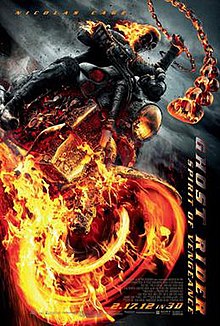
Ghost Rider: Spirit of Vengeance

Rating: **

If nothing else, Ghost Rider: Spirit of Vengeance gets an A for effort. But across the board what we have here is a movie that’s trying very hard to be something that it’s not: a campy, winking, cult film in the making that’s part Leone western and part remedial passion play mixed with the amped up, Red Bull-fuelled delirium of the Crank films.

Rarely does a movie try so hard and miss so spectacularly. Maybe it’s because you can’t make a balls out action picture with PG-13 limitations, and maybe it’s because you can’t do camp right when only the leading man is in on the joke. Or just maybe it’s because no matter how many times Marvel’s tried to make a marquee hero out of Ghost Rider the whole endeavour’s doomed to failure. But what a failure it is.

On the plus side, filmmakers Mark Neveldine and Brian Taylor get that Ghost Rider isn’t a hero moulded in the same stuff as Spider-Man, Iron Man, et al. Mark Steven Johnson’s first Ghost Rider film was too clean, too antiseptic, and followed too many of the supposed rules of the superhero movie even though I think any comic book fan will tell you that Ghost Rider only loosely fits the definition of a superhero. A guy who’s cursed by the Devil isn’t a superhero, and a guy that accepts that curse to bring vengeance to those that deserve it is certainly not a heroic ideal.

Catching up with Johnny Blaze in Spirit of Vengeance we find him on the run in Eastern Europe, struggling to control his darker half. Flinching at sunlight, and seeking shelter in abandoned and desolate places far from human contact, Blaze is found by Moreau (Idris Elba). What Moreau is, is never quite explained, but he tells Blaze that he needs the Rider’s help to protect a young boy from becoming the new vessel for The Devil. If they can guard the boy and keep him safe till after the sun rises on the winter solstice, Moreau will lift the curse off Blaze and return his soul. Good deal, except for all those minions of The Devil in the way.

The primary minion is Ray Carrigan (Johnny Whitworth), a non-descript mercenary charged with bring the boy to The Devil (now perplexingly called Roarke and played by Ciarán Hinds). If the name “Ray Carrigan” is familiar to you, then you just might be a fan of the Ghost Rider comic because Carrigan becomes Blackout, a demonic figure with the ability to cause anything he touches to decay (except for Twinkies). The make-up job turning Whitworth into Blackout is kind of horrible, and that’s putting aside the thought that creating an adversary worthy of the Rider seems almost secondary. Blackout is one of Ghost Rider’s most consistent nemeses from the comic, but he almost gets shafted like Bane in Batman & Robin in Spirit of Vengeance.

Mephisto, I mean Roarke, also gets the shaft because Hinds, a typically above board actor with weight and gravitas, seems bored and disinterested every moment on screen. Say what you want about Peter Fonda from Ghost Rider 1, but he at least looked like he was having a good time, laying aside the cleverness of casting one of the guys from Easy Rider to play The Devil in a movie about a demonic motorcyclist. And if anyone can tell me what Idris Elba is doing as Moreau, you’re smarter than I am because how a wine drinking, motorcycle-riding black ninja fits into the Ghost Rider mythology, I have no idea.

Perplexingly, the only one who seems to know what’s going on is Cage, who brings some of that typical craziness to the part of Johnny Blaze in this outing. In the recent past, Cage has restrained himself when he really shouldn’t have in movies like the first Ghost Rider and Drive Angry 3-D; he would play things too seriously, too straight. In Spirit of Vengeance he gets a little more manic, and a little more madcap. You at least get the feeling that he’s a guy tormented by living in the same mind of the demon, and fortunately the flipside mopey Nicolas Cage is left home for this outing.

Neveldine and Taylor also seem to “get it” to an extent. This Ghost Rider is rawer, a bit more real and a great deal grimier than the first film. Mostly though, they seem to be having a bit of fun, and they seem to enjoy playing with the Rider’s powers a bit. One of the big action scenes involves Ghost Rider turning a piece of industrial demolition equipment into hellfire concoction of doom used to pulverize all enemies. The climactic highway chase was also very well done, but if there was one noticeable improvement in this Ghost Rider over the last, it was the look of the Rider himself. Let’s just say he was crispier in this film, and the character seemed to be much more vivid in how he’s interacted with on screen. It goes to show that there’s a world of difference that can be made in CG characters in just a few years times.

But Ghost Rider: Spirit of Vengeance still feels like it’s holding itself back. What’s the point of introducing the notion of Ghost Rider pissing fire if there isn’t going to be a scene later of the Rider defecating on someone in flame. There was also a scene where Blaze shows the boy Danny how to ride a bike, which bordered far too much on sickening Spielbergian cuteness for liking. I give the filmmakers credit for putting significantly more effort into creating something that feels more like a Ghost Rider movie in Spirit of Vengeance, but much like the comic it’s based on, what seems like a good idea on paper, doesn’t necessarily come across as one in execution.

I’m not sure “better than Ghost Rider” is exactly a ringing endorsement for Ghost Rider: Spirit of Vengeance, but it’s the best complement in could probably be paid in context.

Friday, 3 February 2012

The Woman in Black

Rating: ***1/2

I get the feeling that Daniel Radcliffe’s first conversation with his agent after Harry Potter and the Deathly Hallows Part 2 wrapped went something like this:

RADCLIFFE: So I need a new part: no blockbusters, no boy and especially no wizards. What have you got?

AGENT: Well, there’s this one thing here that’s a ghost story…

RADCLIFFE: Meh.

AGENT: It’s a period piece too! It takes place at the turn of the 20th century…

RADCLIFFE: Hm… Yeah…

AGENT: You would play a lawyer with a young son and who’s a widower.

RADCLIFFE: Wow! Can he also be emotionally disturbed?

AGENT: He can!

RADCLIFFE: Sold.

Indeed, the first time we see Radcliffe’s Arthur Kippy on screen he’s quite the mess. Losing his young wife in child-birth, he’s now left with a four-year-old son, and one last chance to prove himself before he’s fired for trauma-related gold-bricking at his law firm. He’s dispatched to a quiet sea-side village to over see the legal paperwork of an isolated estate there, and Arthur, determined not to let himself down or his boy, is going to make the best of a bad situation.

Naturally, the bad situation tends to be worse, and in the sad, unfortunate era before Google and iPhones, Arthur comes into town not knowing that there’s a curse on the very house he’s trying to put into escrow. This curse involves the spirit of a deranged woman who kills the children of the town’s people whenever she’s seen when the living are in view of the estate. The town’s people, scared beyond the capacity for rational thought, don’t tell Arthur why he has to leave, they just make it clear that he should. The kindly Mr. Daly (Ciarán Hinds) though sides with Arthur and refuses to accept all the mystical mumbo-jumbo. Guess what happens next.

The Woman in Black comes from Hammer Studios, the production company famous for the great British horror films of the 60s and 70s starring the likes of Christopher Lee, Peter Cushing and Vincent Price. Admittedly, this film is much more in the mould of those cult classics that Hammer’s initial re-entry into filmmaking, 2010’s American remake of Let the Right One In, but to a certain kind of film that aesthetic is an attractive selling point. Much of the action takes place in the haunted estate, a giant house on an island that’s routinely cut off from the mainland when the tide comes in and takes out the only road to and from.

Director James Watkins never fails to capitalize on the possibilities of isolation, and thus a lot of the film’s heavy lifting falls of Radcliffe who routinely has to act out entire scenes alone with only shadows, props, and the occasionally ghost to respond to. It’s hard not to shake the feeling that Radcliffe may be a little out of his depth on this one, but he puts up a valiant effort and pushes through the macabre to make Arthur honest and relatable. Sure, it’s initially hard to buy “Harry Potter” as a husband, father, and lawyer – it’s all a little mundane and mature – but once the haunting starts happening, you settle into a good place with the film. That and the scares. There are many good jumps in the film thanks to it’s old school approach, and some of those scares, at least in part, come from your concern for the main character.

The Woman in Black represents something old fashioned in the way to tell a horror story. Many of the frights and jumps are half psychological, and the story does such a decent job of enrapturing you that you fall for every little shadow and creak. There’s a certain charm to this, because outside of so-called “found footage” horrors, like the Paranormal Activity films, generally we, as audience members, are much too savvy to fall for such old school scares. The first two-thirds of the film are masterful, but when Arthur and Mr Daly set it to themselves to solve the problem, the script visits time-tested clichés when it comes to solving a ghost problem. The last half-hour creaks for entirely different reasons. I remained intrigued enough to see the pay off, but I’m afraid I wasn’t entirely fulfilled.

Still, I think kudos are deserved all around: director James Watkins, in only his second feature, plies his craft with tremendous skill and grace; screenwriter Jane Goldman (Kick-Ass, X-Men: First Class) builds a credibly suspenseful world and a mystery that can at times be both surprising and familiar; and Daniel Radcliffe does a satisfactory job in a more grown-up role that requires him to be mostly emotionally distraught. But the unsung hero of the film is the island setting and production design of the haunted mansion. The rest of the elements come together resulting is a satisfying, if flawed, fright flick, but that wouldn’t matter if the film’s setting didn’t scream “horror movie.” Coming out of The Woman in Black, the winter air might not be the only chill you feel.

Friday, 20 January 2012

Underworld: Awakening

Rating: **1/2

I congratulate the makers of Underworld: Awakening for being able to make a mountain out of a molehill; from the humble elevator pitch of “Romeo and Juliet with vampires and werewolves” comes one of the most densely packed mythologies of modern movie franchises covering fantasy, action, sci-fi, horror, and borderline homages to the bondage subculture. The films are a proverbial genre frappé, carried mostly on the notion that fan boys would watch Kate Beckinsale reading the phone book if she were dressed head to toe in skin tight leather and firing a big, damn gun.

In the series fourth outing, Underworld, like action franchise cousin Mission: Impossible, proves that age ain’t nothing but a number. The action scenes are brisk, well-executed and enthralling, and Beckinsale proves that after a break of a couple years from kicking any kind of butt that she can still stab, shoot, throw ninja stars and set off explosives with the best of them. In other words if you don’t like loud noises, monsters, death metal, and assorted on-screen carnage, this is not the movie for you. Reversely, if you’re looking for a movie with coherent storytelling, thoughtful characters and logical pacing, this is not the film for you either.

A couple of years ago, there was a film released called Ultraviolet about a future world where a virus turned ordinary people into superhumans who were then hunted and killed by an evil medical research company. In this uncertain time, one rebellious female warrior refused to go down without a fight and struggled to protect a child that both sides wanted dead, but who had the power to end the war. I only bring this up because Underworld: Awakening follows almost exactly the same plotline.

Taking place in the not too distant future, the secret war between vampires and Lycans (werewolves, remember) has become a not-so secret war where the human race is trying to rid the world of both immortal species. Captured by the obviously evil Antigen, vampire warrior goddess Selene (Beckinsale) has been cryogenically frozen and studied for over 12 years, when the breakout of “Subject 2” causes the release of Selene as well. Caught up in the new normal of the world, Selene seeks to get to the bottom of Antigen’s true purpose, copes with the revelation of “Subject 2” being her daughter Eve (India Eisley), and looks really, really good while fighting some new bad guy every five minutes.

The sheer brazenness of these films, which act as though coherent storytelling and practical character motivation is a luxury of script-writing, is something I rather enjoy. For instance, when Eve reveals that she’s really Selene’s previously unknown daughter it’s in the midst of a car chase, the human detective investigating the resurgence in supernatural activity seems to disappear from the plot for an hour, and Michael, the werewolf hybrid played by Scott Speedman who was so central to the plot of the first two films, appears only briefly and is played by a stand in. Granted, Underworld isn’t a Tolkien-esque tome filled with back story and detail, but I believe there is a minimum amount of work necessarily to at least build your world in three dimensions.

The technical edge this film has over the previous instalments is that it’s screening in 3-D and in IMAX. Now I didn’t see it in IMAX, so maybe that makes a difference, but watching an Underworld film in 3-D is an experience in squinting. It’s not good when you give up on the 3-D glasses and watch the film without them about 50 per cent of the time. If you have similar issues with 3-D, maybe only where the glasses for the action scenes, but I will say that one sequence where heroes let off a grenade of silver powder to take out a group of bad wolves looked amazing in 3-D. Seeing the little specs of silver dance out from the screen was almost worth the 3-D surcharge. Almost.

I also think that Swedish directors Måns Mårlind and Björn Stein have a better idea of what an Underworld is supposed to be, but that idea is putting emphasis on action and cool looking effects over a substantive script. Still, it’s an improvement considering that past films have had aspirations of Shakespeare and Puzo, but it also means you hiring decent actors who get wasted. Stephen Rea as the head of Antigen looks downright unsure what he’s doing on this film, and Canadian actor Kris Holden-Ried, who plays a werewolf weekly on the hit Showcase series on Lost Girl, deserved a, ahem, meatier part.

But despite everything I just wrote, most of which being arm chair quarterbacking post game, I still walked out of Underworld Awakening feeling moderately satisfied. It is what it is, Kate Beckinsale in skin tight leather fighting monsters for an hour and a half. If only all movies were this self-aware.

Thursday, 22 September 2011

TIFF - Livid

Rating: ***

Alexandre Bustillo and Julien Maury made a splash the last time they were at the Toronto International Film Festival with their first movie Inside. Sadly, I don’t think Livid will make as big an impact, but I don’t think that comes from a lack of trying. Livid is a haunted house mystery that’s creepy and engaging, but there’s not a lot that jumps out at the audience, or at least not a lot to make you jump out of your seat.

The film’s heroine, Lucie (Chloé Coulloud), is a young woman that’s training to take care of people shut in their homes. Lucie’s trademark is her heterochromia, she has one eye that’s blue and one eye that’s brown, a fact that’s immediately picked up on by Madame Wilson (Catherine Jacob), the experienced nurse training her. A trip to the country mansion of renowned dancer, Madame Jessel (Marie-Claude Pietragalla) leads Lucie and two of friends on a midnight heist to rip off a comatose old lady of her rumoured treasure, but naturally that’s easier said than done.

So what’s the story? Well, it’s part ghost story, part Cube, part Black Swan, part Frankenstein, and part Let the Right One In. Perhaps that’s the contributing factor to the film’s interesting tone, it is a whole lot of different horror stories rolled into one package. But Livid clarifies nothing, and while the film goes along for the first half as a perfectly serviceable haunted house drama, it segues into a vampire story as he flashback and see Madame Jessel’s daughter eat one of her dance classmates and then run out into the sunlight and flies around inexplicably. It’s more or less all downhill from there.

But the film itself has atmosphere to spare. The production design and set decoration is so brilliantly realized that you should practically get Goosebumps just by seeing the on screen imagery. But for some strange reason there’s a disconnect between style and substance; the film looks amazing, there’s a story that seems like it wants to be told, but the film really leaves no lasting trace, no haunted feeling. I wouldn’t call the film a disappointment, but it was a kind of a letdown. Still, it’s a compelling let down just the same and it still kind of shows the promise of Hunger. Perhaps the third time will find the charm again.

Monday, 12 September 2011

TIFF - The Day

Rating: ***

Every Midnight Madness there’s always at least one unique post-apocalyptic drama, and unless it’s George Romero’s latest attempt to elongate his Living Dead franchise, it’s usually something good, or at least interesting. Zombies are foremost on your mind while watching The Day, a low budget end of the world drama about a group of survivors trying not to be eaten, but there’s a twist.

We open with Shawn Ashmore (X-Men 1-3) as he pulls the family van into a desolate suburban neighbourhood. Whatever apocalypse that’s happened, has happened, and Ashmore’s Adam, along with his wife and daughter are looking for provisions. While Adam investigates inside a promising house, the van is attacked by an unseen force, and he returns he finds the window smashed in and his wife and child missing.

Flash-forward to sometime much later. Adam now wonders the wild with four friends, including group leader Rick (Dominic Monaghan). Walking the back roads and trying to avoid trouble, but always on the look out for it, the group comes upon an old farmhouse, and they take shelter there from a pounding rain storm. And as these things go, the house holds a secret. A very bad secret for anyone looking for a meal, but doesn’t want to become one themselves.

The twist is that these folks aren’t running from zombies, but they’re running from cannibals. They’re regular old humans, but they just happen to live on other human beings. But they’re also not the types of cannibals you see in the similarly themed The Book of Eli, where you could tell a cannibal because they were basically hillbillies with a case of the shakes. Nope, these man eaters are clever, organized and unembarrassed about how they survive. “We’re all dying, you’re just dying faster,” one of them tells our trapped gang of five.

It adds an extra element of danger when we discover that this is the threat facing our merry band. As Zombieland so ably demonstrated, with a little cardio you can outrun a zombie, and like in I Am Legend, some monsters can only come out at night. But how do you deal with monsters when they’re just like you? When there’s no obvious advantage? You’re already starved, your resources are weak, they’ve got greater numbers and strength, and since they can live off their casualties, the odds will always be in their favour.

Director Douglas Aarniokoski also likes to take his time. He doesn’t tip his hand too easily, and indeed the film is more than a third over before we see the face of the enemy. There’s good build up and tension, and the film comes down to an old-fashioned siege on the abandoned farmhouse, the surviving humans and pack of angry cannibals. Aarniokoski is smart enough to not make it easy on our human heroes, we see them do an ammo count at the start of the film that reinforces how desperate they are, and there’s a reveal that makes you wonder if there’s any chance for any of them at all.

The story and the pacing were tight, but I did find the characters a little thin, Ashmore is pretty good, always seemingly like he’s on the brink of an emotional breakdown, but managing to keep it together as possible the group’s most level-headed member, and Ashley Bell (The Last Exorcism) is fascinatingly aloof as the mysterious Mary. But like a lot of horror movies, acting takes second place to staging, and at least in this respect The Day is a winner.

Friday, 9 September 2011

Creature

Rating: **1/2

The surprise with the new monster feature Creature has nothing to do with the twists and turns of the story about six young people that go site-seeing in the bayou for a legendary alligator man. It’s that you kind of like them and hope they survive. Which is impossible, I know, but still, one can hope. And yes, that does turn out to be a false hope.

Creature begins like half the horror movies ever made by showing a happy-go-lucky group of hot, nubile twentysomething campers on their way, in this case to New Orleans, for some general debauchery. Also in typical fashion, they stop at a store in the middle of nowhere and razz the local hicks about their love for the legend of Lockjaw, a kind of Bigfoot with a crocodile head whose story involves incest, grief, man-on-nature revenge and finally, cannibalism. By the time the kids gets out to Lockjaw’s infamous cabin in the exact centre of dense of swampland, you can already see where this is going.

I give co-screenwriter and director Fred Andrews credit, he crafted a script where the main characters are neither broad stereotypes or dim-wittedly unlikeable meat that you have no trouble seeing put through the grinder. As a former production designer, I have a feeling that Andrews spent a lot of time on sets where characterization was a low priority, and thus spent a lot of time thinking about what his approach would be should he make a movie of his own. It works, at least until the main story has to get rolling, and the plot takes on the feeling of Creature from the Black Lagoon meets Deliverance.

First, the make-up job on Lockjaw is the sort that makes you want a CG monster over a sub par prosthetic, which is too bad because from far away and in the dark the suit is fine, but close-ups are not Lockjaw’s best friend. The story itself could have been cast in a new light as well because there’s a confusing mash-up of in-bred hick family values and virgin sacrifice. Family lines are blurred and who’s a bad guy and who’s not is a game you don’t necessarily want to play in this type of movie. When the monster’s loose, you don’t want to cut away to see how Hee Haw does human sacrifice.

But since the actors are so engaging you play the “just go with it game.” Mehcad Brooks (Eggs from True Blood) and Aaron Hill make for unconventional horror leads if only because their characters, as soldiers on leave, are proactive and capable. Dillon Casey is great as the group’s defacto Shaggy and squeezes a lot of humour out of the part. Casey also gets the film’s best twist of the film and plays it up very well. Serinda Swan, Amanda Fuller, and Lauren Schneider bring the girl power, and thankfully avoid any horror movie tropes involving whiny, screamy girlfriends who are basically useless in these situations, but the slightly off-kilter Karen played by Schneider is my favourite. Rob Zombie regular Sid Haig is, of course, excellent as he effortlessly puts friendly jokster uncle and your leering creepy uncle in the same role.

Creature may not break the mould, but I did find it compelling enough to sit through to the end to see how it turns out. On a pure, basic horror movie level of blood and guts, nubile young people and nudity, and maybe a little fun beneath the goofy monster make-up, there are worse ways to kill a couple of hours in the cinema. And on a technical filmmaking level, you can dig the genuine bayou flavour of the movie. So much so that you’ll check the theatre floor for snakes.

So Creatures gets an A for effort, even if it gets lower marks for actual execution. It’s cheese, but it’s quality cheese, and in my experience even getting that much right is difficult to achieve in modern movies.

Monday, 15 August 2011

Red State

Rating: ****

Red State doesn’t look like a Kevin Smith movie, and of course I don’t mean that in a condescending, “I can’t believe HE directed this” kind of way, but rather a wow, “You’ve come a long way, baby” frame of mind.

With a few notable exceptions, Smith’s career and filmmaking oeuvre has been mainly directed towards arrested development (not the show) style humour about young men getting in situations both implausible and obscene while trading up-to-the-minute pop culture quips. Don’t get me wrong here, it’s suited the director well over the years, and has shown himself as a man that definitely knows his audience. To put this in terms of career optics, this is like when Steven Spielberg took on The Colour Purple and Empire of the Sun after establishing himself as the predominant popcorn dream weaver of his generation. In other words, a great leap forward as an artist.

Given its title, Red State, the film might seem on the surface to be a polemic of the Westboro Baptist Church. They’re a religious group led by a pastor named Fred Phelps that have gained infamy primarily for protesting the funerals of U.S. soldiers, calling it an indictment by God on America’s acceptance of homosexuality. Certainly Abin Cooper as portrayed by Michael Parks in the film, is a flaming bigot that uses The Bible and righteousness as his sword and shield, but I’m not sure how much politics plays a part in the subtext so much as “religious nuts” makes for compelling antagonists.

The tone in this respect reminded me of Smith’s past dalliance with commentary on modern religion: Dogma. You could call it a love the sin, hate the sinner approach to considering Christianity in the 21st century, religion can give you strength and comfort, but it also arms a lot of cooks with out there ideas and the will to enact them. But really no one in Red State comes off as particularly virtuous, not the church full of gun-toting Christians, or the government agents that eventually confront them in a Waco-esque showdown. But we’re getting ahead of ourselves…

After a simple title card, Red State begins like a typical horror movie: three teenage boys head out to the sticks to get laid by an older woman they’re chatting with online. But it turns out to be a trap by laid by the members of the Five Points Trinity Church led by Reverend Cooper, to lure morally bankrupt boys interested only in carnal delights, and teaching them a lesson with fatal severity. But just as Smith’s got you thinking that you’re about to watch Saw with a Left Behind twist, he swerves and brings in the ATF.

Void of Smith regulars like Ben Affleck, Jason Lee or Jason Mewes, the film’s Smithlessness is compounded. Fortunately the director leans on some excellent acting talent in the form of the aforementioned Parks, Melissa Leo as the most devout church member, and John Goodman, who’s looking pretty fit these days, as the head ATF agent. It’s mostly through Goodman and his scenes that Smith’s revered, and recognizable, skill with dialogue is utilized. It’s not often that a film can capture the spirit of morale-rotting, bureaucratic leadership, but Goodman’s Agent Kenman feels like a genuine middle man caught in a situation way over his head. Not to mention the fact that the script is able to do it without treating the characters as dumb.

What’s particularly impressive is how Smith is able to weave the various tones of the film into a single cohesive production that has elements of Tarantino, the Coen Brothers, Peckinpah, and even Smith himself. There are surprising moments of humour, and there are dreadful moments of violence. The one seems to flow into the other easily, creating a kind of benign though craven bloodlust in the audience. Each kill comes as a shock, and if someone that deserves their fate gets whacked, the audience reacts with cheers. But there are also some deaths that just make you gasp for a second and ask if that just happened.

Technically, the film represents a huge leap forward for Smith. The look is dirty and grimy, he uses jump shots in the editing and even crossing the line from time to time. Red State is also able to sell a feeling of claustrophobia and foreboding with bizarre POV shots and hand-held camera movements. If this is where Smith is going as a filmmaker, then it’s a genuine shame that this is his second to last film.

During his Q&A after this Toronto screening, Smith said that this film isn’t a horror movie, and he’s half right. This isn’t a horror movie in a way that will make you jump out your seat or gross you out with gore, but Red State is Smith’s horror movie in the same way that Antichrist was Lars von Trier’s horror movie: we see filmmakers stretching their hand and embracing one of the true genres made for directors and making it their own. Forget the hype, and the innovative way Smith is marketing this film by touring it. No matter how you see it, know that Red State is excellent no matter who made it and why.

Friday, 12 August 2011

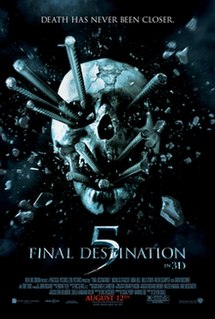
Final Destination 5

Rating: ***

There’s three types of 3-D: the type that’s artfully integrated into the film as a storytelling mechanism, the type that’s added to blockbusters for so-called added value, and the type that’s used for the express purpose of having stuff jump out of the screen at you, usually in horror movies. Final Destination 5 is unabashedly one of those films from the third category. Like its predecessor, The Final Destination, the filmmakers are so giddy about having everything from glass, to steel rods, to blood and guts fly out of the screen at you.

It’s worth noting that 3-D is also probably the reason this franchise keeps going, after all, the last film was called THE Final Destination. Finality has always been an issue when it comes to horror movie sequels, but writer Eric Heisserer and director Steven Quale find a surprisingly elegant way of getting around that in this film. It’s so surprising that I’m hesitant about spoiling it, and a little ticked that I didn’t figure it out before since I clued in on a couple of hints and thought nothing of them. Combined with an ambitious set piece to kick off the film, and a go for broke gusto when it comes to the film’s gore, Final Destination 5 is perhaps the series most entertaining entry.

In this chapter, Death comes for a group of employees of a paper company on their way to a corporate retreat. While crossing a suspension bridge, wannabe chef Sam (Nicholas D'Agosto) has a vision of the bridge collapsing and of 100s of people dying; getting snapped in half by cables, crushed by cars, plunging to their deaths in the water and getting impaled by the mast of a yacht. Cue the freak out, and Sam flees with his girlfriend Molly (Emma Bell) and several co-workers who get to the other side of the bridge in time to see the whole thing come down. Now since they’ve escaped Death, Death wants to come and collect them one at a time. Tony Todd returns as William Bludworth, the coroner who knows the rules of Death, and knows that the survivors are in deep trouble.

The biggest stumbling block to the film, for me, is that they’re so formulaic: somebody gets a vision of disaster, that person and a group of others escape doom, Death starts picking them off, they figure out what’s going on, and then try to beat fate only to usually fail miserably. And if there’s to be a Final Destination 6 then the writer or writers is going to have to explain why, if Death is so fickle about getting all the names on his list, then where are all these life-saving visions coming from?

On the other hand, I’m not sure such metaphysical implications are apropos for a film series like Final Destination. Really, when it comes to these films, it’s all about the gruesome death scenes, and if I were to judge this film solely on the “No-they-didn’t!” factor of the kills, then it would definitely be a five star effort. Unfortunate “accidents” involving gymnastics, laser-eye-surgery, and acupuncture make for some pretty cringe-inducing finales for many of the characters, but there was a pretty glaring logical fallacy in the film’s climactic showdown, but here again I’m using big words when I really shouldn’t be. As for the cast, I found them mostly unimpressive. They do their jobs well, and that job is to die horribly and make us feel it. Mission: accomplished. Besides, credit should be paid to any casting agent that can get horror icon Tony Todd, respectable actor Courtney B. Vance and comedian David Koechner into the same cheesy B-movie.

As for the film, it will definitely satisfy any blood lust you have in seeing pretty young things trying to outwit fate and succeeding poorly. And what more can you ask for from a movie that’s the fifth one in a series called “Final Destination.”

Friday, 3 June 2011

Good Neighbours

Rating: ***1/2

Jacob Tierney’s new film Good Neighbours is about as different from his last film The Trotsky, as The Trotsky was from Tierney’s first film, Twist. What do you do with a whodunit where you know who did it somewhere around the one-third point of the movie? How can you find a likeable character amongst a group of socially awkward characters with a number of obvious psychological maladies? Is this a Hitchcokcian mind game masquerading as dark comedy, or is this a sitcom written by Stephen King? Good Neighbours is all those things, and more.

A satisfying dark comedy with a thoroughly malicious bent, the act of watching Good Neighbours is equal parts enjoyment and equal parts bewilderment. It’s one of those movies that requires a second viewing so that you can make sure that you have the details right in your head. It’s not that the film is confusing, at least not so far as the plot goes. I, personally, wasn’t even sure that I liked the film until I started talking about it with other people. If you’re someone that likes to go to the café or bar after a film and hash out the details and the meaning of certain scenes and character actions, congratulations, you’ve found your summer obsession.

The film begins against the back drop of the 1995 Quebec Referendum on sovereignty. Victor (Jay Baruchel) moves into a building in the Notre Dame de Grace neighbourhood of Montreal, and right away is introduced to Spencer (Scott Speedman), a widower who lives downstairs and is stuck in a wheel chair, and Louise (Emily Hampshire), who’s employed in Chinese restaurant, and who Victor is immediately attracted to. Spencer and Loiuse have a unique friendship, but the only thing they really talk about is a serial killer working his way through women victims around the NDG. Into their perfect little dyad comes Victor, a well-meaning school teacher that tries to make a good impression with Spencer and Louise, but doesn’t realize he’s kind of an interloper.

Based on the book by Chrystine Brouillet, Tierney’s script challenges many preconceived notions of genre and plot development, while still developing some fascinating story ideas based around these three very odd ball characters. The trouble is that a lot of it is almost too good to spoil, but needless to say, you will either find yourself bound by fascination or rolling your eyes in disbelief. The film has the potential to make the viewer go either way with the plot developments. Good Neighbours is one of those movies that doesn’t make it easy to decide who to root for, and who to root against, and to some people that’s the difference between love and hate.

Technically speaking, if The Trotsky was homage to the sunny disposition of American high school movies in the 80s, Good Neighbours is its gritty and dark 70s cousin. Aided by the predominately winter setting, there’s a palpable sense of foreboding to the way that Tierney shot the film; it reminded me of Dean Cundey’s work with John Carpenter on Halloween. Shots are very deliberate, not relying on any hand-held camera work and going purely old school with lots of tracking shots on dollies. The film doesn’t draw attention to itself, and seems mostly about telling a good, compelling story, which leaves a lot of the heavy lifting to the actors.

On that note though, Good Neighbours is fortunate in casting decisions. Baruchel buries his man-boy persona under a Grizzly Adams-style beard and a demeanour not unfamiliar to anyone that’s ever seen Woody Allen act in a movie. Speedman tackles an out of character persona portraying Spencer as bitter, a little cynical and a little malevolent. It’s a really good role for him considering his built a career on playing the nice guy that finishes first. Hampshire, who like Baruchel is a transplant from The Trotsky, is interesting as Louise, a woman that seems so detached unless she’s talking about a serial killer or her cats. Hampshire is so marvellously understated, that even Louise’s most extreme character quirks come across as endearing.

But like a lot of good movies, I think Good Neighbours will be divisive in a good way. It’s a dry, black comedy that pushes the envelope of good taste and the definitions of genre filmmaking. It’s old-fashioned filmmaking with a post-modernist twist throughout. The acting is solid, and the artistry and control by filmmaker Tierney is unquestionable. Amongst all the blustery, blockbusters of summer, Good Neighbours is a movie you can get your head around, whether you fell good doing it or not.

Friday, 11 March 2011

Red Riding Hood

Rating: ***

Red Riding Hood is a mess. It’s got purposefully stilted-acting, incidents of sheer lunacy, harlequin-style romance, scary scenes that are not particularly scary and gory scenes that are not particularly gory. But having said all that there’s some kind of magic at work here by director Catherine Hardwicke.

The (kinda) modern retelling of the classic fairytale “Little Red Riding Hood” starts with a theme used popularly in Hardwicke’s last supernatural outing Twilight: an innocent girl torn between two lovers. The titular heroine is Valerie played by Amanda Seyfried, who with her big Disney princess eyes looks like she just walked out of a fairytale herself. Valerie’s in love with Peter (Shiloh Fernandez), a woodcutter that’s after her own tomboyish heart, but Valerie is betrothed to Henry (Max Irons), son of a prosperous blacksmith who’s no where near as dark and dashing as Peter.

But in this village – “So small barely anyone remembers the name,” Valerie informs us – there’s more to the local colour than who the prettiest girl in the land is going to marry. Nope, this town is haunted by a werewolf, whom the villagers have been satiating for two generations with an animal sacrifice every full moon. Ritual goes off the rails though when Valerie’s sister is found dead, killed by the wolf. With that it’s pitchforks and torches time as the men folk head off into the mountains for hunting season.

The fun doesn’t really get started until Father Solomon rolls into town. Played by Gary Oldman as a combination of Dr VanHelsing, Father Merrick and Col. Kurtz, Solomon arrives with an entourage of werewolf hunters and a giant copper elephant teapot torture device to help flush out the offending wolf. What are his credentials? “I killed wife!” he yells at anyone that doubts his resolve. She was also a werewolf.

Not that this is a simple monster/monster hunting story. Nope, there’s plenty of other intrigue as well like which one of the numerous villagers are suspect of being the werewolf, and why exactly Valerie is able to commune with the wolf when no one else can? It asks her to run away with him… like Peter. One the other hand, she glimpses its human eyes and sees they’re brown… like Henry’s. And what exactly is grandmother (Julie Christie) always doing skulking about?

For a sleepy little village plagued by a monster, this hamlet seems more like Melrose Place during Sweeps. But at least it’s beautifully realized. The film’s design is superb, with nary a flake of fake snow out of place in the beautifully created village by Tom Sanders. It reminded me very much of Tim Burton’s Sleepy Hollow where there’s a very naturalistic yet artificially creepiness to the setting, which you can do when you build a medieval village to your specifications on a soundstage. Even with that there are several loving establishing shots of the mountain wilderness of British Columbia, where the movie was shot.

The technical specs of the film are amazing, I would expect nothing less, but that’s not a reason to see Red Riding Hood. Amanda Seyfried is pretty to look at, as are the two strapping lads that play her consorts, but really what kind of Hollywood movie would this be without pretty young things in the middle of the action? And for those of you expecting sparks in the vein of another Seyfried vehicle, Atom Egoyan’s Chloe, holster your guns, because aside from a brief instance of PG-13 rated “sensuality,” Red Riding Hood is pretty chaste.

The best part of the film for me was watching a talented group of actors each acting like they’re in an entirely different movie. Seyfried sometimes seems like she’s trying out for innocent bystander number two, Christie seems like she’s playing the Cheshire Cat, or even the proverbial cat that caught canary at that, and even creepy Gary Oldman would be creeped out by the level of creepiness Father Solomon is capable of exuding.

Meanwhile, even actors in smaller parts get a chance to shine. Christine Willes plays Henry’s grandmother and has a Joan Crawford “no wire hangers” vibe when she tells her perspective future granddaughter-in-law that she’s the prettiest of all. And Michel Hogan (Battlestar Galactica) proves again that whether he’s talking about frakking toasters or carrying around a wolf head on a stick, nobody does gristle better than he does.

Despite all that though, the improbable combination of acting styles, the immaculate décor of the set design and the conventions of 700-year-old legend known to everyone, there’s something quite entertaining about Red Riding Hood. It’s not a perfect film and its intentions are not exactly clear, but it’s a breeze to get through. Although not to Grim Brother specs, this fairytale provides a good time at the movies, whether you end up loving it or hating in the end. I have a feeling that there will be plenty of either.

Friday, 29 October 2010

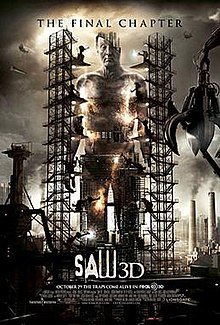
Saw 3D

Rating: **

Nothing says finality like 3-D. That seems to be the theory of the day with the previous release of THE FINAL DESTINATION in 3-D (which, as it turns out, is not The FINAL DESTINATION after all), and the new release of what is supposed to be the final SAW. The finale can’t come soon enough, in my opinion. There are only so many times that a group of narcissistic, self-involved people can be lured into overly elaborate and grisly death traps where they are literally taken apart at the seams featuring buckets and buckets of fake blood and chum. Unless it’s in 3-D, of course.

But really, 3-D was about all the producers of SAW could do to inject some new life into this franchise, which despite being still the slimly budgeted gore fest it’s always been, has come to feel bloated and self-involved. Every new film adds a layer of mythology that both complicates the original simplicity of the core story, and requires even greater feats of mental dexterity from the viewer to keep track of who’s a threat to who and is trying to get revenge on who else, all while a character that’s been dead for four films now somehow pulls the puppet strings from beyond the grave.

Tobin Bell still has some face time in this one as the titular philosophical serial killer Jigsaw, but his on-screen presence is mitigated. Even the villains(?), or is that antagonists, from the past few movies, Betsy Russell as Jigsaw’s ex-wife Jill and Costas Mandylor as his would-be protégé Hoffman, seem to spend a lot of time on the bench. The real story in this SAW is the return of Cary Elwes as Dr. Gordon, the man who gets away at the end of SAW I after sawing off is own foot. A prologue shows Dr. Gordon crawling away immediately after and cauterizing his own stump to stop the blood loss. I’m sure fans of the series enjoyed this throwback, but to me it’s another reminder of what this series has lost through all its iterations.

The subject this time is Bobby Dagen played by Sean Patrick Flanery. His sin is that he’s a survivor of one of Jigsaw’s death traps and has made a mint as a self-help guru in the aftermath. Of course, he’s surrounded by a group of spineless yes men (and women) and has a loving wife that admires him for his courage in the face of having had hooks pierced in his chest and forced to hoist himself on a rig in order to escape. If it takes you longer than two minutes to figure that Bobby is talking out both sides of his mouth, you might not be smarter than a fifth grader. Time to play a game for real, Bobby? You betcha!

One thing I’ll say about the 3-D is that it makes the death scenes much more squeamish. Seeing the blood and guts fly everywhere, even right at you, is enough to turn your stomach. At that, I think SAW reaches you on a visceral level, but outside that immediate yank on your gag reflex your left with a confusing mythology and a bunch of characters you don’t give a damn about. The kick-off game features a two men and a woman. The men, who were both being led on by the woman, are forced to choose who will get the business end of buzz saw, and by default win the girl. In the brief time we know them these characters are so ugly, killing all three would be a mercy to the human race.

At least if this is the end, the SAW movies go out on a technical high note, which should leave the fans of the series with a satisfied blood lust and a stunted appetite for bloody disgusting deaths. If not, their thirst will never be quenched and it’s pointless to continue anyway. It’s hard to believe that this is the series that started out so audaciously and featured first rate actors like Bell, Elwes, Danny Glover, Ken Leung and Michael Emerson. But I guess on the seventh film of a horror franchise, playing the G-list players is inevitable, even if they don’t get to work with A-list material.