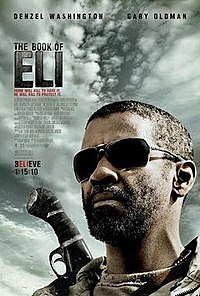
Rating: ****
You can take The Book of Eli a couple of ways. It’s a kin to Children of Men where in the hope of humanity’s future is in the hands of a single stranger running through a minefield of unscrupulous villains. It’s a Sergio Leone-like western about a man with no name, but one who’s on a righteous mission in a Godless land. Comparisons with the Cormac McCarthy novel The Road and its film adaptation are also inevitable as one man walks a lonely road westward avoiding bandits and cannibals while surviving by his wits and luck. The Book of Eli references all these things, but for some strange reason feels neither stolid nor derivative.
This gritty, violent and occasionally disconcerting tale is weaved with incredible visual flare and snappy pacing by Albert and Allen Hughes. The Hughes Brothers came screaming out of the gate in the 90s with Menace II Society and Dead Presidents, two powerful urban dramas about men on the fringes struggling to find a better life. In a way, The Book of Eli covers the same thematic ground: a man wanders the deserts of an Armageddon wasteland, driven by a voice to deliver a book to a location he knows not where, in the vague hope that the human race will find the ability to rebuild itself.
Denzel Washington plays the wandering soul, who, like the aforementioned nameless character from A Fistful of Dollars, drifts into a small town ruled under the iron thumb of petty tyrant here called Carnegie who’s played by Gary Oldman. Carnegie is a dreamer. A man that seeks to unite the last dregs of humanity under his flag, he just needs a certain book in order to do it, the one that just so happens to be in possession of Washington’s wanderer. But rather then bending to Carnegie’s will, the stranger is a much more vexing presence, and adding insult to injury is the fact that his stepdaughter Solara (Mila Kunis) takes off after the stranger to follow his example.
First you have to appreciate just how bad ass Washington gets in this movie. The actor, although never failing to enlighten, inspire or entertain, is certainly not known for his butt-kicking heroics, so it was interesting to see Washington play that part. Oldman is, of course, a natural sleaze from the top of his greasy hair to the bottom of his blood-covered boots. There’s a wicked rivalry between the two men, which gives a more complex social and political underpinning to this world that the Hughes Brothers have created, at least more so than the average after-the-end-of-the-world drama. It’s a post-apocalyptic story you can admire for its visceral, yet fantastical believability.
This balance is hard to find, just look at the recent adaptation of McCarthy’s The Road. It’s weird that a lot of the potent and poetic imagery that was missing from the movie Road was present in Book of Eli. The opening scene in Eli takes place in a dead forest as it snows ash, which is right out of some of the most powerful images in The Road book, yet strangely this was never evoked in the film version. The desolation, the desperation, the silence, all seemed kind of missing in The Road film as I remember it but is brought to depressing life in The Book of Eli.
The added bonus is that the audience gets some slick action as well and a rather interesting twist that will get you thinking after the credits roll, perhaps even to the point of catching a repeat showing. Sure, The Book of Eli is not wholly original, but in the moment of watching a really amazing gunfight it really doesn’t matter. From the awesomeness of Washington’s kung fu, to the evilness of Oldman’s wannabe preacher, the movie doesn’t fail to entertain. I’m not sure if one book can save the world, especially the book Washington’s wanderer is packing in the movie, but you will believe there’s hope for the post-apocalyptic genre.


