
 Rating: ****
I’m a big admirer of the book Imperial Life in the Emerald City by Rajiv Chandrasekaran. For those of us who were against the Iraq War before it was cool, it’s a soul-crushing, hair-pulling, frustrating tale of corporate greed, partisan back-slapping and one particularly disturbing episode where the one time probable Secretary of Homeland Security treated Baghdad like his own personal Westworld. The book was told in vignettes, but it painted an overall picture of how the post-war effort in Iraq went so horribly wrong. The Mess O’Potamia, if you will, wasn’t a result of one big screw-up, but rather the proverbial sting of a thousand bees.
When the book was optioned by Hollywood, I had no idea how they would turn Chandrasekaran’s book into a narrative film. Recruiting director Paul Greengrass was a good start though because his Bloody Sunday and United 93 were both detailed, visceral, near-documentary accurate dramatizations of real events. However, in the case of Green Zone, the trailers came across as kind of “Bourne Identity in Baghdad,” as in all action and no subtext. This was a rather frightening notion for me, again, because Chandrasekaran’s literary work was so powerful to begin with.
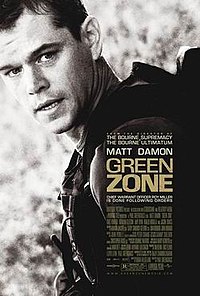
But for a minute there, I forgot I was working with professional: Greengrass, actor Matt Damon, and screenwriter Brian Helgeland. The many vantages of the book are boiled down into a single player, Warrant Officer Miller played by Damon, a U.S. Army soldier charged with finding weapons of mass destruction. As we join the action, just a couple of months after the fall of Saddam Hussein, Miller is already frustrated with the fruitless search for WMDs. He begins questioning the intelligence openly and rightly figures that if the threat was so imminent and the intel overwhelming, then his job should be going a heck of a lot easier.
Damon is really good as a patriotic soldier driven to performing duty, but is gradually coming to terms that his country may not be as altruistic in its intensions as he is. The plot unfurls convincingly without seemingly like a digestible, Hollywood version of the complexities presented in Chandrasekaran’s book. Greg Kinnear gives a thoroughly sleezy performance as typical Bush-era lackey Clark Poundstone and Brendan Gleeson does surly right as Martin Brown, a C.I.A. operative that’s been in the Middle East long enough to know political B.S. when he hears it. These three characters really perfectly encapsulate the themes and points of view from the book, and as a bonus, they feel neither plastic nor preachy.
Aside from Amy Ryan’s reporter, a kind of apologetic newspaper woman that was given access in exchange for hyping the war, the film feels real. My problem with the reporter character is that she flies in the face of what we saw, and what we still see, in American mainstream news. Those people are not sorry, and never have they seemed anything of the sort. Their current criticisms of the war seem hollow because it was non-existent before the war started and in hindsight, there was plenty to be suspicious about. Ryan’s character also doesn’t fit because she seems more pastiche than person. A plot device to give Kinnear’s Pouondstone a villain on his field.
Mostly though, Green Zone was a profoundly satisfying thriller of both the war and political variety. Greengrass blends both well by giving the thinking man the complexities of war policy and its administration to mull over, while the obligatory action scenes provide nice balance and a few explosions. But what I really appreciate is the details, the little stories and asides worked in the background to make this film a true adaptation of Imperial Life in the Emerald City. This may also be the first film about the Iraq War to transcend the partisanship, and if there’s a reason for that it’s because of the old axiom: truth is stranger than fiction.


