
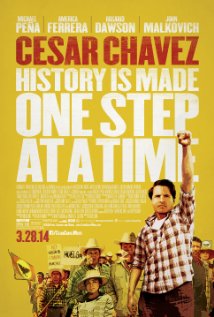
Rating: ***
For a bio-pic to be
effective it has to be more than Wikipedia entry with some stage directions and
dialogue; for a bio-pic to be good it was to make a case why the life of the
person it’s about is important, and how that connects to us in the here and now.
It’s hard to imagine a more appropriate bio-pic for the times than a film about
the life of Cesar Chavez, a pioneering labour leader who went out into the
farmers fields of California’s central valley and organized the
workers there into the National Farm Workers Association. Issues around migrant
labour still exist, and are still deeply felt on all sides. There's also the
dwindling returns of the entirety of the labour movement as a whole, so the
time seems ripe to remind people just how much blood, sweat and struggle went
into workers rights.
The movie Cesar Chavez
meets, at least, those goals in a perfectly satisfying way. Director Diego Luna
highlights the struggles and successes of Chavez’s five year odyssey to get
justice for the California farm workers in the midst of one of the most
socially tumultuous times in American history. More than that though, Luna
demonstrates that most parties in that struggle, from the poor farm hand to the
rich growers, were human people with complex emotions and thoughts and less
like the heroes and the villains of the story respectively. The film around
those performances is a history lesson and morality play, but when you focus on
the people, the message of Chavez and Chavez just might reach you.
The film begins in 1965 as
Chavez (Michael Peña) and his wife Helen (America Ferrera) pack up their eight
kids into a VW bug and head off for California farm country. Chavez, tired of
organizing out of a Los Angeles office, wants to get his hands
dirty, and dirty he does get them. Over the years, he struggles not just with
the incorrigible growers and a brutally corrupt local police force led by
Sheriff Smith (Michael Cudlitz), but with the his own people’s agony and
outrage as their movement seems to take one step forward and three steps back.
Despite personal cost to himself and his family, Chavez perseveres and in an
ending spoiled by historical fact, gets the members of the NFWA the dignity
they deserve.
As a screenwriting
exercise, this telling of Chavez’s life is paint by numbers. The connect the
dots plotting follows the character Chavez as he arrives amongst the
downtrodden masses, struggles to establish legitimacy, enjoys some success
before the man intervenes, enjoys greater success in spite of that before the
end of the second act when everything seems lost. The third act then becomes
eking out that victory despite the odds, and although we know those odds were
darn near insurmountable, juxtaposing archival footage of Richard Nixon’s
presidential inauguration with scenes of police brutality against the union
activists was a little on the nose.
Perhaps it’s because of
Luna’s extensive acting experience, but it’s the performances that, if
anything, will sell you on Chavez, particularly Peña as the title
character. Peña is one of those actors who has a face you recognize from some
film you've seen; he was Jake Gyllenhaal’s partner in End of Watch, he
was Nicolas Cage’s fellow trapped fireman in World Trade Center, and he was Mark Wahlberg’s
unwitting co-conspirator in Shooter. As Chavez though, Peña proves
himself extremely comfortable and capable going solo in the spotlight.
It can’t be an easy thing
being a Mexican-American actor playing such a towering figure of historical
significance to especially the Latino community, but Peña shows a lot of
confidence playing Chavez in an understated way. Peña lets the film frame the
importance of Chavez while he grounds the character as a man struggling to
create the circumstances so that people like him can have a better life. The movie
tries to force drama by occasionally visiting the growing estrangement between
Chavez and his eldest son Fernando, but the movie underestimates the already
existing and tremendous drama of the union struggles, and Peña’s ability to
portray Chavez’s self doubt and concern without needing a big scene to do it.
If there’s a main villain
in the piece, its co-executive producer John Malkovich as Bogdanovich, one of
the wealthiest growers in California and the main opposition to the
workers organizing. Neither Luna nor Malkovich play Bogdanovich as a moustache
twirling villain that’s in love with the idea of putting workers in their
place, but as an immigrant himself whose opposition comes from the American
ideal that if he can pull himself up by his bootstraps then anyone can.
Thankfully, you never see Malkovich scream about teaching anyone a lesson or
get hysterical about the workers coming for him like some kind of Farmer Al
Capone, and instead he calls upon reserve of calm and chilled logic to play
Bogdanovich.
With the actors doing their
jobs well, it’s easy to forgive Luna for using a style that’s hard to pin. He
sometimes favours something that feels like a docudrama while following the
workers out in the field, and then doing something else in scenes at home that
feels more staged and purposeful. The director does do a very good job of
painting the hard work in the fields using the harshest light possible, and for
keeping the story moving briskly and only rarely losing focus on the main story
of the union’s struggle. Luna shrewdly avoids the trap of a lot of bio-pics
that presume every detail in their subject’s life is a plot point and thus
losing the picture to the biography.
If you plan on walking into
Cesar Chavez thinking that you’re going to see something that breaks
the mould with its technical and structural brilliance, you’re bound to
disappointment. Frankly, it’s hard to say that Chavez aspires to
anything more than being Capra-esque with it’s intentions and being a true-life
story of how sometimes David does beat Goliath. Also, one can’t take away the
timeliness of the story. Many would argue that modern labour needs a towering
figure like Chavez to lead them in these modern times, but in lieu of that,
maybe a towering performance by Michael Peña as Cesar Chavez will do the trick.


No comments:
Post a Comment