Showing posts with label issues. Show all posts

Friday, 28 March 2014

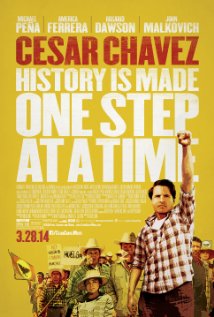
Cesar Chavez

Rating: ***

For a bio-pic to be effective it has to be more than Wikipedia entry with some stage directions and dialogue; for a bio-pic to be good it was to make a case why the life of the person it’s about is important, and how that connects to us in the here and now. It’s hard to imagine a more appropriate bio-pic for the times than a film about the life of Cesar Chavez, a pioneering labour leader who went out into the farmers fields of California’s central valley and organized the workers there into the National Farm Workers Association. Issues around migrant labour still exist, and are still deeply felt on all sides. There's also the dwindling returns of the entirety of the labour movement as a whole, so the time seems ripe to remind people just how much blood, sweat and struggle went into workers rights.

The movie Cesar Chavez meets, at least, those goals in a perfectly satisfying way. Director Diego Luna highlights the struggles and successes of Chavez’s five year odyssey to get justice for the California farm workers in the midst of one of the most socially tumultuous times in American history. More than that though, Luna demonstrates that most parties in that struggle, from the poor farm hand to the rich growers, were human people with complex emotions and thoughts and less like the heroes and the villains of the story respectively. The film around those performances is a history lesson and morality play, but when you focus on the people, the message of Chavez and Chavez just might reach you.

Thursday, 3 May 2012

Hot Docs - Finding North

 
Rating: ****

How can you be both hungry and obese? It’s a paradox that more and more people in the United States are beginning to understand, and a question that’s convincingly answered in Finding North, a provocative documentary about hunger within America’s own borders.

Finding North tackles a variety of desperate questions that come into conflict with each other. America is the richest country in the world, so why do nearly 50 million people not get enough to eat everyday? Food seems plentiful, so why is it so hard for people to get nutritious and healthy food options? Obesity is huge problem, but why is it a problem amongst the poor? How are you fat, if you don’t eat much? All challenging questions, and interestingly, they all come down to a couple of interconnected reasons.

Filmmakers Lori Silverbush and Kristi Jacobson interview health experts and advocates, as well as talking to people affected by food issues, like Barbie. Barbie is a single mother in Philadelphia who not only has to stretch her budget because she’s on food stamps, but she has to take a two hour round trip to the nearest grocery store that sells fresh fruits and veggies. Elsewhere, a local pastor deals with an explosion in the use of his church’s services, an accessible food bank and a free meal night, and a teacher tries to deal with a classroom of students where more than a few struggle with attention at school because they aren’t getting enough to eat at home.

Celebrities like actor Jeff Bridges and chef Tom Colicchio are also tackling the subject of “food insecurity,” the predicament that nearly 1 in 6 Americans find themselves in where they don’t know where their next meal is coming from. Colicchio tries to demonstrate that the some $2 and change that the American school system spends per student on meals, does not offer enough nutritional bang for their buck. But while the diagnosis is clear, the issue seems hopelessly tied up in the current American political climate that says there’s no room for free loaders on the system, even if they need the help, and maybe need a little more.

Finding North reminded my of Davis Guggenheim’s great education doc Waiting for Superman, trying to shine a light on a complex and important issue that so easily gets shaped and cast aside based on broad assumptions. The film’s an incitement on America’s approach to a problem it once quite nearly eliminated, only to be revived through ignorance and the seeming uncaring of the people that can do something about it. But it’s also a tribute to those working so hard on the ground to try and change things for the better.

Wednesday, 2 May 2012

Hot Docs - We Are Legion: The Story of the Hacktivists

Rating: ****

Memes? D-Dos’ed? 4chan? Lol Cat? To the average ludite, a stroll through the world of We Are Legion might be a bit like taking a trip to Wonderland without knowing how to speak the language. One wrong turn and you’re eating cakes that make you shrink and taking advice from hookah-smoking caterpillars that nearly gets your head chopped off.

We Are Legion explores the impact and evolution of Anonymous. Labelled by some as cyber-terrorists, others as merry pranksters, and others still as the defensive wing of the internet, it naturally occurs that Anonymous is none of those things, and all of them. And then maybe a bit more. Director Brian Knappenberger follows what was once a loose coalition of net-savvy users sharing the weird and outrageous on a message board called 4chan, and traces it through its activist incarnation as the legions of the Anonymous take on Scientology, defend Wikileaks, and rise to still greater prominence even as its original members splinter.

I think Knappenberger does a couple of things very smart. While his admiration for Anonymous is apparent, he doesn’t present this as a smirky fan boy rendering of “look how clever these guys are and you’re not.” There is some very fair analysis in We Are Legion, and Knappenberger does more than fetish the Guy Fawkes mask (though I wonder if he was able to, or even considered, taking to V for Vendetta creators Alan Moore and Dave Gibbons). The other thing that Knappenberger does well is work within the parameters of Anonymous, which is the anonymity of several of its members. Scene after scene of talking heads hidden behind one type of mask or another as seen through a Skype connection could have made the doc technically jump the shark, but Knappenberger handles the mixed mediums well.

It’s a testament to just how well trusted Knappenberger was by the people of Anonymous that he was able to get these comments in the first place, but to reiterate, I don’t think We Are Legion is a glowing piece of propaganda for the group. Knappenberger tackles the good and the bad, the benefits and the demerits, and the potential good of Anonymous and previous actions that don’t reflect well on them moving forward. We Are Legion may not prompt you to remake yourself as a hacktivist, but it will give you a greater, more detailed appreciation of the culture.

Monday, 30 April 2012

Hot Docs - Inocente with The Quiet One


For Both Films: ****

Filmmakers Sean Fine and Andrea Nix Fine do the incredible in Inocente, they made a bright and positive film out of the struggles of one young homeless girl’s quest to find something in this world to believe in. That’s not to say that Inocente doesn’t have its fair share of drama, but despite the titular subject’s circumstances – homelessness, being an illegal immigrant, personal struggles with her single mother – there’s always a bright side, and the world still manages to be a beautiful place at the end of the day.

Inocente and her family struggle. They are not truly homeless, as Inocente points out. Homelessness does not mean you are sleeping in an alley or a park, it might just mean that you don’t have a permanent home. Inocente’s family is continually on the move, mostly because they get evicted from the places they stay when Inocente’s mother, an illegal immigrant whose work options are limited, can’t make-up the rent. Living in San Diego, Inocente goes to school with some of the richest kids in the country, but despite all her troubles, Inocente keeps a positive outlook, and focuses on the thing that makes her happiest: her art.

I think rather easily Inocente could have become a dark and depressing effort, and it’s not that the issues that affect Inocente’s life aren’t serious, but I think the filmmakers were right in taking the lead from their subject and trying to stay on the sunny side. Inocente’s no naïve, pie-in-the-sky dreamer. She knows the odds are staked against her, she knows she’s going to have to work three times as hard to get half as far, but she’s bound and determined to make it, and make it through her art. You cheer for her successes and you feel for her disappointments. The documentary works exceptionally well telling its tale from Inocente’s point of view.

Inocente is a charming documentary that manages to prompt more than a few smiles, and given the tough issues involved that is a surprising approach to the story. Inocente herself, meanwhile, has a bright future ahead of her; the hero of her own story that breaks the bounds of what’s possible as much as any of the fantastic visions that come out of her paint brush. Inocente is a wonderful, life affirming story.

The Quiet One, the documentary that accompanies Inocente, is another immigrant story. This one is in Sweden and follows six-year-old Maryam, who’s come to the northern European country with her family of Iranian refuges. Maryam struggles to not just learn the language and culture of her new home, but to fit in with the class of native Swedish kids, who with their near universal blonde hair and fair complexions make Maryam stand out all the more.

But despite the educational and cultural differences, what struck me was that underneath it all, kids are all the same. The other kids in the class run hot and cold with Maryam, sometimes they’re all friends and sometimes they tease her. But after every fight, there’s a brief period of calm where the kids are all friends again, introducing Maryam to the strange new world of snow suits and tobogganing. After her first trip down the hill, Maryam lays in the snow and smiles; she’s proved her metal to her classmates, and maybe for the first time she feels more at home in this strange new land than ever. If only it were so easy for all of us…

Friday, 27 April 2012

Hot Docs - Shadows of Liberty


Rating: ***

So it turns out that corporate media is bad. That’s the surprisingly unsurprising message of Shadows of Liberty, a documentary about how the monopolizing of media – newspapers, radio and TV stations – under the umbrella of a handful of giant media conglomerates has made news consumers and the general public less informed if not downright ignorant. As the world burns, they say, and people of impure motives work their evil deeds, we the viewer, or listener, or reader, thrill to the tabloid exploits of celebrities who are making sex tapes, dying young, or going to jail…

And you know what? …They’re not wrong.

Director Jean-Philippe Tremblay is meticulous and cutting in his analysis. He puts together a tremendous cast of commentators to illustrate the problem – among them Democracy Now’s Amy Goodman, former CBS anchor Dan Rather and Danny Glover (?) – to provide context. His case studies are well chosen; a CBS expose on Nike sweatshops is killed after CBS Sports reaches a sponsorship deal with the company for the ’98 Winter Olympics, another CBS reporter is fired after openly questioning the FBI’s official explanation for the crash of TWA 800, and the grand-daddy of media missed opportunities, the case against Iraq.

Again, nothing in that is at all surprising.

Indeed, Tremblay’s moral and historical autopsy on mainstream media is impressive, and exhaustive, but what I think was missing was some semblance of balance. I don’t mean the defense of companies like News Corp, Disney and Viacom, but I mean signs of hope; the people working independently, on the outside of the system. He had Julian Asange there, but didn’t talk about how his upstart Wikileaks ended up feeding the New York Times as a source. It also would have been nice to get a rebuttal from the people Tremblay was lambasting. I don’t think Bill O’Reilly would have sat down with him, but Anderson Cooper maybe. Rachel Maddow and Lawrence O’Donnell possibly…

But the film is really well made, beautifully filmed and fulfilled, and in the end, Tremblay makes his case very, very well. But here’s the rub: I think he’s preaching to the choir. This was an extremely hot ticket Friday at Hot Docs, and I doubt it was just because it was the one of the first screenings of the fest. To this crowd, they know the media is not all it should be, and they know the reasons why that is, but the question is how do we change that culture, and how to we convert the non-members of the choir to that tune. Maybe we’ll save that for the sequel.

Hot Docs - The Invisible War


Rating: ****


The women featured in The Invisible War are everything one would expect from modern U.S. military officers: they’re driven, ambitious, skilled, accomplished, and selfless. True leaders in every sense of the word; women dedicated to serving their country and answering the call to be a part of something bigger than themselves. For all these reasons, it’s all the more unfortunate, one way or the other, that they were forced to give up their commissions after being sexually assaulted by their fellow soldiers or superiors.

The Invisible War explored by Kirby Dick (This Film is Not Yet Rated) in this film is the struggle of literally thousands of women who have served in uniform, were sexually assaulted and forced to cope in a system hopelessly stacked in favour of their attackers, a small fraction of whom ever see a court room, and an even small fraction of those receive severe consequences. Dick and his crew chronicle the daily struggles of the brave women who came forward for the film, while at the same time trying to get to the bottom of why, despite the government’s own statistics and the accusations of its female officers, the military is left to police its own in the case of rape on armed forces personnel.

The statistics are staggering, as is the seeming indifference of military leadership and representatives in the U.S. Department of Defense. Even women in the system, who you would think would be more sympathetic, show tremendous callousness and ignorance for the issue. Dr. Kaye Whitley, the former head of the military’s program to combat rape in the ranks, SAPRO (Sexual Assault Prevention and Response Office), advocates for female service members to use the “buddy system” as an acceptable strategy to combat rape. In another segment, a former officer in the Army’s Criminal Investigation Division (CID) explains that cases of rape reported are always given to male agents, since the perception is that female agents are “too sympathetic” and can’t be “impartial.”

Meanwhile, former Coast Guard Seaman Kori Cioca tells a waitress she meets to reconsider a career in the navy because chances are she’ll one day be raped and her superiors will do nothing. And while politicians in Washington agree there’s a problem, with nothing ever seeming to be done about it, female veterans suffering from PTSD (post-traumatic stress disorder) are more likely to be suffering not because of combat trauma, but because they were raped.

It’s a startling tale, but it does not enshrine victimhood. There’s tremendous sympathy for these women, but there’s also anger for what’s been done to them, and for what’s not being done for them. Hearing Dr. Whitley hem and haw through her interview with Dick would be funny if it weren’t so shocking, but it’s part of an astonishing system of ostriches all sticking their heads in the sand together. A glass-shattering story, and a wake-up call to anyone that still wants to believe that you – male or female – can be all you can be in the U.S. armed forces.

Hot Docs - Ai Weiwei: Never Sorry

 
Rating: ****

Ai Weiwei is a giant in Chinese arts scene, a giant in the international arts community, and a giant pain in the butt for the Chinese government. Despite China’s reputation as a place that clamps down hard on any and all criticism, Ai Weiwei stood boldly in contrast, poking and prodding the state, practically daring them to “black bag” him. For a minute there last year, it seemed that Ai Weiwei had finally been silenced, but international response was resounding, and after 81 days he was released from custody.

Ai Weiwei: Never Sorry offers incredible access into the artist and his world, but it’s also a serendipitous chronicle of the weeks leading up to Ai Weiwei’s arrest and the events that may have been the last draw for the Chinese government. In stark contrast to his homeland, Ai Weiwei is open and engaged, willing to be questioned and challenged in conversation. He really is the perfect subject matter for a documentary, and is a thoroughly captivating character.

But beyond the hindsight build up to Ai Weiwei’s arrest, director Alison Klayman plays with a number of themes: the fine line between art and activism, working within and without strict state-run censorship, and trying to promote change from the outside while still working from the inside. It’s heady stuff, but Ai Weiwei is such a relatable figure. Quite often the arts seem impenetrable to the layman, and the discussion of it requires a language most people don’t understand. But Ai Weiwei and his work flies in the face of that.

What’s weird is that in the midst of being surveilled and continually, sometimes literally, sticking his middle finger out to the Chinese government, you’re never concerned for Ai Weiwei, even if you have some idea what’s coming. He’s a rebel with a cause, and a glass half-full disposition. The film too is an extension of the artist’s spirit, not preaching, not condemning, and not afraid. The dividing line between art and politics falls away, and for Ai Weiwei, his politics become his art. Or vice versa.

Klayman effortlessly balances a lot of balls in the air and manages to tell a story that’s biographical, political, cultural and human. It’s all of those things and none of them. At least all that once. It’s a fascinating trip inside the mind of a man that shares his uniqueness without having to deconstruct the magic out of it.

Tuesday, 20 September 2011

TIFF - Last Call at the Oasis

Rating: ****

Every year, there’s at least one documentary that makes you frightful for the immediate future of the human race: Food Inc. made us scared of what we eat, An Inconvenient Truth made us afraid of the weather, and this year at TIFF that film was Last Call at the Oasis, and its issue is water, or rather the growing lack of it. Director Jessica Yu uses high-production standards and a calming tone to make people aware of one inexorable truth: we have a serious problem with the quality and availability of our fresh drinking water.

Smartly, Yu immediately puts the focus not on far-flung places in the world where we typically consider drought and lack of water to be an issue, but right in our backyard in places like Las Vegas and Southern California. Sure, this issue is global, as the film tells us that half the world’s hospital beds are taken up by people with water-born illnesses, but predominately Yu brings the issues home and makes a case that our “water footprint” in North America, is dangerously out of sink with our resources and usage worldwide.

Yu brilliantly draws the dangers by reinforcing the domino effect. In Las Vegas, about three per cent of the city’s water is used for those magnificent fountains along the strip. Due to a variety of factors, water levels in the Colorado River are going down. The Colorado, being where Vegas draws its water, are now looking to northern Nevada who fear that Vegas tapping into their taps will sap their wells dry. Meanwhile, at the Hoover Dam, which is fed by the Colorado, water levels currently sit at 1086 feet. The turbines stop spinning and generating electricity at 1050 feet.

Compounding to the loss of water, the water that remains is in danger from not just overuse, but from chemicals and pollutants as well. Enter Erin Brockovich, who once famously fought against a large corporation polluting a small town’s water and thus killing the inhabitants, and still fields dozens of requests daily from people looking for help. Sometimes the documentary feels like it’s going to break out into Erin Brockovich 2, but she’s a significant and recognizable figure on this issue and her prominence is understandable.

What’s interesting is that in spite of the somewhat apocalyptic idea of running out of fresh water, and the idea that we’re kind of screwed in any case, Last Call is surprisingly upbeat. You don’t walk about this movie with a cloud of doom over your head, and at least feel elated because there’s some indication that on the ground there’s a growing recognition of the problem, which is more than can be said of climate change six years after An Inconvenient Truth.

Last Call at the Oasis makes a compelling case, and does so with a light touch. It’s well made, well researched and certainly makes an impact with breaking you over the head with a diatribe. I’d say that this documentary is cool drink of water, but I think that there might be some implied waste there.

Monday, 9 May 2011

Hot Docs - Boy Cheerleaders

Rating: ***1/2

The idea of seeing boys on cheerleading squads amongst the girls is hardly new or surprising. At this point, I’m not exactly sure how rare a thing it is to find squads made up entirely of boys. Of course, if boys being cheerleaders was the sole preoccupation of James Newton’s British-made documentary Boy Cheerleaders, it would be a terribly dull affair. What’s interesting is the film’s setting, a council estate in Leeds, and the main characters, a colourful cast of troubled boys, many of whom are being raised by single mothers, and all of whom are finding something challenging and redeeming in the sport of cheerleading.

What’s interesting about the film is not that so many of the boys take it on the chin from their school chums that they’re into cheerleading, or even the fact that they’re working class boys that like to dance while waving pom-poms. What’s interesting is that it seems that cheerleading is one of the only things that can reach them. These boys so often drift into fighting and other forms of acting out, they’re indifferent to authority of any kind, but absolutely live to dance. There’s a great scene where one of the boys is forced to take a time-out from cheerleading after some particularly unruly behaviour. His disappointment, and his penance, eventually allow him back in, but it’s interesting watching him try and deny that he’s really missing something by not being allowed to cheerlead.

The film flows very naturally. It follows Coach Ian Rodley as he tries to galvanize the boys to become the tops in their field, and not just as boy cheerleaders, but for all cheerleaders. There’s a stop on a popular British talk show along the way, and an important audition for one of the boys that could lead to a possible future as a professional dancer. Obviously, the film comes down to the championships and whether or not the boys will rank. Whether they do or do not is superfluous to the fact that you can just lean back and have a good time watching this documentary. It’s like Billy Elliot, but with a bunch of Billys and it’s a documentary. What’s not to love?

Saturday, 8 May 2010

Hot Docs - Congo in Four Acts

Rating: ****

Events in Congo don’t make the news a lot, but it’s one of the most unstable areas in Africa and that’s really saying something. This is where the documentary works really good, highlighting the people, stories and aspects of current events that don’t typically get covered in the nightly news. What makes Congo in Four Acts even more interesting is that it’s four short documentaries directed by filmmakers from The Democratic Republic of Congo (DRC). From the impoverished streets to the overworked civil servants, a very fascinating light is shed on this country by the people who know it best.

The project began as an educational experience for its filmmakers: Dieudo Hamadi, Divita Wa Lusala and Kiripi Katembo Siku. The result was a refreshingly honest and direct look the people and problems of Congo, representing four very diverse subject matters. In Ladies in Waiting the bureaucratic nightmare that is a struggling maternity ward is examined. Symphony is an eye-opening, first-person look at the slums of Kinshasa. Zero Tolerance is an almost COPS-like vignette about justice and sexual violence in the eastern DRC. Then, to finish, there’s Mine, which is about young children that break rocks for pennies.

Each of these films offers a unique insight into several areas of life in the Congo. It’s hard to pick a single segment that has more of an impact than the others, but those versed on the issues will certainly come to appreciate Zero Tolerance. Rape has been used as a weapon with alarming frequency in the Congo, but seeing the sight of young men under the age of 13 being brought in to the police charged with sexual assault is fairly haunting. Combined with the matter of fact manner in which these boys are brought in to elocute their crimes with the parents trying to make excuses for them, and you’ve got a really bleak picture of human rights in the Congo.

By comparison, Ladies in Waiting, Symphony and Mine aren’t nearly as sensational, but they are still very powerful. These three highlight tremendously the struggles with poverty and status in the Congo. Mine shows a mother and child breaking rocks for hours in order to make the equivalent of a quarter for all that hard labour. The barter system is taken to the extreme in the maternity ward featured in Ladies in Waiting where treatment continues only if the women or a family member is able to provide a significant item for collateral. Both of those shorts are vastly different in opposition to the starkly silent Symphony, as the only sound comes from life on a crowded, filthy street in the city of Kinshasa that’s just miles from a more affluent area.

There’s a looking glass factor to Congo in Four Acts where in we’re given these brief though potent little insights into life in the DRC. We see what life is like in this place but we’re not given either context or commentary. The filmmaking style is very visceral and immediate, almost the roughest, greatest intention of the documentary art form. Basically, these are stories and insights that could only be gotten by people living in this place, at this time. Fascinating and enlightening, Congo in Four Acts is a must see for anyone interested in issues and Africa.

Wednesday, 6 May 2009

Hot Docs - 69 and Black Badge

Rating:
69 – ****
Black Badge – ****

Both 69 and Black Badge are documentaries about people being pushed to extremes to get reaction and action on an issue of critical importance to them. Although the distance between Denmark and South Korea covers thousands of miles, the ideals driving the protagonists of both films could not be more closely related. The lesson from both films is that action matters, and in our media savvy age, the right kind of action brought to your cause can either make you or break you, that is if you’re noticed at all. Two desperate quests; two different journeys; two different results, but one desire: to change things for the better.

To begin with there’s Black Badge whose name is taken from the name tag worn by contract workers at a South Korean GM plant. If you’re a regular, salaried worker you get a white badge, but the ever growing number of temporary, or contract workers, get black. And in an odd bit of symbolism that shouldn’t be lost on anyone, the contract workers are treated as a disposable class in the factory hierarchy, by both the plant management and their salaried colleagues. One worker, Hyunsang Park, turns himself into a spectacle by occupying the top perch on a traffic control tower 80 feet in the air in order to protest for more equitable pay and more equitable treatment.

Unfortunately for Park and the few compatriots offering him logistical support, their protest seems to be falling on mostly deaf ears. Interesting comparisons are made between Black Badge and the classic Michael Moore doc Roger & Me as Park, with director Jung-min Choi and his camera in tow, try to reach the management of GM’s Korean plant to try and meet about the appalling conditions and treatment of the contract workers. In anything, the film draws a portrait of how the workers rights struggle isn’t always strike breakers and soaring rhetoric. Sometimes it’s sitting around bored for hours or otherwise stewing about the proverbial roadblocks continually being thrown up, and being surrounded by people who seem not to care.

Institutional apathy is also a recurring theme in 69, which follows the struggles of the residents of Copenhagen’s youth house, a building occupied in 1982 and given to the disenfranchised youth of the Danish city now sold to developers. For 25 years, this place served as a refuge for the poor, the punks, and people who just have no where else to go. An open and inclusive community that’s not only welcoming but functional, the youth house finds itself a victim of gentrification as the city sells it to make room for new condos. But the youth don’t take defeat easily, and rally in a number of ways, legal and illegal, mainstream and subversive, in order to keep their home.

But unlike poor Hyunsang Park, the youths are very successful and drawing media attention to their plight and their action. But rather than just being a chronicle of fighting the man and the old story of how the Powers That Be roll the powerless without hesitation, 69 poses an important question about the difference between good attention and bad attention. While direct action against police and rioting definitely brings the cameras, the focus drawn to the fact that about 20 youths are being evicted with no where to go is supplanted by a more incendiary story about anarchist youth and destruction of property.

Youth meetings to decide courses of actions in regards to saving their home are more war room than a loose coalition. These kids are energized, informed and mobilized, not to mention media savvy in a way people probably wouldn’t expect. Director Nikolaj Viborg’s remarkable access paints a succinct and compelling picture and there are also some great instances of political subversion. Despite all the trouble that the city of Copenhagen cast upon the kids and the reciprocal rioting and civil unrest that came as a result, it turned out that the simplest solution was the easiest after all.

But while 69 wraps up on a happy ending, Hyunsang Park’s fate remains very much up in the air at the end of Black Badge. These are two powerful documentaries, two very different styles and two similar messages about persistence and drive for your cause in the face of overwhelming defeat. Very inspirational, but at the same time very real, 69 and Black Badge are a double-bill for the mind and the heart.