Friday, 30 April 2010

A Nightmare on Elm Street [2010]

Rating: **

So I guess all that’s left is Pinhead and the Leprechaun to get the remake treatment. In any case, Freddy Krueger can now have his name off crossed off the re-imagined list with this new film called A Nightmare on Elm Street based on Wes Craven’s 1984 original. It’s from the producers of the previously remade The Texas Chainsaw Massacre, The Amityville Horror, The Hitcher and Friday the 13th and the director of a bunch of music videos, so it should come as no surprise that there are no surprises here. In the remake free-for-all that’s been the last decade or so of horror cinema, this Nightmare is remarkable for being unremarkable.

So what’s not to like? Well, the teen characters are utterly unremarkable. The main cast includes many recognizable faces if not recognizable names like Kyle Gallner (Jennifer’s Body), Thomas Dekker (The Sarah Connor Chronicles), Katie Cassidy (the Melrose Place remake), and Kellan Lutz (The Twilight Saga), but their characters are all whiny, pathetic and just otherwise unengaging. Newcomer Rooney Mara gets to fill Heather Langenkamp’s shoes as Nancy… Holbrook? Say what?! Nancy’s last name is supposed to by Thompson. As in Thompson’s a perfectly bland name that a lot of suburban girls have. Many of them are probably also named Nancy. And to add insult to injury, this Nancy seems like a passive secondary player in her own story.

But really we just all want to know if this non-Robert Englund portrayed Freddy is going to be any good. Unlike his contemporaries Jason Voorhees and Michael Meyers, Freddy Krueger’s only ever been played by one man. A man of such outstanding charisma and presence, he actually jacked the film series from its supposed heroes - the teenage kids – and became the loveable antihero who just happened to be the murder psycho demon from your nightmares.

Jackie Earle Haley had his work cut out for him and he acquits himself well by going for menace and creepiness. There’s no roller coaster of puns and cheesy one-liners, just lots of heebie-jeebies. I give props for the filmmakers for really confronting, for the first time I think, that Freddy is a child molester and murderer. You’re not supposed to love him, you’re supposed to despise him. If Freddy was being collared by the cops on Law & Order: SVU the people would demand he hang for his crimes. But because in Nightmare he’s a wise-cracking ghoul with tenth degree burns and glove full of knives he gets a pass. Kudos to the filmmakers for going another way.

Still, that doesn’t give the people behind this new Nightmare – and by that I unintentionally reference Wes Craven’s 1994 New Nightmare which was actually very good – a pass. The kills are incredibly pedestrian with absolutely nothing new or memorable in how this film was shot or designed. Forget the bloody bed explosion from the original, there’s nothing here that even bests the “Are You Ready for Freddy?” music video by The Fat Boys. This Nightmare remake is unremarkable, disposable and you kind of forget it mere moments after it’s over. So I suppose by that standard, the producers have managed to carve a niche for themselves in following the tradition of all those Nightmare sequels.

I guess that in and of itself isn’t so bad, but if you aren’t going to try and do better than what’s come before, or at least try something completely different, why bother remaking this in the first place? It’s a question I’m sure we won’t get answered by the time the next remake comes around.

Thursday, 29 April 2010

Hot Docs - Waste Land

Rating: ***

I remember one day in high school art class when our teacher told us that we were heading out into the woods behind the school to look for pieces of garbage that we were going to turn into art. It was one of those occasions where we thought our teacher had, you know, checked out – mentally speaking. But hey, a day out of the classroom was a day out of the classroom, right? Of course, being idiot teenagers, we never realized how progressive our art teacher really was.

Now, there’s Waste Land, a movie that’s all about making art out of garbage. Of course, that’s putting things rather simplistically as Waste Land is not a movie about art; or rather it’s not just a movie about art. It touches on themes of environment, waste, social inequality, and self-determinism. Much like a previously well-received documentary about the photography, Jennifer Baichwal’s Manufactured Landscapes featuring Edward Burtynsky, Waste Land is so much more than a movie about taking pictures of humanity’s mess.

The central figure of this doc is Vik Muniz, a Brazilian artist and photographer from a poorer area in São Paulo. Now making a comfortable living out of his Brooklyn studio using trash as art supplies, Muniz decides to mount a large project based out of the Jardim Gramacho, one of the largest garbage dumps in the world, located on the outskirts of Rio de Janeiro.

At Jardim Gramacho Muniz and his team encounter numerous characters that become the subjects of his new project. The pickers, workers who scrounge through the dump to separate out the recyclable materials, become the subjects of the photos. They also become kind of artistic interns as Muniz’s small 8x10s become enormous pieces brought to life through the same recyclables the pickers rummage through on a daily basis. The pieces they create are extraordinary, but as any art appreciator knows, it’s the story behind the portrait that matters more.

Waste Land leans heavily on the transformative power of art, but to be candid the film kind of makes things seem a little too simplistic. Still, it’s endlessly engaging watch these poor workers that toil on a garbage pile all day, every day, see themselves in a new light. To see themselves as someone else sees them and realize the beauty of who they are and what they do is undoubtedly a powerful thing. It’s hard not to be touched by one woman’s tears of joy as she sees her portrait in the Rio Museum of Modern Art and says that she hade never thought that she would be the subject of a work of art in a museum.

Every one of Muniz’s subjects is profiled as director Lucy Walker and her crew follow them to their homes and visit with their families. They talk about how they ended up working at the Jardim Gramacho and their hopes and ambitions. One person featured especially is young Tiao, who’s led the workers of Jardim Gramacho to form a sort of cooperative, one that has since become a model and inspiration to pickers across Brazil. His workers being featured in an art show, and the attention that brings, is a vindication of this enterprising young man; his tears of joy after a portrait is sold in London for $50,000 in a fundraising effort are palpable.

That scene kind of encapsulates what the film’s about: empowerment. It’s not so much about an artist making art as it is about his subjects becoming art and what they take away from that. It doesn’t change their world, but it does change their perceptions. Though as observed, the movie does sometimes stray to the overly optimistic tact that art can conquer all, there’s no doubt in the end that there’s been a change for the better for the profiled pickers of Jardim Gramacho.

Waste Land is an interesting and fitting reminder that sometimes garbage is art and that beauty can be found in unlikely places. Very unlikely places.

Hot Docs - The People Vs George Lucas

Rating: ***1/2

“George Lucas raped by childhood.” Back during the free spirited days at the beginning of the internet revolution, the above phrase was born out of the dual traumas of Greedo shooting first and Jar Jar Binks. For the re-edits of the original Star Wars trilogy and Star Wars Episode 1 The Phantom Menace were so horrific that… well, you might have seen the South Park episode with Lucas, Spielberg and Indiana Jones, and if you haven’t, I’m sure the clip is on You Tube somewhere.

Walking out of the Hot Docs screening of The People Vs George Lucas though, I wondered to myself: Really? Was it that bad? Certainly the prequel Star Wars trilogy, released between 1999 and 2005, weren’t exactly shiny, glorious moments of cinematic triumph, but weren’t we, at least, entertained? Apparently not since Alexandre O. Philippe not only made a documentary in the form of a mock trial about Lucas and his crimes against Star Warriors, he got fandom itself to line-up as witnesses for the prosecution. Their evidence is presented in a myriad of clips and spoofs both live action and animated.

But the length to which people decry George Lucas and condemn him for compromising his vision only really proves one thing anyway: just how much these people still, and forever will, love Star Wars. After all, could not the prequel trilogy and fan reaction find an allegory in the story of Icarus? The file footage of people lining-up for Meet Joe Black in November 1998 just to see the Phantom Menace trailer is proof that expectations for the film were atmospheric. (And in a note to our younger readers, 1998 was prior to the advent of You Tube, so people still had to go to a movie theatre to see a trailer.)

So is The People Vs George Lucas the Nuremberg of fandom retaliation? Hardly, but that doesn’t mean it’s not a terrific show trial. The mania, the hysteria, the cultural impact, the preternatural outrage, and the depression-turned-anger limited two-stage mourning process is palpable. However, there was an element where all the condemnation made me say to myself, Come on, just change the DVD and watch something different. You also discover that there’s a fine line between being overly critical and committing overdosing on cinematic outrage.

Interestingly, it was the French that gave the most refreshing bit of insight about the prequel trilogy as two French film critics remark of Lucas’ boldness in inserting a broadly comedic character like Jar Jar into the normally demure Star Wars universe. Now it’s true that the French have previously elevated Jerry Lewis to comedic divinity, but what an interesting new interpretation, especially inserted amongst a montage of fan films featuring everyone’s favourite Gungan being visited on by season’s worth of 24-style torture.

There were times watching this film where it felt like there really wasn’t anything new to add, rather just a rallying point for people still ticked in the years to come to say, “Look. Look at this movie. You know why George Lucas sucks? Here’s why!” Carry a grudge much? But there are a couple of things that the movie touched on that I do feel is legit criticisms, and I wish they had expanded on them. For instance, what happened to Lucas’ plan to make these small, personal films once Star Wars was “finished”? And how can the guy that stood up against Ted Turner for his colourize crazy agenda, then years later throw away the 1.0 versions of his own films and call them “imperfect”?

But those are kind of intellectual concerns. What The People Vs George Lucas delivers really is pure fun. A lot of metaphors are made to between victims of domestic violence and Star Wars fans feelings about the saga post-1997, but I think it’s more like people who fall in love with prison inmates. You know the person behind bars has done something wrong, but you just can’t help yourself, you love them the same as you always have despite the character flaws. Or maybe you could just get over it and watch something by John Ford or Akira Kurosawa. Your call entirely.

Friday, 23 April 2010

The Losers

Rating: **

When you call your movie THE LOSERS you’re more or less asking for a negative review. But in all seriousness, THE LOSERS also suffers from being one of a number of movies being released this year about a group of hard-fightin’ manly men, shirked by the system and gone rogue like so much Alaskan governor. Based on the graphic novel by Andy Diggle, THE LOSERS plays to this archetype well, but ultimately it doesn’t amount to much more than a typical action movie, with typical characters including former military men with silly nicknames, and an extremely hot chick that will help them get even with the system that screwed them.

The title refers to the nickname for a Special Forces team, this time, working Black Ops in Bolivia. Assigned to kill some nameless South American bad guy, the team, lead by the cool-headed Clay (Jeffrey Dean Morgan), is betrayed by a mysterious operative named Max (later played by Jason Patric) and left for dead. I say “left” because actually, almost everybody thinks they are dead. A mysterious woman named Aisha (Zoe Saldana) approaches The Losers with a proposition: if you want to get revenge on Max, I know how.

The rest is the usual convoluted action movie stuff with revenge, double-crosses, and sequences involving utterly unbelievable, incredibly loud violence. What exactly the sum and total of all the onscreen madness is, I have no idea. All I do know is that there really isn’t a single action sequence that stands out, and nothing wholly original in the way that STOMP THE YARD director Sylvain White presents it. The shame of it is that when action’s done well, it can draw attention away from other things, like poor dialogue, stiff characters or a meandering plot. No such luck here, although there was enough to THE LOSERS to provide significant distraction.

Part of that “distraction” is Zoë Saldana who between this, Avatar and Star Trek appears to be setting herself up as the go to femme fatale for comic nerds and movie geeks everywhere. She’s downright thrown herself into the part I would say, and in THE LOSERS she does admirable job of being the bad behaving eye candy amongst a crew of not-so rough roughnecks. Chris Evans, Idris Elba, and Columbus Short as three of The Losers seem to think that they’re in OCEAN’S 11, while Jeffrey Dean Morgan definitely skewers more towards George Clooney territory when what’s really required is Sylvester Stallone. Only Jason Patric seems to realize what movie he’s in, and you can almost actually see the bite marks in the scenery.

Interestingly, comparisons to THE A-TEAM have been thrown a lot in reference to THE LOSERS and one can see why. Both are about teams of army guys framed for a crime they didn’t commit and forced to clear their names by becoming mercenaries. But for all intents and purposes, if you can only see one film with that plot description this year, hold on to your money and wait for the actual A-TEAM movie. THE LOSERS meanwhile, is the epitome of brainless action. It’s bubblegum, you chew it till the flavour’s gone and then you spit it out and pop in a new stick. That’s not to say that the chew wasn’t satisfying, but that’s all you got out of it. What more can you expect from a stick of gum?

Friday, 16 April 2010

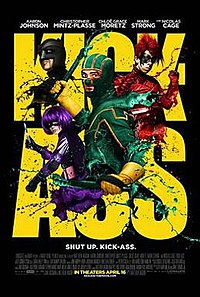
Kick-Ass

Rating: ****

It seems almost crass to say that Kick-Ass is a great superhero movie. In many ways the movie, not to mention the comic it’s based on, hates superheroes. This might not have been the intention of comic creators Mark Millar and John Romita Jr, and it probably wasn’t the intention of filmmaker Matthew Vaughn either. Still, it’s a feeling I got while both reading the comic and watching the movie.

Then something interesting happens. Kick-Ass, the scuba suit-wearing, heroic identity of Dave Lizewski (Aaron Johnson), confronts three hoodlums beating up a fourth. In the annals of super-fights this ranks somewhere around Archie Vs Punisher, but then there’s a moment. One of the punks says to Dave/Kick-Ass, “The f**k is wrong with you, man? You'd rather die for some piece of $#!t that you don't even f**king know?” after the hero-wannabe refuses to leave a man down. “The three @$$holes, laying into one guy while everybody else watches? And you wanna know what's wrong with me? Yeah, I'd rather die... so bring it on!” Kick-Ass retorts.

Bull’s Eye. This isn’t Spider-Man for the cynical. This is Mr Smith Goes to Washington for the Twitter Generation.

Kick-Ass isn’t really a movie servicing the trope of what if superheroes existed in the real world. If you want that, go over to the DVD shelf and re-watch Watchmen. This film is more satirical. Not a comedy mind you, but darkly funny. Sometimes uncomfortably funny. It’s a tone I don’t think a lot of people got, but for the open-minded Kick-Ass is infinitely rewarding. It’s about teenage alienation, feeling powerless in a power-mad world, and making your own fate. It’s all that plus Nicolas Cage at his spastic best. (On a side note: for prime Cage go out and rent Bad Lieutenant: Port of Call New Orleans. Now!)

The story is about Dave, your average high school comic nerd, and his pursuit of a simple dream: to become a superhero. Why hasn’t some crank with an axe to grind ever put on a costume and acted out delusions of Batman, Dave ponders to his friends (Clark Duke and Evan Peters). Simple, they’d get their ass kicked. Bing. Of course, the first time that Dave dons the green scuba suit of Kick-Ass, that’s exactly what happens. However getting beaten, stabbed and run over is no deterrent for Dave, and after his aforementioned exploits make the Must See list on You Tube, Kick-Ass becomes a sensation.

But what’s that old saying about imitation? Kick-Ass begets a number of copycats, among them Hit-Girl and Big Daddy (Chloë Grace Moretz and Cage), a daughter-father team that’s out for revenge against the mob boss that framed Daddy’s ex-cop alterego, Damon Macready, as a drug dealer. Now, the most controversial bit about Kick-Ass has been Moretz portrayal of Hit-Girl, a 12-year-old with the lethal skill of Bruce Lee and the potty mouth of Andrew Dice Clay. Sure, she uses the C-word and the MF-word with zero discretion, but as compared to scenes of mob guys getting microwaved and blown away by bazookas, can we grade on a curve the cursing? Shoot, I’ve heard worse in the mall.

The real money in this movie belongs to Cage, channelling his skeezy best with a sort of paternal Adam West as Batman patter that’s both heartfelt and creepy. As well, Mark Strong plays demented and motivated in the best comic book villain tradition as mob boss Frank D'Amico. Johnson is alright in the title role, not that his purpose is particularly inspiring. After all, the character of Dave is supposed to fade in the background, but there’s really nothing to say that he’s grown from the experience by the end of the film. I did enjoy the moral corner that Dave is painted in. His altruistic intentions crumble when confronted with the full extent of the evil people are capable of, and watching how he squirms feels real.

Which brings us to McLovin’ Christopher Mintz-Plasse who plays the final member of the heroic quartet, Red Mist. Here, the movie drops the ball because unlike how the comic sets it up, we know all along that Red Mist, AKA: Chris D’Amico, is the some of Frank D’Amico. Which makes the eventual double-cross rather tedious because we know it’s coming and waiting for the other shoe to fall takes a lot of fun out of it. On the other hand, there would have been a lot of missed opportunities for Mintz-Plasse and Strong to interact, and a lot of those scenes were pretty golden. So I guess it comes down to a matter of story versus character. I’m just not sure which one wins more in this instance.

Still. Kick-Ass is immensely enjoyable overall. It’s a deconstruction of the superhero myth that’s both critic and fan, and more miraculously, both spheres are able to exist in the same orbit at the same time without one adversely affecting the other. It’s a very well done piece that proves once again that Matthew Vaughn knows what he’s doing. Vaughn, as you may or may not know, was once to be the director of X-Men: The Last Stand. Probably for the best though because if Kick-Ass proves one thing again, spandex in a superhero movie still looks lame.

Friday, 2 April 2010

Clash of the Titans

**1/2 stars

The subject of much controversy, this Easter weekend brings to theatres the new rendition of Clash of the Titans, the big budget remake of the film more famous for being F/X king Ray Harryhausen’s last than for being any good. The controversy comes from Clash’s quickie conversion to 3-D in post-production, a process initiated after studio bosses heard the cash register bells ring off the hook for Avatar. Of course, Avatar had 3-D in mind all along when it went before the cameras. You know James Cameron’s vision and blah, blah, blah. One can hardly blame a studio suit for trying to squeeze out a couple of extra bucks, but you can, however, blame them for the result.

The fault of Clash lies not in the mythology, but in how it ends up being treated. Say what you want about the first Clash, including some harsh words about young Mark Harmon in a toga, but at least one could sense a giddy love of all things Greek. In this Clash, Greek mythology seems a handy system upon which a Lord of the Rings by way of Gladiator story of questing, vengeance and daddy issues can be hung. So far, so unimpressed. And adding insult to injury is the fact that we’re saddled with a Perseus that’s one of those heroes that does nearly as much whining and brooding as he does world-saving.

Sam Worthington beams down from Pandora to fill the armour of Perseus and he does an admirable, if not overwhelming job playing the hero. In other words, he’s perfectly bland but it doesn’t really matter because the point of this movie is action, spectacle and more action. We also get duelling brothers Zeus and Hades as essayed by Liam Neeson and Ralph Fiennes respectively. What’s interesting, as pointed out by one of my sisters, is that in Clash, as in the other recent Greek-centric movie Percy Jackson, Zeus and Hades are portrayed as rivals. The crux of their divide is never really explained (or understood), but at least Neeson and Fiennes seem to be relishing their roles. Danny Huston, on the other hand, gets treated more like a red-headed step child than the third brother in the pantheon.

The story goes that a kindly old fisherman (played by Pete “more grizzled than ever” Postlethwaite) finds a baby boy in a casket the surfaces in the sea near his boat. This boy is Perseus, who grows up to be a fisherman like is dad. But Perseus’ real dad is Zeus, who seduced the hero’s mom in one of his sex-as-revenge schemes against a spiteful King. Now, here we are, 20 years later, and another act of Zeus defiance results in Hades going medieval over Perseus and his family, who just so happened to be in the neighbourhood. Now this I didn’t like. The notion of Perseus stepping out to save the City of Argos because it’s an obvious path to getting revenge on the guy that smote his family rubbed me the same wrong way as when Tim Burton subbed pre-Joker Joker as Batman’s parents’ killers. Isn’t it enough that a hero does heroic things because he wants to, without being driven by personal, short-sighted revenge?

Well, let’s just assume it is and continue. Leaving Argos, Perseus is teamed up with a group of soldiers led by former Bond villain Mads Mikkelsen. In a montage, they march across various landscapes to receive wisdom on how to save Argos from the gods’ wicked wrath and stop the unstoppable Kraken. Oh yeah, there’s a whole thing in there about saving the Princess whom Hades has decreed worthy of sacrifice to placate the gods’ anger, but no one seems to care. As Andromeda, Alexa Davalos gets the award for most ineffectual damsel in distress in recent film history. Can they save her time? I could care less, and what’s worse is that seems to be Perseus’ opinion too.

But if all else fails, if you can’t have fun at a movie, then there really is no hope at all, and say what you want about Clash of the Titans, but it is rather fun. When the gang of warriors has to fight through giant scorpions, or outfox the enormous kraken while riding a Pegasus, that is a sight to see. But the thing of it is, don’t go wasting your money on 3-D. It doesn’t enhance the experience, although it doesn’t do anything to dampen the experience either. It just seems like a whole lot of wasted money, so don’t go adding fuel to the fire by further convincing Hollywood to dump money on this trend. Save 3-D from itself should be the new motto.

Saturday, 20 March 2010

The Runaways

Rating: ***

It’s easy to forget while watching her get all damsel in distressy as TWILIGHT heroine Bella Swan, but Kristen Stewart can act. Dakota Fanning, meanwhile, I used to think can act, but it seems like she’s forgotten how somewhere between CHARLOTTE’S WEB and THE TWILIGHT SAGA. Together they’re the vaguely lesbian jail bait – I mean quintessential and groundbreaking founders of the all-girl band The Runaways in the new bio-pic of the same name.

Stewart plays Joan Jett and Fanning plays Cherie Currie, who through an act of fate come together to form their breakthrough act. Currie, a disenfranchised suburban high school student with delusions of David Bowie, finds herself on the radar of famous manager Kim Fowley (Michael Shannon) shortly after he’s approached by Jett with an idea for a band that’s made up 100 per cent of musicians of the female persuasion. Contracts are signed, hits are made, and tours in Japan incite riot amongst the local fans. All of which is pretty typical of these sorts of movies.

In case the history escapes you, Currie went into a spiral of booze, drugs and sexual experimentation. You’re supposed to be concerned, but you could honestly care less if Currie flames out or fades away. Fanning doesn’t do much to make Currie likeable, and as a result the character comes off as cold, unlikable and thoroughly unengaging. Stewart is much cooler, probably because we know there’s a brighter future for Jett than Currie. Stewart also doesn’t seem to be drawing attention to herself, and whether that’s due to the nature of the character, or the coolness of the actress’ performance, I don’t know.

Regardless, the real star of the film is Shannon as Fowley. Every minute this guy’s on screen you’re engaged, you’re fascinated and you’re enthralled. Such an absolutely magnetic performance comes dangerously close to outshining the rest of the cast, which is sort of problematic when you consider that the focus of the film is supposed to be the all-girl band he’s representing. I hope that Shannon is remembered at awards’ time, as this is incredibly compelling work.

Also on the plus side is director Floria Sigismondi’s treatment of the time period. Things have a very genuine 70s feel from set design to wardrobe. And it goes without saying that the music’s incredible. I’m not sure if the real life Jett actually heard Stewart’s voice and for a minute thought it was her’s – as reported in a New York Times article – but it’s easy to see, given the way that Stewart seems to channel all aspects of Jett. Indeed, the film is steeped in the rock ‘n’ roll vibe of the period, a throwback to days when becoming a rock star that packs stadiums was still in the realm of possibilities and when people had to buy your music.

Where THE RUNAWAYS slides though is that the band’s story didn’t feel particularly worthy of its own movie, at least the way it was presented. There are a lot of typical band movie clichés including over-indulgence, temper tantrums, fallings out and reconciliations, but overall, aside from the real life aspect of the story, I’m not sure what recommends THE RUNAWAYS over other movies about bands. The film is still compelling though thanks to Michael Shannon and Floria Sigismondi’s team who brought the rockin’ 70s back to life with such wicked clarity. For this, THE RUNAWAYS is perfectly enjoyable so long as you don’t expect anything too deep besides good music.