Showing posts with label superhero. Show all posts

Friday, 4 May 2012

The Avengers

Rating: ****

The Avengers, by virtue of being the first movie of summer, gets to set the tone for the season, and that tone is a fun, thrilling spectacle that balances big action and heart. It develops strong characters with complex relationships, while still being able to level New York under the thumb of an alien invasion. Under the stewardship of Joss Whedon, The Avengers, a movie that really was too big to fail, does the highly improbable for modern Hollywood blockbuster filmmaking: it makes your ticket price seem like money well spent.

Following up on Iron Man, The Incredible Hulk, Iron Man 2, Thor, and Captain America: The First Avenger, The Avengers brings together characters from all those films into a single adventure. When Thor’s vengeful brother Loki suddenly appears in an installation run by the world peacekeeping agency S.H.I.E.L.D., stealing the Cosmic Cube (from Captain America) and kidnapping Dr Selvig and Hawkeye (from Thor) as his worker bees, S.H.I.E.L.D. Director Nick Fury puts the Avengers Initiative into effect. Assembling Captain America, Bruce Banner, Iron Man, Black Widow and eventually Thor, The Avengers set out to stop Loki before he can unleash an alien army to take over the Earth.

So, where to begin? How about the writer/director Joss Whedon, and may I say how astounded I am about how much of his typical Whedon-ness manages to make it into the finished film. How does one define ‘Whedon-ness?” Well, there’s the scene during the alien invasion when Black Widow reminisces about Budapest to which Hawkeye retorts that the two of them remember Budapest very differently. There’s the scene on the helicarrier where Stark refers to Loki’s slaves as “flying monkeys” to which Captain America excitedly realizes that he gets that reference. And then there a couple of prime Hulk scenes that are honestly too good to spoil.

Speaking of whom, this is another area that Whedon excels: his characterization of the Hulk and his alterego Bruce Banner. The recasting of Mark Ruffalo for the part was an added treat because Ruffalo, as a person, is so unassuming and seems so harmless that when he Hulks out, there really is something to fear. Ruffalo getting to be the first actor to play both Banner and Hulk through the miracle of motion capture adds to that effect because you can see both characters reflected in each other. But Whedon gets credit for this Hulk too because I think the script gets that psychology better than any writer on a Hulk movie previous.

The rest of the cast does well, although I think Chris Hemsworth as Thor and Jeremy Renner as Hawkeye get the short end of the stick, because, sadly, in a cast this big, there just isn’t the same amount of room for everyone. The one character, besides the Hulk, that gets the benefit of the Whedon treatment is Scarlett Johansson’s Black Widow. In Whedon’s hands, Widow rightly joins the filmmaker’s pantheon of butt-kicking females, and Johansson gets to show some vulnerability as well as some cleverness considering Widow is one of two Avengers without powers. Chris Evans continues to be commanding as Captain America, and subtly plays well Cap’s man out of time struggles while still being a authoritative presence. Whedon also does well restraining the unbridled enthusiasm of Robert Downey Jr as Tony Stark, and focusing it. Downey also plays well off Ruffalo as the team’s two resident brainiacs.

But the true miracle of The Avengers is pacing. There were so many masters that Whedon had to answer to, so many highlights he had to hit, it’s a wonder that the movie didn’t look more like a highlight reel rather something with a coherent narrative. There’s a lot of action, but there’s also a lot of character moments, a lot of time spent on seeing how these heroes interact outside the immediacy of the next crisis. And in another typical Whedon touch, one supporting character is killed before the end of the second act, providing both a dramatic impetus for the team, and a justifiable reason why they go with their given nom de plume.

On the downside, The Avengers is geek chic of the highest order, so when you come, you have to come in a playful mood because there’s no room for curmudgeons in the theatre. Alan Silvestri’s score is perfectly unmemorable, which is a real shame because I think if there’s one element holding this back from being perfect popcorn fare it’s the forgettable music. Sure Raiders of the Lost Ark was great, but what connected you to all those great memories of the film as you left the theatre? It was the John Williams theme. Perhaps J.J. Abrams’ Star Trek, featuring a score by Michael Giacchino, may be a more recent example of a musical score that makes just that little bit of extra difference.

But ultimately I feel that any criticism of The Avengers might fall under the category of nit-picking, and certainly the box office returns thus far prove that if ever there was a movie that fit the definition of critic proof, this would be it. But the thing of it is that The Avengers deserves the accolades and the adulation, and appropriately, just as the superhero genre seemed to be a game of diminishing returns, The Avengers comes in and saves the day. Ultimately, when it came to building hype for this movie, there was no assembly required.

And do stay to the very end of the credits for the second bonus scene. You will not be disappointed.

Friday, 17 February 2012

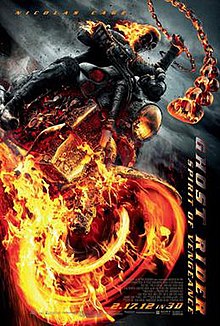
Ghost Rider: Spirit of Vengeance

Rating: **

If nothing else, Ghost Rider: Spirit of Vengeance gets an A for effort. But across the board what we have here is a movie that’s trying very hard to be something that it’s not: a campy, winking, cult film in the making that’s part Leone western and part remedial passion play mixed with the amped up, Red Bull-fuelled delirium of the Crank films.

Rarely does a movie try so hard and miss so spectacularly. Maybe it’s because you can’t make a balls out action picture with PG-13 limitations, and maybe it’s because you can’t do camp right when only the leading man is in on the joke. Or just maybe it’s because no matter how many times Marvel’s tried to make a marquee hero out of Ghost Rider the whole endeavour’s doomed to failure. But what a failure it is.

On the plus side, filmmakers Mark Neveldine and Brian Taylor get that Ghost Rider isn’t a hero moulded in the same stuff as Spider-Man, Iron Man, et al. Mark Steven Johnson’s first Ghost Rider film was too clean, too antiseptic, and followed too many of the supposed rules of the superhero movie even though I think any comic book fan will tell you that Ghost Rider only loosely fits the definition of a superhero. A guy who’s cursed by the Devil isn’t a superhero, and a guy that accepts that curse to bring vengeance to those that deserve it is certainly not a heroic ideal.

Catching up with Johnny Blaze in Spirit of Vengeance we find him on the run in Eastern Europe, struggling to control his darker half. Flinching at sunlight, and seeking shelter in abandoned and desolate places far from human contact, Blaze is found by Moreau (Idris Elba). What Moreau is, is never quite explained, but he tells Blaze that he needs the Rider’s help to protect a young boy from becoming the new vessel for The Devil. If they can guard the boy and keep him safe till after the sun rises on the winter solstice, Moreau will lift the curse off Blaze and return his soul. Good deal, except for all those minions of The Devil in the way.

The primary minion is Ray Carrigan (Johnny Whitworth), a non-descript mercenary charged with bring the boy to The Devil (now perplexingly called Roarke and played by Ciarán Hinds). If the name “Ray Carrigan” is familiar to you, then you just might be a fan of the Ghost Rider comic because Carrigan becomes Blackout, a demonic figure with the ability to cause anything he touches to decay (except for Twinkies). The make-up job turning Whitworth into Blackout is kind of horrible, and that’s putting aside the thought that creating an adversary worthy of the Rider seems almost secondary. Blackout is one of Ghost Rider’s most consistent nemeses from the comic, but he almost gets shafted like Bane in Batman & Robin in Spirit of Vengeance.

Mephisto, I mean Roarke, also gets the shaft because Hinds, a typically above board actor with weight and gravitas, seems bored and disinterested every moment on screen. Say what you want about Peter Fonda from Ghost Rider 1, but he at least looked like he was having a good time, laying aside the cleverness of casting one of the guys from Easy Rider to play The Devil in a movie about a demonic motorcyclist. And if anyone can tell me what Idris Elba is doing as Moreau, you’re smarter than I am because how a wine drinking, motorcycle-riding black ninja fits into the Ghost Rider mythology, I have no idea.

Perplexingly, the only one who seems to know what’s going on is Cage, who brings some of that typical craziness to the part of Johnny Blaze in this outing. In the recent past, Cage has restrained himself when he really shouldn’t have in movies like the first Ghost Rider and Drive Angry 3-D; he would play things too seriously, too straight. In Spirit of Vengeance he gets a little more manic, and a little more madcap. You at least get the feeling that he’s a guy tormented by living in the same mind of the demon, and fortunately the flipside mopey Nicolas Cage is left home for this outing.

Neveldine and Taylor also seem to “get it” to an extent. This Ghost Rider is rawer, a bit more real and a great deal grimier than the first film. Mostly though, they seem to be having a bit of fun, and they seem to enjoy playing with the Rider’s powers a bit. One of the big action scenes involves Ghost Rider turning a piece of industrial demolition equipment into hellfire concoction of doom used to pulverize all enemies. The climactic highway chase was also very well done, but if there was one noticeable improvement in this Ghost Rider over the last, it was the look of the Rider himself. Let’s just say he was crispier in this film, and the character seemed to be much more vivid in how he’s interacted with on screen. It goes to show that there’s a world of difference that can be made in CG characters in just a few years times.

But Ghost Rider: Spirit of Vengeance still feels like it’s holding itself back. What’s the point of introducing the notion of Ghost Rider pissing fire if there isn’t going to be a scene later of the Rider defecating on someone in flame. There was also a scene where Blaze shows the boy Danny how to ride a bike, which bordered far too much on sickening Spielbergian cuteness for liking. I give the filmmakers credit for putting significantly more effort into creating something that feels more like a Ghost Rider movie in Spirit of Vengeance, but much like the comic it’s based on, what seems like a good idea on paper, doesn’t necessarily come across as one in execution.

I’m not sure “better than Ghost Rider” is exactly a ringing endorsement for Ghost Rider: Spirit of Vengeance, but it’s the best complement in could probably be paid in context.

Tuesday, 18 October 2011

Batman: Year One

Rating: ***1/2

Before Christopher Nolan spun his own tale of Batman’s origins, Warner Bros was in the process of shepherding an adaptation of Year One, the seminal retelling of Batman’s origins as envisioned by Frank Miller. No less than Darren Aronofsky, then well-known for low budget films like Pi and Requiem for a Dream, signed on to direct as he and Miller collaborated on the script, but sadly it was not meant to be.

Apparently what was meant to be was an animated adaptation courtesy of the crew behind the DC Animated Universe series of movies. Technically, this is only Warner Animation’s second stand-alone Batman story after Under the Red Hood, which is a more recent tale from Batman lore, and maybe not yet as influential as other tales of the Dark Knight. Basically, committing to Year One in animation form is as bold a choice as Zack Snyder adapting Watchmen as his third film, just to put this in context.

Fortunately, director Lauren Montgomery and her all-star voice cast is more than up to the task. The film straightforwardly and faithfully adapts Frank Miller’s story and finds an artful and beautiful blending of the DCAU style and the Year One comic artwork by David Mazzucchelli. For people perhaps unfamiliar with the source material, the movie may feel like a lo-fi version of Nolan’s script in Batman Begins, so the filmmakers deserve a great deal of appreciation for their restraint and their reverence for Year One.

What’s interesting about the story is that is really is as much, if not more, like “Commissioner Gordon Year One.” Much of the story follows Bruce Wayne’s return to Gotham City and his initial fumbles becoming a costumed avenger, but the balance is how a young Lt. Gordon, fleeing Chicago after breaking police corruption there, arrives in an even more corrupt Gotham and struggles to make some headway in cleaning up both the streets and the halls of power.

Giving the story its proper weight is the casting of Bryan Cranston (Breaking Bad) as Lt Gordon. There’s such a heavy quality to Cranston’s voice work, you can feel the stress, and the exhaustion, and the concern. Miller can be rather pessimistic in this writing and his worldview, but Cranston manages to find the humanity and make it real. Benjamin McKenzie (The O.C.) is the voice of Batman/Bruce Wayne and does an admirable job portraying the young Dark Knight’s inexperience. He’s not the best Batman ever, but he’s not the worst either.

Also joining the cast is Eliza Dushku (Buffy, Dollhouse) as Catwoman/Selina Kyle, which is a fitting choice given Dushku’s resume and the type of character she’s well known for, but I don’t feel that the character gets a chance to shine in the film. However, the disc does come with a bonus Catwoman short written by Paul Dini that does sufficiently fill the Cat-quota. Battlestar Galactica’s Katee Sackoff rounds out the name cast as Sarah Essen, a police detective Gordon becomes romantically involved with while investigating Batman.

If you liked the tone of the film Sin City, or are otherwise familiar with the source material, you’ll easily get into Year One. I think the dialogue, especially the narration and the inner monologues is kind of hard-boiled for the screen, but it’s just the way Miller writes that can be rather difficult to translate to the screen sometimes (see: The Spirit).

Still, for anyone interested in seeing Year One realized off the page, you probably won’t get much better than the fine work by the DCAU team. Year One is probably one of the better DCAU films as well, and considering the quality of the series that’s really saying something.

Also included on the disc is an advanced preview of Justice League: Doom, which reunites many of the favourite voice actors of animated adventures’ past including Tim Daly as Superman (Superman: The Animated Series), Kevin Conroy as Batman (Batman: The Animated Series), Nathan Fillion as Green Lantern (Green Lantern: Emerald Knights) and Michael Rosenbaum as The Flash (Justice League). And I’m guessing that unless the filmmakers completely drop the ball, it will be another animated success.

Friday, 19 August 2011

Griff the Invisible

Rating: ***1/2

The notion of a singly-determined man to done a costume and become a superhero is not new, especially in the last couple of years. On the high-profile side there was Matthew Vaughan’s Kick-Ass, about a bullied teen that finds his chutzpah in a scuba suit, and on the low-profile side is James Gunn’s grossly hilarious Super about a man sent over a mental cliff after his wife leaves him. Now, offering a different tone is Griff the Invisible, which, like Super, originally bowed at last year’s Toronto International Film Festival.

But that’s probably where the similarities end. In fact, Griff probably has more in common with Jean-Pierre Jeunet’s charming 2001 film Amélie, about a young Parisian woman who comes out of her vast inner world to make the lives of others a little bit brighter. Griff also has a socially awkward hero with a large inner world. And unlike films like Kick-Ass and Super, which uses superheroes as metaphor for escalation and power unchecked, Griff is about how the fantasy of imagining one’s self as super can make you open to the world in ways others may not appreciate.

Ryan Kwanten, whom fans may be solely familiar with playing Sookie’s dimwitted himbo brother Jason from True Blood, plays the title character. Griff, by anyone’s standards, is socially awkward to a fault. He spends his days working in customer service for an unnamed company, and is inevitably bullied by one of his fellow office dwellers (Toby Schmitz). But at night, Griff dons a black leather suit and runs the streets as a crime fighter, protecting the average guy from various ne’er-do-wells.

Griff’s world is thrown for a loop when he meets Melody (Maeve Dermody), the new girlfriend of his brother, Tim (Patrick Brammall). From when we first meet Melody, we automatically recognize that she and Griff are the real soulmates of story; Griff with his experimentations in creating an invisibility suit, and Melody with her belief that she can manifest the ability to space out her molecules and pass through walls. Griff’s feelings for Melody, and the inner conflict of crushing on his brother’s girl, forces Griff to go inside himself more and more, even as Melody realizes its destiny for her and Griff to meld their worlds.

The heart of the movie really is this touching and self-conscious romantic dance between Griff and Melody, and Kwanten and Dermody play things beautifully. It may have gone amiss in the past, but Kwanten can be quite adorable when his shirt’s on, and Dermody is lovely and poised. They both play understated really well, and don’t feel the need to play their parts with any kind of put upon quirks or ticks to reinforce the fact that they’re social outsiders. But the film’s script, written by director Leon Ford, confounded me in third act when it reaches for a plausible reason to make Griff flirt with normalcy just as his future with Melody seemed to be coming together.

What I did enjoy was how the film unfurled in atypical comic book movie fashion. Even Kick-Ass and Super, as much as they were trying to send up the genre, played right into it with villains and a climactic, winner-takes-all battle in the end. But while Griff is a romantic-comedy-drama masquerading in a superhero suit, it actually does a pretty good job of looking like one too. If you liked the world of Warren Beatty’s Dick Tracy, with its primary colours and cityscapes that looked like they were taken straight out of the comic panel, then you’ll love seeing the world of Griff unfold.

For a connoisseur of the art form, Griff the Invisible is uniquely different, but is still satisfying taste in terms of being a superhero movie. It’s refreshing to see a film take on the genre and not make it about how “in real life” mentally disturbed people can take the call to being a superhero as an excuse to do violence and immoral things to others with impunity. Griff is a sweet film, and it has a positive message that seeing one’s self in heroic terms and believing in the powers of self-made magic and ingenuity, doesn’t necessarily make one mad. It also proves that delusion, like love, is best shared with the one you love.

Monday, 15 August 2011

Super

Rating: ***

James Gunn is a talented man when it comes to combining gross outs and belly laughs, a genre approach that Sam Raimi coined in Evil Dead 2 calling it “splat stick.” One would think that this approach would not bend easily to the superhero genre, which typically shirks blood and guts unless the hero on the marquee is named Punisher or Kick-Ass. But in the case of Super the hero is mentally deranged. What can you expect when the man in the mask is driven to crime-fighting after his wife leaves him for a local drug kingpin and looks suspiciously like The Office’s Dwight Schrute?

Gunn’s fingerprints on Super are apparent. When poor, old, down on his luck Frank (Rainn Wilson) realizes his wife has retuned to her life of drugs and is not coming back without a fight, Frank receives the finger of God. It’s not what you think, but rather a bunch of slimy tentacles that appear from nowhere, slice open his skull cap and pours the light of the universe directly into his brain. But whatever it is that happens to Frank, it inspires him to dress in a crappy, home-made red costume, arm himself with a plumbers’ wrench, and call himself the Crimson Bolt. His tough guy catchphrase: “Shut up, crime!”

But unlike, say, Batman, who thwarts super-villains like The Joker from turning Gotham City into an anarchists’ paradise of crime and debauchery, The Crimson Bolt runs the gamut from child molesters to people that cut in line at the movies. One of the fun bits about the film is that it enjoys the notion that, despite the mask, people still kind of recognize Frank as the Crimson Bolt. Usually the mask, or a secret identity period for that matter, is about suspension of disbelief. There’s none of that here though, odd duck Frank isn’t exactly subtle, and is even less concerned about security.

Speaking of The Joker, Frank’s arch-nemesis is Jacques played by Kevin Bacon. Bacon, of course, has experience playing the heavy in comic book movies, this past summer’s X-Men: First Class being a prime example, but it’s not like he’s required to be the Kingpin of Crime or something. Jacques is actually nothing more than a two-bit, three block dope dealer, but Gunn does a rather good job of making you forget that. In Frank’s world, he’s Lex Luthor. Or Green Goblin. Or Red Skull. Although Jacques isn’t out for world domination in the literal sense, he did take away Frank’s world, his beloved wife Sarah (Liv Tyler).

The other primary ingredient in Super’s recipe for superhero movie subversion is Ellen Page, who comes to be the Crimson Bolt’s sidekick, Bolty, AKA: Libby. First of all, can we reflect on how perfectly absurd it is for a grown woman to call herself Bolty, even in a comic book movie? Second, Page’s character may feel like a uninspired spin on the Hit Girl character from Kick-Ass, as in a profanity-spewing girl in a mask that likes violence, but Gunn’s too sly to straight up steal. Where as Frank has his issues, Libby becomes borderline derange when she learns his secret. Being Bolty becomes a weird form of psycho-sexual release for Libby, and Page, playing both to and against type, enjoys every minute of it.

But despite the startling originality in some aspects of the film, it still relies a bit too much on typical superhero standards. The typical three act structure of origin, training and battle is used, and the climactic scene is a big, winner take all fight between Frank, Bolty and Jacques’s army of not-so sharp shooters. I give Gunn credit enough to make a very compelling product, especially with the budgetary restrictions he worked with, but the film wasn’t grungy enough to sell the premise, and it wasn’t glossy enough to play as a Hollywood product. It should also go without saying that this is a superhero movie not for the easily squeamish.

Still, the originality of the film cannot be denied and the actors all do a great job of investing themselves in the script and selling their roles. With studios still churning out superhero flicks on a regular schedule, I hope more filmmakers follow Gunn’s example and undermine the genre. “Shut up, Crime!” is a rallying call we can all get behind.

Friday, 22 July 2011

Captain America: The First Avenger

****

With two out of three of the necessary pieces to build The Avengers crown jewel under its belt, Marvel Studios would have to work pretty hard to screw up at this point. Frankly, they could have hired any director of average ability and gotten a descent, if not overly impressive, Captain America movie. Granted, the process isn’t as easy as it looks, as people who’ve seen the 1990, rubber ears version of the Star-Spangled Avenger will attest.

But if the producers of Captain America can be credited with one smart move it’s in the hiring of Joe Johnston to direct. Johnston is most well-known for his early work at Industrial Light & Magic creating key designs for the original Star Wars trilogy before directing fine, blockbuster fair like Jumanji and Jurassic Park III. But most importantly, Johnston directed a film called The Rocketeer. Set in pre-World War II Hollywood, it was based on a comic strip about a pilot named Cliff Secord, who finds a jetpack invented by Howard Hughes and uses it to thwart gangsters and Nazis. The film was a blockbuster failure, but its combination of 90s superheroism and 30s matinee swashbuckling has made the film a cult favourite.

Looking at Captain America: The First Avenger, it’s hard not to see the influence and style of Johnston’s own work on The Rocketeer: The gee-whiz quality, the retro-futuristic props, the big set pieces, daring-do heroes and diabolical villains with no grey in between. Oh, and it’s also a prime superhero story that not only stands on its own perfectly in the archetype, but it’s also the most effective tease yet for next summer’s The Avengers.

It starts with a man being chosen from several potential candidates, and his mission is to somehow be the embodiment of a nation’s hopes while leading the good guys to victory over heinous villains. And that man’s name is Chris Evans. Chosen from a proverbial laundry list of fine, upstanding leading men, Evans got the nod to play Capt. Steve Rogers, AKA: Captain America, a scrawny kid from Brooklyn given a super-soldier serum to become a super-human Nazi fighter.

Evans has a variety of experience playing comic book characters like the Human Torch in Fantastic Four, and one of the seven evil-exes in Scott Pilgrim, but as Captain America he really finds a groove and exudes an effortless confidence and earnestness that sells you on him as the shield-brandishing hero. When Cap plays modest and says he’s nothing special, “Just a kid from Brooklyn,” you believe it. In fact, one could argue that the whole story hinges on Evans believably turning from puny Rogers to brawny Captain America, and doing so without a hint of irony or sarcasm, two things Evans has excelled at in past performances.

On the flip side is Hugo Weaving as Cap’s arch-nemesis The Red Skull, the head of the Nazis; advanced science division called Hydra. Being the heavy is an act that Weaving can do in his sleep, but the actor shows an interesting kind of restraint in playing Red Skull. He may have delusions of world domination, but Red Skull isn’t a scenery chewing, two-dimensional villain. Or at least he doesn’t seem like it. Toby Jones should also be commended for getting Weaving’s back up as Red Skull’s snivelling toady Dr. Zola.

The story itself, interestingly, is where Captain America is weakest, but unlike Iron Man 2 and Thor that weakness has nothing to do with setting up The Avengers. The film builds up a solid first hour, chronicling Steve’s recruitment into the super-soldier program and transformation into Captain America, but many of Cap’s World War II exploits are crammed into a five minute montage. For the sake of brevity, a true sense of Cap’s prowess and importance as a warrior is lost, and the film could have been another hour longer and I don’t think fans would have had much of a problem with it.

But if Captain America suffers from an abundance of ambition, I can live with that. The film is a zinging and thrilling superhero adventure that’s pulpy to a tee while still feeling genuine. The set pieces are brilliantly executed and there’s some great character work too thanks to its talented cast. Johnston has taken a lot of different ingredients and cooked them up in a unique tasting suffle of a movie. It’s a fun ride by itself, and as a pleasant bonus, there’s a wonderful little hook for The Avengers at the end. By any stretch, Captain America is a wonderful addition to the comic book movie canon.

For maximum value, go for the Blu-ray/DVD combo pack which includes deleted scenes, making of featurettes and a commentary track with Johnston and key crew members. Also, there’s a fun little short with Clark Gregg, who plays S.H.I.E.L.D. agent Coulson in Iron Man and Thor called” A Funny Thing Happened on the Way to Thor’s Hammer.” Gregg’s brilliant deadpan delivery, and Coulson’s never before seen killer instinct, make for a funny short worthy of the price of the disc alone.

Tuesday, 7 June 2011

Green Lantern: Emerald Knights

Rating: *** 

In a case of go with what works, Warner Bros has taken a page from the marketing playbook for The Dark Knight in promoting its latest superhero effort Green Lantern. Prior to the release of Dark Knight, Warner Animation released an anthology called Batman: Gotham Knight, which featured a variety of short stories from different creators and artists. Gotham Knight became the second highest grossing film of the DC Animated Universe series of films, and The Dark Knight went on to be the second highest grossing film of all time. Coincidence? Probably.

Still, the idea is served even better in the context of the Green Lantern Corps, the interstellar group of peacekeepers with power rings that harness the green energy of will power to which human Hal Jordan is recruited into in Green Lantern. Although the producers this time kept things in house rather than reaching out to the best and brightest of Japan anime, Emerald Knights still features an impressive line-up of behind the scenes talent. Alan Burnett, Dave Gibbons, Michael Green, Marc Guggenheim and Geoff Johns all contribute to the film, and if you don’t recognize those names, let me just say Batman: The Animated Series, Watchmen, Heroes, No Ordinary Family and the man that catapulted Green Lantern to the top of the current comic book sales charts.

From what I know about the Green Lantern movie, Emerald Knights gets into the back story of many of the film’s main players. One segment focuses on how the Corps drill instructor Kilowog (voiced by Henry Rollins) handled the pressure from his own drill instructor Deegan (Wade Williams). Another segment shows the relationship between Sinestro (Jason Isaacs) and Abin Sur (Arnold Vosloo), who’s the Green Lantern that passes his power ring on to Hal Jordan (here voiced by Nathan Fillion).

The stories are framed around an ancient evil threatening Oa, the homeworld of the Guardians of the Universe, and masters of the Corps. The planet is evacuated, and as the Green Lanterns await the battle to come, Jordan tells a rookie named Arisia (Elisabeth Moss) stories of the Corps that are either known well or hardly known at all. Several well known GL comic stories are adapted including "Mogo Doesn't Socialize" by Alan Moore and Gibbons about a planet-sized Green Lantern and "What Price Honor?" about Laira’s mission to her homeworld Jade and her battle with her own father.

The animation meets the usual high standards of the DCAU, and the film’s format works surprisingly well as its own story and not just as a loose framework on which to hang the various short stories on. The story moves fairly briskly, and the universe of the Green Lanterns is easily and brilliantly realized through animation. It may make you wonder how they’ll be able to do the same live action. But the target audience for this film will probably skewer more to the Green Lantern fan than the average viewer, but curiosity seekers need not worry, because if you’re looking for more Green Lantern, there can be no finer addition to the canon.

Speaking of the geek-attenuated, it is interesting that Nathan Fillion was cast as Hal Jordan. Fillion was the fan favourite for the part in Martin Campbell’s film, and was even featured in a very popular fan-made, trailer mash. I’m not sure if Fillion was hired because of this fact, or whether it was his overall familiarity with the DCAU (he voiced Steve Trevor in the Wonder Woman film), but whatever the reason I guess fans now get to have their cake and eat it too. Speaking of the fans, you’ll want to check out the preview for the next DCAU film, an adaptation of Frank Miller’s Batman: Year One featuring the voices of Ben McKenzie (The OC) as Bruce Wayne, Bryan Cranston (Breaking Bad) as James Gordon and Eliza Dushku (Dollhouse) as Selina Kyle.

Friday, 3 June 2011

X-Men: First Class

Rating: ****

Astonishing! Astounding! Uncanny! Three word X-Men fans might use about X-Men: First Class.

Surprised? So was I. This superhero franchise, desperately in need of a booster jump following the creative catastrophe of Last Stand, and the critical and commercial bomb of X-Men Origins: Wolverine, managed to do the impossible: deliver a Marvel film that contains no foreshadowing about The Avengers.

But seriously, Matthew Vaughn has managed to rejuvenate the X-Men brand and does so by breaking one of the assumptions in making a prequel – it can’t be surprising. Set against the Cuban Missile Crisis, the film has the feeling that someone transplanted the X-Men into the world of Sean Connery’s James Bond with sexy villainesses, exotic locales, and the world destroying threat of nuclear war. Scoff you may at the very notion, but the X-Men comics have spanned numerous genres, from space opera (anything with the Shi’ar and the Starjammers), to science fiction (“Days of Future Past”), to political commentary (“God Loves, Man Kills”) to horror (“Inferno”) and even humour (“X-Babies”).

Part origin story, part spy thriller, part relationship drama and part superhero movie, X-Men: First Class combines all these elements and cooks them to perfection. The film is a beautiful soufflé of inspirations and ideas, not necessarily perfect, but wholly satisfying. Anchored by a great cast, solid direction and a tremendous eye for period detail and the requisite visual effects eye candy, it might be safe to say that X-Men delivers the first, great blockbuster of the summer season with very few reservations.

This film starts out very similarly to Bryan Singer’s initial X-film in 2000. A young Erik Lehnsherr is separated from his family as they enter a Nazi Concentration Camp in Poland, during which young Erik first demonstrates his gift to manipulate metal. He’s brought to a doctor named Schmidt who tries to test the boy by threatening to kill his mother, and when Erik is unable to move a coin, Schmidt shoots Mrs. Lehnsherr, unleashing Erik’s wrath. Good, says Schmidt, your hate has made you powerful… Oh wait, wrong movie.

By contrast, young Charles Xavier has had an easy life. He awakes one night to a noise in his kitchen. He comes downstairs expecting to find a burglar, but instead finds his mother rummaging in the pantry. Wait a minute, says Charles, my mom’s never been inside our kitchen in her life… Presto-chango, his mother morphs into an adorable little blue-skinned Mystique. The two become fast friends as Charles promises that the runaway Mystique need never to go hungry again. But again, that’s the wrong movie.

From there, the film follows Xavier through his schooling at Oxford and Erik through his globe-trotting revenge tour to eliminate the Nazis made his life a living hell. The two catch up while independently pursuing the same man, Schmidt, who’s really Sebastian Shaw, a mutant with global domination on his bucket list. Erik wants the man that shot his mother in cold blood, Charles is helping the CIA stop an imminent threat to world peace. The two men form a bond despite their different goals, for they both agree on one thing, mutants are the future.

One of the reasons that the initial trilogy of X-Men films worked so well, was because of the casting of classically trained actors to play Xavier and Magneto, Patrick Stewart as and Ian McKellen respectively. They brought such gravitas and realism to the parts that it was going to hard to find young actors who could not only match them, but make it believable that these are their younger versions.

But James McAvoy brings surprising charm to Xavier, who in First Class is still has that optimism and humanist spirit known to be Xavier, while letting Professor X have a scene or two where he tries to pick up women with a biology lesson. As his opposite, Michael Fassbender brings a nice tone of menace to Magneto, but also a weird kind of hopefulness as he finds his purpose as mutantkind’s saviour. If any actor will benefit the most from First Class it will be Fassbender. Like Hugh Jackman in the first X-Men, this movie could launch Fassbender to the A-list.

The supporting cast is top notch. Kevin Bacon as Shaw is especially a standout, chewing the scenery with relish and striding across the screen with the swagger of an old-fashioned Bond villain. Bacon may have always been a solid actor and pop culture curio, but there’s something magnetic about how he plays Shaw. There’s a different kind of magnetism when it comes to Shaw’s girl Friday, Emma Frost, as personified by January Jones, and if you’ve seen the pictures then you know why. Frost seems to get lost in the shuffle in the film’s last act, but Jones brings a fine touch of coolness and clinical detachment – along with her physical attributes – to the role.

Oddly enough, the weakest bits of the story in X-Men: First Class have to do with the first class of X-Men. Jennifer Lawrence brings some new dimension to Mystigue by making her more than the “naked blue chick,” and Nicholas Hoult as Hank McCoy/Beast plays well the mutant struggle to be normal and the dual effort to accept and be accepted, and trying to change without changing. The rest of the first class get a moment or two to shine, but both the first battle with these X-Men and the scene of their training is kind of truncated to an uncomfortable level, but if that’s all it takes to keep the story moving, I don’t have that big a problem with it.

But there is far more to love in X-Men: First Class then there is to complain about. It’s an inventive way to jumpstart a stolid franchise, and it leaves the doors open to pursue further adventures from the X-Men’s past. An excellent summer blockbuster with brains, heart and courage. A triple threat.

Friday, 6 May 2011

Thor

***1/2

If there’s a fault to Thor it’s that it feels like two different movies smooshed together into one ying-yang narrative. One of these films is a standard superhero origin story, which is, in fact, part of grander tapestry that will be realized next summer in The Avengers, and the other is a dynamic drama about family and duty and the fate of a kingdom. One of these is very paint by numbers; the other is given a relevant gravitas befitting an epic stage tragedy.

It was an unusual choice to select Kenneth Branagh to direct Thor, who along with Iron Man and Captain America makes up the core trinity of the Avengers super-team. Branagh, known predominately for his screen adaptations of Shakespeare plays like Henry V, Hamlet and Much Ado About Nothing, brings these considerable resources to bear in painting the God of Thunder’s life on Asgard, a mythical realm where the Norse gods dwell. Thor (played by Chris Hemsworth) believe he is ready to be king, his father Odin (Anthony Hopkins) is not so sure, and his brother Loki (Tom Hiddleston) seems unusually shifty.

But when Thor is banished to Earth for jumping the gun to start a war with the Frost Giants, the family psychodrama takes a backseat to the paint-by-numbers superhero origin, and the not-suitable stuffing of Easter egg references of Marvel movies past and future. Clark Gregg reprises his role as Agent Coulson from the Iron Man movies, and is the S.H.I.E.L.D. agent supervising all the other-worldly stuff afoot in the New Mexico desert. Jeremy Renner appears briefly as Clint Barton, better know to the comic book mafia as The Avengers’ archer in residence, Hawkeye.

Aside from all the superhero drama, Thor encounters a lovely human scientist named Jane (Natalie Portman), her sarcastic sidekick Darcy (Kat Dennings) and their mentor Dr. Selvig (Stellan Skarsgård). This aspect of the film is probably the most underdeveloped in an already loaded script that still clocks in at just over two hours. We’re supposed to believe that in two and a half days Thor falls in love with Jane, discovers the value of mortal existence, and learns the lessons of humility and self-sacrifice that his father sent him to Earth to learn. Possible, I guess, but I don’t feel that the film gives this aspect the proper time to develop naturally.

Of course, technically the film is an achievement all its own. Asgard is beautifully realized thanks to master production designer Bo Welch, a seamless mish-mash of futuristic Cloud City and old school medievalism; they’ve got both horses and temporal portholes. After all, Thor reminds us that Asgard is a place where magic and science are the exact same thing. The effects are outstanding and the worlds that Thor explores beyond our mortal realm blend very well with the real world we know. The film is vivid and colourful and jumps off the screen, but it doesn’t overwhelm the humans in their make-up and costumes.

The cast is very solid. Hemswroth makes a convincing Thor in both physicality and personality. He has a commanding presence, but is able to show some humanity, but I’m not sure that the film tests him as much as it could have. Thor lacks the same kind of personality crutch as say Tony Stark, or a pessimistic you lose when you win fate like Peter Parker. Hiddleston does snivelling well, but I have a feeling that the Loki’s true villain potential has been left to be explored in The Avengers. Hopkins, meanwhile, finds a descent balance between scenery chewing and the hyper-reality of playing an old world god.

The DVD includes some simple features, like the barebones “Road to the Avengers,” which doesn’t tell you anything that you couldn’t have gotten from a movie spoiler site three months ago. A commentary by Branagh offers some interesting insight into the filmmaking process and there are a couple of gems in the deleted scenes, including a warm, brotherly moment between Loki and Thor that I wish had stayed in the film. It might have made Loki’s later machinations much more impacting to see the brothers in a rare friendly moment.

As a film franchise, Thor definitely has potential. It would have been nice had in this first outing the film hadn’t been weighed down with all this Avengers preamble, but in this respect it’s a crutch that Thor shares with Iron Man 2. I will say that I warmed more to Thor in its second viewing. Perhaps the characters were more familiar now, or I was able to appreciate it on its own merits. Still, as superhero movies go, Thor demonstrates above average achievement and dedication. Hopefully when the eventual sequel rolls around, Thor might be able to stand on his own.

Monday, 2 May 2011

Hot Docs - Superheroes

Rating: ***

The conceit of the graphic novel and film Kick Ass is the idea that no one before in real life has had the thought of putting on a costume and fight crime as a superhero, and if they did, and they took it seriously, then they would have to be insane. There’s a fine line between genius and inspiration, and the people profiled in Michael Barnett’s documentary Superheroes definitely mark that line as their own.

To anyone that’s ever read a comic or seen a superhero movie, the language and the iconography used by the so-called superheroes featured in Barnett’s doc are all too familiar. From the streets of Orlando, to the borough of Brooklyn, a nationwide fraternity of costumed avengers are striving to make a difference in their towns in the flamboyant and chivalrous traditions of Stan Lee, Jack Kirby, Joe Shuster and Bob Kane. Real life superheroes are alive and well and patrolling down sidewalks and back alleys in a town near you.

Barnett maintains a difficult tone with his movie. On the one hand, many of these “superheroes” describe terrible, painful and downright abusive backgrounds that spurn them to make the leap to costumed crime fighting. On the other hand, one has to admire these people. In their communities, despite the jeers and despite the looks, they are delivering a kind of hope to people in precious need of some. It’s not all about beating up bank robbers or rescuing orphans from fires. It’s also about giving a helping hand, assisting a drunk man home, giving a man whose foot is run over medical assistance, and handing out needed essentials to homeless people.

But despite their good intentions, it’s hard to deny that some of these people suffer from some kind of mental malady. Mr. Extreme, a California-based hero, gives up his apartment and lives in his van in order to free up more money for the cause, plus this way he can remain mobile lest unscrupulous characters find out where he lives. In Orlando, Master Legend happily takes a break from patrolling to either grab a pint from the bar, or out of the back of his van. It doesn’t do much to brace the confidence in these heroes, but hearing them talk about their personal abuse stories, you’re glad that their emotional turbulence found a rather benign outlet like playing superhero.

The final scene of the documentary takes us to San Diego in July, the setting for the biggest annual gathering of all things geeky and superheroish, the San Diego Comic Con. But a few blocks away from the convention centre where fans dress up as comic book strong men and Hollywood studios preview superhero films, a gathering of so-called real life superheroes are helping San Diego’s homeless. These two things juxtaposed, it becomes really hard trying to figure out just who the crazy people are in this scenario. Who are the real pretenders here, and do these people truly understand the idea of superheroes better than the thousands than honour them as fans? That’s for the audience to decide.

Friday, 7 May 2010

Iron Man 2

Rating: ***1/2

Oh hype. Bringer of expectations, destroyer of dreams, you certainly know how to jerk our collective chains and make us expect the impossible. Realistically, no movie could live up to the economic and critical expectations that are those now owned by the superhero sequel Iron Man 2. The tremendous success of the first Iron Man movie was completely out of left field given the fact that the billionaire in the high tech suit of armour didn’t quite have the name cache of Marvel Universe compatriots like the X-Men or Spider-Man. But casting Robert Downey Jr as the titular hero and hiring so-called serious actors like Terrance Howard, Gwyneth Paltrow and Beau Bridges cultivated a rare attitude towards summer blockbusters: that this was something that might be able to be enjoyed on an intellectual level as well as visceral one.

Indeed the whiz bang of Iron Man 1 was its weakest link with everyone noting the power of the acting, character development and storytelling over the special effects and action sequences. But naturally, the only thing in Hollywood better than success is even greater success. And just like that, the expectations for Iron Man 2 are as high as anything called Harry Potter, Star Wars or Twilight. Which is why it’s so frustrating to say that this movie misses the mark, although it should be noted that it doesn’t miss it by much.

But frankly, this Iron Man is packed. Not only is Tony Stark (as portrayed once again by Downey) struggling with his very public dual identity, but he’s also struggling with his mortality as the very same technology that’s keeping him alive is also killing him. Aside from the personal, Stark must contend with a government that wants his suit and a rival that wants his life, only to get gobsmacked by a new villain with a claim on Stark’s technology and a deadly grudge that needs indulging.

This might be problematic if not for director Jon Favreau’s penchant for casting. Sam Rockwell and Mickey Rourke share co-villain credit as Justin Hammer and Ivan Vanko respectively. Hammer is Stark’s closest rival and trades between hating Stark for his genius and charisma and admiring him like a younger brother. Vanko, who’s a conglomeration of two Iron Man comic villains, is a man on a mission of vengeance, and Rourke has the right menacing presence to make Vanko a formidable foe for Stark. The other new character is Scarlett Johansson as Iron Man’s fellow superhero (and possible future Avenger) the Black Widow. Predominately it seems that Johansson’s responsibility for the film is to look sexy and kick butt, and by this basis she succeeds beyond expectations.

Still, the appearance of Black Widow and the expanded role of Samuel L. Jackson as Gen. Nick Fury tips a potentially fatal flaw in the film in that there are times when this Iron Man movie seems to be more about being a “backdoor pilot” to the upcoming Avengers movie. The so-called Easter Eggs are kind of glaring in their obviousness in that there might as well be Post-Its on screen referencing why this item is important. Like the old Pop-Up Video show. There’s a section in the middle where Stark is given a time out by Fury that seems like a tacked on tease for The Avengers and it kind of takes you out of the movie, which already has a lot of complex plotlines going on, aside from setting up more movies.

When not bogged down with foreshadowing, Favreau does well picking up where he left off so far as the main characters and their relationships. Don Cheadle seems more comfortable playing Stark BFF Col. Jim Rhodes than Terrence Howard did in part one, but despite being upgraded to fellow iron man War Machine, it seems that Rhodes’ role is still kind of diminished. Downey still plays a mean Tony Stark, but there was a kind of sense that he was reaching a bit too hard. Like Johnny Depp in the second Pirates of the Caribbean movie, Downey was trying force himself to play Stark rather than just play him. Still, Stark is one of the most dynamic and relatable superheroes ever put to film.

Despite these sophomore hiccups, the Iron Man franchise is still remarkably satisfying as a popcorn movie and as a dramatic work. Favreau’s emphasis on character continues to pay off and the director even gives himself a chance to play in this one with an expanded part for his Happy Hogan, Stark’s bodyguard. In one way, it reminded me of The Dark Knight for the way it crammed so much in to the story, leaving the viewer wondering what possible direction the filmmakers can take the character in next. I mean that on an individual basis in Iron Man 3 of course. We all know that Stark’s got a big meeting with his super friends in the future.

Friday, 16 April 2010

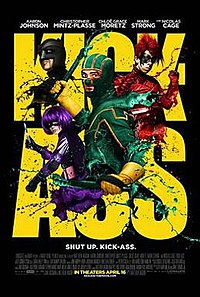
Kick-Ass

Rating: ****

It seems almost crass to say that Kick-Ass is a great superhero movie. In many ways the movie, not to mention the comic it’s based on, hates superheroes. This might not have been the intention of comic creators Mark Millar and John Romita Jr, and it probably wasn’t the intention of filmmaker Matthew Vaughn either. Still, it’s a feeling I got while both reading the comic and watching the movie.

Then something interesting happens. Kick-Ass, the scuba suit-wearing, heroic identity of Dave Lizewski (Aaron Johnson), confronts three hoodlums beating up a fourth. In the annals of super-fights this ranks somewhere around Archie Vs Punisher, but then there’s a moment. One of the punks says to Dave/Kick-Ass, “The f**k is wrong with you, man? You'd rather die for some piece of $#!t that you don't even f**king know?” after the hero-wannabe refuses to leave a man down. “The three @$$holes, laying into one guy while everybody else watches? And you wanna know what's wrong with me? Yeah, I'd rather die... so bring it on!” Kick-Ass retorts.

Bull’s Eye. This isn’t Spider-Man for the cynical. This is Mr Smith Goes to Washington for the Twitter Generation.

Kick-Ass isn’t really a movie servicing the trope of what if superheroes existed in the real world. If you want that, go over to the DVD shelf and re-watch Watchmen. This film is more satirical. Not a comedy mind you, but darkly funny. Sometimes uncomfortably funny. It’s a tone I don’t think a lot of people got, but for the open-minded Kick-Ass is infinitely rewarding. It’s about teenage alienation, feeling powerless in a power-mad world, and making your own fate. It’s all that plus Nicolas Cage at his spastic best. (On a side note: for prime Cage go out and rent Bad Lieutenant: Port of Call New Orleans. Now!)

The story is about Dave, your average high school comic nerd, and his pursuit of a simple dream: to become a superhero. Why hasn’t some crank with an axe to grind ever put on a costume and acted out delusions of Batman, Dave ponders to his friends (Clark Duke and Evan Peters). Simple, they’d get their ass kicked. Bing. Of course, the first time that Dave dons the green scuba suit of Kick-Ass, that’s exactly what happens. However getting beaten, stabbed and run over is no deterrent for Dave, and after his aforementioned exploits make the Must See list on You Tube, Kick-Ass becomes a sensation.

But what’s that old saying about imitation? Kick-Ass begets a number of copycats, among them Hit-Girl and Big Daddy (Chloë Grace Moretz and Cage), a daughter-father team that’s out for revenge against the mob boss that framed Daddy’s ex-cop alterego, Damon Macready, as a drug dealer. Now, the most controversial bit about Kick-Ass has been Moretz portrayal of Hit-Girl, a 12-year-old with the lethal skill of Bruce Lee and the potty mouth of Andrew Dice Clay. Sure, she uses the C-word and the MF-word with zero discretion, but as compared to scenes of mob guys getting microwaved and blown away by bazookas, can we grade on a curve the cursing? Shoot, I’ve heard worse in the mall.

The real money in this movie belongs to Cage, channelling his skeezy best with a sort of paternal Adam West as Batman patter that’s both heartfelt and creepy. As well, Mark Strong plays demented and motivated in the best comic book villain tradition as mob boss Frank D'Amico. Johnson is alright in the title role, not that his purpose is particularly inspiring. After all, the character of Dave is supposed to fade in the background, but there’s really nothing to say that he’s grown from the experience by the end of the film. I did enjoy the moral corner that Dave is painted in. His altruistic intentions crumble when confronted with the full extent of the evil people are capable of, and watching how he squirms feels real.

Which brings us to McLovin’ Christopher Mintz-Plasse who plays the final member of the heroic quartet, Red Mist. Here, the movie drops the ball because unlike how the comic sets it up, we know all along that Red Mist, AKA: Chris D’Amico, is the some of Frank D’Amico. Which makes the eventual double-cross rather tedious because we know it’s coming and waiting for the other shoe to fall takes a lot of fun out of it. On the other hand, there would have been a lot of missed opportunities for Mintz-Plasse and Strong to interact, and a lot of those scenes were pretty golden. So I guess it comes down to a matter of story versus character. I’m just not sure which one wins more in this instance.

Still. Kick-Ass is immensely enjoyable overall. It’s a deconstruction of the superhero myth that’s both critic and fan, and more miraculously, both spheres are able to exist in the same orbit at the same time without one adversely affecting the other. It’s a very well done piece that proves once again that Matthew Vaughn knows what he’s doing. Vaughn, as you may or may not know, was once to be the director of X-Men: The Last Stand. Probably for the best though because if Kick-Ass proves one thing again, spandex in a superhero movie still looks lame.

Friday, 6 March 2009

Watchmen

Rating: ****

Certain things you thought would never happen: an African-American man getting elected President of the United States; Guns ‘N Roses releasing another studio album; enjoying a soup that eats like a meal; affordable jet packs for all; there’s a whole list. Once upon a time the whole notion of a filmed adaptation from the groundbreaking graphic novel Watchmen was on it, but all it took was one maverick named Zack Snyder to take all his Hollywood capital and put it into the film they said couldn’t be made. At this point, Watchmen represents more than just a movie, it’s a monument like those in ancient times: largely symbolic and taking decades to build.

What’s surprising is that despite the years and expectations, this Watchmen stands up miraculously well and manages to not just succeed as a faithful adaptation of the graphic novel, but is a thrilling movie event in its own right. I purposely avoided re-reading the novel before seeing the movie so as to floss false expectations from my mind and judge Snyder’s work on its own. The fact that there’s even a Watchmen movie at all is a minor miracle, but the fact that it turned out this well must be classified under some kind of celestial alignment that happens only once every millennia or so.

But that’s not to say that this film is not without its issues. The script is streamlined to perfection, but it does so by sacrificing subtext and foreshadowing. But while the film is certainly faithful to a degree not just expected but demanded by the fans, the occasional clinical detachment of Moore’s writing sometimes doesn’t translate to the film medium. At times the Watchmen movie doesn’t feel like it has its own identity, and like the Harry Potter movies it sometimes seems that the only way to full appreciate it is with the source material in hand.

But like I said, the movie captures not just the story and themes, but the numerous inspired moments of the various scenes as well. As in 300, Snyder used the original graphic novel as a visual template. I’m unwilling to say “storyboards” because to me that implies that storyboards and panels taken from works of sequential art are interchangeable. The most dramatic of which is the often mentioned opening credits sequence which has the dual affect of cramming a great many of the novels Easter Eggs into one awe-inspiring set. Snyder’s sense of scene serves him well, and say what you want about this Watchmen but it’s never not a visual feast to behold.

Snyder gets bonus marks for the mostly spot-on casting that avoids previous requests for big stars (Robin Williams as Rorschach?) in exchange for using character actors. Patrick Wilson is appropriately bland as Nite Owl II, obviously the least interesting and the least troubled of the heroes. But because of this, Wilson gets to be the steady rock in which a lot of the characters can bounce off of. He was perhaps the most surprisingly affective members of the cast, considering he’s the most “normal.”

By the far the standout of the film though is Jackie Earle Haley as the aforementioned Rorschach. Now this character is so hard-boiled that it takes an actor of great finesse to play pulp without an ounce of self-consciousness, which Haley easily manages to do. Plus he has to act practically the whole time in a face covering mask which ain’t easy. But bonus points to Haley for somehow managing to do a gravely voiced hero without making it sound ridiculous like another hero from a big superhero movie from last summer I could name.

But the casting might not be the divisive part of this film no matter who you might think should have been cast as whom to begin with. That honour belongs to how Snyder and crew decided to tinker with the ending. Basically the conundrum comes down to the fact that the story basically ends the same, but the how is just a little different. In other words: no space squid. The world doesn’t unite under the threat personified by some Cthulhu-like beast engineered to look like invaders threatening the Earth, but what Snyder and the screenwriters do is arrange something much more in keeping with the story, and not quite as random. But what plays out well in nine panels on a page doesn’t necessarily work as well on screen, and although the ending is more or less true to the graphic novel, it still isn’t quite cinematic enough to work on the big screen; it feels drawn out and static.

But what I can’t deny is the package Snyder created. Unlike a lot of superhero movies which are preoccupied with creating a world apart, Watchmen feels very much of our world. There’s really no swelling superhero score, but instead a pop culture time capsule of songs setting the tone. This alternate 1985 is brilliantly and thoroughly realized, even if the make-up on the actor playing the fifth-term President Richard Nixon looks like it was modeled after Bob Hope’s caricature (i.e.: huge nose). I can say unequivocally that this is the best Watchmen movie that we could have expected coming out of Hollywood. Is it perfect? No, but it is what it was always supposed to be: a $150 million art house picture about men in tights.