Showing posts with label police. Show all posts

Friday, 16 March 2012

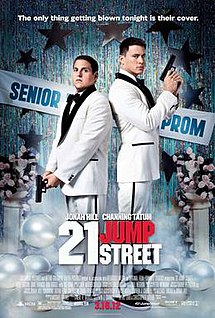
21 Jump Street

Rating: ***1/2

It's long been on the list of properties from TV's past to weave into box office gold, but 21 Jump Street, until recently, just hasn't been able to make the leap. Perhaps that's owed to its ludicrous premise, a squad of police detectives who go undercover at a high school to bust crimes. For a savvy audience in the 21st century, could such an idea really work? Well this movie version of the classic(?) Fox series makes it work by addressing said conundrum and doing it in a way that's humorous and pointed. Along the way, there's a shot or two at all these re-imaginings/rebootings/reworkings of product from Hollywood's past, and most importantly, one of the most entertaining action/buddy-cop comedies to be produced in some time.

Channing Tatum and Jonah Hill play Jenko and Schmidt, a pair of rookie cops with delusions of grandeur. Unable to make a simple drug bust without screwing it up, they're reassigned to a resuscitated Jump Street bureau and ordered to the local high school to investigate the distribution of a new synthetic drug. Both Jenko and Schmidt welcome the opportunity - Jenko to relive his glory days, and Schmidt to correct his high school geekiness - but reintegrating into high school is easier said than done. Instead, Schmidt ends up with the cool kids and Jenko makes friends with the geeks, but the pair still have to work together to end the evil spread of H.F.S. and bring its suppliers to justice.

The key to Jump Steet's success is its embrace of the obsurd. As explained to Jenko and Schmidt when they're assigned to their new unit, the force is just re-starting an old program because they've run out of ideas and hope no one will notice, a little wink-wink, nudge-nudge to the movie's less than original inspirations. There are also recurrent jokes about how Jenko in particular doesn't fit your standard mould for a high school student, of course I'd be very surprised if any of the young actors cast as high school students, even the background extras, were under the age of 20, but it was nice for the directors to acknowledge the situation.

But really, what makes the film's concept work best is the team of Hill and Tatum who make believable friends, partners and fake brothers. Hill, given is background, is unsurprisingly funny for his part, which makes Tatum the real breakout star of the film. Although undoubtedly handsome, and a capable leading man when physicality is required - whether in action like G.I. Joe, or dancing like in Step Up - Tatum proves he's got comedic chops to spare in the thankless role of the lughead jock, to which he adds some surprising dimension. Hill and Tatum get good support too from veterans like Ice Cube as the police captain who just happens to be angry and black, and newcomers like Dave Franco, brother of James, who plays the main high school dealer.

The action and comedy elements are adequately balanced, with the former being particularly over the top while sometimes undermining the expectations for such sequences. For instance, the question of what one might do in a car chase situation when constantly confronted by traffic jams is answered. Then, a later car chase involves limos tearing through the street, which is about the only debauchery on prom night that limos rarely see. Hill actually acquits himself as well with the action as Tatum does with the comedy. He also clearly went the Simon Pegg and Seth Rogen route of taking his role in an action movie seriously by slimming down somewhat, although not too much, because that probably wouldn't have been as funny.

And the cherry on top is a pair of cameos from some original 21 Jump Streeters, including a really surprising actor who you never thought would ever get involved in something called 21 Jump Street again. But its to the credit of filmmakers Phil Lord and Chris Miller that such a high-profile appearance feels more like an after thought rather than being a central gag that much of the film is built around. It seems that the formula's been bent once again for these classic(?) TV to big screen transfers: exploit the logical inconsistency and play it for laughs. Arrogance and self-awareness rarely go together, but 21 Jump Street is the exception that proves the rule.

Sunday, 11 September 2011

TIFF – Keyhole

Rating: ****

So far as Guy Maddin movies go, Keyhole is almost comprehendible, which despite the artistry and skill of the film is still kind of a disappointment because if there’s one thing you never want to be able to do in a Guy Maddin movie, it’s follow along. You see, a Maddin movie is one of those experiences where you want to leave the theatre and ask somebody what they thought and nod knowingly as if what he’s describing is exactly the same thing you think you saw and you don’t want to look like an idiot.

Keyhole is a stream on consciousness movie. It’s about life and death, and secrets and lies, and regrets and reconsiderations. Taking place entirely in an ethereal plain made up to look like your typical North American home. The various players appear to be an assortment of characters from the 1930s, gangsters mostly, hold up in a house during a police siege. It’s the end of the line, but the boss Ulysses does not want to fight his way out, rather there’s something he needs to accomplish in the house before the eventual raid.

Of course, that’s the straight-ahead, almost myopic perception of what the film’s all about. Being how this is a Guy Maddin film there’s layer upon layer of subtext, but there’s still this nagging bit about how I could follow along with the story. Where was the confusion? The bewilderment? The befuddlement? You know, all the staples of a Maddin classic. There was the black and white film, and odd moments of ghost falacio that remind you what world you’re playing in. And then there’s the treatment of Winnipeg as a Wonderland of an acid trip, which are all positive steps in the right direction.

This also might be Maddin’s most star-studded cast. Jason Patric plays Ulysses and throws himself into the world of Maddin with tremendous gusto. Isabella Rossellini, a veteran of the worlds of Maddin since The Saddest Music in the World, plays Ulysses’ wife Hyacinth, who fills the film with emotion and mystery. The always reliably creepy Udo Kier goes for daffy comedic, while former Kid in the Hall Kevin McDonald puts in a brief but memorable role as the loose link in Ulysses’ chain.

But like past Maddin films, Keyhole is a marvel of economy. Almost performed exclusively on the single, though complex, set of Ulysses’ house, Maddin makes the whole thing come alive thanks to the energetic performance of the cast, light camera work, and Spartan art direction. In other words, the house comes alive with both ghosts and memories; feeling that’s both nostalgic and visceral.

Walking out of the theatre, you realize that your head doesn’t have that usual ringing that a Guy Maddin film leaves you with, but that’s not to say that there wasn’t a lot to think about. There’s a surprisingly haunted quality that washes over you, and that’s despite the fact that there’s little on the surface to tie your personal experiences to the narrative and the tremendous comedy Maddin infuses the film with. Still, it’s a little nag, and that’s Maddin’s great gift, to smack you in the face with so much emotion, and so many visuals you don’t know what to believe anymore. Bravo sir.

Saturday, 1 May 2010

Harry Brown

Rating: ****

Revenge is a pretty durable theme in movies, and on the surface the new film HARRY BROWN has a lot in common with the Charles Bronson franchise DEATH WISH. Both are about urban decay, personal loss, ineffectual police and the horrid discover of what a man is capable of and how easy it is to pursue those dark matters. However, what’s lacking is a kind of raw-raw, “Kill-‘em-all!” philosophy that’s embedded in the DEATH WISH films, vessels of a time in urban America when crime was a sphinx and completely impenetrable.

The background of HARRY BROWN is the socio-economic conditions of the council-estates, the British version of social housing. Not that this is a documentary or anything, but it is made clear that this is the background for the film. It’s a place where things are desperate and where the hooligans can have an easy foothold because the area is made of people that can’t easily defend themselves. Like the title character’s best friend Leonard (David Bradley) who starts carrying a knife to defend himself when he begins to be bullied by the local youth. Believing the police unable or unwilling to help, Leonard assuredly tells Harry that he will defend himself if necessary.

Leonard is, naturally, killed, and the police, as he predicted, seem unable to help bring the people responsible to justice. Against this though are Harry’s own frustrations about his fear about the local youths and his unwillingness to travel through an underpass, even considering that it’s a short cut to the hospital where his wife lies dying. The one-two punch of the death of his wife and Leonard makes Harry depressed. He’s either looking for a fighting or looking for an out when he encounters some local punks in that same underpass after Leonard’s funeral. Either way, his training as a former marine kicks in and he kills the punk. And an idea is formed…

In terms of glorification for D.I.Y. justice, HARRY BROWN falls somewhere between DEATH WISH and GRAN TORINO. Unlike Bronson’s character in the DEATH WISH series, Harry’s vengeance is directed to the people that killed that his friend, and he has a plan that consists of more complicated mechanisms than walking around the neighbourhood with a loaded gun. (It’s worth keeping in mind too that in DEATH WISH, the gang that kills Bronson’s wife and rapes his daughter are never seen again after that scene. And there’s no greater evidence that it didn’t take the writers much to push Bronsan’s character to kill.) Violence isn’t the point in the film, but more the character’s set loose frustration. The discover y of violence as an easy solution.

What sells the film is the performance by Michael Caine as Harry Brown. He’s able to play both sides of the characters soul: the inner soldier and the outer man broken by age and his own perceived ineffectualness. Harry’s character, as essayed by Caine, is kind of easy to understand, which is really something giving the complicated morality of the situation. Caine is good here. He’s reserved, he’s thoughtful and he makes damn sure that he’s not giving Harry even a gleam in his eye or any other hint that this character is having a good time. Harry Brown is a pretty compelling character, and its Caine’s gravitas and poise that helps sell it.

The file itself is built pretty standard. Anytime the story veers away to the detectives investigating the death of Leonard or combating gang activity in the estate, the movie comes across like any other police procedural. The third act too was a typical Hollywood conclusion with Harry heroically saving the cops, and finding out that there’s a bit of a conspiracy afoot with all the local criminality. I could have done without any of that, but I suppose they had to find a way to wrap the film and that was the best of all options. But when focused on Harry Brown, HARRY BROWN is a fascinating character study in the well-worn cinematic genre of the revenge fantasy.

Friday, 26 February 2010

Cop Out

Rating: **1/2

Really, there’s nothing in Cop Out to dislike. It’s a perfectly inoffensive buddy cop comedy that hits all the usual buddy cop comedy clichés: hilariously mismatched partners, rival detectives, a surly boss, a dangerous gang threatening to overtake the city, a damsel in distress and problems at home. If you’ve ever seen a cop movie from the 80s, hell, if you’ve ever seen a movie at all, then there’s nothing even remotely offensive about Cop Out.

Except maybe that this is a film from Kevin Smith, the man that put “Porno” into the title of a major studio release and made a donkey show a central plot element in the film before that, and he’s made something so blatantly inoffensive. Cop Out is Smith’s most generic effort. It’s perfectly serviceable, and it has some good laughs, but there’s nothing here that puts Smith’s seal on it. There’s nothing about it that says “Kevin Smith” laying aside a typically smarmy performance by Jason Lee.

The plot follows two NYPD cops, Jimmy Monroe (Bruce Willis) and Paul Hodges (Tracey Morgan). Hoping to break an influx of drugs into Brooklyn, Monroe and Hodges’ (mostly Hodges) ineptitude blow a big gang case, and the two are suspended without pay. At home, Monroe is trying to swing paying for the dream wedding of his daughter Ava (Michelle Trachtenberg), and Hodges is paranoid about his wife Debbie (Rashida Jones) cheating on him. Of course, both cops don’t stay on the bench very long, as they end up getting dragged back into the case, encountering the comically bottom of the barrel scum of the Brooklyn underworld.

Just in typing that plot synopsis, I realized just how unfocused the plot of Cop Out is. Strangely, this film once sat on the Black List, an annual list of the best unproduced scripts in Hollywood, and through it all I kept thinking that someone was trying to combine the conversational style of Smith with the typical staged action and gunplay of a Lethal Weapon type film. If the sole job of Cop Out was to capture that feeling, it’s an unequivocal success. But what’s the point?

The point is to see Willis and Morgan’s mismatched styles clash, and to watch them act like high school seniors with badges and guns. Morgan does his usual schtick, and Willis at least seems engaged enough to play the comedy with Morgan while still convincingly doing his signature action stuff. Seann William Scott is a good third wheel as a robber that provides the boys with a vital clue in breaking the case, but the exact point of his character other than to pop up, be annoying for a little while, and then recede back amongst the other players remains unknown.

And so much of the film plays like that. So many of the characters seem to merely serve their specific purpose with little indication of irony on the part of the filmmakers, or a sign from the actors that they’re in on the joke. As a comedy, the film is played straight-faced, and while the humour connects, you’ll be damned not to say that the endeavour you’re watching isn’t lazy. Smith gets credit for reaching, for trying something new and going for something outside the Clerks oeuvre, but next time he really needs to put more try in his trying.

When it comes to Cop Out, I am entertained, but as the title implies those involved with its making don’t seem entirely invested in it.

Saturday, 17 October 2009

Law Abiding Citizen

Rating: **

It’s tough time out there, everybody wants revenge for something. So why gum up a perfectly good revenge thriller with atypical moral ambiguity that takes your film’s obvious hero and casts him as the Jigsaw-esque psycho, James Bond villain bad guy? Despite showing sporadic signs of life, Law Abiding Citizen swerves too often into oncoming traffic to grasp that it’s a film about the system screwing a deserving man out of justice, rather than a slick DA learning that winning isn’t everything, and then winning. The movie sports some serious credentials – directed by F. Gary Gray (The Negotiator, The Italian Job) and starring Gerard Butler and Jamie Foxx – but it ultimately falls in an null field between A-list ambitions and B-list status.

Abiding also tries to be hardcore, but finds that it too frequently pulls its punches. As the story gets going though you find that it’s basically Law & Order with pieces of other movies grafted on to create some kind of cyborg Law & Order episode with more fire power. To wit there’s a scene in the movie where a hillbilly thief is tipped off that the police are coming to see him. An ethereal voice on the other end of the phone (like in Eagle Eye) leads him to supposed safety. But it’s a trap (Saw). An elaborate trap (Saw II, III, IV, V, VI) as it turns out. And the thief is then taken to an abandoned warehouse where he’s carved up into numerous pieces by a masked assailant (Hostel). The killer now plays a mind games with cops from his jail cell (Silence of the Lambs) in order to get what he wants.

When I began breaking down the story thusly, I realized just how stagnant it really was. In the moment, Law Abiding Citizen can be enjoyable for its own merits, but once you start contemplating the ridiculousness of the plot, you begin to appreciate it for all it’s movie of the week grandstanding and cookie cutter characters. Foxx wears this worst of all because his DA character, Nick Rice, is such a tremendous example of human fertilizer it’s hard for you to care. He’s one of those career people that’s all game, on and off the clock. He skips his own daughter’s recital in order to view the execution of one of numerous scum bags he put away. So in predicable fashion we get the juxtaposition of the execution with the girl’s recital, and back and forth, back and forth. Oh, is it dramatic enough for you yet?

The executed scumbag dies horribly. Someone switched out one of the chemicals that causes a painless death and replaced it with something that causes a painful one. It doesn’t take the police long to find the suspect, but then he’s the aforementioned hillbilly that ends up butchered. Both men were part of a home invasion that killed the wife and daughter of Clyde Shelton (Butler). Shelton’s pissed at Rice because Rice made a deal with the more savage of the crooks (the hillbilly) in order to get a death row conviction on the less violent of the two. Naturally, as these criminal situations go in Hollywood movies, one of the crooks was a sadist, while the other “doesn’t want to be here, man.”

Naturally Clyde thinks justice was not served, and he’s probably not alone; Rice so concerned about his conviction record made a deal with give the most horrible of the duo three years in prison. Is this the same United States that has a higher per cent per capita of their country’s population in prisons than any other nation on Earth? Doubtful. Yes friends, Clyde is the true hero of this mess, but he’s treated no better than your average super-villain. Does he not have a right to be angry? Isn’t Rice a short-sighted jerk that clearly never read a witness statement or saw a piece of evidence before making the deal in Clyde’s case? If you were a freelance Q working for the US Department of Defense, wouldn’t you use your skills to get some payback? Actually, make that extreme payback? Exactly! But instead Clyde is treated like some second-string Dr. Evil, while Rice is the crusading hero. And now I’m bored. Law Abiding Citizen does not abide for this dude.

Thursday, 17 September 2009

TIFF Review-My Son, My Son, What Have Ye Done

Rating: ***1/2

For most directors, getting one film into the Toronto International Film Festival is reason for unabashed celebration and maybe a dance of joy, but then again most directors aren’t Werner Herzog. Not only did Herzog have the aforementioned Bad Lieutenant: Port of Call New Orleans in the Festival, but the smaller more personal drama My Son, My Son, What Have Ye Done as well. Oddly enough both films deal with police officers in difficult situations, but My Son, My Son’s Detective Hank Havenhurst (Willem Dafoe) finds himself inadvertently drawn into an unusual situation when he’s called to a crime scene in an upscale, San Diego neighbourhood.

The underappreciated Michael Shannon turns in another great performance as Brad, a traumatized man that becomes the centre of a hostage situation and the suspect in a murder. Detective Havenhurst and his partner Detective Vargas (Michael Peña) are called to a murder scene where an elderly woman is found murdered by sword. The immediate suspect his her son, who’s held up in the family home across the street, claiming that he has two hostages. As the police hunker down for a drawn out negotiation, Brad’s friends and family arrive on scene to shed light on his deteriorating state of mind, including his finance Ingrid (Chloë Sevigny) and a local theatre director Lee (Udo Kier). Eventually the facts that led Brad to such drastic actions are revealed.

I can’t deny, it’s a potent combination the bringing together of Werner Herzog and David Lynch, who produces the film. My Son, My Son is definitely in keeping with the latter filmmaker’s tendency to be non-linear and sneaky in his storytelling technique. That’s not to say though that Herzog is aping Lynch, but that the course of the movie just doesn’t run as smooth as other Herzog narratives like Rescue Dawn or Bad Lieutenant. As if trying to have the best of both worlds, it seems that Herzog is being philosophical as he’s trying to tell a straightforward story, and sometimes you sit there just wanting him to get on with it rather than take these long dramatic pauses as if putting some kind of ethereal emphasis on specific scenes.

The performances were good though. Shannon plays crazy without playing it as “Hollywood crazy.” He’s hurting and you sense that in every line and action, but he seems to lack the emotional vocabulary to talk about it. His mother doesn’t help matters, but what’s bizarre is that there were times in the flashback scenes where I wasn’t even really sure if she was real. I could have sworn for a moment there that the mother was completely a figment of Brad’s imagination, and it wasn’t until another character acknowledged her that I was certain. Was that intentional, I wonder? Or was I simply mistaking a slight to the meddlesome for something more imaginary? Sevigny is wonderful and heartbreaking as the steadfast girlfriend that plays completely against type as these roles often go; she’s not a hysteric and she’s not a victim, but a loving and concerned partner that wants the Brad she knows back.

So the actors were at least thoughtful and compelling, which was one of the reasons I kept paying attention. The story itself seemed to meander back and forth without any real kind of immediacy despite the situation, and it sometimes seemed that the characters themselves were sitting there waiting for all the pieces to come out before them. The film is ably led by Dafoe playing a diligent Joe Friday trying to collect all the facts, but the one thing he fails to manifest, or maybe that’s Herzog’s job, is a reason to believe. As an episodic story, My Son, My Son can be rewarding, but I’m not sure what it adds up to on the whole. As the down to earth companion to Bad Lieutenant, I enjoyed My Son, My Son in the broader context, especially seeing them both back to back. I have a feeling though, reaction to this film will be somewhat divided.

TIFF Review-Bad Lieutenant: Port of Call New Orleans

Rating: ****

It would make sense that Bad Lieutenant: Port of Call New Orleans would have an occasionally prevalent fascination with dangerous animals getting too close to human pray. From Werner Herzog, the man that gave us Grizzly Man and numerous other documentaries, Bad Lieutenant opens with shots of snakes gliding across water. That water is flood water from Hurricane Katrina, and it’s seeped into the basement holding cells where one lone criminal finds himself caught between drowning or getting bit be something possibly poisonous (sorry, but I don’t know from snakes). As two cops take bets at the top of the landing as to what time the prisoner will drown under the rising water, you know immediately that this isn’t going to be an ordinary cop film.

It starts with the potent combination of Herzog and Nicolas Cage; both men in their way are iconoclasts, men who defy convention in their artistic decisions. Say what you want about some of those decisions, especially in Cage’s case, but only a man like Nicolas Cage could take the purified crap that was The Wicker Man and turn it slightly camp by exclaiming about his broken legs. Some directors are able to take Cage’s natural inclination to reach for the cheap seats with his over-acting and just le him run with it randomly, but some filmmakers know how to use it, and Herzog seems to be one of them. He lets Cage be Cage, but actually not too much.

In actuality, Bad Lieutenant probably owes as much to Grand Theft Auto as it does to typical cop movies like, well, I guess the original Bad Lieutenant starring Harvey Keitel. Cage’s Lt. Terrence McDonagh, having damaged his back saving the convict in the flood cell, is a rumpled wind-up toy of a detective in a cream-coloured suit, running on a likely dangerous combination of pain killers and cocaine. The death of a drug dealer six months after Katrina’s waters have receded ends up pushing McDonagh to the braking point as he loses the only witness to the crime while saving his prostitute girlfriend (Eva Mendes) from an abusive John that won’t pay. This John ends up having friends in high places, which leads McDonagh into another whole series of problems that have absolutely nothing to do with putting the gangster (played by rapper Xzibit) responsible for the murder of a family of 5 behind bars.

There are some dramatic elements in Bad Lieutenant, but I would never in a million years call it a police drama. What else would you call a comedy about a police detective whose drug induced delusions include iguanas and the break-dancing soul of a dead criminal but a comedy? Cage is on fire through this whole movie delivering line after line with a flair and a hint of derangement in a mix that the actor rarely seems to reach anymore either taking himself too seriously (The Weather Man), or not seriously enough (the aforementioned Wicker). There’s some pretty solid supporting work from Mendes, Xzibit, Shawn Hatosy, Brad Dourif and Val Kilmer too, but mostly this is Cage’s show and he really works it.

It’s been said before that cop movies come dangerously close to skirting the same ground over and over again: the loose cannon, the patient captain, the suspicious internal affairs guy, do-or-die final shoot outs that require neither a warrant or probably cause, the things that real life police people have to do, you know. Bad Lieutenant though isn’t about serious police work. It’s a Sergio Leone-style version of Twin Peaks with bizarre characters and even more bizarre circumstances. It says a lot that in the end, after going through the motions of fairly well-constructed script that Herzog throws a curveball as McDonagh sits at an aquarium and wonders if fish dream after everything works out for him in the end. At least the whole thing was rarely dull, and for that I can live with a little confusion.