Showing posts with label New York. Show all posts

Wednesday, 14 July 2010

The Sorcerer’s Apprentice

Rating: ***

From the studio that brought you the film based on a theme park ride, and the sequel to a movie that’s 70 years old and didn’t need a part two anyway, comes a film based on a segment from a movie of short cartoons inspired by pieces of classical music. Further still, this movie has almost nothing to do with the material that inspired it save for a title and the fact that it’s about a wizard and his employee. Of course to make matters more egregious is the fact that the filmmakers shoehorned in a little homage to the famous Mickey Mouse starring segment from Fantasia, all mops a dancing and cleaning supplies going awry. Thanks, there’s another childhood memory butchered.

Strangely enough though, there is something compelling to be found in The Sorcerer’s Apprentice. If anything, there’s enough adventure and magic in it to make the act of sitting through it worthwhile. It’s perfectly entertaining in its own way, but I can’t say that I get wholly invested in the story. In fact, it’s a reaction quite similar to the one I had for director Jon Turteltaub’s most recent effort, the National Treasure movies. The plot contrivances, the technobabble, and quirkier than quirky characters make the movie, at times, hard to swallow, but if you can get around that, you might have a good time.

But first you have to get over the exposition loading as the opening narration tells us about Merlin, his apprentices, sorcerer wars, Morgana La Fey and something called the “Prime Merlinian.” This ridiculous piece of alliteration is revealed to be a sorcerer born whose power will be equal to Merlin, and thus be able to defeat Morgana once and for all should her minions release her from the nesting doll holding her prisoner. Naturally, this prophesized chosen one is a nerdish slacker living in the 21st century.

There’s something enchanting about treating modern New York City as a hidden magical playground, and casting the pronouncedly loopy Nicolas Cage as the sorcerer Balthazar, charged with the mission of finding the Prime Merlinian and training him, is inspired. It’s too bad then that Cage is on complete autopilot mode, which leaves his poor apprentice Jay Baruchel to work his acting magic on the audience. Baruchel does an admirable job, but one can’t help but get the feeling that he may be a little bit over his head. Alfred Molina though, as the film’s primary villain, manages to be saucy, creepy and just generally slick while he’s making with the evil.

The main trouble though is that like a lot of big, studio, summer pictures, it’s got its mind on franchise opportunities. Now it’s often a good idea to look to the future, but not when it comes at the expense of the here and now. I look at the first Pirates of the Caribbean as a prime example because in that is no sign that the filmmakers were laying out a plan for part two, three and four. In Sorcerer’s there’s so much backstory and ground work you can practically see the producers flagging things to reference in later films. Why else would you saddle the opening with prologue before prologue before getting into the real story?

I will say that once the story gets going it breezes by, which is a kind of a shame because it feels like there should be some more to it. Baruchel’s Dave does a lot of whiny about how he doesn’t want to be a wizard and how he keeps blowing his chances to date anew the girl that got away in the fourth grade. In other words, it’s all rather typical, and in the end, despite having a briefer training regiment than Skywalker at Yoda’s Jedi School, Dave is able to summon the magical gravitas to overthrown Morgana (played by the underused and undervalued Alice Krige).

But somewhere in this litany of complaints there are moments that were enjoyable. Molina’s evil scheming, whenever he’s on screen, is consistently enjoyable to watch, especially his interactions with Toby Kebbell as Drake Stone, a wizard who poses as David Blane like showman. There are also some reasonably well done action scenes that make good use of effects and the movie’s New York locations. Of course I expect Turteltaub to be able to construct some decent adventure, but this Sorcerer lacks that certain spell that could have made it sing. Satisfying, but not overall inspiring.

Friday, 26 February 2010

Cop Out

Rating: **1/2

Really, there’s nothing in Cop Out to dislike. It’s a perfectly inoffensive buddy cop comedy that hits all the usual buddy cop comedy clichés: hilariously mismatched partners, rival detectives, a surly boss, a dangerous gang threatening to overtake the city, a damsel in distress and problems at home. If you’ve ever seen a cop movie from the 80s, hell, if you’ve ever seen a movie at all, then there’s nothing even remotely offensive about Cop Out.

Except maybe that this is a film from Kevin Smith, the man that put “Porno” into the title of a major studio release and made a donkey show a central plot element in the film before that, and he’s made something so blatantly inoffensive. Cop Out is Smith’s most generic effort. It’s perfectly serviceable, and it has some good laughs, but there’s nothing here that puts Smith’s seal on it. There’s nothing about it that says “Kevin Smith” laying aside a typically smarmy performance by Jason Lee.

The plot follows two NYPD cops, Jimmy Monroe (Bruce Willis) and Paul Hodges (Tracey Morgan). Hoping to break an influx of drugs into Brooklyn, Monroe and Hodges’ (mostly Hodges) ineptitude blow a big gang case, and the two are suspended without pay. At home, Monroe is trying to swing paying for the dream wedding of his daughter Ava (Michelle Trachtenberg), and Hodges is paranoid about his wife Debbie (Rashida Jones) cheating on him. Of course, both cops don’t stay on the bench very long, as they end up getting dragged back into the case, encountering the comically bottom of the barrel scum of the Brooklyn underworld.

Just in typing that plot synopsis, I realized just how unfocused the plot of Cop Out is. Strangely, this film once sat on the Black List, an annual list of the best unproduced scripts in Hollywood, and through it all I kept thinking that someone was trying to combine the conversational style of Smith with the typical staged action and gunplay of a Lethal Weapon type film. If the sole job of Cop Out was to capture that feeling, it’s an unequivocal success. But what’s the point?

The point is to see Willis and Morgan’s mismatched styles clash, and to watch them act like high school seniors with badges and guns. Morgan does his usual schtick, and Willis at least seems engaged enough to play the comedy with Morgan while still convincingly doing his signature action stuff. Seann William Scott is a good third wheel as a robber that provides the boys with a vital clue in breaking the case, but the exact point of his character other than to pop up, be annoying for a little while, and then recede back amongst the other players remains unknown.

And so much of the film plays like that. So many of the characters seem to merely serve their specific purpose with little indication of irony on the part of the filmmakers, or a sign from the actors that they’re in on the joke. As a comedy, the film is played straight-faced, and while the humour connects, you’ll be damned not to say that the endeavour you’re watching isn’t lazy. Smith gets credit for reaching, for trying something new and going for something outside the Clerks oeuvre, but next time he really needs to put more try in his trying.

When it comes to Cop Out, I am entertained, but as the title implies those involved with its making don’t seem entirely invested in it.

Wednesday, 25 November 2009

New York, I Love You

Rating: **1/2

A series of short film anthologies focuses on finding, keeping, and losing love in the world’s most cosmopolitan cities isn’t the worst idea for a franchise producers have ever come up with. Recruiting various well known directors to film each segment isn’t a terrible notion either. In the compilation Paris, je t’aime, which was released in 2006, the formula worked beautifully. The finished collection features varying styles and stories which highlight not just different characters, but different areas of the city of Paris as well. In its sequel, if that’s the right word, New York City gets its close-up, but some of the magic however didn’t rub off from New York, I Love You’s Parisian predecessor.

I first saw New York, I Love You last year at the Toronto International Film Festival. It was a preview print, a work in progress, and we in the press were warned that spilling any details would come with non-specific consequences. Well due to either my own short term memory, or the fact that very few alterations were made, I could detect no discernable difference between the two versions of NYILY. In reality though, there were two segments removed from the finished film, including Scarlett Johansson’s contribution, thus proving once and for all that Natalie Portman has a brighter future than Scarlett Johansson as a filmmaker. But despite the loss of a big-name like Johansson, the film is still pretty stocked. Allen Hughes (Menace II Society), Mira Nair (Monsoon Wedding), Brett Ratner (the Rush Hour movies) and Shekhar Kapur (Elizabeth) are amongst the contributors.

The ensemble of directors is nothing to sneeze at, but the thing of it is that the amount of talent gathered for New York, I Love You seems oddly imbalanced as compared to its Paris brother. Paris, je t’aime featured work by The Coen Brothers, Wes Craven, Alfonso Cuarón, Alexander Payne and Gus Van Sant. It also seemed that those directors were granted more creative freedom than the filmmakers in New York. In New York, I Love You, everything seems to come across as some form of Woody Allen. Paris had vampires, magical cowboys, Steve Buscemi, and the ghost of Oscar Wilde. New York, on the other hand has insipid urbanites re-enacting the same conversation on every street corner in lower Manhattan.

New York, I Love You is not without its fair share of charm. Kapur’s segment, which was originally supposed to be directed by Anthony Minghella until his untimely death, broke up a lot of the relationship drama nicely. The story was about a singer played by Julie Christie who’s staying at her favourite Manhattan hotel one last time. Look for the touching moment she shares with the hunchbacked bellboy, played by Shia LaBeouf. This short film had atmosphere, poetry and interesting performances, despite the difficulty in buying “The Beef” as an Eastern European hunchback. Joshua Marston also delivered with his short about a married couple on their 63rd wedding anniversary. Eli Wallach and Cloris Leachman are equal parts hilarious and adorable as the couple, bickering in perfect time, as they very slowly make their way to the boardwalk where the first met over six decades earlier.

Strangely, despite the fact that the shorts of New York, I Love You don’t measure up to the same level as Paris, je t’aime, it feels like everyone involved in this film were simply trying too hard. There’s more interconnectivity between the various vignettes, and although I appreciate that, I wonder if it is tied together too strictly? Plus, it leaves no room for individual flare or signature style, because if each segment is tied together, then it also requires some level of continuity. Still, I’d be lying if I said that New York, I Love You wasn’t without its charm. Hopefully, when this series moves on to the next city, like the proposed Jerusalem, I Love You, Rio, Eu Te Amo, and Shanghai, I Love You they put the focus on the artistic expression to create the aesthetic rather than let the aesthetic dictate the art.

Monday, 23 November 2009

Big Fan

Rating: ****

Some aspects of life are beyond me. For example, the bizarre level of devotion and worship some people commit to their local sports team. In Canada, this typically means hockey, but that list can be extend to account for Major League Baseball, the NBA, the CFL, the NFL, or professional soccer. As for me, I’ve never grown a beard during the play-offs, I’ve never revelled in a World Cup soccer win, and the slings and arrows of a professional sporting labour dispute have never had a negative effect on my life. And should you be one of those people that obsessively calculate how many games the Leafs have to win versus how many games their nearest competitors have to lose for a Toronto play-off berth every April, I think this one’s for you.

Last year, Robert D. Siegel’s script, The Wrestler did the improbable. It brought a gaudy, 80s professional wrestler down to earth, and with the help of Academy Award-nominated actor Mickey Rouke, exploited his depressing life for deliberate dramatic effect. But as implausible as it once may have been that Hollywood bad boy Rourke would be considered Oscar calibre, there’s been a long and fine tradition of comedic actors being dissed by the little gold man. I say this because I do think that Patton Oswalt is deserving of some kind of acting recognition for his part in Big Fan, this tale of hero-worship and fandom gone awry. Oswalt does powerful and impressive work here, and taking part in a low budget indie like this shows a great deal of range and commitment.

As for the story, Big Fan trades between laughably zany character moments, and dangerous heartbreaking epiphanies. Oswalt plays Paul Aufiero, a deeply disturbed New York Giants fan that obsessively lives for game day. His self-delusion fuels a false sense of authority on everything that has to do with Giants football. He calls a sports radio talk show to frequently clashes horns with Eagles fan “Philadelphia Phil” (Michael Rapaport). Throughout the film, the two trade pot-shots and talking-points as if they were debating healthcare reform. In reality though, Paul works a dead-end job, lives with his mother, and basically has one friend (Kevin Corrigan). If this sounds like you, stop reading, because what happens to Paul is the fandom equivalent of a composer being crushed under the weight of his prized piano.

Paul meets the giant of Giants, Quantrell Bishop (Jonathan Hamm), or rather stalks him from a gas station on Staten Island to a gentlemen’s club in Manhattan. Now, to be fair, “stalking” may be the wrong term. It’s a kind of fan adoration that gives you verbal lockjaw as you work up the courage to talk to the person that means so much to you, be they pro sports hero or high school crush. (Yes, there’s a story to go with that. No, I won’t tell you.) Regardless, Mr. Bishop takes things the wrong way and smacks down his biggest fan - Hard. Paul’s quarterback-induced trip to the hospital becomes a major scandal on the sports’ page. Bishop is benched until the legal issues can be sorted out, which could make Paul singlehandedly responsible for whether or not the Giants make the playoffs. What is a fan to do?

What’s most disturbing is that although Paul’s denial of Bishop’s culpability appears utterly ludicrous, there is undeniably a little logic behind it. Despite the fact that Paul’s brother is a lawyer who spends most of the movie pressuring for a lawsuit, the big fan just doesn’t have it in him to find fault in his hero. In the end, Paul understands that his behaviour crossed some important boundary, but he has also sort of led himself to believe that he deserves the pain that his hero has caused him. There’s a painful allegory to domestic abuse cases here, but again there’s that bizarre combination of understanding and disbelief in Paul’s actions. How many of us, no matter what level of adoration, would let the guy that put us in a coma escape from criminal charges?

Big Fan isn’t really a thinking man’s piece of filmmaking. It’s not really posing any big questions, or trying to make a grand point. It’s a dark comedy at the very least. There’s a lot of humour, especially in seeing people who are essential Monday Morning Quarterbacks talk like they have a stake in anything of personal relevance. It’s also a character piece. In the same way that gritty urban movies of the 70s weren’t so much about the story but as to how the characters manoeuvred within them. Big Fan is well-crafted, and it keeps your attention throughout as you watch Paul scurry through his own personal rat maze. You don’t need to understand sports fans in this movie, but you’ll be riveted nonetheless.

Monday, 16 November 2009

Precious: Based on the Novel Push by Sapphire

Rating: ****

It’s rare that you encounter a movie that’s starkly honest, blatantly hopeful, and just plain brutal to watch. The new film Precious is just such a film. Not only that, but it makes you struggle along with the titular heroine for every small measure of grace that can be had. To the uninitiated, Precious was the winner of this year’s audience choice award at the Toronto International Film Festival. It shares a lot in common with last year’s winner Slumdog Millionaire in the way it paints heroes who dream of something better, despite the overwhelming cruelty and hopelessness of the world around them.

Where Slumdog was something of fantasy, Precious remains a vividly human horror of urban decay and social injustice. Set in Harlem in the late 80s, the movie begins with another day in an overworked and overcrowded public school. This is where we meet 16-year-old Precious, as she dreams away her math class, fantasizing about marrying her teacher and being whisked away to the suburban New York community of Westchester. Before you get confused, you should know that there’s nothing sexual about her imagination. The daydream almost resembles a wholesome fairytale that Precious has constructed for herself. She merely wants an escape, and when you see Precious’ home life, well you start to understand why. Her mother is physically, verbally and emotionally abusive, while her father abuses her sexually.

Precious is kicked out of school when it’s revealed that she’s pregnant for a second time. Of course, what she shares with no one is that her children are the product of incest. Truly, filmmaker Lee Daniels’ fearless depiction of Precious’ life is told in such graphic detail that it is equal parts horrible and inspiring. Between the rape and incest, the horrible diet, the borderline illiteracy, and her mother occasionally trying to whack her over the head with a frying pan, it’s a wonder there’s any small room for hope in this girl’s life. But therein lies the power of Precious, that despite all this horror, nastiness, and desperation, there is still that irrepressible need to dream. Rarely are life changes as sweeping and total as they are in the movies. In actuality, they are more often then not simply a bunch of small moves, here and there. The true lesson of Precious - everyday tragedies can get a little bit better if you’re strong enough to see it through.

This strength is especially evident in the talent cast of Precious, and it is the acting that helps to balance of pathos and optimism that gives this movie its life. Newcomer, Gabourey Sidibe delivers an unexpected but complete emotional performance in the title role, while she paints with a palette that is brazenly cheerful to heart, but yet crushing in its misery. Possibly though, the thing about Precious that makes her so relatable is her ability to draw the audience into her almost unbelievably desperate circumstances. Through her performance, the audience feels her frustration, and her want of something more, but at the same time feeling ill-equipped and alienated. Truly, every one of us knows that feeling of elation that follows in wake of things finally going your way. We also know that opposite feeling, that feeling of frustration that lingers long after fate cruelly sticks out a leg to trip you up.

Not to be out-shadowed though is Mo'Nique, who plays Precioous’ abusive mother, Mary. Mo’Nique delivers such a tour de force performance of arrogant cruelty that even when she tempers her character with a shred of humanity, she breaths fresh new life into this emotionally complex role. Mo'Nique is magnetic performance is rooted in the fact that, despite being the villain of the piece, Mary and Precious exist as two sides of the same coin. Throughout the narrative, wherever Precious finds optimism, Mary finds suspicion. Another surprise lies in Mariah Carey’s role as a tough-but-caring social worker. Burying her diva image beneath a frumpy suit, uncoiffed dark hair, and a think Long Island accent Carey does disappear into this role, to the betterment of the movie.

Precious is so powerful a dramatic work that you can overlook some of its problem areas. Are some of the characters a bit too stereotypical and one-dimensional? Perhaps, but since the film is told from Precious’ perspective, maybe it’s her tone that’s coming across. Plus the film tends to rely on the cliché of the tireless, saint-like teacher here embodied by Paula Patton. Even the character’s name, Blu Rain, implies a kind of ethereal quality, a goddess teacher that never yells and never feels frustrated despite the troubled students she deals with. Patton wears it well, and as an audience member it’s hard not to fall under Ms Rain’s spell. Indeed the film itself is almost magical for letting you leave the theatre not with feelings of revulsion, but with gratitude and remembrance that our situation’s never too dark for there to be a chance of light.

Tuesday, 18 August 2009

Whatever Works

Rating: ***1/2

After several years abroad Woody Allen returns to his own backyard, New York City, for his latest comedy Whatever Works. Typically Allen, Whatever Works is about a Jewish curmudgeon that may be a little too self-aware for his own good. “I'm a profound and sensitive soul with an enormous grasp of the human condition,” retired, Nobel Prize worthy quantum physicist Boris Yellnikoff says about himself. What he really means is that he’ll rant and rave till the cows home (that’s a cliché), waxing poetic and not so poetic about the stupidity of people he sees on the street, or the kids he tutors in chess. "People make life so much worse than it has to be and believe me, it's a nightmare without their help." Big words from a man with chronic panic attacks and sings the chorus of the Happy Birthday song twice when he washes his hands.

Like many times before in Allen’s movies, out hero is shaken out of his typical malaise with the arrival a peculiar stranger, in this case it’s the young, runaway southern belle Ms. Melodie St. Ann Celestine (Evan Rachel Wood). On the streets, having run away from home, she latches on to Boris for a night’s room and board and eventually ends up his wife despite their differences in age, interests, background, intellect and a laundry list of other things. True, this could just be more of Allen’s wishful thinking (or in his case, wish fulfillment), but Whatever Works plays to broad farce, so unless you’re a terrible stick in the mud, you go with it. At the very least Wood throws herself into the part, playing the most over-the-top southern whirlwind since Blanche Dubois.

Later we catch up with Melodie’s parents, Marietta (Patricia Clarkson) and John (Ed Begley Jr.) subjects of an old fashioned southern drama ending in infidelity, destitution and divorce. If Melodie seems like a caricature it’s nothing as compared to her mom and dad. Marietta sweeps in like Scarlett from Gone with the Wind, all tales of misery and woe, fire and brimstone. She comes into town, not just finding her daughter, but finding her married in a just above roach-motel status apartment with a man old enough to be her father. It offends her delicate southern religious conservative sensibilities, and so Marietta tries to steer Melodie towards an actor (Henry Cavill) closer to her own age. Naturally though, Marietta is a closeted bohemian with a successful photography career in the offing and the open-mindedness to have two male lovers at the same time.

Meanwhile, John has all the bluster of a TV evangelist, which can only mean one thing: he’s a closeted gay man and it’s a fact only revealed in that Mecca of gayness, New York City. Could you see this turn coming from a mile away? You better believe it, and a rather simplistic message it is that all it takes for ignorant conservative tight asses to get their head on more progressive is to see a few of the sights in New York. Come on, Woody, you’re smarter than that. Or perhaps the filmmaker, like his crotchety alter ego as immortalized by Larry David, Allen doesn’t realize that he’s off the reservation. Feeling superior is one thing, but going around with the tact of a five-alarm fire is something different. Fortunately, as portrayed by David, Boris is likeable despite his prickly demeanour, if only because he’s venting a lot of the frustration some of us feel in the face of the modern world.

It’s not Allen’s best, but the title speaks for itself. “[W]hatever love you can get and give, whatever happiness you can filtch or provide, every temporary measure of grace -- whatever works!” In a world where people get so uptight over how other people live, it’s a good message, but again that’s kind of where the autobiographical pall enters back into the picture. There’s a conflicting style at times, the old Hollywoodness of Boris’ breaking of the fourth wall combined with the post-modern reaction of passers by to Boris seemingly talking to himself. Outside of that ridiculously staged bit of farce, Whatever Works works well enough to provide laughs and oddballs to keep you enjoyed and Allen still knows how to write a line like no one else. “Don't kid yourself,” adds Boris, “it is by no means up to your human ingenuity, a bigger part of your existence is luck.” So too it seems is a decent modern comedy.

Saturday, 8 August 2009

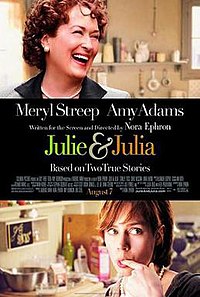
Julie & Julia

Rating: ***1/2

Normally I’d say that adapting two books in one movie is a fool’s errand, sometimes there’s so much book in just one that the movie feels light by comparison. Such an experiment seems far outside the ordinary prevue of filmmaker Nora Ephron, the woman behind such pedestrian fare as Sleepless in Seattle, You’ve Got Mail and Bewitched. In an astounding feat of syncopation though, Ephron has found a formula that works, telling parallel stories that are about a romance we can all relate to: food. A great cast, a mostly solid script and a lot of common themes give Ephron much to work with, and what she cooks is probably one of her best films.

The two books in question are Julie & Julia by Julie Powell and My Life in France by Julia Child with Alex Prud'homme. Powell is a writer who in 2002 was stuck in a rut as a government cubicle worker. Looking for a way to expand her horizons she started the “Julie/Julia Project,” which was a blog that followed Powell’s progress as she tried to cook the over 500 recipes that make up Child’s book Mastering the Art of French Cooking in one year. Julie’s year long odyssey is juxtaposed with Child’s years in Paris. Child moved there in 1949 when her husband Paul, an employee of the US State Department, was assigned to the American Embassy. Looking for a way to fill her days, Child studied at Le Cordon Bleu cooking school, starting her on the road to becoming the first, and possibly most renowned, celebrity chef in America.

It may be Powell’s story that got the ball rolling, but it’s the Child portion that really sings. By and large this has to do with the portrayal of the chef by Meryl Streep, who fills Ms. Child’s ample shoes with tremendous presence and light-hearted aplomb. Of course, Streep is a tremendous actress, we all know that, but disappearing behind Child’s pearls Streep blurs the lines between acting and impersonation. Well paired with Streep is her Devil Wears Prada co-star Stanley Tucci playing Paul Child. They make an adorable odd couple, both grounded and romantic. By far the Julia portions of Julie & Julia are strongest, mostly thanks to the enormous (both psychologically and literally, given Child’s 6’2” frame) presence of Streep.

As for Julie, played by Amy Adams, she’s not without her charms either, although I think her story kind of strains at times. On the one hand I found that the story didn’t go deep enough into the challenge Powell put before herself; there weren’t a lot of scenes of trial and error, or things gone wrong, or the occasions where working a full-time job and taking on a massive cooking project conflicted. The whole fight between Powell and her husband (played by Chris Messina) seemed tacked on to create some kind of conflict, but it was rather unconvincing. But all-in-all it did provide a nice counterbalance to Child’s story, the trouble is that this was supposed to be Powell’s story for the most part.

Julie & Julia is nothing less than a pleasant film with two strong female characters in its centre. Ephron for the most part keeps things well balanced with the two though I imagine at some point during the editing process the real star of the film became apparent. In the end though, you’ll leave the theatre feeling filled with good human cheer and perhaps a little peckish after having so many fabulous dishes shoved under your nose during the two hour running time. If there’s an apt culinary comparison, think of Julie & Julia as comfort food, served well and made with classic ingredients. It’s impossible to resist, and I dare anyone to try and not want to ask for seconds.

Friday, 12 June 2009

The Taking of Pelham 123

Rating: ***1/2

John Travolta’s never been one to miss irony. Over his long, illustrious and not so illustrious career, he’s done a lot of memorable things, but perhaps none so memorable as this little monologue that kicked off the 2001 action movie Swordfish: “You know what the problem with Hollywood is? They make $#!t. Unbelievable, unremarkable $#!t. Now I'm not some grungy wannabe filmmaker that's searching for existentialism through a haze of bong smoke or something. No, it's easy to pick apart bad acting, short-sighted directing, and a purely moronic stringing together of words that many of the studios term as ‘prose.’ No, I'm talking about the lack of realism.”

Well, who better to get a lesson in realism from than the guy that spearheaded Battlefield Earth, especially in a movie like Swordfish which strained even the most open sense of suspension of disbelief? But Swordfish is one example of many of Travolta’s famous “misses.” No body in Hollywood has a batting average like Travolta, from choices of audacious brilliance (Pulp Fiction, Primary Colours and Face/Off) to astounding stupidity (Look Who’s Talking, Look Who’s Talking Too, Look Who’s Talking Now). Well Travolta actually comes out pretty good in The Taking of Pelham 123, a remake of the 1974 film of the same name. The film itself is rather well done, at least two-thirds so.

That vast majority of the film that works is built on a great cat-and-mouse verbal sparring match between Travolta’s subway hostage-taking Ryder and Denzel Washington’s accidental hostage negotiator Walter Garber. What’s weird is that as soon as the two come face-to-face is when the movie starts to break the tension and strain reality. Everything leading up to that is golden though. There’s great tension, consequences, a couple of compelling mysteries and a story behind the story. This is not like the trailer with car crashes and explosions, though there are some. This is about character and drama… for the first hour and ten minutes at least anyway.

And it unfolds in real time too, more or less, and everybody loves real time. I’d almost say that you half expect Jack Bauer to bust in and take command, but Tony Scott’s break-neck pacing keeps things at a fever pitch. At the centre of the film is Ryder, who’s smooth operation in taking nearly 20 people hostage for $10 million on a single subway car, comes down to Garber, who’s doing dispatch duty while being investigated for taking bribes. The hostage negotiator (John Turturro) thinks Garber might be sketchy, but when he tries to take control of the situation he makes Ryder angry, and you won’t like him when he’s angry. With a ticking time clock for delivery of the $10 million, Garber finds himself with the lives of over a dozen people in his untrained hands.

Scott keeps the action tight, and doesn’t allow the viewer much room for comfort or opportunity to use the whole seat. The plot goes from little crisis to little crisis, and I have to admit that for a while there I wasn’t sure how it was all going to work itself out. Played out against the hustle and bustle of New York rush hour, there’s something that feels even more genuine. Anchored by the compelling back and forth between Washington and Travolta, The Taking of Pelham 123 is a compelling mix of dramatics and suspense. But like I said, that only lasts so long as the film’s climax when contrivances become clichéd and the old action movie checklist is brought out and engaged to produce pedantic results.

But even given that fact that movie ends rather formulaically, I found myself still digging the vibe and the action right up till the final confrontation. By the time you get to the end, you’re so invested in the characters anyway that the fact there isn’t much making sense is a rather secondary consideration. As far as action movies go, The Taking of Pelham 123 is an offering of both style and substance; technically well done and surprisingly well written. And that’s all the realism you need.

Tuesday, 5 May 2009

Hot Docs - Diary of a Times Square Thief with Steel Houses

Rating:
Diary: 4 stars
Houses: 3.5 stars

I love tales of pre-Giuliani New York City, be they real or imagined. Such a picture of moral decay and lawlessness is painted that you can’t help but be intrigued in the way any good story of street level grey can. That is why Diary of a Times Square Thief appealed to me, as well as the fact that it’s a documentary with some mystery. So many souls come to New York every year with big dreams and naïve ideals, how many get lost along the way, be it by their own demons or the ones that can be found down every dark alley? Unknown, but as Diary ponders: what if one of them left something behind?

The film starts with filmmaker Klaas Bense buying a person’s diary on eBay from one of the site’s “darker corners” as he describes. Bense leaves his home in the Netherlands and arrives in New York with a mission: find the mysterious writer of the diary, a man who came to Manhattan from a “provincial American town” to become a successful writer only to find himself a successful screw-up. All Bense has is a first name, John, and the name of the place John stayed at in the late 1980s, the Times Square Hotel on 42nd Street.

Piece by piece, Bense seems to learn a little bit more about John and his current, possible whereabouts, even consulting a psychic when meeting one incidentally. As much as Diary is John’s story though, it’s also an oral history of a bygone chapter of New York history and I can speak first hand to that having walked along the same stretch of 42nd Street when I was in New York just this past February. It’s interesting trying to put those two places together in your head, it’s like trying to imagine Superman’s Metropolis and Batman’s Gotham City as the same place.

As for what became of John, yes we do find out, and no, I’m not going to tell you about it. I’m kind of two minds about it myself, and while the resolution to the mystery was nice, there’s something about the enduring mystery of this hodgepodge work of prose and Polaroids that feels too much like an artefact to have much barring on the here and now. Still, it was a great hook for the story and a compelling tale it is with numerous facets and wormholes to explore. Plus, it’s a complete film. It has a beginning, middle and end and covers a lot of ground in such a short space of time. A brilliant work in and of itself.

Not quite there though was the preceding short Steel Homes, about surviving relatives that store their departed loved ones belongings at a self-storage company because, well because they really don’t want to part with them. This will appeal to the inner pack rat in you, if you can self-identify as such. I heard a few people in the crowd grumble about how, in their opinion, the film had no point, but I disagree. In its way, it was a kind of poem about the power we ascribe to objects even though they really have none and examining how we come to terms with accepting that it’s the memory, not the object that has true power. Documentary as poetry? Not bad.

Wednesday, 15 April 2009

Man Push Cart

Rating: ***

The title’s not exactly provocative, is it? It’s just not that sexy, it doesn’t suggest anything really mythical or powerful. All it really seems to conjure is an image of a man. Pushing a cart. To somewhere. And basically, that’s all there really is to Man Push Cart, an independent film now available on DVD. Director Ramin Bahrani has concocted a strange little film that’s kind of desolate and stagnate, yet some how enrapturing and quietly effective. It’s not a perfect work, but considering the script and the subject matter, Bahrani manages to weave something both oddly touching, and weirdly soul-sapping.

The man is Ahmed, a Pakistani immigrant trying to make his way in the Big Apple selling coffee and bagels on a street corner in Manhattan, which would be from the aforementioned cart. His day starts at three in the morning and goes from dawn to dusk when he makes the rounds trying to sell a few pornographic DVDs. And that’s his day. He’s one of hundreds of guys struggling to make ends meet, dreaming of something different, but trapped by the routine and the vague hope that maybe better things are coming. As portrayed in the film, everyday, lugging his push cart up the streets of Manhattan, is a labour of Herculean proportions for Ahmed; one that never ends.

Bahrani relies on the cycle and the repetitiveness of things to get the viewer to feel Ahmed’s pain. Add to that is the performance by Ahmed Razvi who practically wears downtrodden hopelessness as some kind of badge of honour and you’ve got a pretty good dynamic to work off of. What makes Ahmed so pessimistic is merely ever glanced at. It’s presumed that his wife died and that his son ended up in the care of his in-laws sometime afterward, but the specifics are unfortunately never given. And this is where I get into some of the problematic stuff with the film: is the film trying to let us into the life of the street corner coffee vendor, or is trying to reinforce clinical detachment effect: seeing someone everyday, but knowing nothing about them.

Of course, the film would get especially dull if they same sequence were repeated again and again, thank you very much Vantage Point for proving that ably last year. Ahmed, it seems, was a pop star of some renown in Pakistan, the Pakistani contemporary of Aaron Carter perhaps? Or Hanson? The guy doesn’t look that old. Anyway, Ahmed meets a fan that throws him some work and gets him thinking about putting his musical career back on track. That, and a flirtation with the Spanish girl that works a nearby newsstand, has Ahmed thinking life might be going his way. Silly Ahmed. Does the universe sometimes conspire to keep certain people down, or is that just the nature of life and society? Kind of philosophical, I know, but in this film questions are only raised.

Before writing this review, I was reading some of the online feedback to this film, which, by in large, was mostly of the “waste of time”/“nothing happened”/“what’s the point” variety. Waste of time? Not really. Like I said, the repetitive nature of the story had a kind of hypnotic effect, on me at least. There’s something about witnessing another person’s tedium that soothes the part of you that feels stuck in natural. Nothing happened? That depends on your perspective. On a day-to-day and a week-to-week perspective it appears that nothing’s happening with us, but we’re changing all the time in subtle ways. At least this filmmaker had the patience to realize that a life change is a process, not a sudden burst. And perhaps that’s the point; those expecting a sudden alteration to the pattern are bound to be convinced that nothing changes. If nothing else, Man Push Cart reinforces that life’s in the details.

Saturday, 14 February 2009

Confessions of a Shopaholic

Rating: *1/2

Am I insulted by a movie that semi-glorifies the consumer debt culture that helped precipitate the current, global financial crisis? No, or at least I don’t feel nearly as insulted by that as I do that someone tried to pass this off as comedy. In a way, Confessions of a Shopaholic offers a strange counterpoint to the thriller The International in terms of timely, finance related fantasies. In one, a giant bank is evil and must be stopped and in the other spending your brains out is fine so long as you can write it off as an addiction and are really, really sorry about it.

But reality intrudes because not everyone that spent themselves into a giant hole of consumer debt is able to dig themselves out in quit so fairy tale-a-fashion. I realize that romantic-comedies are rarely known for their down to earth realism, but there’s something about the gluttony and avarice on display in this film – given prevailing conditions talked about on the nightly news – that doesn’t sit right. Rebecca Bloomwood (Isla Fisher) is one of millions of Americans that have spent themselves into a deep hole filled with designer goods and cute bobbles that they really don’t need, but can’t seem to stop themselves from buying.

To illustrate, Rebecca’s so hooked on the shopping drug that she stops to buy a scarf on her way to the job interview she’s waiting years to go to, and then spreads the price tag over about a dozen credit cards. And then, when she still comes up 20 bucks short, she tries to get cash back from a hot dog vendor. Like any addict, it’s not until she hits rock bottom that she truly appreciates that she has a problem, and as these things go it involves the betrayal of the best friend, the boy friend, her career success, her skin-flint parents and her very dignity. The theme of spending as addiction is interesting, but too often it’s treated as joke. I think there are a lot of people out there that missed the punchline.

Also, people aren’t quite so lucky as Rebecca Bloomwood and aren’t able to basically walk into a job they’re not qualified for and succeed; not to mention win the affections of the handsomely British Hugh Dancy. When Confessions isn’t busy making a mockery of fiscal irresponsibility and poor budgeting, it embraces those frivolous rom-com clichés. Rebecca is typically flighty, but anyone comparing shopping to falling in love would have to be. Naturally, the boss she initially detests becomes her soulmate, her long suffering best friend reaches a breaking point and she succeeds in spite of herself despite repeated social faux pas and other blunders. Clearly Sex & The City is an influence, a kind of “What if… Carrie Bradshaw was a spendthrift red head with debt issues?”

Not even Isla Fisher, who’s infinitely charming and adorable in equal measure, can salvage even a glimmer of hope for this movie. It’s one of those films where you sit there and feel embarrassed for everyone on screen because it’s so silly and derivative that they might as well hand out copies of the script so that you can follow along in the audience. Not that those savvy movie watchers would need it. We’ve been there and seen it all before but still wish we hadn’t. Even without all that murky economy stuff, even if it were the Roaring 20s or the Tech Boom all over again, this movie would still stick because life as we know it bears no resemblance to anything associated with this film, period. But in this time of economic uncertainty, the smart investment is to get tickets for another film.

Saturday, 19 January 2008

Cloverfield

Rating: ****

Brian the Dog’s assisted commentary for the hearing impaired for The Blair Witch Project was pretty accurate. But mainly what people remember more about that whole episode was the hype and not the nothing that all that sound and fury brought about. Which is what makes Cloverfield the perfect counterpoint to Blair Witch, both movies push the cinéma vérité style to the outer reaches of fiction based cinema. I know that this film has divided the public, and I think I get the reasons why, but there’s one thing I can’t deny and that is I loved just about every second of it.

What begins with a going away party for Rob (Michael Stahl-David) turns into the night from hell as a giant monster begins stomping and trashing Manhattan Island under its gigantic feet. Also dangerous is that fact that the monster can “give birth” to smaller creatures that can infect people with their bites. The survivors attempt to escape the island across the Brooklyn Bridge only to see it destroyed. Rob, along with a few friends, tries to make it to the home of Rob’s friend Beth (Odette Yustman), who we learn from outtakes on the tape from another day, had a bit of tryst with Rob just a few days prior. Through the camera’s lens we see snippets of the army’s counterattack against the monster and some of the destruction that it’s wrought.

Now some people hate the shaky cam, and there are times I must agree as I think its frequent use is unnecessary and has become a lazy way to demonstrate hustle and pandemonium. In this circumstance though, it’s a given and you either learn to go with it or you’re going to have a real uncomfortable 90 minute sit. The second most frequently heard critique: “It’s just Godzilla meets The Blair Witch. And I answer: “Yeah, what’s your point?” Frankly, I don’t know what else you can do with the monster destroys city archetype; the American remake of Godzilla tried to make it about the people and we all know well how that worked out. What the genre needed was a gimmick and this was a heck of a gimmick.

The other thing I know people had a hard time reconciling was the invocation of 9/11 imagery. Again, I understand how this can make people feel uncomfortable, and I appreciate that, but there is precedent for this and I don’t just mean the first 20 minutes of Spielberg’s War of the Worlds. Godzilla came out in Japan in 1952, just seven years after the atomic fury was unleashed on Hiroshima and Nagasaki. True, the monster was a man in a rubber suit stomping on cardboard buildings, but there was a genuine, primal fear driving this realization of panic by the only people in history who have had a nuclear weapon used against them. So here I think the use of plumes of smoke and falling, flaming paper is apropos to the cause: evoking our shared imagery of being caught in disaster.

What do I like about Cloverfield? First off, I love monster movies, and we don’t get enough of them now in days. I love the gimmickry of this monster movie in particular: the shock value, the traps, the telegraphed scares – it’s all good. I love the way it lures you into a false sense of security right off, how the party scene at the beginning lasts just long enough to make you think that maybe this isn’t a monster movie after all and then it starts to hit you with the action, which then speeds along until the very end. The giddy destruction of New York landmarks is a throwback to more innocent times, but one that’s not taken for granted by filmmaker Matt Reeves and screenwriter Drew Goddard.

What’s not to love? Well, I grant you the conceit that the premise of the film is based upon sometimes stretches the imagination. The natural ending for the movie seems bypassed for the sole reason to keep the story moving until a prearranged running time. And there were occasions when I’d see “camera operator” put down the camera only to pick it back up again and I would think, “You know, if that were me, I’d probably just leave it and run the hell for my life.” Of course though, it probably wouldn’t make for an interesting film if 20 minutes in the camera was left on the ground watching everybody walk away.

Generally though, people who complain about the logic behind a movie that features a giant amoeba playing six-pin with the head of the Statue of Liberty obviously takes life way to serious, and their cinema for that matter. It kind of disappoints me that Cloverfield has disappeared from the radar so quickly, the nature of modern hype I suppose that first weekends set records only to create empty theatres the second week. I hope that Cloverfield sticks around for awhile, I hope that there’s a Cloverfield 2 and I hope that this inspires others to bring back the creature feature, big time!

Sunday, 25 November 2007

August Rush

Rating: ***

Now, for anyone who’s never seen or read Oliver Twist there’s August Rush, where little Oliver is actually a music prodigy named Evan who one day runs away from his orphanage to find his parents in the big city and have all sorts of wacky adventures. He even has a Fagan, a delightfully creepy, manic depressive man with mutton chops and a soul patch who philosophizes about the nature of music and its place in the universe. You can’t see right now, but I’m making a “gag me” face.

Yes, August Rush is unabashedly sentimental. It’s a feel good, chicken soup of a movie that works its magic even if you’re half a Grinch. (Yes, even me.) But it can’t be denied that this is an obvious and gushy film where happily ever afters happen as easily as five car pile-ups on the 401 on a snowy day. Also, I don’t know all there is to know about music, but I’m somewhat unconvinced of its Harry Potter-like magical abilities to help us solve our Earthly struggles.

Just don’t tell Evan (Freddie Highmore) that, he hears music everywhere, even in the electrical wires, which tell him to walk away from the orphanage in the dead of night. He arrives in New York City and runs into Wizard, a former street musician that now runs a whole crew of child labour musicians. Obviously with Evan’s musical ability, Wizard sees a gold mine and rechristens the kid “August Rush”.

Through flashbacks we learn that Evan’s parents were a debutant cello player with Julliard named Lyla (Keri Russell) and a soulful Irish rocker named Louis (Jonathan Rhys Meyers). They were star-crossed lovers torn apart when Lyla’s overprotective father (William Sadler) forbids her from seeing Louis, but not before she gets pregnant. Several years later, during a deathbed confession, dear old dad reveals that he used the injuries Lyla suffered in a car accident to fake a miscarriage and spirit her son into foster care.

Now this is deep stuff assuming that you’ve never seen a Disney movie, or in fact any movie, ever. It’s full of many pleasant little contrivances, like how an 11-year-old boy can wander the streets of Manhattan for hours and nothing bad ever possibly happens to him. Then there’s the way everybody starts looking for each other at the exact same time; dad’s death coincides with Louis desire to find the woman he loved more than all others, which is the exact same time that Evan performs his little Hail Mary to the big city. And then the way that Louis finds Lyla again: a Google search? Jeez buddy, what was holding you back? Carpal Tunnel Syndrome? Arthritis? Bonus Eruptus?

To be fair, I did find the performers engaging. I thought that Russell was really good and low key as the frantic mother and she played really well against Terrance Howard as a sympathetic social worker. Freddie Highmore, although being at times a little creepy, also does a good job of portraying Evans longing and search for not just spiritual fulfilment in finding his parents, but also looking for artistic fulfilment along the way even though he didn’t know that he was supposed to be looking for it. Robin Williams is impressive for his restraint, but there was something about his character that really disturbed by, although apparently benign, his character felt out of place and something more attune with perhaps the New York of Law & Order: SVU.

Some of the praise I’ve heard about August Rush calls it a “modern fairy tale.” I certainly can’t say that I disagree, but maybe that’s part of the problem: is it or isn’t it some kind of modern fairy tale? Because if it is, it’s a little too real for a simple fable and if it is not that it’s far to whimsical to be believed straight up. Maybe I wasn’t in the right head space to watch this movie, I don’t know. What I do know is that the ending, without giving too much away, left a little bit wanting and that’s not a good thing for any movie to leave the most satisfying bits out of frame by the time the credits roll.

Sunday, 18 November 2007

Mr. Magorium's Wonder Emporium

Rating: ****

Some movies aimed at kids are just so stupid, and I don’t just mean this from an adult’s point of view but I think that they literally make our kids dumber. This need not necessarily be the case, for there are several examples of family entertainment being accessible and satisfying for all age levels, even though it’s directed at a younger audience specifically. Mr. Magorium’s Wonder Emporium is an example of this and even though it was released some time ago now, I still feel it was one of the best family films of the year. It got pretty beat up in the reviews and IMDB rates it only a 6.2 out of 10, which is pretty brutal considering that I absolutely loved it.

Mr. Magorium (Dustin Hoffman) is a 243-year-old toy manufacturing entrepreneur who sells his creations in a New York toy store. Mr. Magorium after a life of mirth-making and avid shoe wearing is reaching the end of his life and is putting his affairs in order. He hires Henry Weston (Jason Bateman), an account he nicknames “Mutant” on the assumption that the route of the word “account” is “a counting mutant”, to put the stores financial books in order. Mr. Magorium’s intention is to leave the store to his employee Molly Mahoney (Natalie Portman), who’s unsure about inheriting a magical toy store, especially when she’s trying to get back to her first love: music.

This movie is about simple delights and simple charm. It’s a story about characters trying to find something with a moral of self-realization. It can get kind of dark, but dark need not necessarily be all bad. As we saw earlier this year with The Bridge to Terabithia, there are valuable lessons in the dark, not that Mr. Magorium is like something out of Frank Miller though. It’s just that in the midst of all the silliness in the trailer, you would never guess that there’s a semi-serious message about life, death and finding the things that make you happy while you’re in between.

Leading the way in a wonderfully weird performance is Dustin Hoffman. Now a guy like Hoffman in a part like this could easily rest on his laurels, but he’s friendly, heart-warming and just goofy enough to evade any claims of normality without any kind of creepiness. Portman is adorable as Mahoney and is the heart and soul of the movie; she plays well against Bateman who, as The Mutant, plays the straight man in the midst of all the zaniness. Rounding out the cast is Zach Mills as Eric, a lonely little boy that shows wisdom beyond his years. He’s also the narrator of the movie, delivering lines with the gentle, matter-of-fact manner of any kid telling a really interesting story.

I did actually have a problem with the final act as it just seemed that the magic in the film kind of slowly drained out of it on until the very end. The story seemed to stop at something of an abrupt note and doesn’t even offer a glimpse as to what happens after the credits role. A movie like this needs closure and something to give us more than the presumption that everyone lived happily ever after, we have to see it. I also have concern that in our cynical age the movie might be too earnest for people, but that’s there problem not the filmmakers’. Reading some message boards about this movie it disappoints me that whimsy seems to be such a disposable commodity in the world today.

But in the end I think that Mr. Magorium has a solid message that anyone can get something out of: “Life is an occasion, rise to it.” The material is beautifully handled and writer/director Zach Helm has a gifted touch for the handling of such fantastical material. I hope that when this movie comes out on DVD that the people will discover this and hail it with the praise it deserves: a true family classic with a timeless quality and a timeless message.

Sunday, 4 November 2007

American Gangster

Rating: ****

What’s all the hype about? This isn’t the first time that Denzel Washington and Russell Crowe have faced off on the big screen. Remember Virtuosity? That’s what I thought. The basic premise was that Crowe, flush from his star making turn in The Quick and the Dead, plays SID 6.7, a serial killer composite born in virtual reality that escapes into the real world. Denzel was the cop that had to stop him from reaping havoc in the not-to-distant-future. Such a story, and what a tremendous success at the box office, one wonders why it took more then 12 years for these titans to team up again.

Based on a true story, American Gangster takes place on the mean streets of Manhattan in the 1970s. Frank Lucas (Washington) takes over a criminal empire from his mentor and sets about making a name for himself by getting into the heroin business. Lucas establishes a delivery route for pure heroin direct from Southeast Asia to the US, where he can sell a product that’s twice as pure for half the price. Richie Roberts (Crowe) is a NYPD narcotics officer famous for turning over a million dollars in cash to evidence. Roberts is made head of a crew of federal agents under a new drug-centric agency to track down the heroin to its source and very slowly they begin making a case against Frank Lucas.

Like Heat, another movie that teamed two powerhouse actors on opposite sides of the law, the script almost goes out of its way to keep these characters apart until the very end of the film. As a consequence we almost get two different movies with Washington as the black Godfather and Crowe leading an Untouchables like crew out to bring down a criminal empire. In fact, there are portions of Gangster that plays like Brian De Palma’s The Untouchables, but sans De Palma’s characteristic action style and oblique camera angles.

This is the Washington show, unquestionably. His character is the more interesting, he has the better arc and as consequence, he gets the lion’s share of the attention. What’s neat is the way Washington clothes himself in that nice guy demeanour that he’s so perfectly perfected over the years; Lucas is no Alonzo-style thug to be sure. Lucas sets himself up as a man of the people and you believe, which makes it all the more galling when he walks up to an enemy on the street and shoots him in the head in broad daylight.

Crowe’s cop is more staid despite attempts to make him more of an imperfect human though not dirty per se. Crowe is also saddled with a subplot involving a custody battle with his ex-wife (played by Carla Gugino) which is utterly pointless as it adds nothing really to the story. I can only imagine that it was employed in order to give Crowe some balance and give him something more interesting to chew on other than looking imploringly at police files and rap sheets for inspiration to break the case.

The film’s two hour and forty minute running time appears daunting, but I actually found that the story moved along rather briskly. Sir Ridley Scott goes to great trouble to detail the elaborate operation that Lucas put in place and the obstacles that Roberts encountered in trying to not only identify the big boss, but also having to fight his not only this intricate organization but the cops that are supposed to be in his side. Aside from the marquee names, the film is filled with a tremendous character actors giving great performances in parts big and small, whether its Josh Brolin’s morally bankrupt cop or Cuba Gooding Jr’s gangster Nicky Barnes.

It’s always hard to do something new and exciting with the gangster genre but American Gangster comes with a marvellous energy and a script that allows powerhouse actors to shine in their roles. Both Scott and Crowe can consider themselves redeemed for their combined failure in A Good Year (Better known as “Russell Crowe sits around and drinks wine for two hours”).