Showing posts with label future. Show all posts

Friday, 24 February 2012

Donovan’s Echo

Rating: ***

Prophets and premonitions provide a rich narrative for stories. After all, seeing the future, and the personal and universal long-term implications of that, provide excellent narrative fodder. In the new film, Donovan’s Echo, our titular protagonist is haunted by more than his visions – brief flashes really – of the future; he’s being chased as much by the ghosts of his past as he is the hints of things to come. A human story about regret, told with both pathos and humour, Donovan’s Echo may be about the future, but you might not see the end coming.

The story follows Donovan Matheson (Danny Glover) as her returns to the small British Columbian town where his wife and child died in an unfortunate car accident 30 years earlier. Once a promising scientist that graduated from the Manhattan Project to nearly making a breakthrough with cold fusion before his work was discredited, Donovan is now a broken man, trying to hold down a McJob at the local supermarket. While walking home drunk one night, Donovan sees flashes of a car accident before it happens, and going over old notes in storage at his house, Donovan discovers that this may not be the first time he’s had a sense of something happening before it happened.

In context, Donovan’s Echo plays like an episode of the old Twilight Zone. A single man, ordinary though cursed by tragedy, touched by an extraordinary force that may be real, but has just as much an equal chance of being all in his head. While watching the film, co-writer/director Jim Cliffe does a good job of suspending your suspension of disbelief, making you (and Donovan) believe that his futuristic transmissions are all a delusion. Donovan rescues the little girl from next door from a falling power tool, but did he really see it hitting her a split second before it happened, or did he jostle the scaffolding and actually start the chain-of-events in the first place?

The one playing devil’s advocate is Bruce Greenwood as Donovan’s friend Finnley, a local RCMP officer who’s married to the sister of Donovan’s deceased wife. Although Finnley is initially patient with Donovan’s eccentricities he eventually has to hammer down as, from his point of view, Donovan’s behaviour is getting out of control. There’s a nice camaraderie between Greenwood and Glover, but it’s very easy to get the sense of Finnley’s frustration. The characters on paper are kind of straightforward, so this is one of those times where the presence of the actors adds the needed dimensions, so the casting of Glover and Greenwood is fortuitous and welcome.

At the same time, Donovan’s Echo is a film that itself requires patience. This is not an ADD pinball machine full of distractions, but very purposefully driven. Its pacing can be frustrating, but at the same time its deliberate. The more the film moves along, the more speed it picks up. Those deliberate tones in the first half of the film yield dividends in the second as all the fractured pieces come together. I have to say that I didn’t foresee how the whole story would end up, which is a rare sort of treat when you see a lot of movies. The film’s crescendo is simple, but affective, and once the film is over there’s a palpable bittersweetness that ties everything off. In the end, there are no good guys and no bad guys, just the hope that our lives have made a difference in the end.

Credit goes to Cliffe for setting a tone and sticking to it, and to Glover for caring the movie with a surefooted performance that’s subtle and complex. Not everyone will be able to get a handle on the film, and by far its biggest demerit is that there are times the story seems as aloof and unfocused as its protagonist, but in the end you see that the filmmakers seemed to know what they were doing all along. What we have here is a good mind puzzle with a moralistic centre, one that would have made Rod Serling nod with approval.

Friday, 8 January 2010

Daybreakers

Rating: ***1/2

It’s no great secret that there are a lot of Twilight haters out there, so guys, because many of you are guys, this one’s for you. Yes, post-modernism and melodramatic teen romance is for wimps in Daybreakers, a movie that doesn’t just bring back those old vampire idioms, but does it with style. Do like vampires that burn up in sunlight? Vampires that cast no reflection? Vampires that have to be eliminated with an old school stake to the heart? Well ladies and gentlemen, you just found your ride and I think it’s safe to say that you will not be disappointed. Daybreakers has everything a vampire movie needs: mood, monsters and bucket after bucket of blood.

Daybreakers posits a world nine years hence that’s been transformed by some kind of plague that started turning people into vampires. In a little under a decade, vampires have taken over and the human race is on its last legs either being sedated and farmed for their blood or on the run from ending up in such a fate. Sadly though, this isn’t a vampire Shangri-la because fewer humans mean fewer blood supplies. The price of blood is going up and the supply is being rationed, but with the horrible result of lack of blood being a monstrous mutation for the suffering vampire, society is on the brink of collapse. For haematologist Edward Dalton (Ethan Hawke), whose job is to find an adequate blood substitute, things are a little stressful.

Like a certain other vampire also named Edward, Dalton has mixed feelings about human blood and begrudgingly works on a blood substitute believing it a round about way of saving the human race by eliminating the culling and blood farming. A vampire of such moral fortitude would naturally find allies amongst the remaining humans. Enter Elvis played with winning B-movie hero swagger by Willem Dafoe. Elvis was a vampire, but accidentally cured himself and thinks Dalton might be able to help him find the answer. The solution is ingeniously simple as it turns out, but is it too late to save human and vampire? That’ll be for the sequels to decide. For the most part, Daybreakers is a compelling tale about survival on the fringes, and a fascinating look at a society gone topsy-turvy.

A world of vampires running out of blood makes for a powerful allegory be it oil, food or water. Along with that is the sneaking corporate interest as represented here by San Neill’s Charles Bromley, a Lex Luthor-like business suit that controls the largest supplier of human blood. Neill does evil right in playing Bromley as a slick tycoon that doesn’t see problems, but sees money making opportunities. For the monster maniacs there are subsiders, a mutated, almost zombie-like vampire that’ll feed on vampires once driven mad by long-term fasting from human blood. There is a lot of good bloodletting at the hands and mouths of the subsiders, so despite high-minded literary terms, horror fans will enjoy the guts that Daybreakers has.

But then again, perhaps you’ll just enjoy the central conceit of the film and the fact that it takes place in a world run by vampires. A world where you can buy blood and coffee at the subway newsstand, travel through underground walkways during daylight hours and have your car specially rigged with a series of cameras so you can drive around protected from sunlight. You’ve got to love those little details, and the film plays them beautifully. True, this is one of those futures where everybody dresses like it’s the 1950s, but for high concept on a budget, the filmmakers do a pretty decent job. The bottom line is that Daybreakers is fun, and there haven’t been a lot of vampires movies that you’ve been able to say that about, sparkle-pires and their teenage concubines included.

Friday, 18 December 2009

Avatar

Rating: ****

For the longest time I was an Avatar denier. As good as writer/director James Cameron is there was just no way possible for his $400 million sci-fi opus to carrier the weight of all expectations behind it. Between the fact that it was the filmmaker’s first narrative movie in a dozen years, to all the talk about ushering in a new era in both motion capture performance and 3-D cinema, it’s enough to give even the most egocentric filmmaker nervous collapse. But this is Cameron we’re talking about, and anyone bold enough to call himself King of the World in front of a roomful of Hollywood’s elitist of the elite at the Oscars is bound to be predisposed to not just trying to meet expectations, but exceed them with extreme gusto.

So it is with Avatar, which doesn’t just fulfill the promise of what’s possible from James Cameron, but takes it those expectations and gives them the maximum dosage of steroids medical science can allow. Hyperbole? Perhaps. On a story level, the film is not without its flaws and is, actually, rather derivative of other movies, including one or two of Cameron’s own. On a visual and technical level though, Avatar is out of this world to use just the right term. Brilliantly realized with the same kind of obsessive detail that drove Cameron to hire the same china makers that made the plates on the original Titanic for his movie of the same name, Avatar is the most engrossing epic put to film since the Lord of the Rings trilogy.

The film takes place on Pandora, a life-filled moon orbiting a gas giant planet several light years away from Earth. A nameless corporation is trying extract a mineral called Unobtanium (an inspired bit of word play) but are running into problems due to the indigenous population’s refusal to be re-educated and re-located. A group of scientists led by Grace Augustine (Sigourney Weaver) are trying to study the planet and learn about its people called the Na’vi. One of the new members of the team is Jake Sully (Sam Worthington), a paraplegic Marine who’s subbing for his dead twin brother by getting behind the proverbial wheel of an Avatar. The avatars, cloned from a combination of Na’vi DNA and the DNA of its eventual driver, are very expensive to make, which is why Sully’s brought in unprepared for the rigours of Pandora, or for interaction with the Na’vi.

One can gleam from the mere pretext that Sully will end up “going native” in a predictable fashion. He’s taught by Na’vi princess Neytiri (Zoe Saldana) the ways of her people and their deep connection to the planet and all its life forms. One can see that the Na’vi and their culture isn’t something that Cameron cooked up over a weekend with such great detail given to everything that has to do with Pandora. Though it’s mostly a computer cooked up imaginative realm, Pandora is so vivid you can almost reach out and touch it, and with Cameron’s improvements to the 3-D process you really feel like you can. Avatar is an immersive experience tailor made for the big screen, a larger than life adventure that dares to be duplicated even though it probably never will.

But there’s no denying that Cameron put more energy into visualizing his world than writing an original story around it. Avatar plays like Last of the Mohicans meets The Happening with a dash of the Endor scenes in Return of the Jedi. Cameron borrows characterization from Aliens with the uncaring corporate administrator played by Giovanni Ribisi and a feisty Latina ally in Michelle Rodriguez’s Trudy. Worthington again confounds, leaving us wondering how this unknown beguiled so many into thinking he was such substantial leading man material. There’s something that seems terribly bland about the man, which may be the point in the case of Sully but I sense another Jim Caviezel in the offing, an actor of supposed great wells of talent that burns bright and then disappears.

But what does work for Avatar is the motion-capture. On many occasions one can sense the actor behind the performance and feel that you’re actually watching someone act like a character rather than a special effect. This is no minor trifle either because if the Na’vi didn’t work this whole movie would have fallen apart like a cheap car. The execution matches the grand vision even in spite of all the hiccups in the script. Avatar is an absolute bombastic thrill ride that has to be seen to be believed, and seen in 3-D in order to be full appreciated. James Cameron is back in fine form, ladies and gentlemen. Here’s hoping he doesn’t have to wait another 12 years for technology to catch up so he can execute his next bold vision.

Saturday, 24 October 2009

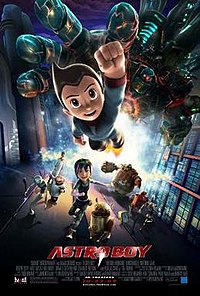
Astro Boy

Rating: ***1/2

I grew up with Astro Boy. I remember he came on Global in the mornings before school and then on Saturday afternoons. He was brave and gentle and wise. He had rocket boots and machine guns in his butt. And frankly, if I remembered anything more than that I’d probably lose my mind over all the minute changes made to the mythos as done in the new CGI Astro Boy.

The reaction from the hardcore fan community has ranged from the valid (“It was cute, and fun. A little morbid for kids”) to the debateable (“[Astro Boy] had a quasi adolescent voice”), to the just plain demented (“Astro Boy doesn't look Asian”). No, this Astro Boy is not perfect, but it’s the Superman Returns of anime adaptations with so much riding on it after so many years of development. And for the record, no character, in any anime ever, has looked even remotely Asian.

Another note for the record is that I actually liked Freddie Highmore as Astro, the post-modern Pinocchio who was the real boy Toby until he’s killed in accident and resurrected in a robot body by the brilliant scientist Dr. Tenma voiced here by Nicolas Cage. It’s a credit to Cage as a personality that his lunacy is able to translate to a cartoon character, but of all the veritable actors who contribute a voice to this film –with the possible exception of Donald Sutherland finding his inner Bauer Power as Metro City’s President– Cage stands out the most.

But the who’s who of voices is almost inconsequential, and it should be, because Astro Boy is bright with action, and dark in plot points. If you’ve seen Steven Spielberg’s A.I. or the history lesson The Second Renaissance segments of The Animatrix, then you’ll recognize several winks and nods in Astro Boy. Metro City floats above the Earth living in opulence and the Homer Simpson “Can’t Someone Else Do It” philosophy thanks to robot servants, which are then horribly discarded to the Earth below once then outlive their usefulness.

There’s a lot of Astro Boy that skims the surface of social commentary and historical allegory. It’ll go over the kids’ heads, but damned if some of it ain’t kind of creepy. At this point we get the R.R.F., or the Robot Revolutionary Front, a group of bumbling, English accented, robotic Marxists that believe in equality and liberté for all robots. A cynical person might see this as a sign that Astro Boy is communist propaganda in a new era of leftist oligarchy. But really, the R.R.F. are about as effective as Team Rocket is in the field of Pokémon collecting.

With the insertion of mixed grown-up messages along with the youthful, colourful fun and adventure, Astro Boy comes dangerously close to hodge-podging themselves into a stylistic corner that would have shrunk the target audience down to the six people that get the “Worker and Parasite” gag from The Simpsons episode “Krusty Gets Kancelled.” But as soon as the fascistic Stone gets “absorbed” (as explained through the movies woefully inaccurate science) by the giant Peacekeeper robot and pursues Astro in a rampage across Metro City, you can’t help but find your inner-child again.

Overall, I found Astro Boy a satisfying adventure film that had a few laughs and a decent amount of fun despite dark themes of loss and confusing political and environmental allegories. But the best moment, perhaps, comes at the end. Just as Metro City seems safe and sound, a giant one-eyed squid creature appears in the sky, and Astro takes off with a power punch at the ready. It’s almost at this point that you want to see the movie continue, it’s just such a wonderful tip of the hat to the occasional absurdities of anime. But alas, I guess there must be something saved for the sequel.

Friday, 25 September 2009

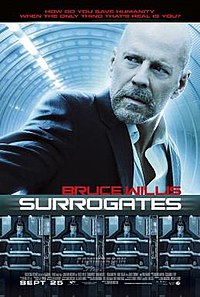
Surrogates

Rating: *

It’s difficult to appreciate how bad a movie Surrogates is without talking about the litany of logical fallacies in the film. Based on a graphic novel by Robert Venditti and Brett Weldele, Surrogates is about a future where most of humanity plugs into robot duplicates through which they live their daylight lives. As a person sits in a specially designed rig in the comfort of their own home, their “surrogates” go to work, run errands, hit the club, pick up a hottie, in other words, everything except going to the bathroom for you. Awesome, right? But there’s just one thing: what’s the point? Sure surrogates keep you from experiencing the bad, like massive internal injuries inflicted in a helicopter crash, but what about the pleasantries in life? What’s the point of experiencing those through a robot?

So now we’re off to the races because instead of sitting back and enjoying the movie, you’re asking a tonne of questions to yourself about its most basic premise. Surrogates supposes that in this robot future, human beings will suddenly find it within themselves to get along and eliminate crime and other social ills as if the true cause behind them was the fact that people can’t deal with each other in the flesh. As if some people, I don’t know, might not use their surrogates to do bad things specifically because a controlled human robot might be sturdier and better suited to commit certain deeds. Why is robot future so much better? Because people never have to leave home. Ever. That’s messed up.

But in another bizarre twist, how is everyone able to afford robot doubles? Some people can’t even afford a car and I expect a near-perfect replica of yourself (with or without alterations) to be considerable more pricey than the average gas engine block on four wheels in a metal frame. And considering how recklessly I see people use their automobiles on a daily basis, I wonder how well we’d treat our robot selves if the potentiality arose. Think of it: no pain, no limits, more strength, and more durability; everything you can do, I can better with the proportional physical dexterity of a machine.

I just couldn’t understand the appeal, and it seems there are numerous other citizens in this world that don’t either. This leads us to another little plot hole though because if surrogate use is near universal (as offered at the beginning of the movie), then how is there able to be such huge pockets of resistance, enough that every major city has a ‘rez,’ a machine-free zone outside government control. Even the characters in the film seem surprised at just how corrupt and imperfect their perfect world is. “You mean you can hack into my surrogate and tell it to shut off and you don’t a person’s permission or anything?” Of course you can, and who cares? You can get hit by a bus and keep on ticking!

Bruce Willis stars as an FBI agent caught up in a conspiracy to end so-called surrogacy and return humanity to a state of not living life through robots. A new weapon has the ability to fry a surrogate and send the signal back to the human at the wheel, blowing their brains out the back of their skull. Willis likes to do these sorts of movies every now and then, thinking man’s sci-fi like The Fifth Element or 12 Monkeys. Surrogates may sound like something written by Philip K. Dick, but this is Dick dumbed down. A sci-fi/noir that gives away all its cards upfront, depriving the screenplay of whatever mystery it ever might have had.

On the surface, Surrogates has the appearance of a movie that thinks it has a message and thinks it’s competent enough to tell it. But the bottom line is that others before, like the late, lamented Battlestar Galactica, have handled issues of the synthesis of man and machine in a much more competent manner. Unfortunately, Surrogates doesn’t even gel as a thriller, a mystery or an action movie, it’s merely a half-hearted affair that thinks it’s more sly than it is. When you’re caught up thinking about all the little things that the movie’s not about, all the little things it shouldn’t have to explain, then you know you’re in trouble, and Surrogates is in big trouble indeed.

Monday, 14 September 2009

TIFF Review-The Road

Rating: ***1/2

In reading Cormac McCarthy`s award-winning novel The Road, you can’t help but get enraptured by the imagery and the emotion of a father trying desperately to keep his son alive on the fringes of decaying society in post-apocalyptic America. It’s not an easy novel by any stretch, but finishing it is incredibly satisfying; there is no end just the promise that maybe this isn’t the end. That promise is kept in John Hillcoat’s adaptation of The Road, which premiered this past weekend at the Toronto International Film Festival. At the same time though, the bleakness, the isolation and the near suicidal despair still work better on the written page, where the thoughts of the title character, known simply as “The Man,” are spilled out uncensored and unrestrained.

Viggo Mortensen plays The Man and Kodi Smit-McPhee plays his son. They travel “The Road,” the deserted remains of America’s once mighty highway system, travelling in one direction hoping for the coast, and hoping to avoid any cannibals and scavengers they might encounter along the way. A number of top actors put in what are basically cameo performances as people The Man and his son encounter during their travels, as Charlize Theron plays The Man’s wife in flashbacks. The thing of it is that all these little roles add to a kind of irksome factor in that the desolate world of McCarthy’s novel suddenly seems so very crowded.

You can’t fault the script because it was picking up on all the things from the novel. Obviously all the scenes with other people are heavy on typical movie things like action and dialogue, but what made the novel work for me was the isolation. Those long stretches where The Man and boy encounter no one, frightened for what’s around the next bend, forging for spare nuts and half rotten apples. There’s an entire section in the novel where the two go hungry for days on end before their saved by the bomb shelter store house, and for a brief minute they find salvation. In the film, that brief moment seems even briefer. That part was actually good, but half of what worked in the book was imagining what horrors await in the dark.

But in these situations I always try and measure on a movie on its own without the baggage of its original work. Director Hillcoat miraculously seems to have found the dead Earth described by McCarthy, so much so that the decimated wilderness is almost the third character accompanying father and son on the journey. Young Smit-McPhee is a revelation finding both the maturity and childishness that are equal in the boy. Mortensen as the father wears so much of his emotion on his scruffy face; the rare happiness he feels seems even happier and his longing and sadness wear like a weathered old jacket. The exchanges between Mortensen and Smit-McPhee almost perfectly echo the way that father and son interact in the book, but I’m trying to get away from those comparisons, remember?

Overall, I think anyone expecting the film to carry some weighty emotional punch aren’t going to be affected like they think they are. Much like the world it’s set in, The Road can be cold and distant, but there is some sense of solace in the end. The film tries its hardest to bombard you with scenes to provoke emotion, but it only occasionally goes far enough; the frights just aren’t that frightening, moments of desperation seem easily resolved with good timing and there’s far too much focus on the world that was and the wife that left them behind in selfishness depending on how you see things. The Road novel felt almost like oral history that hadn’t happened yet, The Road movie feels like Hollywood’s version. Unquestionably, it is made very well, but as I feared, the aesthetic couldn’t be translated whole.

Wednesday, 9 September 2009

9

Rating: ****

“We had such potential, such promise,” says a dying scientist in a voice over at the beginning of 9, a CG-animated film and the second of three films this year to prominently feature the numeral ‘9.’ The potential/promise referred to by the scientist is humanity’s, who are long dead by the time 9 begins. It can also refer to a lot of movies, with fancy trailers and interesting ideas that promise a wonderful film-going experience and then utterly let you down on release day. Fortunately, 9 isn’t one of them. As to whom exactly this film will appeal to outside the Tim Burton faithful and grown-up animation appreciators, I’m not sure.

Yes, 9 is one of those films that slipped through Hollywood’s demographic driven zaniness and exists as a piece of art without demands of expectations. It’s too scary for the younger kids, to whom anything animated is invariable promoted towards; some of the teens out there will be bored because there’s not an overwhelming amount of action; and unless they are so whimsically inclined, the adults just might get bored. Fortunately, I fall through the demographic cracks, as both a critic and a movie appreciator. Or at least I’d like to think.

9 is a bursting visual feast to behold. One of those movies you can probably watch again and again in order to find all the hidden details. What started as an impressive short film that even got Academy Award recognition, which in turn resulted in big name producers like Tim Burton fighting for the chance to foster a feature, reaches a true fruition here. Similar to what happened with Monster House a few years ago, we have a project with a unique visual sense and a certain flare for making you able to identify with typically inanimate objects, be they possessed houses or so-called “stitchpunks.”

The term “stitchpunk” being an obvious derivative of “steampunk,” a unique subgenre of science fiction that puts advanced technology back in a time that would never have had it; the works of Jules Verne and H.G. Wells could be retroactively be considered steampunk, for example. A “stitchpunk” is basically a rag doll given life by a scientist seeking to preserve some measure of humanity after the death of mankind in the wake of a war against machines. The head machine, a kind of bastard child of the sentinels from The Matrix and the tripods from War of the Worlds, sleeps dormant in its evil factory when awoken accidentally by No. 9, the final (and perhaps most important) of the stitchpunks.

Interestingly, the nine stitchpunks (all named by numbers one through nine) are not the salvation there creator intended. Indeed since they’re the last vestigial of humanity it’s fitting that they represent the full spectrum of human failings and capabilities. No. 1 (Christopher Plummer) leads a group hidden in a church, as to not attract the attention of “The Beast.” Meanwhile, No. 7 (Jennifer Connelly) lives in the wilds of the broken down city trying to carry on the good fight against the remnants of the former enemy. No. 6 (Crispin Glover) seems driven mad with a memory of a device he doesn’t know the function of, but knows it’s important. No. 5 (John C. Reilly), meanwhile, seems to have grown weary of No. 1’s command and anxious follows No. 9 (Elijah Wood) in exploration of their inherited world.

But for such highly adult themes and characterization, 9 does at times like to play it safe. Too safe for my taste actually. The film kind of launches into the main story and keeps up the momentum until the end credits, and it only occasionally pauses to take stalk of the richness of this world that’s been created. But I was however captivated by it just the same. The world of 9, though bleak and perhaps frightening, was startlingly realized. There’s sumptuousness to this film that’s engrossing, and to be able to get so caught up in the plight of a bunch of burlap voodoo dolls is a wonder. The real shame is that we don’t get more 9’s, (as in the movie not the stitchpunk) and like the film implies, that maybe our loss.

Friday, 14 August 2009

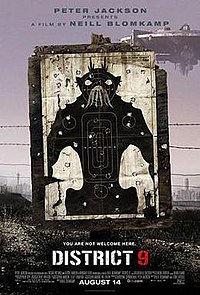
District 9

Rating: ****

I’m not saying that District 9 is a sci-fi classic, but if any sci-fi film released in the last few years deserves to eventually be known as such, then it’s pretty darn close. Filmmaker Neill Blomkamp takes his excellent short film, “Alive in Joburg” and expands upon it with a lot of skill and minimalist (for modern Hollywood sci-fi) effect. In true Twilight Zone fashion, the real monsters of District 9 aren’t the shell-fish-looking, bug-like aliens that arrive in an inoperable spaceship over the skies of Johannesburg, but the feckless corporation that forces them into slums, and keeps them there with armed guards and top-of-the-line security where they live off garbage and are taken advantage of by ruthless Nigerian gangs.

The film is shot from two different perspectives. There’s the standard third-person omnipresent, where the camera is everyone and no one. But at the beginning and end of the film appear to be some kind of documentary made after the events depicted in the film. The documentary segments are also intercut throughout the film along with security camera footage and other film from different vantage points “on scene.” Mostly though after the first half hour, much of the documentary-style is dropped and the story is presented straightforward. Still, Blomkamp’s technique immediately sets the tone of District 9 apart, and that tone is very matter of fact. There’s no evil doers (with exception), or doomsday device, or saving the planet at the last minute, but a very down-to-earth story that’s very rich in parable.

There are also no names in this movie save for the man who’s Academy Award winning John Hancock goes about the title, Peter Jackson. Using unknowns adds to the documentary feel and lends the story a further degree of authenticity; there’s a reason that 2001 starring Keir Dullea is a classic and 2010 starring Roy Scheider and John Lithgow is not. The main character of District 9 is Wikus Van De Merwe (Sharlto Copley), a middle-manager at Multi-National United (MNU) which is responsible for the administration of the aliens, nicknamed ‘prawns’ by the people, and not in the good way. Van De Merwe is promoted by his father-in-law to supervise the forced eviction of the aliens from their slums in District 9, to a new facility established outside of Johannesburg, where security can be better assured. And that’s where things get interesting.

Setting the film in South Africa, home to a more earthbound form of segregation barely 20 years ago, is a smart move on the part of the filmmakers. More than that, District 9 can be taken as a powerful allegory for immigration issues in North America and Europe with the MNU being a sort of government sanctioned Minute Men complete with a personal military and the infrastructure of a small country. The other half of it, of course, is exploitation. Would a powerful corporation like MNU take on the responsibility of shepherding 2 million aliens without some kind of substantive recompense? Unlikely.

These broader implications, and their discussion, would be moot if the main story weren’t compelling. Van De Merwe finds himself the unfortunate ill-timed victim of one alien’s plan to get him, his child and their people off Earth and back to their own world, the side effect of which is that he’s able to control alien devices. This is important because after over 20 years of trying by human scientists, the only thing they known about the alien’s technology – but especially their weapons – is that only the aliens themselves can work them. Van De Merwe finds himself the most important human on the planet and the key to a new arms race, which unfortunately exposes him to MNU’s mad scientist side operation where aliens have been tortured and dissected to learn their genetic secrets.

It certainly marks a stark change in the way Van De Merwe sees his former employer. Imagine one’s father-in-law standing over him strapped to a hospital bed saying that he’ll his daughter the right cover story to hide the fact her husband was dissected and harvested against his will while living. From the almost gleeful tone Van De Merwe accepts his new assignment to “help the prawns for the better,” to being on the run from the Repo Man, you could almost compare Van De Merwe to the millions of Germans who didn’t know people were being slaughtered wholesale in their own backyard during World War II. Though Van De Merwe intention is a quid pro quo with the alien not-so-affectionately called Christopher Johnson, helping him escape Earth for the cure to his condition, that surely changes by the end to a more basic and ironic struggle for human rights.

There’s no secret revelation, no third act twist, no grand flag planting moment where the good guys win with the utter defeat of terrible evil. No, that’s too easy. The door however is left wide open for a return visit to the mistreated aliens of what’s at the end called District 10. Blomkamp, in his first feature, shows the steady hand of a professional confident in his vision and in his ability to get the audience to invest emotion into cockroach-looking aliens and a mid-level government drone that bears a passing resemblance to Schneider from One Day at a Time. Like a lot of the best sci-fi, District 9 isn’t about flashy special effects, but about powerful storytelling with real world resonance. Although I think the image of a flying disc hovering gently over Johannesburg is about as close to iconic imagery you can get.