Showing posts with label 3-D. Show all posts

Friday, 10 February 2012

Star Wars Episode I: The Phantom Menace 3-D

Rating: ***

Sadly, I think even the most ardent Star Wars fan might be disappointed walking out of the 3-D screening of The Phantom Menace. Not because of some bizarre new change by filmmaker George Lucas, the kind that always seems to get him raked over the coals when he re-releases these films every few years, but because a 3-D upgrade of the film seems so underwhelming and this so unnecessary.

This isn’t another tirade about Star Wars and its dwindling returns over the years and with each successive film. If anything my fondness for Episode I, at least, has grown over the years. There’s a charming innocence about it as Lucas, then feeling the weight of fans expectations but not necessarily bound by them, delivered the movie he wanted to make. If you watch Episodes II and III you see Lucas becoming for responsive to, and struggling with, those criticisms. But in Episode I, I think we see pure Lucas, and in its way, there’s something appealing there.

As for the film itself, what more can possibly be said about the plot, or the acting, or the character development. It’s fun to see the history of Liam Neeson’s acting career unfold again as he takes up what was the first of his traditional blockbuster role as the mentor, a streak he would continue through Batman Begins, Kingdom of Heaven and the upcoming Battleship. It’s also interesting to see the youthful promise of Natalie Portman, which was rather squandered during her Star Wars years before her recent Black Swan comeback. It’s also something to see such normally versatile and engaging actors like Ewan McGregor, Samuel L. Jackson and Terrence Stamp be turned into bland pallets, shadows of the normally vivid personalities they are.

But really, do we watch a Star Wars movie for the acting? Unlikely. In the case of this release, the 3-D is particularly impressive in effects heavy scenes like the podrace and the ending space battle. The rest is just eye candy, but it’s the kind of eye candy that wasn’t worth the extra $3 for the third dimension (even if the glasses had a cool Darth Maul decal). Frankly, for pure technical specs I got more bang for my buck from the recently released Blu-ray edition of The Phantom Menace. The high-def detail on the disc is amazing, and if there’s one thing that 3-D doesn’t service well, it’s detail.

Overall, this new 3-D cut seems like a half-hearted effort, but the film itself feels like a half-hearted attempt to make a Star Wars movie to begin with. If there’s any reason to see these3-D re-releases of the Star Wars prequels at all, it’s because the sooner we see them and they’ve had their run in the theatres, the sooner we can get to seeing the original trilogy back on the big screen. Of course, these 3-D renderings of classic movies seem like a good idea, but I it remains to be seen just how much longer the trend will continue as people go off even new, original 3-D movies. Is it not enough just to enjoy old favourites on the big screen without 3-D-ing them up? I wish it was.

Wednesday, 23 November 2011

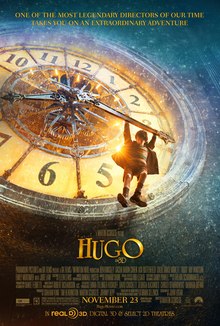
Hugo

Rating: **** 
 
The overriding theme of film in 2011 was moviemaking’s past, and in some respects its early past. Oscar nominees like The Artist, My Week with Marilyn, and the subject of this review, Hugo, are films that look back fondly at a simpler time in cinema, where creativity flourished and the power of the movie screen had no equal, least of all iPads, iPods and laptops. What’s fascinating about Hugo is that its nostalgia was at once balanced with being one of the most meticulously designed and brilliantly executed use of 3-D since the medium blew up post-Avatar.

If Hugo doesn’t stand out for that fact alone, there’s also a consideration for this being a children’s film directed by Martin Scorsese, the proverbial godfather of gangsters films, violence and mayhem. He of Taxi Driver and Raging Bull, the epic controversy of The Last Temptation of Christ, and setting the record for swears with The Departed. Yes, Hugo is a children’s film in that you can take your child to it and not be perturbed by anything other than the Hollywood glorification of life as a Depression-era orphan in France. But as for being a film that children will enjoy, I’m not sure that that’s something for them in Hugo.

The story, based on the book The Invention of Hugo Cabret by Brian Selznick, follows a young boy named Hugo (Asa Butterfield), who keeps all the clocks going at the Paris train station, while trying to avoid getting caught and sent to the orphanage by the station’s surly Inspector (Sacha Baron Cohen). Hugo’s side project is repairing a mechanical man, a process that’s helped along by “borrowing” the odd gear or switch from the man that operates a toy and trinket stand in the station (Ben Kingsley). Although initially weary of Hugo, the man takes him on as a helper to pay him back for all the stolen bits. Meanwhile, Hugo befriends the man’s goddaughter Isabelle (Chloë Grace Moretz), and together they try to uncover the mystery of the automaton, which ties back to Georges Méliès, one of the fathers of cinema who is also Isabelle’s godfather.

The movie has a soft touch, whether it’s through the use of computer-generated effects, or the laid back way that Scorsese lets the story unfold. It’s also unflinchingly sentimental, which is a weird thing to say about Scorsese, who is not typically given to that adjective. Sentiment is not something you associate with him as a filmmaker. The pleasant surprise is that being shrunk to the size of a TV screen does nothing to dull the magic of the film; the story is still incredibly engrossing and rewards patience and repeat viewing.

Hugo is also the rare kids movie where the performances of the kid actors are strong and three dimensional. Not to say that all kid actors are bad, but it’s a rarity that child actors can carry a film this well when so much of the story rests on them. Butterfield and Moretz are a treat together, a very well matched pair. Many of the adult actors too are excellent. Kingsley does beautiful work as Méliès, a whirlwind of grief and regret and lost ambition. It’s about halfway through the movie by the time the full picture comes into focus, and we realize Kingsley’s done an effortless job in building mystery and emotion around the stodgy Uncle Georges. Also good is Cohen as the Station Inspector, a kind of ruthless, single-minded Javert that believes orphans are society draining Val Jeans, although his crush on florist Lisette (Emily Mortimer) makes him charming and human.

The film’s climax is the heartbreaking revelation of Méliès’ career from stage magician to pioneering filmmaker to a disaffected merchant. It’s a Greek tragedy about creativity, and lost innocence, and the importance of art. Only someone that truly loves the movies as art, and not just as a time-killer or something to talk about, can appreciate the love of cinema that bleeds from Hugo. It’s a love that’s harder to appreciate in our fast times, when movies come and go from the cinema in the blink of an eye, and if you do go to the movies, you’re less likely to be enchanted by what’s on screen than you are to be disaffected by the behaviour of your theatre-mates. In other words, there’s something very old school about Hugo.

In any event, it shows that there’s still some juice in Scrosese, and he shows himself to be an artist able to adapt and flourish still, and in the case of 3-D (and you can get the combo pack Blu-ray with the 3-D version of the film to experience it the way it was meant to be), Scorsese shows that he knows the medium better than those tech savvy whippersnappers. Hugo is a wonderful film that shows that there’s still magic to be found in the dark.

Friday, 12 August 2011

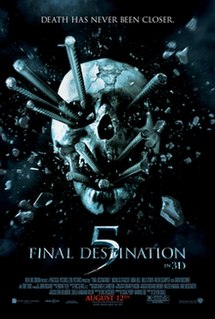
Final Destination 5

Rating: ***

There’s three types of 3-D: the type that’s artfully integrated into the film as a storytelling mechanism, the type that’s added to blockbusters for so-called added value, and the type that’s used for the express purpose of having stuff jump out of the screen at you, usually in horror movies. Final Destination 5 is unabashedly one of those films from the third category. Like its predecessor, The Final Destination, the filmmakers are so giddy about having everything from glass, to steel rods, to blood and guts fly out of the screen at you.

It’s worth noting that 3-D is also probably the reason this franchise keeps going, after all, the last film was called THE Final Destination. Finality has always been an issue when it comes to horror movie sequels, but writer Eric Heisserer and director Steven Quale find a surprisingly elegant way of getting around that in this film. It’s so surprising that I’m hesitant about spoiling it, and a little ticked that I didn’t figure it out before since I clued in on a couple of hints and thought nothing of them. Combined with an ambitious set piece to kick off the film, and a go for broke gusto when it comes to the film’s gore, Final Destination 5 is perhaps the series most entertaining entry.

In this chapter, Death comes for a group of employees of a paper company on their way to a corporate retreat. While crossing a suspension bridge, wannabe chef Sam (Nicholas D'Agosto) has a vision of the bridge collapsing and of 100s of people dying; getting snapped in half by cables, crushed by cars, plunging to their deaths in the water and getting impaled by the mast of a yacht. Cue the freak out, and Sam flees with his girlfriend Molly (Emma Bell) and several co-workers who get to the other side of the bridge in time to see the whole thing come down. Now since they’ve escaped Death, Death wants to come and collect them one at a time. Tony Todd returns as William Bludworth, the coroner who knows the rules of Death, and knows that the survivors are in deep trouble.

The biggest stumbling block to the film, for me, is that they’re so formulaic: somebody gets a vision of disaster, that person and a group of others escape doom, Death starts picking them off, they figure out what’s going on, and then try to beat fate only to usually fail miserably. And if there’s to be a Final Destination 6 then the writer or writers is going to have to explain why, if Death is so fickle about getting all the names on his list, then where are all these life-saving visions coming from?

On the other hand, I’m not sure such metaphysical implications are apropos for a film series like Final Destination. Really, when it comes to these films, it’s all about the gruesome death scenes, and if I were to judge this film solely on the “No-they-didn’t!” factor of the kills, then it would definitely be a five star effort. Unfortunate “accidents” involving gymnastics, laser-eye-surgery, and acupuncture make for some pretty cringe-inducing finales for many of the characters, but there was a pretty glaring logical fallacy in the film’s climactic showdown, but here again I’m using big words when I really shouldn’t be. As for the cast, I found them mostly unimpressive. They do their jobs well, and that job is to die horribly and make us feel it. Mission: accomplished. Besides, credit should be paid to any casting agent that can get horror icon Tony Todd, respectable actor Courtney B. Vance and comedian David Koechner into the same cheesy B-movie.

As for the film, it will definitely satisfy any blood lust you have in seeing pretty young things trying to outwit fate and succeeding poorly. And what more can you ask for from a movie that’s the fifth one in a series called “Final Destination.”

Friday, 25 February 2011

Drive Angry 3-D

Rating: **1/2

There are two schools of thought in this new era of 3-D; either it gives your film prestige, or it gives your film a gimmick. One of those schools is championed by Avatar filmmaker James Cameron, who has called out filmmakers and studios for shoddy, eleventh hour conversions to 3-D along with the old school pop outs and gags, for cheapening the technology. The other school is one in which Patrick Lussier belongs to.

Lussier, who was perfecting sharp objects being thrown at the audience in 3-D by releasing My Bloody Valentine while Avatar was still in post-production, now gives us Drive Angry. It’s a giddy romp through the grindhouse triple threat of swear words, violence and nudity, but in glorious 3-D. The problem is that only the director’s exuberance is there on screen. Cheap tricks, blood-filled gun fights, and exploding cars can be executed well, but if the actors are acting like they’re doing King Lear. It just doesn’t feel the same.

The plot follows John Milton, a character named with such lack of subtlety that he could only be played by Nicolas Cage. Milton tears into a gang of nogoodniks to find the whereabouts of his kidnapped granddaughter, the infant of his late daughter kidnapped by Satanist and certified nutjob Jonah King (Billy Burke). Along the way, Milton picks up Piper (Amber Heard) and her ’69 Charger. Together they head to Stillwater, a prison in Louisiana where King will sacrifice Milton’s granddaughter to bring Hell to Earth. The thing of it is though, the “prison” that Milton escaped out of, is really Hell, and hot on is trail is “The Accountant” (William Fichtner), Hell’s version of a U.S. Marshall.

The ludicrous concept and characters should have yielded Drive Angry to a delightfully cheesy deliciousness. The combination of in-your-face 3-D, practical stunts and Nicolas Cage should have at least given us a giddy delight and edge of your seat thrill. This is about as far from Oscar material as you can get, so it poses the question as to why many of these characters are so stolid. Only Fichtner seems to realize what movie he’s in and delivers his lines with a sardonic tone and pitch-perfect straight man delivery. The Accountant bears the appearance of a man bored with humans after chasing down Hell’s escapees for eons. To him, chasing Milton offers giddy excitement. Not that he’s going to let it show, or interfere with getting the job done.

But the most important question is: Where is CRAZY Nicolas Cage? The Nicolas Cage from Bad Lieutenant: Port of Call New Orleans. Where was the guy that appears from behind the door and starts interrogating you while using an electric shaver and being clearly hung over? Seriously, I’ve seen Cage look screwier in the National Treasure movies, middle of the road Disney adventure movies. And speaking of middle of the road, one would have thought that Billy Burke would have seized the opportunity to play a child-sacrificing, false-prophet Satanist, especially after playing the role of Twilight heroine Bella Swan’s straight-laced, button-down Sheriff father over three films.

The rather tepid performances of many of the actors, with their confusing restraint and insistence that lines like “I don't want to disrobe before a gunfight” as Milton says while sex with a sluty waitress, literally before a gun fight breaks out, doesn’t give the film the energy it needs. When a tanker truck full of hydrogen is barrelling down on the cops preventing Milton and Piper from reaching the Satanists, and no one makes a “full of hot air” pun about the loud-mouth Sheriff, something’s amiss. There was honestly more humour in The King’s Speech than Drive Angry, with the previously noted exception of Mr. Fichtner.

The stunts though were satisfying and well-executed. The film moves at a satisfactory pace and seems like a good length. Lussier allows his effects team to revel in the conventions of 3-D with stuff being thrown at you, the audience, every couple of minutes. But there are no jumps, and you never feel particularly threatened, though the gimmick works on a giddy/enjoyable level. If the writing and the acting had been a little more up to snuff, this could have been something truly enjoyable, but Drive Angry should have been more accurately entitled: Drive Slightly Irritated. But that probably wouldn’t have sold as well.

Friday, 17 December 2010

TRON: Legacy

Rating: **1/2

The hype was outstanding, which is interesting because when the original TRON came out in 1982 it was, to borrow the phrase, an unmitigated disaster. Still, to a lot of children of the 80s there is something to recommend it with a retro-futuristic charm from back in the day when Commodore 64 and Atari 2600 were the cutting edge of home computing. It’s as quaint as it is antiquated in the cyber-age, and the legend has been fuelled through the years by a small and growing chorus of fans. Disney heard the siren song of endless, sweaty wads of geek money and knew that the long gestating sequel was to be moved to the top of their to-do pile. But honestly, what was the point?

The original TRON, much like last year’s AVATAR, was a creature of style before substance. It was a GULLIVER’S TRAVELS tale of a stranger in a strange land whose triteness was obscured by the cutting edge filmmaking that was being employed to tell the story. I wish that TRON LEGACY had the same problem. The story is a whirlwind of philosophical technobabble and special effects porn tied together by the loosest tendrils of a story. When your film’s called TRON and the actual character the film is named after comes across as a mere after thought, there’s cause for concern.

But that’s just part of the problem. For some reason Kevin Flynn, the computer visionary played by Jeff Bridges in both the original TRON and its sequel has morphed from a young Bill Gates to an older Dude. As in THE BIG LEBOWSKI’s Dude. There’s actually a scene where Flynn tells his anxious son Sam (played with perfect woodenness by Garrett Hedlund) that he’s messing with his zen thing. Well sorry there Flynn, but the son who hasn’t seen you in 20 years has a lot to deal with, including being sucked into the computer-based wonderland of The Grid.

The backstory is basically that Kevin Flynn disappeared two decades ago, leaving behind his son Sam orphaned and ambiguous as to whether or not he wants to continue his father’s legacy at Microsof… I mean, Encom. Content to live like a digital anarchist, Sam does what he can to skewer Encom’s capitalist agenda. He’s still visited by his father’s friend Alan Bradley (Bruce Boxleitner, also of TRON part 1) who this night comes with interesting news: he’s received a page – like, on a pager – from Kevin Flynn’s old arcade, where the porthole to TRON land resides.

Once inside, Sam does the usual TRON stuff like racing on light cycles and throwing flying discs in gladiatoresque struggles. It’s part of the machinations of KLU (a younger-by-way-of-CG Bridges) to escape The Grid and take over the real world because the porthole can only be opened from the outside. Flynn, for his part, has been trying to protect the last of the “isomorphic algorithms,” a group of programs that evolved naturally in the environment of The Grid. Quorra (Olivia Wilde) is the last of these programs after KLU’s genocidal spree.

One of the key problems is that the story is almost needlessly convoluted. What could have been a solid father-son story is loaded with a lot of misspent and unrealized mythology, and that’s a complete turn-off. “Isomorphic algorithms” don’t exactly have the same simplicity as, say, The One Ring, or a mystical alien rain forest, and getting talked down to with the cyber speak by The Dude is somewhat less than appealing. The plot holes were galling, and odd little Easter Eggs are inserted with no subtlety at all. For example, Cillian Murphy appears as “Edward Dillinger II,” a character named after the antagonist played by David Warner in the original film. He appears in one scene, and such heavy emphasis is placed on naming this character with three lines, they might as well have put in one of those You Tube footnotes saying, “See more about Edward in TRON 3.”

The acting is also demure. Bridges looks like he’s thinking about all the better roles he’s done lately and how he’s back here in TRON land in spite of all good sense. “Younger” Bridges doesn’t fair much better as the film seems to teeter between believability and outright goofiness so far as the effects work is concerned. Hedlund almost seems like a computer himself, as Sam is remarkably emotionless in spite of a story that should have had him on a roller coaster of emotion. Wilde manages to defy the odds by being engaging and energetic as Quorra. She’s easily the best part of the film. Michael Sheen also shines in a brief bit as a Ziggy Stardust looking nightclub(?) manager.

But despite the fact that this was a fan driven enterprise, I can’t possibly see why a fan of original TRON could find this film approachable. There’s not a lot of fun here, and because the effects are state-of-the-art, photo realistic 3-D, even the kitsch value of the production design is lost. The movie is pristine to look at, and the music by Daft Punk is amazing, but at most, TRON LEGACY is an awesome, two hour Daft Punk music video. Sadly, TRON LEGACY is another example of a movie not living up to its own hype.

Friday, 29 October 2010

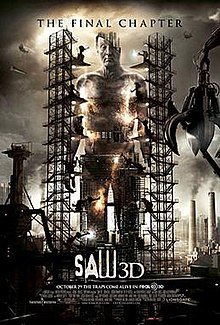
Saw 3D

Rating: **

Nothing says finality like 3-D. That seems to be the theory of the day with the previous release of THE FINAL DESTINATION in 3-D (which, as it turns out, is not The FINAL DESTINATION after all), and the new release of what is supposed to be the final SAW. The finale can’t come soon enough, in my opinion. There are only so many times that a group of narcissistic, self-involved people can be lured into overly elaborate and grisly death traps where they are literally taken apart at the seams featuring buckets and buckets of fake blood and chum. Unless it’s in 3-D, of course.

But really, 3-D was about all the producers of SAW could do to inject some new life into this franchise, which despite being still the slimly budgeted gore fest it’s always been, has come to feel bloated and self-involved. Every new film adds a layer of mythology that both complicates the original simplicity of the core story, and requires even greater feats of mental dexterity from the viewer to keep track of who’s a threat to who and is trying to get revenge on who else, all while a character that’s been dead for four films now somehow pulls the puppet strings from beyond the grave.

Tobin Bell still has some face time in this one as the titular philosophical serial killer Jigsaw, but his on-screen presence is mitigated. Even the villains(?), or is that antagonists, from the past few movies, Betsy Russell as Jigsaw’s ex-wife Jill and Costas Mandylor as his would-be protégé Hoffman, seem to spend a lot of time on the bench. The real story in this SAW is the return of Cary Elwes as Dr. Gordon, the man who gets away at the end of SAW I after sawing off is own foot. A prologue shows Dr. Gordon crawling away immediately after and cauterizing his own stump to stop the blood loss. I’m sure fans of the series enjoyed this throwback, but to me it’s another reminder of what this series has lost through all its iterations.

The subject this time is Bobby Dagen played by Sean Patrick Flanery. His sin is that he’s a survivor of one of Jigsaw’s death traps and has made a mint as a self-help guru in the aftermath. Of course, he’s surrounded by a group of spineless yes men (and women) and has a loving wife that admires him for his courage in the face of having had hooks pierced in his chest and forced to hoist himself on a rig in order to escape. If it takes you longer than two minutes to figure that Bobby is talking out both sides of his mouth, you might not be smarter than a fifth grader. Time to play a game for real, Bobby? You betcha!

One thing I’ll say about the 3-D is that it makes the death scenes much more squeamish. Seeing the blood and guts fly everywhere, even right at you, is enough to turn your stomach. At that, I think SAW reaches you on a visceral level, but outside that immediate yank on your gag reflex your left with a confusing mythology and a bunch of characters you don’t give a damn about. The kick-off game features a two men and a woman. The men, who were both being led on by the woman, are forced to choose who will get the business end of buzz saw, and by default win the girl. In the brief time we know them these characters are so ugly, killing all three would be a mercy to the human race.

At least if this is the end, the SAW movies go out on a technical high note, which should leave the fans of the series with a satisfied blood lust and a stunted appetite for bloody disgusting deaths. If not, their thirst will never be quenched and it’s pointless to continue anyway. It’s hard to believe that this is the series that started out so audaciously and featured first rate actors like Bell, Elwes, Danny Glover, Ken Leung and Michael Emerson. But I guess on the seventh film of a horror franchise, playing the G-list players is inevitable, even if they don’t get to work with A-list material.

Thursday, 16 September 2010

TIFF - Cave of Forgotten Dreams

Rating: *****

Werner Herzog’s Cave of Forgotten Dreams marks the first time, at least in my mind, that the new 3-D format has made the leap to documentary outside an IMAX screen. I’m not sure if Herzog has grander ambitions with 3-D documentary, but if this is his one, then he couldn’t have chosen a better subject.

The Cave in question is the Chauvet Cave in southern France, home to the oldest collection of prehistoric cave paintings ever discovered. They’re perfectly preserved because the cliff face entrance to the cave collapsed thousands of years ago, creating near perfect hermetic conditions for the paintings to survive. Access is restricted to researchers and scientists, and even they’re only allowed in for a couple of hours a day, a couple of weeks per year. Never one to back away from a challenge, Herzog sought and received special permission from France’s Minister of Culture to film there.

It’s getting so a year can’t go by at the Toronto International Film Festival without there being a Herzog film, not that anyone’s complaining of course. After two dramatic features last year, Bad Lieutenant: Port of Call New Orleans and My Son, My Son, What Have Ye Done?, Cave of Forgotten Dreams was doubly a treat. Triply if you’re a fan of 3-D. Still I think the film would have been compelling just the same in 2-D, but at least Herzog doesn’t seem like he’s reaching for a gimmick in using it.

What’s great about a Herzog doc is that he’s not hands off like it’s found footage. He explains what he’s doing, who’s with him and how he got there. It’s Herzog, through narration, that explains the tight restrictions for cave access and lays out how he and his three man crew practically guerrilla shot there way through the caves. You’re only allowed to walk on a two-foot wide walkway, you can’t touch the cave walls or really anything in the cave, special clothing must be worn at all times, any lights used have to cold lights, and battery powered, and if that’s not enough, some sections of the cave have near toxic levels of radon and carbon dioxide.

Herzog also spends time engaging with the scientists studying the caves and discussing their findings and how they shed light on what life was like for prehistoric humans in prehistoric France. Along the way, we’re treated to some lovely Herzogisms in his deliberate, German-accented tone, which makes the documentary experience much more personal. That’s what elevates a Herzog doc above the ordinary, that voice and mind, the willingness to go off into the far corner more interested in what’s there than what might be right in front of him.

The reason that 3-D is advantageous here is because of the scenery. The depth perception of the format works as the immediate cave wall, again only illuminated by a couple of cold lights, pops right out in front of the camera with yawning darkness going on behind. There’s also a neat laser map of the whole cave system, which looked like a constellation of stars against the black screen behind it. But the 3-D is an enhancive experience. It will be well worth the extra cash when it comes out in theatres, but I don’t think the overall quality of the movie, or its impact, would be diminished without it.

Cave of Forgotten Dreams is another triumph for Herzog, who actually has a pretty long list of those already. If nothing else, the film offers a look inside a human artefact that you’ll probably never be able to see in real life, like the wreck of the Titanic or a visit to the Antarctic. Still, nobody visualizes like Herzog, and with him at the helm this look at the Chauvet Caves is as much a waking dream, a meditation on times past, as it is their actual exploration. Cave of Forgotten Dreams is a time capsule film about a time capsule, and it’s surely one that can’t be missed.

Friday, 6 November 2009

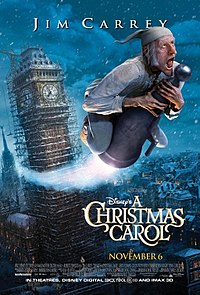
A Christmas Carol

Rating: ***1/2

There were two problems up front with A Christmas Carol. First, what we have here is a favourite of mine that’s constantly getting butchered by people who think they are so much more clever than Charles Dickens. Second, was the fact that director Robert Zemeckis was putting the movie through the same 3-D motion capture process that he made The Polar Express and Beowulf with, a process that trades wildly between too realistic and too fake-looking. Strangely enough it seems my concerns were largely unfounded on both parts. The end result is a highly faithful adaptation as done by an animation process that does seem to be getting better with age.

The story of A Christmas Carol, however, was perfection to begin with and Zemeckis seems to know that. The visual demands of the 3-D have mixed impact on the story though as flights around Victorian London, on the one hand, are wonderful to behold, we get an unnecessary action sequence where in Scrooge is pursued by a ghostly carriage and then shrunk for some zany miniature adventures. But Carol isn’t an action story, and for the most part Zemeckis plays things for how they’re supposed to be: scary. Aside from the CG, there’s really no gimmick: it’s a straight-up, very faithful adaptation with all the shadows remaining.

But this means that this is one of those animated movies that really isn’t designed to be viewed by young kids. The Ghost of Jacob Marley for instance has more in common with The Judge from Peter Jackson’s The Frighteners (which was produced by Zemeckis) than Michael Hordern as Marley in the 1951 Scrooge starring Alastair Sim. His shrieks dislocate his jaw in cringe-worthy fashion as his eyes seem to only focus on his former business partner when he’s being particularly impudent. The Ghost of Christmas Yet to Come appears as nothing else than a shadow, cast by other people and objects but reshaped to classic, reaper form. One of the more disturbing portions comes from when the Ghost of Christmas Present reveals the children Ignorance and Want. Ignorance, the boy, appears as a ghoulish, almost Gollum-like creature that tries to bite and scratch at Scrooge.

I was actually fairly impressed with a lot of what Zemeckis brought to the story; it was like he was answering every critique I’ve had with 99 per cent of the adaptations of this story. It’s scary. It’s supposed to be scary. Scrooge is a bastard and that point is made glaringly and painful obvious in the first scene when after giving two coins as tip to the undertaker, he takes the two coins from dead Marley’s eyes. Jim Carrey did a decent job playing the miser, as well as the numerous other roles that he played including all three of the Christmas spirits. But I’ve always believed that one of the key ways in making this type of animation work was for the actor to disappear into the part, but the Ghosts of Christmas Past and Present seemed particularly Carrey-like to me.

On the other hand it sometimes works so well it’s scary. You could swear at times (squinting of course) that what you’re looking at is Colin Firth as Scrooge’s nephew Fred. As for Bob Cratchit, it almost seems as if Gary Oldman was shrunk and given rosy cheeks to play Scrooge’s put-upon clerk. Unfortunately though, I found Cratchit largely missing from the story, which left the balance of the story feeling a little out of whack. It always seemed to me that half the story was Cratchit’s as the possible (probable) death of Tiny Tim seems to have the most pronounced effect on Scrooge. The effect of Zemeckis’ A Christmas Carol, meanwhile, is exactly what it needs to be and is definitely one of the better versions of this story ever put to film. At least in recent memory.

Sunday, 4 October 2009

Toy Story 1 & 2 in 3-D

Rating: ****

Hyperbole is a wonderful thing, and listening to a filmmaker talk about “their vision” and showing their film “the way it was meant to be seen” you can almost believe them for a minute. And aside from the obvious benefit of seeing a good movie on the big screen again, just what exactly is the point of going back and making a film suitable for 3-D projection anyway? Is there a point? Is it because 3-D is the cool, new thing? As much as I love the Toy Story movies going in, I was pessimistic about the reasons why I was seeing it. Was 3-D really going to enhance these movies in some kind of significant way?

Well, the answer is kind of. But as a bonus the film’s themselves still hold up remarkably well, like the true Disney classics we’ve always known them to be. As both a 10th anniversary re-release in honour of Toy Story 2 (Has it really been 10 years?) and as a friendly reminder in preparation for next summer’s Toy Story 3 (The legend continued or Kingdom of the Crystal Skull redux?), it was great to re-engage these films again. Yes, I have them both on home video, but there are only so many hours in a day unfortunately, and given the constant state of expansion of my DVD collection, hey, sometimes stuff falls through the cracks. Even beloved children’s classics.

The story remains the same; what we have here is no George Lucas hatchet job with Woody shooting first, or whatever. The look of the films is basically the same as they were in 1995 and 1999, respectively, and if the good people of Pixar don’t mind me saying, the evidence of their evolutionary learning curve is very apparent. Although Toy Story 2 was technologically leaps and bounds over Toy Story 1, there’s still a vastness in the difference in what the company’s managed to accomplish with recent hits like WALL-E and Up. So the only enhancements are of a 3-D nature, and there’s also a 10 minute intermission piece that features trivia and lost clips including some bizarre looking test footage of Woody and Buzz.

Fortunately, the 3-D isn’t as jarring as seeing a pudgy marionette Woody and a Buzz Lighter covered in a lot of right angles. Naturally, the 3-D effect comes across a lot better in the sequel than it does in the original, but the 3-D had its moments in Toy Story 1, particularly during the scene of Buzz trying to escape by flying through a window at Sid’s house, and Buzz and Woody’s great rocket flight during the film’s climactic chase. Perspective is what works in Toy Story 2 as the gang heads out into the real world to find a kidnapped Woody; the interiors of Al’s Toy Barn, the elevator in Al’s apartment and the luggage conveyors at the airport seem bigger somehow, as if you’re seeing from the toys’ perspective.

Strangely though, as much as Toy Story 2 is technologically superior, the real excitement and enchantment remains in the first film. I feel it was, and is, a more cinematic experience. In typical sequel fashion, the climactic action scene of Toy Story 2 was certainly bigger, it didn’t quite hit all the notes that Toy Story 1 did. You can’t help but smile outwardly as Woody and Buzz, with rocket taped to the spaceman’s back, lift off towards the heavens and glide back towards the ground. “Buzz! You’re flying!” exclaims Woody. “This isn’t flying, it’s falling with style,” Buzz replies in half-mockery of Woody’s earlier jest, but at this point the cowboy doesn’t mind. “To infinity, and beyond!” he cheers, and in the audience we’re thinking the same thing. You believe a toy spaceman can fly, cowboys and astronauts can get along, and there’s always a place in a kid’s heart for his favourite toy. Welcome back to Andy’s room everyone.

Saturday, 12 September 2009

TIFF Review-The Hole

Rating: ***1/2

Three unusual things happened at Saturday’s screening of Joe Dante’s new film The Hole: one audience member heckled the rest of us for for not joining him in uproarious applause for the genius of W.C. Fields, the digital projection froze about 10 minutes in, and the screening was called off about two-thirds of the way over after a fire alarm was pulled. Now those first two things I get; I’ve been in numerous digitally projected screenings where the thing’s gone boink, and I can’t fault someone else’s man-love for the great Mr. Fields. But whoever pulled that alarm, if it was someone’s idea of an awesome Frosh week prank, I hope they get skewered alive – by Joe Dante – and that they film and put it on You Tube.

So there we were, me and over 1,000 of my closest friends, having to shuffle out of the film not knowing if we’d ever get to see the ending. Outside the Ryerson Theatre, preparations were already underway to receive none other than Mr. George Clooney and his fellow special guests for the premiere of Up in the Air, never mind those of us among the lowly that just wanted to find out what was at the down in Dante’s bottomless pit. I’ve never gotten the bum’s rush before, but I think our evacuation from the Ryerson came pretty close.

But let’s talk about the movie, or least the 66 per cent of the movie I can certifiably say I saw (and if I don’t get to see the rest, I at least want a t-shirt). First things first, The Hole featured the next generation of 3-D technology, the same tech James Cameron’s been developing for his upcoming Avatar. Now these aren’t the same glasses you get at the local Cineplex to see Ice Age 3, the one’s that look like faux-Ray Bans. Nope, these look more like stylish welders goggles, and were designed not so much to get the screen to jump out at you, but to give the audience a greater perception of depth of field. So we were warned going in, these weren’t souvenirs. The glasses coast $150 a piece and were to be handed in as soon as you stepped foot from the theatre (even if you just had to visit the little filmmakers’ room).

As for the new and improved 3-D, it was rather impressive – at times. The images on screen were sharper and brighter, but the staging of some of the scenes occurred to me more like a pop-up book than a film. But content wins, and in this regard The Hole boasts some serious chops. It easily stands as one of the best family adventure films to come along in some time, and is definitely right up there with The Goonies with its ability to exploit childhood phobias and making the imaginative leap of children with suburban ennui. Two brothers, Dane (Chris Massoglia) and Lucas (Nathan Gamble), find a bottomless pit beneath a locked trap door in the basement. After numerous, half-cocked attempts to see what’s down there, sucking in their cute neighbour Julie (Haley Bennett) in the process, they leave it alone. That is until they starting getting nocturnal (ghostly) visitors.

With his usual flair Dante mixes scares and humour to great affect. I think fans of the original Gremlins will find much to admire in Dante’s directorial voice, and Massoglia does bare a bit of a resemblance to Zach Galligan. The desperate qualities of the various things that crawl out of the dark hole make the film seem a little scattershot, but about where the film got interrupted, the elements started coming together in a way that made total sense. Fortunately, the story engenders patience from the audience to get there, and the kid actors are so great playing together just the three of them you almost don’t need mom (Teri Polo) and her drama.

Again though, I say these things not knowing how it all turns out in the end. Things might end up badly, for both the characters and the film itself. But from what I saw, I’m positively pumped about this picture. As for the 3-D, it was fun but the movie didn’t need it for added entertainment value. However, it was cool to be privy to the new technology, and it will definitely be exciting to see where else it can go, specifically in regards to the big action pictures like the aforementioned Avatar. In the meantime, The Hole is a great example of a family film that doesn’t need juvenile humour or anything too cutesy-pooh to catch on. In fact, if you have any kids with Coulrophobia (or clown phobia) you might want to keep them away. Pupaphobia (or puppet phobia) too, because The Hole combines both. I guess Joe Dante’s just a masochist like that.

Saturday, 29 August 2009

The Final Destination

Rating: **

The continuation of these Final Destination movies is truly bizarre. There’s a group of young people that escape an improbable disaster because one of them has a premonition in advanced. But then because Death (note the capital D) is cruel and petty, he decides to go forth and collect those that escaped by getting them in more singular, though no less grisly, situations. I could have swore that the filmmakers were pushing things by making a one-note concept into a trilogy, but with new technology we can now do all the same old kills in the wonder of 3-D. And that’s really the point isn’t it, we have here the same old death and dismemberment, presented exactly as it would back in the good old days of the red and blue 3-D glasses.

To me though, the lessons of the Final Destination movies are pretty basic: look both ways before crossing the street, don’t drink and drive, be careful with your power tools and don’t smoke around flammable material. If many of the simple life lessons our parents had given us were followed by the otherwise clueless people who bumble through these movies they might all live to see the end credits. But stupid is as stupid does, a famous man once said. One would think though that if Death has you on a list, you might be more aware of your surroundings, like not walking into an accident-potential treasure trove like a bustling garage, or driving over to a security guards house in the dead of night to light a wooden cross on his front yard.

For bonus stupidity marks, the whole show gets rolling at a NASCAR race. This is a “sport” where people practically show up in the hope of seeing a potential death-inducing accident, just not amongst the spectators grant you. So here we are, watching cars driving in a circle over and over again. A few loose screws here, a broken bench there, and a “fun” and “exciting” afternoon at the speedway becomes an orgy of death and dismemberment for four friends. And I wish I cared. None of these kids stand out for something other than running and screaming as they ream at each other for being cavalier/disinterested/disbelieving about getting scratched off the Must Die List. The only recognizable face is Mykelti Williamson, who I believe was once heard to utter on set, “The best part is when they gave me my money.”

As for the 3-D… Meh. You’re either going to be impressed by it or you won’t. The two young ladies that were sitting in front of me were definitely impressed by it, though I think they were in the “shiny things” phases of one of their final high times of summer vacation. Things come flying at the film screen be they fireballs, car wreckage or an implement for impaling. On one or two occasions, CG blood and guts get flung at you, and I have to admit that it was rather cool, but there’s really no sense that anything new is being done and once again I get bored waiting. If there’s a bright side, it’s that the film moves along at a rather brisk pace, so you don’t have to worry about sitting there long.

Basically, The Final Destination proves that there are only so many ways to kill somebody, even in 3-D. A massacre only matters when you care about the guys getting massacred and there’s an element of surprise to it, this has neither. I will say that it was well made, and that director David Ellis knows how to stage horrible kills very well, but the film is ultimately so pedantic and predictable that’s it hard to even not to care. So while Final Destination, as a franchise, has shown a lot of growth over the last 10 years in terms of technical achievement, it’s proof that you can’t make the same film three different times and expect people to buy it the same way. For something so cool looking, it’s actually quite dull.

Thursday, 2 July 2009

Ice Age: Dawn of the Dinosaurs

Rating: ***

I will preface this review by saying that I’ve never even watched once either of the two previous Ice Age films. No particular reason though, I wasn’t avoiding them. Rather I just didn’t feel compelled. Fortunately, not seeing the first two Ice Ages is in no way prohibitive in following the action of Ice Age: Dawn of the Dinosaurs, just as not seeing the first couple of Bugs Bunny cartoons stifles the pleasure you get from watching the 50th or 60th. Ice Age is harmless enough, the only true victims being teachers and Palaeozoic scientists and researchers who now have to explain to kids that prehistoric mammals, dinosaurs and humans didn’t all exist together at the end of the last ice age.

The film starts with mammoth couple Manny and Ellie (the voices of Ray Romano and Queen Latifah) expecting their first child, and naturally this has thrown the dynamic of the ad hoc herd out of whack. Sabre-toothed tiger Diego (Denis Leary) is questioning his virility as a fearsome hunter, while Sid the Sloth (John Leguizamo) searches for a family of his own to care for. While wandering, Sid finds a chasm leading to an underground, H.G. Wells-like, tropical grove where the dinosaurs have survived. Sid ends up the captive of a mother T-Rex after he tries to claim her eggs as his own. The others then end up having to head into the dinosaurs’ underground hideaway to save Sid.

All-in-all, Ice Age is rather non-offensive, and rather old-fashioned. The filmmakers aren’t trying to re-invent the wheel like Pixar and they aren’t trying to stuff the screenplay with the highest-possible number of jokes per minute like Dreamworks. I know that the kids that filled the theatre opening day were laughing their socks off, which is credit to a film that counts kids as its target audience, but standing on its own, Ice Age doesn’t leave much of an impression. It just kind of happens, and it’s over. I can’t really remember a single stand-out scene or a joke I like, which really says a lot about the extreme neutrality I feel about this film.

Further, Ice Age is presented in Real 3-D, and then it never really takes advantage of the medium. Actually there were a couple of neat-looking sequences, one of which involved an escape from a river of lava, where the 3-D really added to the effect. But otherwise, there’s really nothing in Ice Age that justifies the added expense and hassle of seeing it in 3-D. Even in movies that aren’t constantly throwing things at the proverbial fourth wall to show you the coolness of the 3-D, a good 3-D film creates a greater sense of place with depth perception and creating a feeling that you’re surrounded by the screen. I never got this in Ice Age, and as a result it doesn’t feel any bigger or more engrossing than the average animated film. The kids might complain, but don’t splurge on the glasses.

This same kind of middle-of-the-road approach extends to the voice actors and their performances as well. Romano and Leary both seem to be like working on this film interrupted their Sunday afternoon and they put forth a minimum effort. Then there’s that buck-toothed rat that chases nuts like a heroin addict looking for a fix, which is so overdone that even a first time viewer like myself is bored of it having seen this act before in every trailer. Still, Ice Age is colourful and well-made, and thanks to Simon Pegg as a one-eyed weasel adventurer living amongst the dinosaurs, the film is given a sudden burst of energy somewhere around the mid-section. Again, the kids will love it, but Ice Age is bubble gum, it’s remembered really only so long as you chew. Well made and tasty bubble gum, but easy to spit out nonetheless.

Friday, 16 January 2009

My Bloody Valentine 3-D

Rating: **1/2

If it weren’t for the conceit of Real 3-D, there’d be really nothing to recommend My Bloody Valentine 3-D. Exploitation cinema tends to only really work when done on a minimalist basis, stretching every dollar for maximum effect on screen. And while I’m not saying that this Valentine was a money pit, it definitely has better production values than not just the Canadian-made original, but probably more than half the movies made in the 70s – put together. You know it’s pretty bad when you’re sitting in a horror movie bored, but it can’t possibly get worse until you realize that there are times when the 3-D’s doing nothing for you.

The convoluted story begins with a miner named Harry Warden (Richard John Waters) that kills five of his compatriots caught with him in a cave-in for “breathing his air.” (The original Valentine implied cannibalism, which is much more icky, but oh, well.) Warden survives a comma and wakes up a year later to attack teenagers partying in the mine he nearly died in. A cave-in appears to bury Warden alive and everything seems hunky-dory for the fine folks of this nameless coal-mining town. But ten years later, a gas-mask clad miner with a pick axe thirsty for blood reappears and begins attacking the town’s beloved slackers and hos. But is it Warden, or isn’t it? And what might the sudden return of mine owner’s son Tom Hanniger have to do with it?

Bor-ring. This movie was the novel device of 3-D, yet wastes a great deal of time on the supposed love triangle between Tom, his former BFF and current Sheriff Axel Plamer, and the girl Tom left behind, Sarah. And as if the soap opera crap between these three characters weren’t bad enough, you get pervert truck drivers, cashier skanks, shadowy town elders and young women without an ounce of shame. Seeing these people, especially the smug Sheriff played by Kerr Smith, get mowed down by a wacko with a literal axe to grind, should have been nearly two hours of indulgent delight. Especially in the third dimension. So why do I feel so empty?

Well, it could be the casting. The appeal of Jensen Ackles escapes me; I mean, he’s good looking I guess, but there’s really nothing there that says I’m building a character. And Smith just seemed a little too baby-faced to play someone who’s at least supposed to be 30. And believe you me, whatever that stuff he was growing all over his face was, it really didn’t make him look that much older, but more like a teenage trying to prove his manliness by not shaving for months. And could he have been any less intimidating as Sheriff? I mean, I know it’s supposed to be a small town and all, but frankly Tom Bosley as Murder, She Wrote’s Sheriff had the killer instinct of Vic Mackey when compared to Sheriff Axel.

With the actors and story a let down, I turn my attention to the movie’s one, true asset: the 3-D. Overall, it’s not that bad. Director Patrick Lussier frequently manages to get creative with some of the shots, from a view of the killer on the other side of a mesh fence to looking down the barrel of a shotgun pointed right out over the audience. A few good blood splatters here and a hurled pick axe there, and you’ve pretty much got the idea for what all the filmmakers were able to do with the medium. It’s substantial mind you, but I think I jumped a total of once, and it seems at times that Lussier forgot he was making a 3-d movie and takes long stretched where there’s really no 3-D effects on screen. Say what you want about last summer’s Journey to the Centre of the Earth 3-D (and I know you have), but at least it didn’t waste time in finding something new to throw at you.

So the 3-D does actually, in a way, end up as the film’s saving grace, but without whatever extra allusion those magical, plastic, Ray-Bans might afford, this is just a bad movie. In fact, there were times I forgot I was wearing them at all; times that just mostly involved what laughingly passes for dramatic tension in the script. The original got it right, and that’s not just the Canadian in me talking. At least in the original there was real shock value, which doesn’t bode well for another year of horror remakes that think they’re more cleaver than the guys that got there first 30 years ago. Sometimes the box is better than the toy that comes in it.