Showing posts with label animation. Show all posts

Tuesday, 18 October 2011

Batman: Year One

Rating: ***1/2

Before Christopher Nolan spun his own tale of Batman’s origins, Warner Bros was in the process of shepherding an adaptation of Year One, the seminal retelling of Batman’s origins as envisioned by Frank Miller. No less than Darren Aronofsky, then well-known for low budget films like Pi and Requiem for a Dream, signed on to direct as he and Miller collaborated on the script, but sadly it was not meant to be.

Apparently what was meant to be was an animated adaptation courtesy of the crew behind the DC Animated Universe series of movies. Technically, this is only Warner Animation’s second stand-alone Batman story after Under the Red Hood, which is a more recent tale from Batman lore, and maybe not yet as influential as other tales of the Dark Knight. Basically, committing to Year One in animation form is as bold a choice as Zack Snyder adapting Watchmen as his third film, just to put this in context.

Fortunately, director Lauren Montgomery and her all-star voice cast is more than up to the task. The film straightforwardly and faithfully adapts Frank Miller’s story and finds an artful and beautiful blending of the DCAU style and the Year One comic artwork by David Mazzucchelli. For people perhaps unfamiliar with the source material, the movie may feel like a lo-fi version of Nolan’s script in Batman Begins, so the filmmakers deserve a great deal of appreciation for their restraint and their reverence for Year One.

What’s interesting about the story is that is really is as much, if not more, like “Commissioner Gordon Year One.” Much of the story follows Bruce Wayne’s return to Gotham City and his initial fumbles becoming a costumed avenger, but the balance is how a young Lt. Gordon, fleeing Chicago after breaking police corruption there, arrives in an even more corrupt Gotham and struggles to make some headway in cleaning up both the streets and the halls of power.

Giving the story its proper weight is the casting of Bryan Cranston (Breaking Bad) as Lt Gordon. There’s such a heavy quality to Cranston’s voice work, you can feel the stress, and the exhaustion, and the concern. Miller can be rather pessimistic in this writing and his worldview, but Cranston manages to find the humanity and make it real. Benjamin McKenzie (The O.C.) is the voice of Batman/Bruce Wayne and does an admirable job portraying the young Dark Knight’s inexperience. He’s not the best Batman ever, but he’s not the worst either.

Also joining the cast is Eliza Dushku (Buffy, Dollhouse) as Catwoman/Selina Kyle, which is a fitting choice given Dushku’s resume and the type of character she’s well known for, but I don’t feel that the character gets a chance to shine in the film. However, the disc does come with a bonus Catwoman short written by Paul Dini that does sufficiently fill the Cat-quota. Battlestar Galactica’s Katee Sackoff rounds out the name cast as Sarah Essen, a police detective Gordon becomes romantically involved with while investigating Batman.

If you liked the tone of the film Sin City, or are otherwise familiar with the source material, you’ll easily get into Year One. I think the dialogue, especially the narration and the inner monologues is kind of hard-boiled for the screen, but it’s just the way Miller writes that can be rather difficult to translate to the screen sometimes (see: The Spirit).

Still, for anyone interested in seeing Year One realized off the page, you probably won’t get much better than the fine work by the DCAU team. Year One is probably one of the better DCAU films as well, and considering the quality of the series that’s really saying something.

Also included on the disc is an advanced preview of Justice League: Doom, which reunites many of the favourite voice actors of animated adventures’ past including Tim Daly as Superman (Superman: The Animated Series), Kevin Conroy as Batman (Batman: The Animated Series), Nathan Fillion as Green Lantern (Green Lantern: Emerald Knights) and Michael Rosenbaum as The Flash (Justice League). And I’m guessing that unless the filmmakers completely drop the ball, it will be another animated success.

Tuesday, 7 June 2011

Green Lantern: Emerald Knights

Rating: *** 

In a case of go with what works, Warner Bros has taken a page from the marketing playbook for The Dark Knight in promoting its latest superhero effort Green Lantern. Prior to the release of Dark Knight, Warner Animation released an anthology called Batman: Gotham Knight, which featured a variety of short stories from different creators and artists. Gotham Knight became the second highest grossing film of the DC Animated Universe series of films, and The Dark Knight went on to be the second highest grossing film of all time. Coincidence? Probably.

Still, the idea is served even better in the context of the Green Lantern Corps, the interstellar group of peacekeepers with power rings that harness the green energy of will power to which human Hal Jordan is recruited into in Green Lantern. Although the producers this time kept things in house rather than reaching out to the best and brightest of Japan anime, Emerald Knights still features an impressive line-up of behind the scenes talent. Alan Burnett, Dave Gibbons, Michael Green, Marc Guggenheim and Geoff Johns all contribute to the film, and if you don’t recognize those names, let me just say Batman: The Animated Series, Watchmen, Heroes, No Ordinary Family and the man that catapulted Green Lantern to the top of the current comic book sales charts.

From what I know about the Green Lantern movie, Emerald Knights gets into the back story of many of the film’s main players. One segment focuses on how the Corps drill instructor Kilowog (voiced by Henry Rollins) handled the pressure from his own drill instructor Deegan (Wade Williams). Another segment shows the relationship between Sinestro (Jason Isaacs) and Abin Sur (Arnold Vosloo), who’s the Green Lantern that passes his power ring on to Hal Jordan (here voiced by Nathan Fillion).

The stories are framed around an ancient evil threatening Oa, the homeworld of the Guardians of the Universe, and masters of the Corps. The planet is evacuated, and as the Green Lanterns await the battle to come, Jordan tells a rookie named Arisia (Elisabeth Moss) stories of the Corps that are either known well or hardly known at all. Several well known GL comic stories are adapted including "Mogo Doesn't Socialize" by Alan Moore and Gibbons about a planet-sized Green Lantern and "What Price Honor?" about Laira’s mission to her homeworld Jade and her battle with her own father.

The animation meets the usual high standards of the DCAU, and the film’s format works surprisingly well as its own story and not just as a loose framework on which to hang the various short stories on. The story moves fairly briskly, and the universe of the Green Lanterns is easily and brilliantly realized through animation. It may make you wonder how they’ll be able to do the same live action. But the target audience for this film will probably skewer more to the Green Lantern fan than the average viewer, but curiosity seekers need not worry, because if you’re looking for more Green Lantern, there can be no finer addition to the canon.

Speaking of the geek-attenuated, it is interesting that Nathan Fillion was cast as Hal Jordan. Fillion was the fan favourite for the part in Martin Campbell’s film, and was even featured in a very popular fan-made, trailer mash. I’m not sure if Fillion was hired because of this fact, or whether it was his overall familiarity with the DCAU (he voiced Steve Trevor in the Wonder Woman film), but whatever the reason I guess fans now get to have their cake and eat it too. Speaking of the fans, you’ll want to check out the preview for the next DCAU film, an adaptation of Frank Miller’s Batman: Year One featuring the voices of Ben McKenzie (The OC) as Bruce Wayne, Bryan Cranston (Breaking Bad) as James Gordon and Eliza Dushku (Dollhouse) as Selina Kyle.

Tuesday, 21 December 2010

It's a Trap!

Rating: ***1/2

I suppose it was inevitable, even the writers of Family Guy’s latest Star Wars parody seemed poised to agree. The Griffins are watching TV when the power goes out, to which Stewie immediately observes, “We’re doing Jedi, aren’t we?” Yes Stewie, yes you are. And despite the protests of the show’s staff, by this point the Family Guy renditions of the original Star Wars trilogy are more than a get rich quick gimmick by the good sports at Fox. Having said that though, one detects a hint of exhaustion. One Star Wars spoof let’s you get most of the funnier jokes out of your system, a second let’s you think about what you might have missed, but a third…

Well, to start of with, It’s a Trap is still pretty darn funny. Fans of Family Guy’s mix of pop culture cut away gags and no they didn’t just say or do that moments will be well rewarded. Written by Cherry Chevapravatdumrong and David A. Goodman, the episode gets a lot done. It stuffs in a lot of cameos from other Seth McFarlane shows like American Dad and The Cleveland Show, a lot of jokes at the Ewoks’ expense and a lot of roasts at the expense of Seth Green. Overall, it’s a solid effort with plenty of laughs, though a few of those jokes couldn’t have been more obvious. (Meg as the Sarlacc? A little on the nose, guys.)

So what works? First of all, the writers’ room clearly knows the material and, despite jokes to the contrary, are still passionate about it. This has to be the only time in history (aside from the three Robot Chicken Star Wars’ specials too, of course) where repeated, obsessive, detail-oriented viewing of George Lucas’ space saga has paid off. Aside from being an enthusiastic spoof, It’s A Trap is also a pain-staking homage to Return of the Jedi, at least artistically, and certain scenes seem practically rotoscoped from the original film. Family Guy is not typically cited for the skill of its animators, but for this they deserve kudos.

As for the gags, the Family Guy crew get things fairly spot on. Recasting the Rancor as Rush Limbaugh was an uproarious bit, especially considering that Rush himself cameos. The Chips Ahoy bit is also fun gag, but for pure pointless hilarity there’s an elongated sequence of the characters nodding to each other before the fight on Jabba’s Sail Barge. For innuendo laughs, it’s got to be the commercial for Han Solo’s staffing service called, not-so-appropriately, “Hanjobs.org,” but fortunately for fans that not the most risqué that the episode gets. (Hint: What did happen to those Imperial prisoners on Endor?)

On the downside, there was almost an over reliance on cameos. Conway Twitty appears in another cutaway, and I’ve got believe even his estate is getting sick of those royalties by now. I also felt that there was maybe a bit too many characters from the “McFarlane-verse” Casting American Dad’s talking fish Klaus as Admiral Akbar was great, but an appearance by Dad’s Roger the Alien as Moff Jerjerrod and The Cleveland Show’s Rolo as Nien Nunb was a little much. And sorry fans, but it’s my sad duty to report that despite Ernie the Giant Chicken’s reappearance as Boba Fett, there is no Giant Chicken Fight. I think we’re all feeling a little cheated there.

Still, I applaud the Family Guy cast and crew for their accomplishment with these Star Wars parodies. It’s kind of sad that it’s over, but I can’t help but think that having The Cleveland Show do parodies of the prequel trilogy is a better idea than the writers might think. As for It’s A Trap, it’s an improvement over the Empire spoof Something, Something, Something, Dark Side, with tighter gags and more energy, but it still can’t top the freshness and excitement of the original Blue Harvest. Regardless, this is a must have for Family Guy fans.

Friday, 11 December 2009

The Princess and the Frog

Rating: ****

Almost 15 years ago, Toy Story broke all the rules of animation. A little while after that there was a movie called Shrek, and it was so successful that the money men in Hollywood started thinking that if your animated movie wasn’t being populated by computer engineered characters you were practically daring the general public to not see it. Since the traditional cel animation wing of Disney seemingly closed its doors nearly six years ago, it seemed that anyone that specialized in the art of hand drawn animation was either relegated to Saturday morning stuff or oblivion. In an interesting twist of fate, it took one of the guys that started the computer animation revolution to blow the dust off the Ink and Paint division of Disney, and do you know what happened? There’s still some magic in those pencils.

Thanks to producer John Lasseter and his team, Disney finds its way home with The Princess and the Frog, a marvel of both moviemaking artistry and storytelling magic. Several smart decisions make Princess and the Frog a worthy successor to modern Disney classics like The Little Mermaid and Beauty and the Beast. First was casting the studio’s first African-American princess, a broken barrier nearly rivalled in grandness by the man now occupying the White House. Second is the transfer of setting to a roaring jazz age New Orleans, which gives the film a rambunctious zeal from the supporting characters to the jazz-inspired musical numbers. There’s still a romantic subplot and the talking animal sidekicks, but these elements seem fresher somehow. The relationship between working class waitress Tiana (Anika Noni Rose) and the indulgent Prince Naveen (Bruno Campos) seems more Hepburn and Tracy then Cinderella and her Prince Charming.

The story follows Tiana trying to live out her father’s dream of opening a restaurant in the Crescent City, working herself to the nub to earn enough money for a down payment on an old sugar mill where she’ll set up shop. Prince Naveen, meanwhile, rolls into the Big Easy looking for a good time. Cut off by his parents from his family’s large fortune, he’s near penniless but doesn’t seem to care as he strums his ukulele in time with a street band. But money is on the mind of the voodoo enchanted con man Dr Facilier (Keith David). He turns the prince into a frog and his assistant into the prince so that a wealthy socialite will marry the stooge prince and Dr Facilier will get all the money and power he wants.

Its after this that Naveen, in frog form, encounters Tiana thinking she’s a princess, and gets her to kiss him only to turn her into a frog as well. Strangely, this is about half an hour into the story, and you think to yourself that there’s no way that the frog versions of Tiana and Naveen can fall in love, find a way to become human again, defeat the plans of Dr. Facilier and fulfill Louis the Crocodile’s dream of playing trumpet in a jazz band, all in the time remaining. But unlike several of Disney’s recent efforts, outside of collaborations with Pixar that is, one can sense a confidence in the material that’s sometimes been lacking. I’m thinking primarily of films like Atlantis: The Lost Empire and Treasure Planet, in which the studio tried to break formula but seemed to get scared along the way resulting in something that seemed bold but watered down.

But in The Princess and the Frog there was nothing watered down and no expense was spared. As a long time admirer of the art form, I felt positively indulged by this film. This is Disney animation as it was meant to be realized with no attempts at backhand satire or cheap shots at pop culture quirks of the moment. I loved the chemistry between Tiana and Naveen, Dr Facilier is perhaps the best Disney villain since Aladdin’s Jafar, and the songs by Randy Newman were memorable and singable. Sure, you get the traditional happy ending, but it feels like it’s earned in The Princess and the Frog, and not just a forgone conclusion based on the accepted Disney playbook of storytelling. I sincerely hope that this film is commercially successful enough to prove that when you put the right effort into traditional animation it can still surprise you. Welcome home Disney, we missed you.

Saturday, 28 November 2009

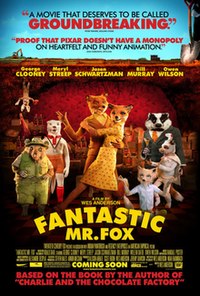
Fantastic Mr. Fox

Rating: ****

Modern animated movies often revel in such high levels of technological sophistication that audiences can count every strand of hair on each colourful character’s computer generated forehead. But when Wes Anderson directs his first animated movie, don’t be surprised if it defies yours, or anyone else’s expectations. Personally, I didn’t know what type of film Fantastic Mr. Fox would be. Anderson’s Rushmore, released in 1998, was nothing short of genius, but his work since then, in this critic’s opinion, has been all over the place. But considering Anderson’s penchant for quirky characters and kitschy soundtracks, I had my suspicions that this film would be out of the ordinary.

Like Where the Wild Things Are, this is a movie that kids can sit down and watch without their parents fretting over the mind-warping effects of coarse language or mature subject matter. It’s as clean as anything on Saturday morning television, but yet you’d be hard pressed to call this one a kids’ movie. In particular, take the scene where Mr. Fox (George Clooney) and his lawyer Badger (Bill Murray) exchange cuss words. And by that I mean the applicable swear word is replaced with the actual word “cuss.” The scene is fun and can be enjoyed on multiple levels. The adults will chuckle at the satirical censorship, while the kids will giggle at almost hearing a swear.

This bizarre balance between different audiences is what gives Mr. Fox its wide-reaching appeal. The film itself almost turns Roald Dahl’s novel into a 90 minute Bugs Bunny cartoon which features Mr. Fox’s obsession with upward mobility. “Honey, I am seven fox-years-old,” he tells Mrs. Fox (Meryl Streep) one morning. “My father died at seven and a half. I don't want to live in a hole anymore, and I'm going to do something about it.” Mr. Fox then devours his toast, in typically animalistic fashion, and leaves to visit Badger in order to purchase a new tree. Unfortunately, the new tree’s proximity to farm fresh game and apple cider proves too tempting for Mr. Fox, who must deal with the repercussions of stealing from three very angry farmers.

There’s a feeling of familiarity etched upon every frame of Fantastic Mr. Fox. In fact, both Anderson and his animation director, Mark Gustafson drew inspiration from the stop-motion productions of Rankin-Bass. It’s a timely choice for the season given that two of the most notable Rankin-Bass productions are the holiday specials Rudolph the Red Nosed Reindeer and Santa Claus Is Comin' To Town. To reinforce this comparison Anderson includes the music of Burl Ives, the snowman narrator from Rudolph, on the film’s soundtrack. Perhaps this is because Fantastic Mr. Fox shares a stylized roughness with those stop-motion animations. But what makes this film unique is the level of perfectly imperfect detail captured in every stop-motion movement. This marks a stark contrast between a stop-motion animation like Fantastic Mr. Fox and a computer generated equivalent like Planet 51. Sure, the computer generated animation is rich in details, but it is also appears polished and antiseptic. While Fantastic Mr. Fox inhabits an intricately flawed fantasy world looks tangible enough to touch.

Which is why Fantastic Mr. Fox is a wonderful change of pace, it’s a world that feels tangible enough that you can reach out and touch it. There’s a definite throwback quality to the animation-styles of old. But at the same time, if you were to close your eyes and only focus on the dialogue, you’d likely assume that you were watching a live-action picture. That’s how well the characters standout, that is to say if you’re at all familiar with Max Fischer, Royal Tenenbaum, Steve Zissou or any one of a number of Anderson characters. In the end, it is a testament to Anderson’s balancing act that Fantastic Mr. Fox may be watched for both zany cartoon antics, and quirky dramatic subtexts. Whether Mr. Fox is struggling to maintain his father’s attention, attempting to outshine the latest competition, or grappling with his pending mortality, this animal’s story will remind you of the humanity in all of us.

Sunday, 22 November 2009

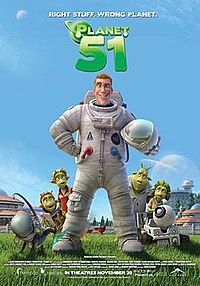
Planet 51

Rating: **1/2

The chances of finding alien life somewhere in the universe that’s biologically comparable to humans is relatively slim. The chances that they would be living an idealistic, Leave it Beaver-style 50s existence is even less likely. But the chance that on top of it all they would miraculously speak a language that’s exactly like English is about as scientifically plausible as losing weight by eating cake. However, these are adult thoughts, and Planet 51 is clearly a kids’ movie. But it’s one of those kids’ movies with a lot of in-jokes and references meant to appease the parents in the crowd. So if you’ll pardon the pun, Planet 51 gives you the best of both worlds - for the adults there’s a dog that looks like a xenomorph from Alien, and for the kids there’s a robot that tinkles itself.

For the most part, Planet 51 is treated, fun and kind of silly little role-reversal where NASA astronaut Chuck Baker (voiced by Dwayne Johnson) is the alien invader. The suburbanite populace of Planet 51 run for the hills when his Lander arrives, with the more paranoid inhabitantstaking a dim view of the visitor thanks to a steady diet of corny, sci-fi B-movies about invaders with death rays and mind-control powers. As an over-anxious military mobilizes against what they believe to be the human (or alien to them) menace, soldiers identified as “zombies” are quickly quarantined and lobotomized by the resident mad scientist. Of course this being a kids’ movie, the complete removal of one’s brain from their skull makes you stereotypically British rather than dead.

Yes, science is not Planet 51’s strong suit, but neither does it escape the rather shallow premise. I kept waiting for an explanation why their world so closely resembled our past. It reminded me of those old episodes of Star Trek where they would beam down to an alien planet and find it full of 30s gangsters because a previous expedition left a book on that subject behind. I also kept thinking that there might be some kind of allegory or metaphor to explain Planet 51’s 1950s Americana, but those are two rather big words given the immature nature of the script. Immaturity though is relative because even the kids in the audience weren’t laughing where they were supposed to at all the various bits of slap-stick and suggestively crude humour.

There’s a blandness in Planet 51 that crosses homage and parody, and takes the audience to a place that’s just stale, mostly because it’s the type of movie you’ve seen one too many times. For instance, Chuck has a robot sidekick called Rover, which looks like a webcam on wheels, and acts like a dog. Get it? It’s called Rover, which is a dog’s name, but it’s like one of those probes we sent to Mars that were called rovers. Clever. Not to mention the confusing mish-mash of eras. There’s a long-haired hippie minstrel protestor that constantly sings songs about how the aliens are peaceful. Now we all enjoy seeing hippies get beat up by The Man, or in this case military, but if you know anything about counterculture, then the aforementioned hippie alien should have been a beatnik. Beatniks were 50s, hippies were 60s. But for whatever reason hippies can be mined for more comedic value than beatniks, and lame Dylan-like folk songs of fair treatment for extraterrestrials is more melodic than hearing it as beat poetry.

If there’s a saving grace to this film, it’s that Planet 51 is very well produced. The animation looks great and is about as technologically sophisticated as anything else I’ve seen from the major studios this year considering it was independently produced. I have to admit that I did laugh at my share of the gags in the film, but thinking back, I believe that most of the time I was the only one. And as I think back about the movie. I can’t help but reconsider those funny bits as an indication not that the film has good jokes, but rather it just catches you enough to make those jokes passable on the first viewing. It’s a visual and auditory assault like the latter films featuring Dreamworks Shrek, but there’s nothing resembling the poetry and soul of even the least of the Pixar films. Planet 51 was an interesting idea, just badly executed.

Friday, 6 November 2009

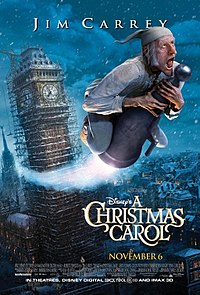
A Christmas Carol

Rating: ***1/2

There were two problems up front with A Christmas Carol. First, what we have here is a favourite of mine that’s constantly getting butchered by people who think they are so much more clever than Charles Dickens. Second, was the fact that director Robert Zemeckis was putting the movie through the same 3-D motion capture process that he made The Polar Express and Beowulf with, a process that trades wildly between too realistic and too fake-looking. Strangely enough it seems my concerns were largely unfounded on both parts. The end result is a highly faithful adaptation as done by an animation process that does seem to be getting better with age.

The story of A Christmas Carol, however, was perfection to begin with and Zemeckis seems to know that. The visual demands of the 3-D have mixed impact on the story though as flights around Victorian London, on the one hand, are wonderful to behold, we get an unnecessary action sequence where in Scrooge is pursued by a ghostly carriage and then shrunk for some zany miniature adventures. But Carol isn’t an action story, and for the most part Zemeckis plays things for how they’re supposed to be: scary. Aside from the CG, there’s really no gimmick: it’s a straight-up, very faithful adaptation with all the shadows remaining.

But this means that this is one of those animated movies that really isn’t designed to be viewed by young kids. The Ghost of Jacob Marley for instance has more in common with The Judge from Peter Jackson’s The Frighteners (which was produced by Zemeckis) than Michael Hordern as Marley in the 1951 Scrooge starring Alastair Sim. His shrieks dislocate his jaw in cringe-worthy fashion as his eyes seem to only focus on his former business partner when he’s being particularly impudent. The Ghost of Christmas Yet to Come appears as nothing else than a shadow, cast by other people and objects but reshaped to classic, reaper form. One of the more disturbing portions comes from when the Ghost of Christmas Present reveals the children Ignorance and Want. Ignorance, the boy, appears as a ghoulish, almost Gollum-like creature that tries to bite and scratch at Scrooge.

I was actually fairly impressed with a lot of what Zemeckis brought to the story; it was like he was answering every critique I’ve had with 99 per cent of the adaptations of this story. It’s scary. It’s supposed to be scary. Scrooge is a bastard and that point is made glaringly and painful obvious in the first scene when after giving two coins as tip to the undertaker, he takes the two coins from dead Marley’s eyes. Jim Carrey did a decent job playing the miser, as well as the numerous other roles that he played including all three of the Christmas spirits. But I’ve always believed that one of the key ways in making this type of animation work was for the actor to disappear into the part, but the Ghosts of Christmas Past and Present seemed particularly Carrey-like to me.

On the other hand it sometimes works so well it’s scary. You could swear at times (squinting of course) that what you’re looking at is Colin Firth as Scrooge’s nephew Fred. As for Bob Cratchit, it almost seems as if Gary Oldman was shrunk and given rosy cheeks to play Scrooge’s put-upon clerk. Unfortunately though, I found Cratchit largely missing from the story, which left the balance of the story feeling a little out of whack. It always seemed to me that half the story was Cratchit’s as the possible (probable) death of Tiny Tim seems to have the most pronounced effect on Scrooge. The effect of Zemeckis’ A Christmas Carol, meanwhile, is exactly what it needs to be and is definitely one of the better versions of this story ever put to film. At least in recent memory.

Saturday, 24 October 2009

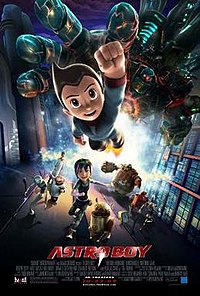
Astro Boy

Rating: ***1/2

I grew up with Astro Boy. I remember he came on Global in the mornings before school and then on Saturday afternoons. He was brave and gentle and wise. He had rocket boots and machine guns in his butt. And frankly, if I remembered anything more than that I’d probably lose my mind over all the minute changes made to the mythos as done in the new CGI Astro Boy.

The reaction from the hardcore fan community has ranged from the valid (“It was cute, and fun. A little morbid for kids”) to the debateable (“[Astro Boy] had a quasi adolescent voice”), to the just plain demented (“Astro Boy doesn't look Asian”). No, this Astro Boy is not perfect, but it’s the Superman Returns of anime adaptations with so much riding on it after so many years of development. And for the record, no character, in any anime ever, has looked even remotely Asian.

Another note for the record is that I actually liked Freddie Highmore as Astro, the post-modern Pinocchio who was the real boy Toby until he’s killed in accident and resurrected in a robot body by the brilliant scientist Dr. Tenma voiced here by Nicolas Cage. It’s a credit to Cage as a personality that his lunacy is able to translate to a cartoon character, but of all the veritable actors who contribute a voice to this film –with the possible exception of Donald Sutherland finding his inner Bauer Power as Metro City’s President– Cage stands out the most.

But the who’s who of voices is almost inconsequential, and it should be, because Astro Boy is bright with action, and dark in plot points. If you’ve seen Steven Spielberg’s A.I. or the history lesson The Second Renaissance segments of The Animatrix, then you’ll recognize several winks and nods in Astro Boy. Metro City floats above the Earth living in opulence and the Homer Simpson “Can’t Someone Else Do It” philosophy thanks to robot servants, which are then horribly discarded to the Earth below once then outlive their usefulness.

There’s a lot of Astro Boy that skims the surface of social commentary and historical allegory. It’ll go over the kids’ heads, but damned if some of it ain’t kind of creepy. At this point we get the R.R.F., or the Robot Revolutionary Front, a group of bumbling, English accented, robotic Marxists that believe in equality and liberté for all robots. A cynical person might see this as a sign that Astro Boy is communist propaganda in a new era of leftist oligarchy. But really, the R.R.F. are about as effective as Team Rocket is in the field of Pokémon collecting.

With the insertion of mixed grown-up messages along with the youthful, colourful fun and adventure, Astro Boy comes dangerously close to hodge-podging themselves into a stylistic corner that would have shrunk the target audience down to the six people that get the “Worker and Parasite” gag from The Simpsons episode “Krusty Gets Kancelled.” But as soon as the fascistic Stone gets “absorbed” (as explained through the movies woefully inaccurate science) by the giant Peacekeeper robot and pursues Astro in a rampage across Metro City, you can’t help but find your inner-child again.

Overall, I found Astro Boy a satisfying adventure film that had a few laughs and a decent amount of fun despite dark themes of loss and confusing political and environmental allegories. But the best moment, perhaps, comes at the end. Just as Metro City seems safe and sound, a giant one-eyed squid creature appears in the sky, and Astro takes off with a power punch at the ready. It’s almost at this point that you want to see the movie continue, it’s just such a wonderful tip of the hat to the occasional absurdities of anime. But alas, I guess there must be something saved for the sequel.

Sunday, 4 October 2009

Toy Story 1 & 2 in 3-D

Rating: ****

Hyperbole is a wonderful thing, and listening to a filmmaker talk about “their vision” and showing their film “the way it was meant to be seen” you can almost believe them for a minute. And aside from the obvious benefit of seeing a good movie on the big screen again, just what exactly is the point of going back and making a film suitable for 3-D projection anyway? Is there a point? Is it because 3-D is the cool, new thing? As much as I love the Toy Story movies going in, I was pessimistic about the reasons why I was seeing it. Was 3-D really going to enhance these movies in some kind of significant way?

Well, the answer is kind of. But as a bonus the film’s themselves still hold up remarkably well, like the true Disney classics we’ve always known them to be. As both a 10th anniversary re-release in honour of Toy Story 2 (Has it really been 10 years?) and as a friendly reminder in preparation for next summer’s Toy Story 3 (The legend continued or Kingdom of the Crystal Skull redux?), it was great to re-engage these films again. Yes, I have them both on home video, but there are only so many hours in a day unfortunately, and given the constant state of expansion of my DVD collection, hey, sometimes stuff falls through the cracks. Even beloved children’s classics.

The story remains the same; what we have here is no George Lucas hatchet job with Woody shooting first, or whatever. The look of the films is basically the same as they were in 1995 and 1999, respectively, and if the good people of Pixar don’t mind me saying, the evidence of their evolutionary learning curve is very apparent. Although Toy Story 2 was technologically leaps and bounds over Toy Story 1, there’s still a vastness in the difference in what the company’s managed to accomplish with recent hits like WALL-E and Up. So the only enhancements are of a 3-D nature, and there’s also a 10 minute intermission piece that features trivia and lost clips including some bizarre looking test footage of Woody and Buzz.

Fortunately, the 3-D isn’t as jarring as seeing a pudgy marionette Woody and a Buzz Lighter covered in a lot of right angles. Naturally, the 3-D effect comes across a lot better in the sequel than it does in the original, but the 3-D had its moments in Toy Story 1, particularly during the scene of Buzz trying to escape by flying through a window at Sid’s house, and Buzz and Woody’s great rocket flight during the film’s climactic chase. Perspective is what works in Toy Story 2 as the gang heads out into the real world to find a kidnapped Woody; the interiors of Al’s Toy Barn, the elevator in Al’s apartment and the luggage conveyors at the airport seem bigger somehow, as if you’re seeing from the toys’ perspective.

Strangely though, as much as Toy Story 2 is technologically superior, the real excitement and enchantment remains in the first film. I feel it was, and is, a more cinematic experience. In typical sequel fashion, the climactic action scene of Toy Story 2 was certainly bigger, it didn’t quite hit all the notes that Toy Story 1 did. You can’t help but smile outwardly as Woody and Buzz, with rocket taped to the spaceman’s back, lift off towards the heavens and glide back towards the ground. “Buzz! You’re flying!” exclaims Woody. “This isn’t flying, it’s falling with style,” Buzz replies in half-mockery of Woody’s earlier jest, but at this point the cowboy doesn’t mind. “To infinity, and beyond!” he cheers, and in the audience we’re thinking the same thing. You believe a toy spaceman can fly, cowboys and astronauts can get along, and there’s always a place in a kid’s heart for his favourite toy. Welcome back to Andy’s room everyone.

Tuesday, 15 September 2009

TIFF Review-Waking Sleeping Beauty

Rating: ****

A lot has been written about Disney’s early 90s rise as a creative and financial powerhouse that cranked out hit after hit, and the fractural relationship that persisted amongst the power players at the top. In the case of Waking Sleeping Beauty though, we have a movie that tells the story from the inside out, in the very own words of the guys that made the decisions as told and remembered by guys who were there in the trenches. The result is a powerful work of oral history that combines archival footage with sound clips of modern interviews. Interestingly though, director Don Hahn made the choice to show no “talking head” segments in order to augment the film and tell the story.

To set the stage, the film goes back to 1984. The Black Cauldron just bombed and there was a culture clash in Disney’s old Ink & Paint building between the new guard of animators (Tim Burton and John Lasseter among them) and the old guard that helped foster the golden age of Disney animation and were on the verge of retirement. The studio itself was under threat of buyout, and drastic measures were taken as Hollywood titans like Michael Eisner and Jeffery Katzenberg were brought in to lead the wayward company back to fortune. It was the first time that Disney went outside the House of Mouse for new leadership, and it wasn’t very long before both Eisner and Katzenberg were ruffling feathers.

Of course, the gamble in hiring the pair, and their subsequent gamble in some of their political and creative manoeuvres ended up paying off big time. Disney, as a result, enjoyed a decade of unprecedented success until the large egos of Eisner, Katzenberg and Roy Disney started making more headlines for their inter-company power games than for the Disney product. The story of how all this came to head in the summer of 1994, right on the eve of Disney’s biggest triumph in The Lion King, has, I think, been well documented. So much so that even if people don’t know the details, they know a fissure erupted amongst the companies leadership at a time when it should have been champagne bottle corks being popped and not the proverbial heads of the brass.

What Watching Sleeping Beauty does is take you back in time, and unequivocally gives us the full story, the good and the bad, as only the people involved could remember it. The feeling of time and place is further anchored by the unusual choice to use only archival footage for the visuals, and that includes a number of sketches and caricatures the animators did as a way of venting frustration about the political mucking about of their fearless leadership. Could this movie have even been made just two or three years ago? Doubtful, something tells me that some of the wounds are still sore if not overly fresh. But the timing of this is even more impeccable as Disney looks at rejuvenating cel, or 2-D, animation this fall with The Princess and the Frog.

As a documentary film, Waking Sleeping Beauty is taunt and exceptionally paced. It’s abridge set-up of events make it easy for the novice to get into the story, but the rich detail in the testimonials will be satisfying for anyone enraptured by the ongoing drama behind the scenes at Disney animation for the last 25 years. It’s a time capsule piece, it’s a cautionary story on a precarious time in one company’s history and it’s a moral tale about the dangers of ego unchecked and success unhampered until the one changed the other. There’s a lot that seems surprising to these men in retrospect, and those real time revelations translate to those eager to understand how ten years can change so many lives, and one giant industry. Expect to hear more about Watching Sleeping Beauty as it looks to be released wide sometime next spring.

Wednesday, 9 September 2009

9

Rating: ****

“We had such potential, such promise,” says a dying scientist in a voice over at the beginning of 9, a CG-animated film and the second of three films this year to prominently feature the numeral ‘9.’ The potential/promise referred to by the scientist is humanity’s, who are long dead by the time 9 begins. It can also refer to a lot of movies, with fancy trailers and interesting ideas that promise a wonderful film-going experience and then utterly let you down on release day. Fortunately, 9 isn’t one of them. As to whom exactly this film will appeal to outside the Tim Burton faithful and grown-up animation appreciators, I’m not sure.

Yes, 9 is one of those films that slipped through Hollywood’s demographic driven zaniness and exists as a piece of art without demands of expectations. It’s too scary for the younger kids, to whom anything animated is invariable promoted towards; some of the teens out there will be bored because there’s not an overwhelming amount of action; and unless they are so whimsically inclined, the adults just might get bored. Fortunately, I fall through the demographic cracks, as both a critic and a movie appreciator. Or at least I’d like to think.

9 is a bursting visual feast to behold. One of those movies you can probably watch again and again in order to find all the hidden details. What started as an impressive short film that even got Academy Award recognition, which in turn resulted in big name producers like Tim Burton fighting for the chance to foster a feature, reaches a true fruition here. Similar to what happened with Monster House a few years ago, we have a project with a unique visual sense and a certain flare for making you able to identify with typically inanimate objects, be they possessed houses or so-called “stitchpunks.”

The term “stitchpunk” being an obvious derivative of “steampunk,” a unique subgenre of science fiction that puts advanced technology back in a time that would never have had it; the works of Jules Verne and H.G. Wells could be retroactively be considered steampunk, for example. A “stitchpunk” is basically a rag doll given life by a scientist seeking to preserve some measure of humanity after the death of mankind in the wake of a war against machines. The head machine, a kind of bastard child of the sentinels from The Matrix and the tripods from War of the Worlds, sleeps dormant in its evil factory when awoken accidentally by No. 9, the final (and perhaps most important) of the stitchpunks.

Interestingly, the nine stitchpunks (all named by numbers one through nine) are not the salvation there creator intended. Indeed since they’re the last vestigial of humanity it’s fitting that they represent the full spectrum of human failings and capabilities. No. 1 (Christopher Plummer) leads a group hidden in a church, as to not attract the attention of “The Beast.” Meanwhile, No. 7 (Jennifer Connelly) lives in the wilds of the broken down city trying to carry on the good fight against the remnants of the former enemy. No. 6 (Crispin Glover) seems driven mad with a memory of a device he doesn’t know the function of, but knows it’s important. No. 5 (John C. Reilly), meanwhile, seems to have grown weary of No. 1’s command and anxious follows No. 9 (Elijah Wood) in exploration of their inherited world.

But for such highly adult themes and characterization, 9 does at times like to play it safe. Too safe for my taste actually. The film kind of launches into the main story and keeps up the momentum until the end credits, and it only occasionally pauses to take stalk of the richness of this world that’s been created. But I was however captivated by it just the same. The world of 9, though bleak and perhaps frightening, was startlingly realized. There’s sumptuousness to this film that’s engrossing, and to be able to get so caught up in the plight of a bunch of burlap voodoo dolls is a wonder. The real shame is that we don’t get more 9’s, (as in the movie not the stitchpunk) and like the film implies, that maybe our loss.

Friday, 7 August 2009

G.I. Joe: The Rise of Cobra

Rating: **1/2

Basically, I think that G.I. Joe: The Rise of Cobra needed three things to be successful: awesome action, a bad ass Snake Eyes as embodied by Ray Park, and Sienna Miller’s Baroness to be the inheritor for leather-bound cat suit goddess that’s been vacated by Underworld’s Kate Beckinsale. So I guess by own standards, G.I. Joe’s a success. Heinously kept from critical eyes – with few geek-friendly exceptions – till the opening night screenings, G.I. Joe does do one thing that its thematic predecessor, Transformers, could not, and that’s put a human face on the action. Mindless and meandering though it may be, G.I. Joe does gives humanity to the characters, and actually seems to strive to be something more than a toy commercial. Whether it succeeds on the other hand…

No matter what, you have to give G.I. Joe filmmaker Stephen Sommers credit, he tried his best create something, though I know not what. Much of the vitriol has come from G.I. Joe fans that don’t like the alterations made to their beloved characters, or otherwise thinking that from the look of the trailers that the film was shaping up lame. A problem only exacerbated a few months ago when it was rumoured that Sommers had been removed from the project by the producers, which turned out to be untrue but once a rumour’s out there it’s hard to get back. Behind the scenes shenanigans aside, G.I. Joe’s failure stems not from what it doesn’t do, but rather for what it does.

The story starts for some perplexing reason in 17th century France where an arms dealer is fitted for an iron mask as punishment for selling arms to both sides. Then the titles come up. “G.I. Joe: The Rise of Cobra,” it says because if you had just walked into the theatre not knowing what was playing you’d now be totally confused. The setting is “the not too distant future,” and the doomsday weapon of choice is a nanite warhead that disperses in a cloud of green mist and eats any metal it encounters. You know you’re in trouble when even theoretical weapons feel played out, but hey, it gets the ball rolling. Indeed the silly science of the animated series remains intact; all that was missing was laser guns and android soldiers.

The plot is both simplistic and needlessly complicated. James McCullen (Christopher Eccleston) is a weapons developer trying to deliver his new nanite bomb to NATO. The military convoy escorting the weapons, led by future Joes Duke (Channing Tatum) and Ripcord (Marlon Wayans), is attacked by Cobra forces led by the Baroness (Miller). Duke recognizes the Baroness as his former fiancée Anna, a little piece of information that gets him on to the G.I. Joe team led by the intrepid General Hawk (Dennis Quaid). Duke, Ripcord and the Joe team made up of Scarlett (Rachel Nichols), Snake Eyes (Park), Breaker (Saïd Taghmaoui) and Heavy Duty (Adewale Akinnuoye-Agbaje) then seek to stop the villainous (and unnamed) Cobra organization from using the nanite bombs to commit certain deeds.

Even harder to find than Cobra’s apparent motivation is two of their key leaders. Eccleston’s Destro is without his trademark silver mask until the end of the movie, although the script spends a lot of time circling its significance. As for Cobra Commander, it’s a case of “flames on Optimus” even in spite of the fact that the normally rock solid Joseph Gordon-Levitt is the actor behind the ventilator and purple monocle. Now I’m not a hardcore fan, and personally if some of the changes turn out positively for the story than who am I to nitpick, but after seeing The Rise of Cobra I have to say that I miss the chrome helmet and Chris Latta’s shrill screeching of “Cobra, Retreat!”

By and large, G.I. Joe gets the job done with some very strong action scenes and enough characterization to not make the whole thing feel like military porn. There’s also a nice balance between characters, as in there’s an ensemble feeling and not just a few characters eating up the majority of the screen time. Don’t mistake that for anything substantive though, so far as your mind goes G.I. Joe is there one minute and gone the next. The action, though well executed, sometimes comes off as a little fake thanks to Sommers’ typically overindulgent use of CG. It’s also problematic that there’s really no clear motivation for Cobra, as the script works diligently to be a prequel, self-contained film, and franchise launcher all in one, probably a bit too long, package.

On the level of being a pleasingly simple summer action film, G.I. Joe delivers. It’s not going to change the world, not that it was ever supposed to I think. But it still boggles the mind that the studio would go to great lengths to hide this from the critical mass despite the fact that their views on this type of movie typically has no bearing on the target audience. G.I. Joe: The Rise of Cobra has all the substance of cotton candy, but can you honestly begrudge it for that? Probably not, it accomplishes what it sets out to achieve and is as pretty a plastic as the toy line it’s based on. Chill out, switch off and watch action figures come to life. At the very least the theatre is air conditioned.

Saturday, 18 July 2009

Fantasia-Les Lascars

Rating: ****

Born out of the Parisian ghetto is Les Lascars, a French animated program that’s been running in that country for eight seasons, now making the transition to the big screen and premiering for the first time anywhere at Fantasia. In case you’ve never heard of them, Les Lascars follows the adventures of José Frelate and Tony Merguez, two streetwise, small time hustlers just trying to get by as down-and-out in Paris’ underbelly. Part outrageous slapstick comedy and part scathing social commentary, Les Lascars has been a hit in France since it debuted on Canal Plus in 1998. Knowledge of the past series is not required to enjoy the film, but the audience at Fantasia was clearly made up of quite a few fans given the reception.

Les Lascars is an outrageous and zippy comedy that plays against the traditional gangsta stereotypes if only because it’s France where hip-hop culture, if you’ll forgive the expression, seems more quaint. And more than the traditional stereotypes, José and Tony are good combination of lofty though laid back ambition with typical “Everyday I’m Hustlin’,” anything for “da Benjamins” aplomb. Well known French actor Vincent Cassel (Ocean’s 12, Derailed) does the voice of Tony with an Eddie Haskell like kiss-up back peddle that’d be funny even if you didn’t understand the language and had no subtitles. Co-screenwriter and Les Lascars co-creator IZM, meanwhile, gives José an exasperated gravitas playing well as straight man off Cassel.

Overall, the film works on a couple of levels. For a North American audience, there’s the culture clash. Our own ghetto culture in the form of gangsta rap and its trappings is almost clichéd now, but seeing how that’s culture’s assimilated and reinterpreted by another makes you look at it in a new and different, and humorous way. It’s on par with Aaron McGruder’s The Boondocks as a social satire, but its political leanings and statements are non-existent. The two also share a sense of character driven comedy where you’re laughing at the seeming implausible predicaments the characters find themselves in, which easily transcend the language barrier. The cool combination of 2-D and 3-D animation, plus the wicked French hip-hop soundtrack accentuate what’s already a very winning, animated comedy.

Friday, 17 July 2009

Fantasia-Evangelion 1.0

Rating: **1/2

The anime film Evangelion 1.0 demonstrates that not even Japan’s film industry is immune to remakes of past successes. I’m not sure how this Evangelion stacks up against past offerings, but I know it’s the typical anime mash-up of giant robots, alien invaders and occult lore referencing. Still, it’s exceedingly well made, features some tight action and has a real emotional drive at the centre, and all this ends up in a cliffhanger to be concluded in the three sequels that followed. (Evangelion 1.0 was released in 2007 in Japan.)

At the heart of the story is Shinji Ikari, a boy rescued in the midst of a military fight against a giant alien invader on the city of Tokyo-3. Shinji Ikari thinks that he’s being taken to his father for safety, but at the secret base of NERV he discovers that he’s actually being recruited to pilot a giant robot weapon thingamajig and that his father’s as cold and distant as ever. Shinji Ikari instead ends up forming a bond with Lt. Col. Misato Katsuragi, one of the officers overseeing the military operation against the invading so-called “Angels.” (Don’t ask.) This parental abandonment and exploitation angle really spoke to me and got me invested in the story. I’m by no means your average anime consumer, but this one reached me and got me engaged. So why did they end on a freakin’ cliffhanger?!

Thursday, 2 July 2009

Ice Age: Dawn of the Dinosaurs

Rating: ***

I will preface this review by saying that I’ve never even watched once either of the two previous Ice Age films. No particular reason though, I wasn’t avoiding them. Rather I just didn’t feel compelled. Fortunately, not seeing the first two Ice Ages is in no way prohibitive in following the action of Ice Age: Dawn of the Dinosaurs, just as not seeing the first couple of Bugs Bunny cartoons stifles the pleasure you get from watching the 50th or 60th. Ice Age is harmless enough, the only true victims being teachers and Palaeozoic scientists and researchers who now have to explain to kids that prehistoric mammals, dinosaurs and humans didn’t all exist together at the end of the last ice age.

The film starts with mammoth couple Manny and Ellie (the voices of Ray Romano and Queen Latifah) expecting their first child, and naturally this has thrown the dynamic of the ad hoc herd out of whack. Sabre-toothed tiger Diego (Denis Leary) is questioning his virility as a fearsome hunter, while Sid the Sloth (John Leguizamo) searches for a family of his own to care for. While wandering, Sid finds a chasm leading to an underground, H.G. Wells-like, tropical grove where the dinosaurs have survived. Sid ends up the captive of a mother T-Rex after he tries to claim her eggs as his own. The others then end up having to head into the dinosaurs’ underground hideaway to save Sid.

All-in-all, Ice Age is rather non-offensive, and rather old-fashioned. The filmmakers aren’t trying to re-invent the wheel like Pixar and they aren’t trying to stuff the screenplay with the highest-possible number of jokes per minute like Dreamworks. I know that the kids that filled the theatre opening day were laughing their socks off, which is credit to a film that counts kids as its target audience, but standing on its own, Ice Age doesn’t leave much of an impression. It just kind of happens, and it’s over. I can’t really remember a single stand-out scene or a joke I like, which really says a lot about the extreme neutrality I feel about this film.

Further, Ice Age is presented in Real 3-D, and then it never really takes advantage of the medium. Actually there were a couple of neat-looking sequences, one of which involved an escape from a river of lava, where the 3-D really added to the effect. But otherwise, there’s really nothing in Ice Age that justifies the added expense and hassle of seeing it in 3-D. Even in movies that aren’t constantly throwing things at the proverbial fourth wall to show you the coolness of the 3-D, a good 3-D film creates a greater sense of place with depth perception and creating a feeling that you’re surrounded by the screen. I never got this in Ice Age, and as a result it doesn’t feel any bigger or more engrossing than the average animated film. The kids might complain, but don’t splurge on the glasses.

This same kind of middle-of-the-road approach extends to the voice actors and their performances as well. Romano and Leary both seem to be like working on this film interrupted their Sunday afternoon and they put forth a minimum effort. Then there’s that buck-toothed rat that chases nuts like a heroin addict looking for a fix, which is so overdone that even a first time viewer like myself is bored of it having seen this act before in every trailer. Still, Ice Age is colourful and well-made, and thanks to Simon Pegg as a one-eyed weasel adventurer living amongst the dinosaurs, the film is given a sudden burst of energy somewhere around the mid-section. Again, the kids will love it, but Ice Age is bubble gum, it’s remembered really only so long as you chew. Well made and tasty bubble gum, but easy to spit out nonetheless.

Friday, 29 May 2009

Up

Rating: *****

Sometimes a film is just so flawless that it’s nothing short of a masterpiece. For their seminal tenth film, Pixar has hit one out of the park with Up, a poignant and adventurous film for the young and the young at heart. From Monsters Inc filmmaker Pete Docter, Up is about an old man, a boy scout, a rare bird and a talking dog on the wildest of possible adventures. But that’s just what the film’s story line, but what it’s about is so much more. And as a bonus, it’s all wrapped up in glorious Disney 3-D, a first for Pixar. Up is definitely a film of substantial style and substance.

It begins with Carl and Ellie, two kids in the 30s that share a love for real life adventure stories, especially ones featuring their favourite South American explorer Charles Muntz. Carl and Ellie grow up and get married and settle down into their happy life together. It’s a tribute to the unswerving skill of the Pixar’s storytellers that they’re able to cover the emotional ground of an entire marriage in one, simple montage and do it so effectively that there are actual tears in your eyes at the end. It’s quite an emotional wallop to start given that commercials advertised Up as a whimsical adventure. Still, it provides the emotional gravitas that carries the story through.

Carl Fredricksen (voice of Ed Asner) could be any old curmudgeon, in any neighbourhood, in any town across the land. When confronted with losing his home after losing his beloved wife, Carl, a former balloon salesman, decides to live his and his wife’s dream of travelling to South America. Killing two birds with one stone, he turns his house into a blimp by using thousands of colourful helium balloons and he takes off for Paradise Falls. But as we all know, Russell, the Wilderness Explorer, manages to accidentally stow away aboard the house. From there the adventure gets really crazy, including the return of Muntz (voiced by Christopher Plummer), who’s not quite the hero Carl and Ellie always thought he was.

The film is gifted with a tremendously light sense of humour, but it’s also got a deep well of pathos too. Sure you get talking dogs and the preposterous notion that a house can be lifted by any amount of helium balloons, but there’s a strong emotional core. Russell has an absentee father who’s more about promises than actual parenting; while Carl is struggling to make his late wife’s dream come true, never knowing that she was living her life’s adventure all along. Like WALL-E, there are some big thoughts underneath, but on the surface there’s the unyielding fun and excitement that any animated family movie should deliver. Several times through out the film, I found myself making the switch from light-hearted laughs to misty emotion that tugs on the heart strings.

Pixar’s recipe continues to serve them well: story first. On their own, each of this film’s story elements seem kind of desperate, and even after seeing preview clips earlier this year at New York Comic Con, I still wasn’t sure how it would all fit together. But Up is a sleek film that’s tied together beautifully. It’s a story about how it’s never too late to find your adventure, and how you’re never too young too make a difference in someone’s life. It’s about finding new friends in strange places, and how when sometimes things don’t end up how you expect, they can instead turn out better. Never short on colour and excitement, combined with a story starring characters you care about, Up is a captivating adventure film with or without 3-D. But if you can, go 3-D because that many balloons probably doesn’t even look half as good in real life.

Friday, 27 March 2009

Monsters Vs. Aliens

Rating: ***1/2

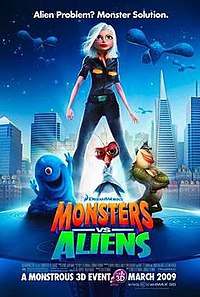
Monsters fighting aliens. It’s such a startling simple idea that it’s a wonder why no one ever thought of putting this down in a movie before. Sure, some of those Japanese monster movies featured monsters from space, but a true titanic struggle between Godzilla and E.T. with minions seems to have escaped the Hollywood cut and paste machine… until now. From Dreamworks Animation comes this highly ambitious 3-D animated film that manages to confound expectations by actually being reasonably well made and well executed. It doesn’t always work, at least for me, but it’s got spirit, artistry and some pretty good gags to boot.

The film starts with Susan Murphy (voiced by Reese Witherspoon), who suffers the extreme misfortune of having a meteorite fall on her right before her wedding. Normally people hit by meteor freefalling from the sky are killed instantly, but Susan just grows to the size of a skyscraper, resulting in her transfer from small town California to a government facility called Area-something-or-other. In custody, and under the command of General W.R. Monger (Kiefer Sutherland), Susan meets other monsters also being held by the government: the man-bug Dr. Cockroach (Hugh Laurie), the fish-man Missing Link (Will Arnett), the gelatinous B.O.B. (Seth Rogen) and the gigantic grub Insectosaurus.

The main thrust of the action is that these monsters become the last hope for America when the alien Gallaxhar (Rainn Wilson) sends his giant, one-eyed robots to collect a rare element he’s detected on Earth. On a basic level, the film’s a very kid friendly tale about misguided misfits of science being cast against a megalomaniac super-villain by borderline competent human commanders. Dig deeper though and we’re dealing with some bizarrely adult themes.

Susan, for instance, is engaged to a wholly, self-absorbed jerk, but doesn’t realize it until after she’s become a “monster;” in fact she has to become a monster in order to realize her inner-feminist and that she can do anything she sets her mind to – alone. More broadly, the other monsters refer to their confinement as “jail,” and when Susan arrives Monger tells her that her stay will be “indefinite.” Hmm, people being held in secret detention centres, being held for indeterminate amounts of time without status or acknowledgement by the government. Sound like anything we might know about?

Despite a few instances of questionably kid-friendly humour, Monsters Vs. Aliens has all you could want in family entertainment. It’s bright and colourful, popping with a lot of really neat visuals thanks to the Digital 3-D effect; and if you are planning on seeing this movie, accept no substitute: splurge on the 3-D glasses. But of course the movie’s going to be technically excellent, that’s not even a question. I’ve chastised some Dreamworks animated films previously for trying too hard to be all things to both kids and parents. And while some of the jokes will like fly above the heads of the young’ins, there’s still a better balance here than in Sharktale, for example.

Sure, kids aren’t going to get the subtle wordplay in the name W.R. Monger, or fully appreciate the inner-pop-culture reference of the US President’s attempt to communicate with the aliens through a synthesiser, but I didn’t find that stuff as galling in this film. The point is that the main story will definitely jive because what kid hasn’t played with the imaginary notion of being either a) a monster or b) an alien. To this spirit of play the film seems dedicated; it’s just a lot of fun and really enjoyable on that level. What the film lacks in subtext, it makes up for in showmanship and amusement. It’s a not completely cohesive effort, but when it works, it works well.

Tuesday, 24 March 2009

Watchmen: Tales of the Black Freighter

Rating: ***

I know some people were out of sorts because Zack Snyder cut the Tales of the Black Freighter, comic within a comic bit from the Watchmen movie, but I think we can all agree that the final product worked fine without it. But having said that though, I think Snyder did a very smart thing by giving The Black Freighter its own separate berth on DVD. The animated tale is now featured on the disc of the same name along with a faux documentary called “Under the Hood.” Both are kind of fun and offer interesting insights into the main story, however only one kind of succeeds at being something more than supplement material.

Tales of the Black Freighter is about a marooned sea captain (voiced by Gerard Butler) whose ship and crew are lost to a freighter manned by monsters. He washes a shore on a deserted island and is consumed by his own inner demons as he struggles to find a way home and save his seaside town from the villains of the Freighter. As he heads back out on to the high seas on a grotesque, makeshift raft, he finds himself drawn more and more into his own fears and anxieties. The story is meant to parallel the “real world” events perpetrated by Adrian Veidt, but there are also some comparisons between Black Freighter and the experiences of Rorschach and Dr. Manhattan in Watchmen.

I have to say, I was kind of impressed by the artistry of Black Freighter, when Snyder could have probably phoned it in and still won some kind of acclaim for making the presentation of the story a priority. The art kind of reminded me of the work of Yutaka Minowa, a Japanese animator famous for contributions to Ninja Scroll and Vampire Hunter D. The colours are rich and the tone is dark. The story draws you in easily and effectively, and it’s powerfully with a pronounced impact on the viewer. But it’s not for the squeamish. Still, considering all that praise, it’s hard to get over the feeling that you’re looking at something worthy enough to stand on its own. Perhaps when it’s integrated into the special edition version of Watchmen, I’ll feel better about it.

Which brings us to Under the Hood, and no matter what, there’s really no way I can get into it as something above and beyond what should be included in the special features section of a DVD of the main movie. In fact, it kind of reminded me of those Mike Engel bits from The Dark Knight DVD. Set-up as a segment of a TV news show called “The Culpepper Minute” it’s a supposed, in-depth look at the original Nite Owl Hollis Mason (Stephen McHattie) and his “then” new book Under the Hood. It’s kind of interesting, and we get expanded looks at characters only touched on in the film like Moloch the Mystic (Matt Frewer), Sally Jupiter (Carla Gugino) and Mason himself, but the enterprise feels cheap and forced; as if Black Freighter couldn’t stand on its own.

Fair enough, Black Freighter’s rather brief to spend $25 on for the DVD, but it would have been nice if the thought and artistry of the animated segment, even in part, had been granted to the live action story. But the disc as a whole still feels like it was taken out of a future Watchmen DVD box set and marketed on its own, which is not a great feeling at this point because so much DVD bonus material now feels kind of staid and retread unless treated in a unique, new way. Obviously, fans will get a kick out of this disk, but I don’t think the fervour translates to even the moderately interested. Some fascinating stuff for sure, and I look forward to seeing how it’s all worked into future cuts of Watchmen, but stand alone? Leave it be.

Tuesday, 3 March 2009

Futurama: Into the Wild Green Yonder

Rating: ***1/2

Is this the end of Futurama? Certainly the end of the fourth and final direct-to-DVD movies, Into the Wild Green Yonder, can be taken that way. Fans will hope not of course, especially given the fact that Green Yonder appears to be the best of the four, more fully capturing the voice of the beloved series that was heinously cancelled by the Fox Network in 2003. Combining the series’ strong undercurrent of environmental themes along with the classical bizarrely motivated characters (some of us) have grown to know and love. And by the time the credits roll, even the most jaded of fan must sit back and hope for a Nixon head like comeback for the Planet Express Ship crew.

The story basically follows the various threads of the series: Leela takes a moral stand while Professor Farnsworth collects a cheque for doing the opposite; Bender follows his own worst instincts; and Fry continues to pine for Leela while discover once again that he’s uniquely qualified to be the universe’s saviour. Most of the plot centres around the capitalistic father of Amy Wong, who tears down the old Mars Vegas in order to build a new, richer one before moving on to plough an entire solar system for a miniature golf course. The move makes Leela join a group of radical environmental feminists, while Fry learns from “The Legion of Mad Fellows” that it’s his destiny to stop Mr. Wong from killing the last Encyclopod, who would be killed in the construction of the golf course.

On the one hand, this Futurama is a downer because of the sense of finality, but on the other, the writers have seemed to “find it” again with all the winking nods to sci-fi past and the little jabs of smarter-than-thou science humour. What makes Futurama zing though is the characters, and in Green Yonder they’re each given some neat turns, and any characters that do get the short-shrift do get something; like the improbably team-up of the Professor, Hermes and Zoidberg as the ship’s new crew. Plus the story itself flows much better in this film, as all the stories seem tied together better and are less episodic.

Mostly though it feels like a lot of effort was put into making this Futurama one for the fans; a love letter of sorts. It’s to their unending loyalty to which Green Yonder is dedicated. Pretty much all your favourite minor characters make an appearance in one way, shape or form even if it’s just in the huge crowd seen at the end. In fact, only two familiar faces are missing, I think: Leonard Nimoy and Al Gore. But if it’s a celebrity cameo you want, you’ve got Snoop Dogg to fill the gap, and Penn Jillette voices his floating head future self, with Teller represented by a decaying cranium bopping in his jar silently next to Penn.

But if this be the last Futurama, then it certainly ends in a satisfying fashion. Zapp Brannigan finally gets visibly fed up with Kif’s constant resignation, Number 9 seems to have a bigger role than anyone realized and the headless body of Spiro Agnew meets a ghastly fate. Things also seem to be coming together for Fry and Leela in a romantic sense before the film ends with both the promise that there might be more to come and the potential that this might be the true end for the adventurous gang from Planet Express. Although not quite as sharp as it was in its heyday, Futurama still has wit and style enough for numerous comedies, live-action or animated. If this is the last then I’m sorry to see it go, but it leaves us off at a great place to move forward from. Either way, I think we’re cool.

Tuesday, 24 February 2009

Waltz with Bashir

Rating: ****

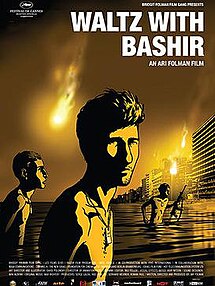
Last year we had the wonderful Persepolis, which offered the unique point of view of an Iranian girl that came of age against the backdrop of the ’79 Islamic Revolution. In keeping with roughly the same time period, we head west to Lebanon and the ’82 war between Israel and the Lebanese and an incident called the Sabra and Shatila massacre that killed hundreds of refugees. Like Persepolis, Waltz with Bashir has a unique animated style and has a compelling story to tell that offers new insights and perspectives from a distinctive point of view. Not only is it the first animated film nominated for the Best Foreign Language film Oscar, but it’s also the first animated documentary I think I’ve ever seen.

The film follows Ari Folman, a successful filmmaker trying to recall his memories of the war, of which he says he has none. He revisits old friends and other people that were part of the Israeli Defense Forces in Lebanon during the conflict and through their remembrances recalls the events leading up the massacre and what happened immediately afterwards. He has one memory in particular of bathing by the seaside of Beirut as flares fell on the city, but no one he talks to seems to remember that. Folman’s explorations test the fallibility and resiliency of memory when confronted with terrible things no 19-year-old, even ones in the infantry, should ever witness. What unfolds are some astounding revelations; an inner journey of the terrible personal cost of wars.

Technically speaking, the film is perfect. My immediate feeling was rotoscoping, an animation style that uses drawings over live footage, but it’s actually a combination of Flash cut-outs and classic animation. Basically the drawings were cut up into pieces and moved around individually like paper stop motion. The result is surprisingly fluid and graceful feeling more real in a way than any type of CG you can render in you computer machine. It’s surrealistic too though, like something that’s going on inside of your head like a memory of your own. The soundtrack is an equally intriguing mix of the old and the new combining 80s pop, classical music and an original score.

By far though the best part of Waltz with Bashir it’s a documentary with a twist. The animation offers a unique kind of gravitas to the memories of the people interviewed because the recreations feel real and that they come from the same place as the memories, as if the subjects are drawing the memory themselves. It can also bring those little exaggerated, fantasy bits of memory forward and make them tangible. If Waltz is about trying to remember, it can also be considered a work about how we remember, how do we deal with memories we don’t want or can’t understand, or don’t want to understand? It’s interesting what Waltz offers, and what it offers may be different for everyone.

As documentaries go, it’s probably just about the most unique one you or I have ever seen. And for movie about war and remembrance, it’s probably one of the strangest journeys you can take, but probably also one of the most honest. I was astounded by how just about every minute of Waltz with Bashir, whether it was by its honesty or the way it pushes buttons of sadness and horror in the viewer that truly makes you stop and think about how low we, as a people, can go. Finally, it’s a top notch effort for animated cinema. It’s another crowning achievement for the fine art of low budget animation, where some of the most elegant storytelling seems to be taking place. You’re unlikely to see another work like this anytime, so seek it out where you can.