Friday, 12 March 2010

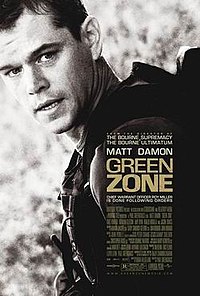
Green Zone

Rating: ****

I’m a big admirer of the book Imperial Life in the Emerald City by Rajiv Chandrasekaran. For those of us who were against the Iraq War before it was cool, it’s a soul-crushing, hair-pulling, frustrating tale of corporate greed, partisan back-slapping and one particularly disturbing episode where the one time probable Secretary of Homeland Security treated Baghdad like his own personal Westworld. The book was told in vignettes, but it painted an overall picture of how the post-war effort in Iraq went so horribly wrong. The Mess O’Potamia, if you will, wasn’t a result of one big screw-up, but rather the proverbial sting of a thousand bees.

When the book was optioned by Hollywood, I had no idea how they would turn Chandrasekaran’s book into a narrative film. Recruiting director Paul Greengrass was a good start though because his Bloody Sunday and United 93 were both detailed, visceral, near-documentary accurate dramatizations of real events. However, in the case of Green Zone, the trailers came across as kind of “Bourne Identity in Baghdad,” as in all action and no subtext. This was a rather frightening notion for me, again, because Chandrasekaran’s literary work was so powerful to begin with.

But for a minute there, I forgot I was working with professional: Greengrass, actor Matt Damon, and screenwriter Brian Helgeland. The many vantages of the book are boiled down into a single player, Warrant Officer Miller played by Damon, a U.S. Army soldier charged with finding weapons of mass destruction. As we join the action, just a couple of months after the fall of Saddam Hussein, Miller is already frustrated with the fruitless search for WMDs. He begins questioning the intelligence openly and rightly figures that if the threat was so imminent and the intel overwhelming, then his job should be going a heck of a lot easier.

Damon is really good as a patriotic soldier driven to performing duty, but is gradually coming to terms that his country may not be as altruistic in its intensions as he is. The plot unfurls convincingly without seemingly like a digestible, Hollywood version of the complexities presented in Chandrasekaran’s book. Greg Kinnear gives a thoroughly sleezy performance as typical Bush-era lackey Clark Poundstone and Brendan Gleeson does surly right as Martin Brown, a C.I.A. operative that’s been in the Middle East long enough to know political B.S. when he hears it. These three characters really perfectly encapsulate the themes and points of view from the book, and as a bonus, they feel neither plastic nor preachy.

Aside from Amy Ryan’s reporter, a kind of apologetic newspaper woman that was given access in exchange for hyping the war, the film feels real. My problem with the reporter character is that she flies in the face of what we saw, and what we still see, in American mainstream news. Those people are not sorry, and never have they seemed anything of the sort. Their current criticisms of the war seem hollow because it was non-existent before the war started and in hindsight, there was plenty to be suspicious about. Ryan’s character also doesn’t fit because she seems more pastiche than person. A plot device to give Kinnear’s Pouondstone a villain on his field.

Mostly though, Green Zone was a profoundly satisfying thriller of both the war and political variety. Greengrass blends both well by giving the thinking man the complexities of war policy and its administration to mull over, while the obligatory action scenes provide nice balance and a few explosions. But what I really appreciate is the details, the little stories and asides worked in the background to make this film a true adaptation of Imperial Life in the Emerald City. This may also be the first film about the Iraq War to transcend the partisanship, and if there’s a reason for that it’s because of the old axiom: truth is stranger than fiction.

Friday, 5 March 2010

Alice in Wonderland

Rating: ***

I knew we were in uncharted territory when Alice in Wonderland didn’t open with one of those great title sequences to Danny Elfman’s theme music that typically kick off a Tim Burton movie. Burton is perhaps my greatest filmmaking inspiration, which is why it pains me so to say that his Alice comes out into a mere ho-hum. Granted, it’s visually amazing, but I can’t say that I was whole-heartedly engaged with this take on Lewis Carroll’s classic. It seems as if Burton has spliced together the original animated Disney Alice with a tame version concocted by American McGee, all in what seems like an effort to bolster Johnny Depp’s ongoing campaign to make himself as ugly looking as possible on film.

Yes, the Bozo the Clown meets Lloyd Christmas mug of what’s supposed to be the Mad Hatter on the movie posters is indeed Johnny Depp. I can’t knock the guy’s enthusiasm, but now having completed their eighth collaboration, I think it’s time for Burton and Depp to see other filmmakers. Nothing against either of them, but Depp’s become a crutch for Burton because Depp’s an actor that Burton knows will go out on a limb. But Depp is “big box” now. His boutique days when he could get away with playing a guy with scissor hands or a cross-dressing schlock-maker while burying his movie star presence aren’t what they used to be. Sadly, Depp doing kabuki Mad Hatter doesn’t work as well as it should. For the most part.

But The Hatter isn’t the main character of this story. In this Wonderland Alice, played by newcomer Mia Wasikowska, is a young woman who’s taken to party where it’s expected she’ll be proposed to. Like Robin Williams’ Peter in Hook, she’s grown up thinking that her childhood sojourn into another world was nothing more than childish fantasy. So it’s an awful surprise to her when she sees a familiar white rabbit in a waist coat and fob watch hopping through the garden. It takes Alice a while to catch on that her Wonderland excursion was real, not that this is the Wonderland she once knew thanks to the machinations of the Red Queen (Helena Bonham Carter).

Of course this isn’t an adaptation, which is probably why the film feels like it has no cohesion beyond the stylistic. There’s a blatant kind of Lord of the Rings feeling where there’s an elaborate quest for a magical device and a final, titanic battle on a chessboard shaped field. Frankly, in this instance, the whole thing seemed rather dull and if there’s one thing that Wonderland shouldn’t be, it’s dull. Sadly, it might be the fate of these 3-D efforts, Avatar included, to suffer in the narrative while being visually very pleasing. In this case though, I can’t completely get behind the look of the film since all the digital tricks work against that Burton vibe. He’s not a boy with his toys like James Cameron, Burton’s the kid that wears 40s fashions because of his distaste for all things modern.

There is an ambition to the film that’s admirable, but Tim Burton has never been an epic kind of filmmaker. Even the little superhero movie he did (Batman) looks like a low budget indie as compared to the way summer tentpoles are made now in days. What does this matter? Because Burton’s about quirk, and quirk doesn’t cost. He’s also about character, and you don’t need motion-capture technology to make a character interesting. The difference between Alice and Burton’s past triumphs is the difference between someone singing a song and really being a performer. I can enjoy it, it can engage me, but it doesn’t really fill me up spiritually. Alice in Wonderland, as the collective name of Lewis Carroll’s literary work, is insanely adaptable with enough vibrantly weirdo characters for two Tim Burton movies. But this could have been better. And while 3-D may save the movie industry, some of us still want a good story with compelling characters. And if possible, a less scary looking Johnny Depp.

Friday, 26 February 2010

Cop Out

Rating: **1/2

Really, there’s nothing in Cop Out to dislike. It’s a perfectly inoffensive buddy cop comedy that hits all the usual buddy cop comedy clichés: hilariously mismatched partners, rival detectives, a surly boss, a dangerous gang threatening to overtake the city, a damsel in distress and problems at home. If you’ve ever seen a cop movie from the 80s, hell, if you’ve ever seen a movie at all, then there’s nothing even remotely offensive about Cop Out.

Except maybe that this is a film from Kevin Smith, the man that put “Porno” into the title of a major studio release and made a donkey show a central plot element in the film before that, and he’s made something so blatantly inoffensive. Cop Out is Smith’s most generic effort. It’s perfectly serviceable, and it has some good laughs, but there’s nothing here that puts Smith’s seal on it. There’s nothing about it that says “Kevin Smith” laying aside a typically smarmy performance by Jason Lee.

The plot follows two NYPD cops, Jimmy Monroe (Bruce Willis) and Paul Hodges (Tracey Morgan). Hoping to break an influx of drugs into Brooklyn, Monroe and Hodges’ (mostly Hodges) ineptitude blow a big gang case, and the two are suspended without pay. At home, Monroe is trying to swing paying for the dream wedding of his daughter Ava (Michelle Trachtenberg), and Hodges is paranoid about his wife Debbie (Rashida Jones) cheating on him. Of course, both cops don’t stay on the bench very long, as they end up getting dragged back into the case, encountering the comically bottom of the barrel scum of the Brooklyn underworld.

Just in typing that plot synopsis, I realized just how unfocused the plot of Cop Out is. Strangely, this film once sat on the Black List, an annual list of the best unproduced scripts in Hollywood, and through it all I kept thinking that someone was trying to combine the conversational style of Smith with the typical staged action and gunplay of a Lethal Weapon type film. If the sole job of Cop Out was to capture that feeling, it’s an unequivocal success. But what’s the point?

The point is to see Willis and Morgan’s mismatched styles clash, and to watch them act like high school seniors with badges and guns. Morgan does his usual schtick, and Willis at least seems engaged enough to play the comedy with Morgan while still convincingly doing his signature action stuff. Seann William Scott is a good third wheel as a robber that provides the boys with a vital clue in breaking the case, but the exact point of his character other than to pop up, be annoying for a little while, and then recede back amongst the other players remains unknown.

And so much of the film plays like that. So many of the characters seem to merely serve their specific purpose with little indication of irony on the part of the filmmakers, or a sign from the actors that they’re in on the joke. As a comedy, the film is played straight-faced, and while the humour connects, you’ll be damned not to say that the endeavour you’re watching isn’t lazy. Smith gets credit for reaching, for trying something new and going for something outside the Clerks oeuvre, but next time he really needs to put more try in his trying.

When it comes to Cop Out, I am entertained, but as the title implies those involved with its making don’t seem entirely invested in it.

Friday, 19 February 2010

Shutter Island

Rating: **1/2

Scorsese gets creepy in Shutter Island, as a pair of federal marshals head to an insane asylum off the coast of Boston to investigate the mysterious disappearance of one of its prisoners. Unfortunately for Master Martin, following up on his (overdue) Academy Award win for Best Director with The Departed, Shutter Island strains to do the one thing it needs to do: tell a coherent mystery. The part that gets you is that Shutter Island sets itself up so brilliantly. The story elements are in place, a terrific cast of actors were assembled, the production design and cinematography were incomparable. Instead the whole thing turns into a Dateline tragedy: Where did it go so horribly wrong?

“Horribly wrong” may be overstating things. Misguided would probably be a better adjective because the story doesn’t so much zig and zag as it completely shifts the ground under your feet. It’s a Rubik’s cube puzzle that makes you think you know where things are going one minute, only to pull the rug out from under you and take down a road into completely different territiory. Now obviously you want your mystery to take some twists and turns, but in Shutter Island the journey is analogous to leaving on a trip to Halifax and realizing you’re on the road to Edmonton when you should really be driving to Yellowknife.

The plot starts out auspiciously with Marshal Teddy Daniels (Leonardo DiCaprio) and Chuck Aule (Mark Ruffalo) arriving on Shutter Island and beginning their investigation. The mental hospital is made up of three main sections: the ward, staff residences, and the old fort that serves as the lockdown for the badest of the bad. As Daniels and Aule approach the hospital, the music tells you that this place is evil. Like something out of an old Universal monster movie, the blaring strings make you think that there’s a creature inside ready to eat you whole. Let’s just say it was a little over the top, and entirely misleading given the direction the movie eventually takes us in.

At least the actors were good though. By now DiCaprio is recognized more for his acting ability than for being the face that launched a ship movie, but it’s to his credit that he’s able to imbue this rather stock character with enough humanity to allow the audience to empathize with him. Daniels has suffered the twin horrors of having liberated the Dachau Concentration camp during the war and retuning home to lose his wife in a fire that burned down their Boston home. DiCaprio is really great at wearing that pain and convincing you of it, and one senses the signs of a disturbed mind even before the film’s final twist is revealed. The rest of cast is playing par, but Ben Kingsley seems to be having a grand old time playing the hospital administrator Dr. Cawley, a veritable, latter day Vincent Price.

But what’s frustrating about Shutter Island is the obvious, tremendous care taken in crafting it; the art direction and cinematography, from Dachau to mental hospital are pure perfection. But the basic building blocks of the film, the script, seems to woefully underservice the finished product on screen. Varying between not wanting to seem predictable and firing clues scattershot like a gun being aimed in the dark, by the time the film ends after its two and a half hour running time you feel exhausted by it. You leave the theatre trying to put the pieces together in your mind as you retrace how the story left point A and drove past points B, C and D to arrive at point E. There’s something kind of unsatisfying about Shutter Island, fortunately Scorsese’s long elusive Oscar is safely secure.

Monday, 15 February 2010

The Wolfman

Rating: **

Mere words can’t express my disappointment after seeing Joe Johnston’s remake of The Wolfman, but we’ll give it a try just the same.

As it goes, the remake of the classic Universal monster movie starring Lon Chaney, Jr began in earnest some time ago. Universal brought in Johnston, director of Jumanji, Jurassic Park III and The Rocketeer, which despite opinions to the contrary, is da bomb. (Jennifer Connelly in white satin and 1940s glam… Nuff said.)

So you’ve got a man of vision in the director’s chair, good. Next is to get a master make-up man to do the effects, and you can’t get much better than Rick Baker. Baker knows werewolves too having created them for The Howling, An American Werewolf in London and Wes Craven’s Cursed, so there really was no better choice. Next, there’s the actors, and if I told you I had Benicio Del Toro, Anthony Hopkins, Emily Blunt and Hugo Weaving signed to my movie, you’d bet your brains out on it. Especially if it was an R-rated, period werewolf movie designed by Rick Baker and directed by Joe Johnston.

So where did this thing go off the tracks? Excellent question. One gets the impression that there were not only significant reshoots before the film was released, but there were also significant rewrites before/during the initial shoot. Del Toro plays Lawrence Talbot, a stage actor who’s suddenly compelled to come home when his brother is – What’s the word? – massacred. Now Larry is either one of those stiff-upper-lip guys or he just doesn’t care because, boy, I have never seen the wholesale slaughter of loved one have less of an impact on a guy.

But maybe it’s the company. Hopkins does his best Wilford Brimley impression to play the senior Talbot and as part of the effect ends up chewing a lot of scenery while he’s at it. Apparently there’s a lot of unresolved tension between Larry and his father, but what precisely that tension is can be a matter of debate after the movie. Where tension’s lacking though is Lawrence’s relationship with his brother’s finance played by Blunt, which seems practically non-existent on an emotional level. The emotional arc for Lawrence is pretty much, “Oh, you’re my brother’s fiancé? You seem cool, I guess. Maybe we can hook up later when, you know, it’s not creepy.”

Which brings us to Hugo Weaving as Scotland Yard detective Abberline, who is based on the real-life Frederick Abberline who was an accomplished and decorated inspector most notably remembered as being the man in charge of investigating the Jack the Ripper murders. Special note is made of this inference in Lawrence’s first encounter with Abberline and it had all the comfort of one of those TV crossovers where a character from another show is introduced to the characters in the one you’re watching. But if the intro is wince worthy, it would be worthwhile if Weaving was given something interesting to do, but he’s not.

Now you’ll have noticed that aside from the obvious, I have yet to talk about the werewolves in the werewolf movie. In an act of sheer audacity (for modern filmmaking), Johnston made his wolfman nearly all practical, only the transformations were handled with computer effects. The result was awesomely old school, but still, the wait between werewolf incidents could be excruciating. But that’s what happens when the main story is melodramatic pabulum, and I know the movie is set in the 19th century but it doesn’t have to read that way.

Saying that though implies that the movie is read at all. It seems to indicate there may be such a thing as insight or subtext between the lines. Like what was the deal with the gypsy village? And how did the senior Talbot manage to evade detection as a werewolf for so long? (Oh relax, it barely qualifies as a spoiler.) The film seems to jump from plot point to plot point with little fidelity, as if someone were trying to make the transitions between werewolf sequences as streamlined as possible. After all, they know what you people came to see and it wasn’t plot or character development.

I can’t say that The Wolfman was a supreme disappointment, just exceptionally underwhelming. There were some ingredients in place from a technical perspective that could have really made this sing, but like past efforts to revive Universal’s classic monsters, the effort seems to suffer from too much emphasis on how it looks rather than trying to capture the magic that made those movies a source of inspiration and enjoyment for moviegoers in the 1930s. It’s the fear of the unknown, the fear of being out of control and the fear of seeing the monster in the mirror. The only fear this Wolfman seemed to have was fear of coherence, lest somebody actually be able to enjoy this film despite all its self-actualized faults.

Friday, 12 February 2010

Percy Jackson and the Olympians: The Lightening Thief

Rating: **1/2

Everything about Percy Jackson and the Olympians: The Lightening Thief screams mea culpa. It’s director Chris Columbus’ mea culpa to himself for passing up the Harry Potter series after launching it with the first two adaptations, and, I presume, it’s Columbus’ mea culpa to the masses after foisting I Love You, Beth Cooper on us. I kid Chris Columbus, mainly because he’s the red-headed step child of Harry Potter filmmakers having made the least inspired and textually limiting of the Harry Potter movies. Alfonso Cuarón had style while Mike Newell and David Yates had the benefit of more adult-minded material (and in the case of Yates, the added comfort of knowing how the series ends).

So with all the fortitude and impetuousness of a drunken robot yelling at security hooligans that he’s going to build his own theme park with black jack and hookers (Futurama reference), Columbus found another supernatural kid to invest in. Based on Rick Riordan’s novel of the same name, The Lightening Thief follows young Percy Jackson (played by Logan Lerman) as he learns that he’s not a struggling teen slacker with dyslexia and ADD. No sir, he’s the son of Poseidon, Greek god of the seas and earthquakes. That dyslexia he’s got, it’s just his brain hardwired to translate everything to Ancient Greek. And the ADD, why it’s his warrior instinct itching to keep him up on his feet and ready for battle.

Like any good young hero moulded in the Campbell tradition, Percy receives guidance from a wise elder, in this case embodied by his wheelchair bound teacher Dr Brunner, who, in actuality, is the centaur warrior Chiron (both played by Pierce Brosnan). No sooner does Percy discover his lineage does he have to do a runner. Zeus’ famed lightening bolt was nicked and for some reason, Percy’s the prime suspect. Hades then kidnaps Percy’s mom as leverage to get Percy to give him the bolt in exchange for his mother. So with a quest at hand, Percy gets assistance from his new allies Grover the satyr (Brandon T. Jackson) and Annabeth, the severe daughter of Athena (Alexandra Daddario). He also gets magical tools to help with his mission including a pen that turns into a sword and a pair of sneakers that are literally wing-tipped thanks to Hermes. So cue the AC/DC and let’s start on that Highway to Hell.

Now I’ve never read the Percy Jackson books, but I do know that in the original Lightening Thief the main character was 12 rather than 16. I suppose, Columbus wanted to buffer himself in some ways from Potter, and though I would never say that this a line-for-line pastiche of J.K. Rowling’s wizard world, a lot of the same story beats are here. In other words, in keeping with a lot of youth novels getting screen time in hopes of having Harry-like success, I just can’t see what makes The Lightening Thief so startlingly different that it screamed, “I must be adapted.”

Truthfully, I found the movie harmless if nothing else. It’s a satisfying adventure that hiccups over some rather obvious musical cues and some uncomfortable winks to the current world climate, especially Grover’s references to recession-induced cash saving measures. The young actors do a serviceable job to their characters, but a lot of the adult actors seemed sidelined in their parts, as if they were merely there to move the plot along. The casting also seemed a bit chaotic. Steve Coogan as Hades? Really? I take it Paul Reubens was unavailable. However putting Rosario Dawson in the part of Hades’ wife Persephone and giving her a Desperate Housewives style makeover was not necessarily a bad idea. And as I watched The Lightening Thief, an intriguing question occurred to me: who would win in a fight, Sean Bean’s Zeus from this film or Liam Neeson’s Zeus from the coming soon remake of Clash of the Titans?

But back to The Lightening Thief, which despite some serious cynical aspirations I cast, was not actually all that bad. Of course, how a group of teenagers criss-cross the United States inside 10 days is a travelogue of 24 proportions, but this is fantasy after all. I think what really holds this film back though is the filmmaker’s rather clinical vision. Of course Mount Olympus, now accessible through an elevator at the top the Empire State Building’s observation deck, is the exact same Olympus visualized by mortals for thousands of years with clouds, columns and togas. How dull. But despite that, The Lightening Thief isn’t a total time burglar. Sequel? Why not.

Friday, 5 February 2010

Frozen

Rating: ****

Sweet originality. Is that so much to ask from a horror movie now-in-days? Finally we have here a major release that’s not a remake, a re-imagining or another in a long line of sequels. Adam Green’s new film Frozen manages to make a frightening flick using not the name value of an original work that’s come before, but by delving deep into the audience’s psyche and making them as uncomfortable as possible. Who hasn’t sat on a chairlift heading up the side of a mountain anticipating a fun time skiing, but wondering what if you might be stranded up there at the same time?

Such a fate befalls Joe, Dan and Parker (Shawn Ashmore, Kevin Zegers and Emma Bell), a trio of friends who decide to take a break from college for a fun afternoon of skiing. Going up for one last run, in the dark, as a storm approaches, seems like a good idea. But then the lift operators take off and leave the trio halfway up the mountain with no way down. Trapped, susceptible to the elements and with nothing to eat or drink, Joe, Dan and Parker have some tough decisions to make. Do they risk an escape by leaping from the chairlift or sit tight in the slim chance that help might arrive in short order?

To Green’s credit, he uses the fear and isolation to create some of the tensest drama you can imagine. Everything that can go wrong, does go wrong; every danger is life threatening. There are no good choices, only the best of a lot of bad choices, and as an audience member, even you have a hard time deciding what’s the right way and the wrong way. The result is several uncomfortable moments where anyone with a fear of heights, fear of isolation, or fear of the elements will be forced to confront their phobia. Oh, and the cold. Don’t like the cold, well this film isn’t going to do anything for you. You can practically feel the chill through the film screen.

The action, so to speak, is perfectly believable. There’s terrible frostbite, brutally broken bones and the painfully dreadful process of slowly dying from hunger and dehydration. You might not be able to relate to being chased through the Texan countryside by a guy wearing human skin and carrying a chainsaw, but peeling your frozen, bare hand off a metal bar is something we can see happening with shocking regularity. Perhaps the human meat munching wolves could have been left on the cutting room floor, but I guess more visceral audience members would need something to focus that tension at.

One must also congratulate director Green for casting well-rounded and realistic actors to play the three leads. Nothing would have deflated this project more if the actors had been entirely unlikeable and/or written shallowly. I think the parts of Joe, Dan and Parker are played just right, and if they come across as occasionally annoying, that’s okay because they’re whiney young people. It’s just part of the realism that encompasses all aspects of production, including the fact that the whole thing was filmed on an actual ski life sans the creature comforts afforded by a studio and a green screen.

Frozen is a rare gem that infuses the genre with the kind of life that only something original would allow. It’s tense and unpredictable and only occasionally does the production hiccup with the rather myopic set-up that it has scripted. As Hollywood churns out remake after remake where style is primary concern over substance, Frozen sticks out like a sore thumb. Of course, I mean that in a good way and better a sore thumb than body parts getting frozen to metal polls, but you get the idea.